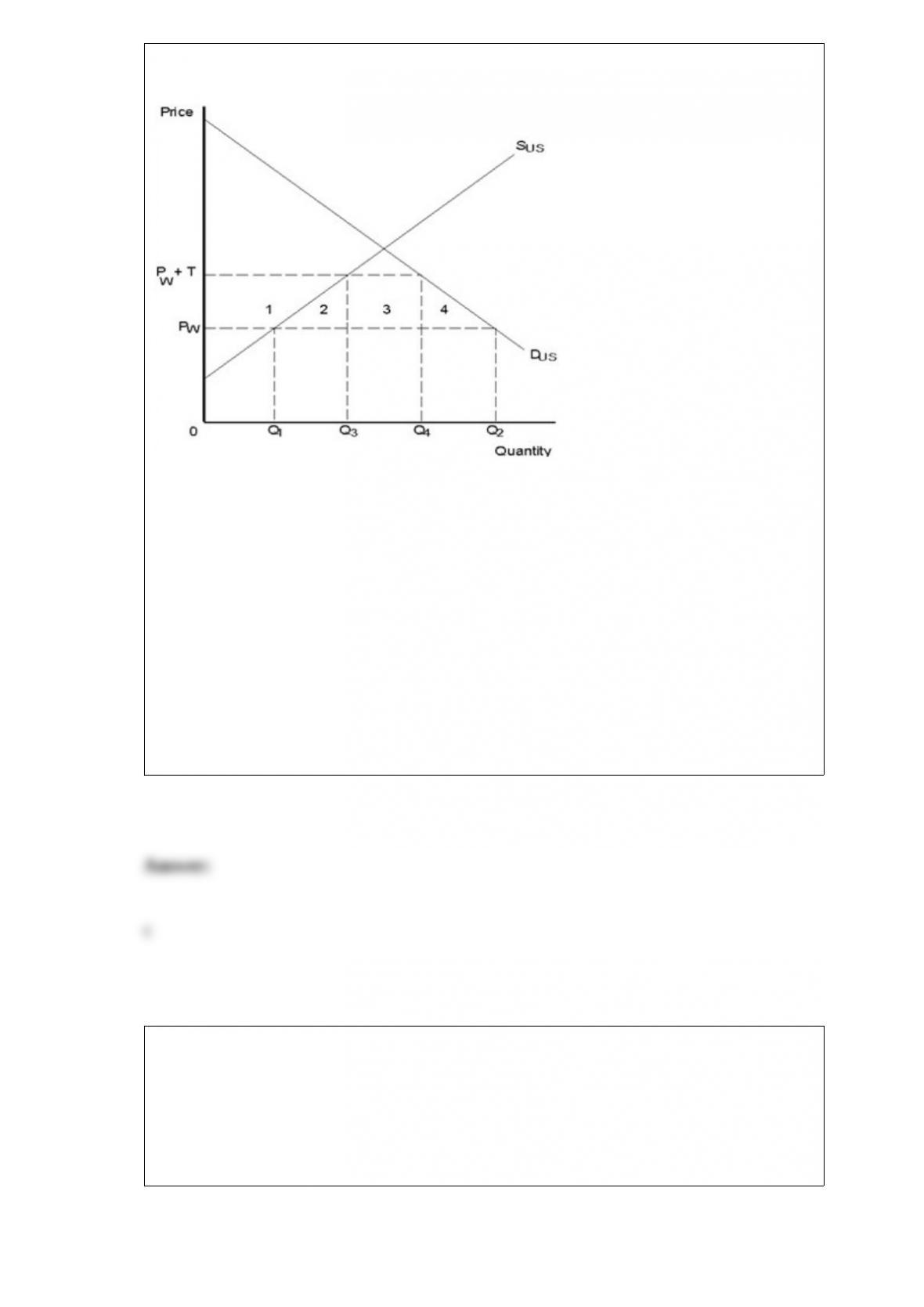
Exhibit 34-3
The world price is PW. If a tariff is imposed, the price rises to PW + T. Because of the
tariff, government collects tariff revenues equal to the area of
a. 1.
b. 1 + 2.
c. 3.
d. 1 + 2 + 4.
e. 1 + 3.
A monopolist that practices perfect price discrimination has the same deadweight loss
triangle as the single-price monopolist.
a. True
b. False

A government agricultural policy that restricts output by limiting the number of farm
acres that can be used to produce a particular crop is the
a. marketing quota system.
b. acreage allotment program.
c. price support program.
d. target price system.
e. paying farmers not to produce system.
The U.S. real interest rate rises relative to Japan’s. As a result,
a. the yen will depreciate and the dollar will appreciate.
b. the yen will appreciate and the dollar will depreciate.
c. both the dollar and the yen will depreciate.
d. both the dollar and the yen will appreciate.

If a single-price monopolist and a perfectly price-discriminating monopolist face the
same demand and cost curves, then
a. the single-price monopolist will attain resource-allocative efficiency, but the
discriminating monopolist will not.
b. the single-price monopolist will attain resource-allocative efficiency, but the
discriminating monopolist may or may not, depending upon the demand for its product.
c. the single-price monopolist will not attain resource-allocative efficiency, but the
discriminating monopolist will.
d. both the single-price and the discriminating monopolist will attain resource-allocative
efficiency.
e. neither the single-price nor the discriminating monopolist will attain
resource-allocative efficiency.
Which of the following can change the supply of labor in labor market A?
a. a change in the wage rate in labor market A.
b. a change in the wage rate in related labor markets B or C.
c. a positive change in the overall pleasantness of working in labor market A.
d. a negative change in the working conditions in labor market A.
e. b, c, and d
Let X be the number of hours you spend studying for an exam on Wednesday afternoon
and Y be your chances of winning the Wednesday night state lottery. What kind of a
relationship do you most likely expect between X and Y?
a. direct
b. inverse
c. linear
d. 45-degree line
e. independent
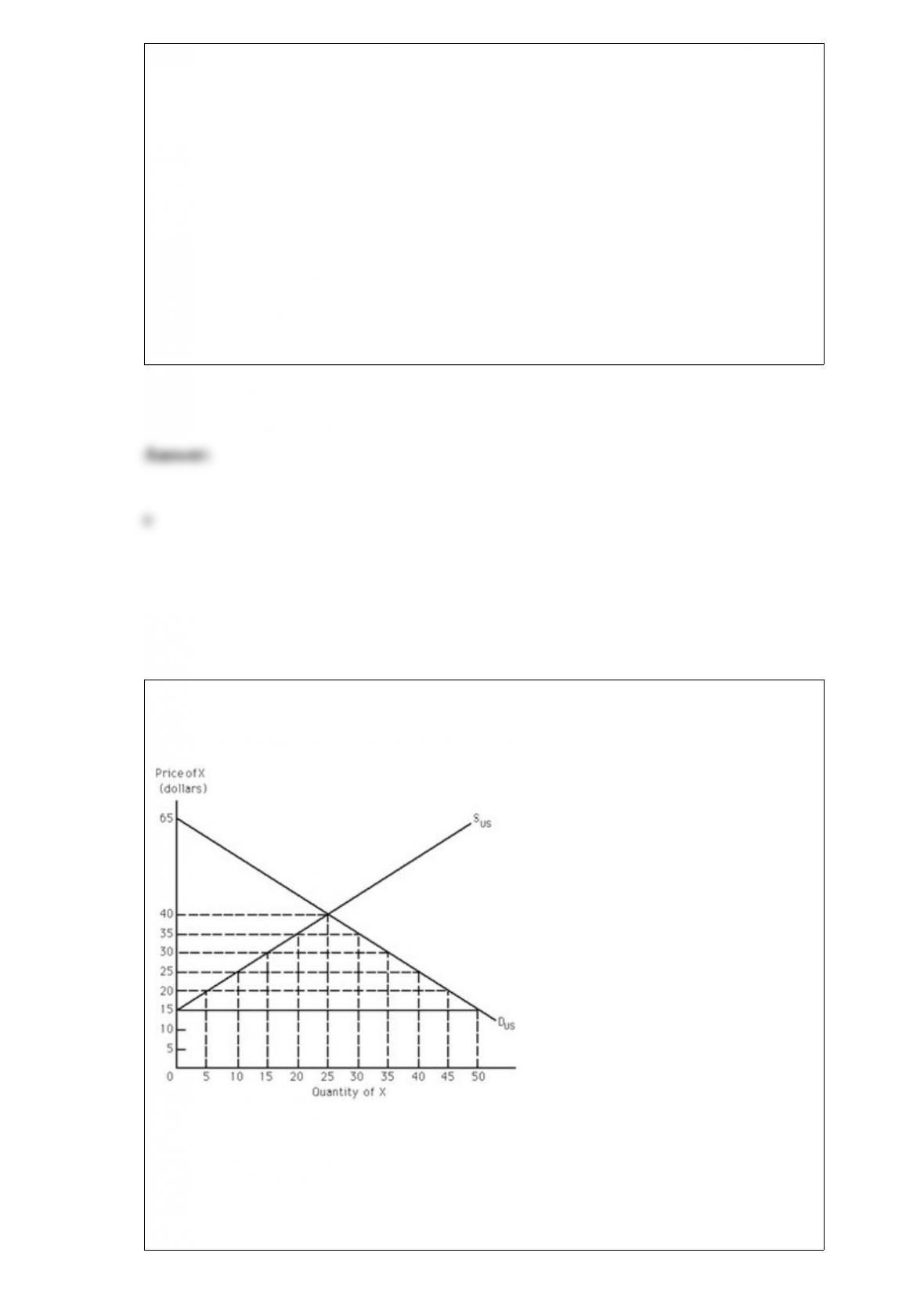
Exhibit 34-7
The world price of good X is $15. If imports of good X are legally limited to 30 units,
the price of X in the United States would be
a. $20.

b. $25.
c. $30.
d. $35.
e. none of the above
In 2000, farmers in the United States represented approximately what percentage of the
population?
a. 8 percent
b. 25 percent
c. 1 percent
d. 5 percent
Country 1 produces two goods, A and B. Country 2 produces the same two goods.
Currently, country 1 produces 100A and 200B and country 2 produces 300A and 700B.
Which of the following statements is true?
a. If country 1 is on its production possibilities frontier, then country 2 must be on its
PPF, too.
b. The PPF for country 1 is necessarily closer to the origin (or further to the left) than
the PPF for country 2.
c. If country 1 is productive inefficient, then so is country 2.
d. Country 2 is operating on its PPF, but country 1 is clearly not operating on its PPF.
e. none of the above
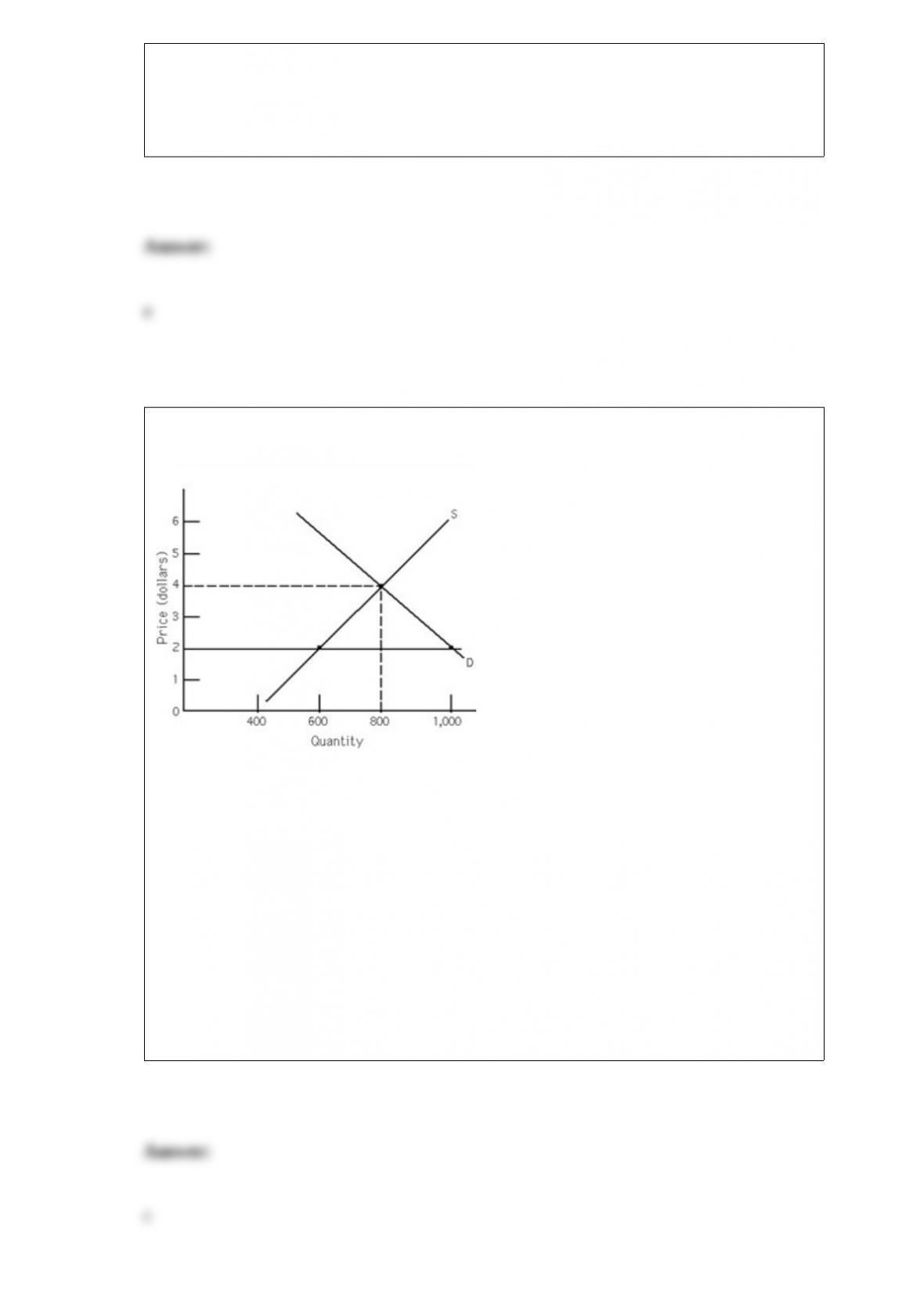
Exhibit 4-2
represents the orange juice market. The horizontal line represents a price ceiling
imposed by the government. Which of the following is true?
a. At equilibrium, the quantity demanded is 700 units.
b. At the price ceiling, there is a surplus of orange juice.
c. The quantity supplied at the price ceiling will equal the quantity exchanged.
d. The quantity demanded at the price ceiling will equal the quantity supplied.
e. The quantity demanded at the price ceiling will equal the quantity exchanged.

Something that motivates or encourages people to take an action is referred to as a(n)
a. utility.
b. abstract.
c. market.
d. incentive.
Large firms may be more likely to innovate because
a. the risks of failure are less to them than to small firms.
b. they can attract the capital needed more easily.
c. they can more easily attract the scientists and engineering staff they need.
d. a, b and c
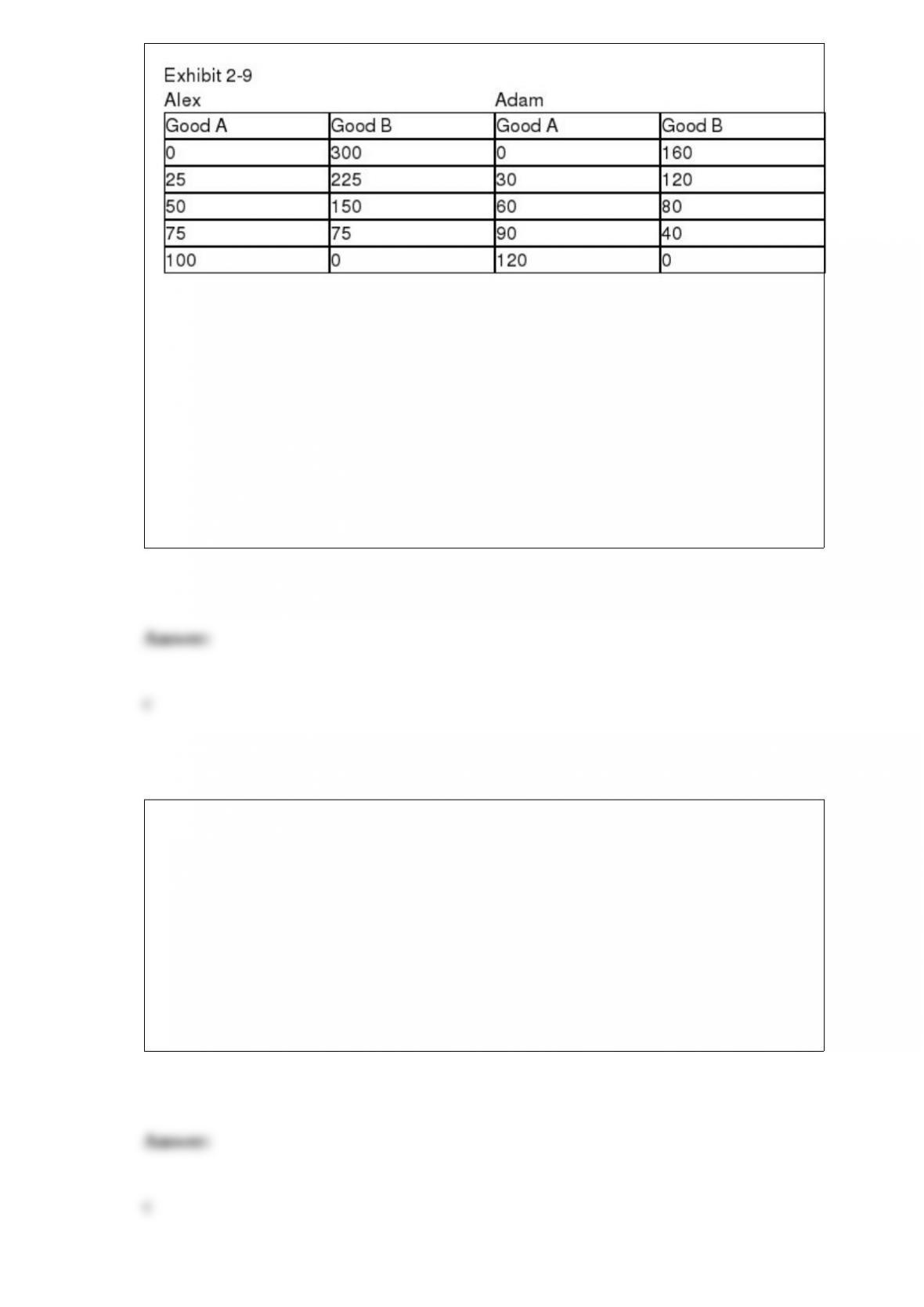
For Adam, the opportunity cost of producing one unit of good B is ____________
unit(s) of good A.
a. 3.00
b. 0.33
c. 0.75
d. 1.33
The ________________________ Acts, passed by the British Parliament in the 1760s,
imposed taxes on a variety of products imported into the American colonies.
a. Smoot-Hawley Tariff
b. Tea
c. Townsend
d. British East India
Theory A predicts that the higher the opportunity cost of having a child, the fewer
children a woman will have.Which of the following is evidence against the theory if
opportunity cost is measured in terms of foregone salary?
a. women with high-paying jobs have more children than women with low-paying jobs.
b. women with low-paying jobs have more children than women with high-paying jobs.
c. men married to women with high-payingjobs want more children than men married
to women with low-paying jobs.
d. the mothers of women with high-paying jobs will want their daughters to have
children more than the mothers of women with low-paying jobs will want their
daughters to have children.
e. none of the above
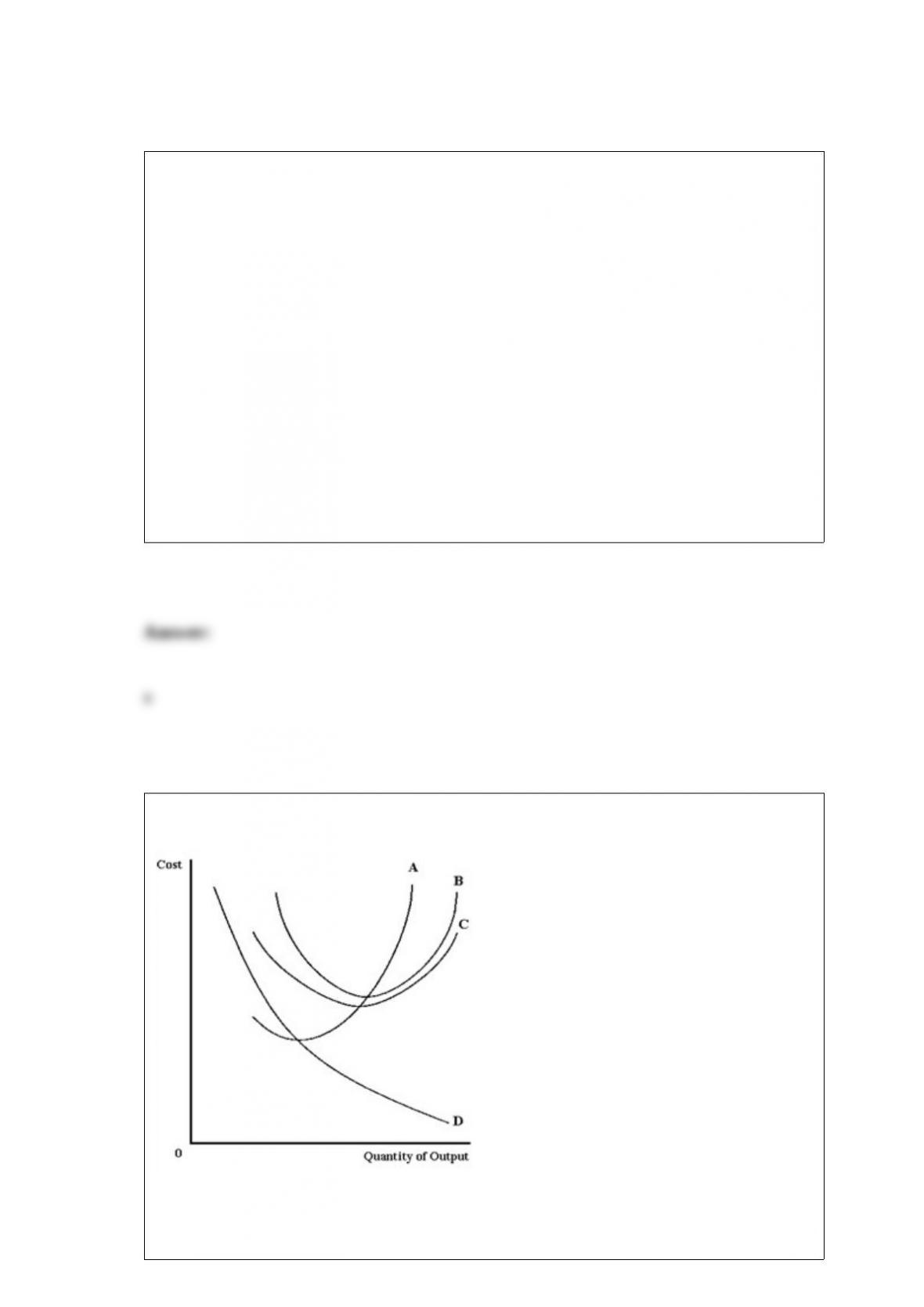
Exhibit 22-4
Curve A is a(n) __________ cost curve.

a. marginal
b. average variable
c. average total
d. average fixed