
For a producer of joint products X and Y with total revenue and RY, an isorevenue
curve:
a. isolates RX and RY separately.
b. shows points where RX = RY .
c. shows points where revenue curves are tangent.
d. shows points where RX /RY is constant.
e. shows points where RX + RY is constant.
The marginal rate of substitution of X for Y is defined as:
a. PX/PY .
b. PXPY .
c. MUXMUY .
d. MUX/MUY .
e. MUX/PX .

If Y = 3X(X3), then d2Y/dX 2 is:
a. 6X 2.
b. 12X3.
c. 18X 2.
d. 24X 2.
e. 36X 2.
Makers of disposable diapers must advertise 5% more to offset completely the 2%
decline in sales due to heightened environmental concern. The advertising elasticity of
demand is:
a. 4.0.
b. 0.4.
c. 2.5.
d. 0.25.
e. 0.20.

A manufacturer of infant clothes has found that the demand for its product is given by
Q = 100P± 1.25A0.5, where P is price and A is advertising expenditures. The price
elasticity of demand for these infant clothes is:
a. “0.8.
b. “1.25.
c. “1.0.
d. “2.5.
e. “0.5.
Glyde Air Fresheners is the dominant firm in the solid room aromatizer industry, which
has a total market demand given by Q = 80 ” 2P. Glyde has competition from a fringe
of four small firms that produce where their individual marginal costs equal the market
price. The fringe firms each have total costs given by TCi = 10Qi + 2Q2
i. If Glyde’s total
costs are given by TCG = 100 + 6QG, what is Glyde’s maximum profit?
a. $148.
b. $184.
c. $240.
d. $332.
e. $362.
In the model of monopoly, firms produce a:
a. standardized product with considerable control over price.
b. differentiated product with considerable control over price.
c. standardized product with no control over price.
d. differentiated product with no control over price.
e. standardized or differentiated product with some control over price.
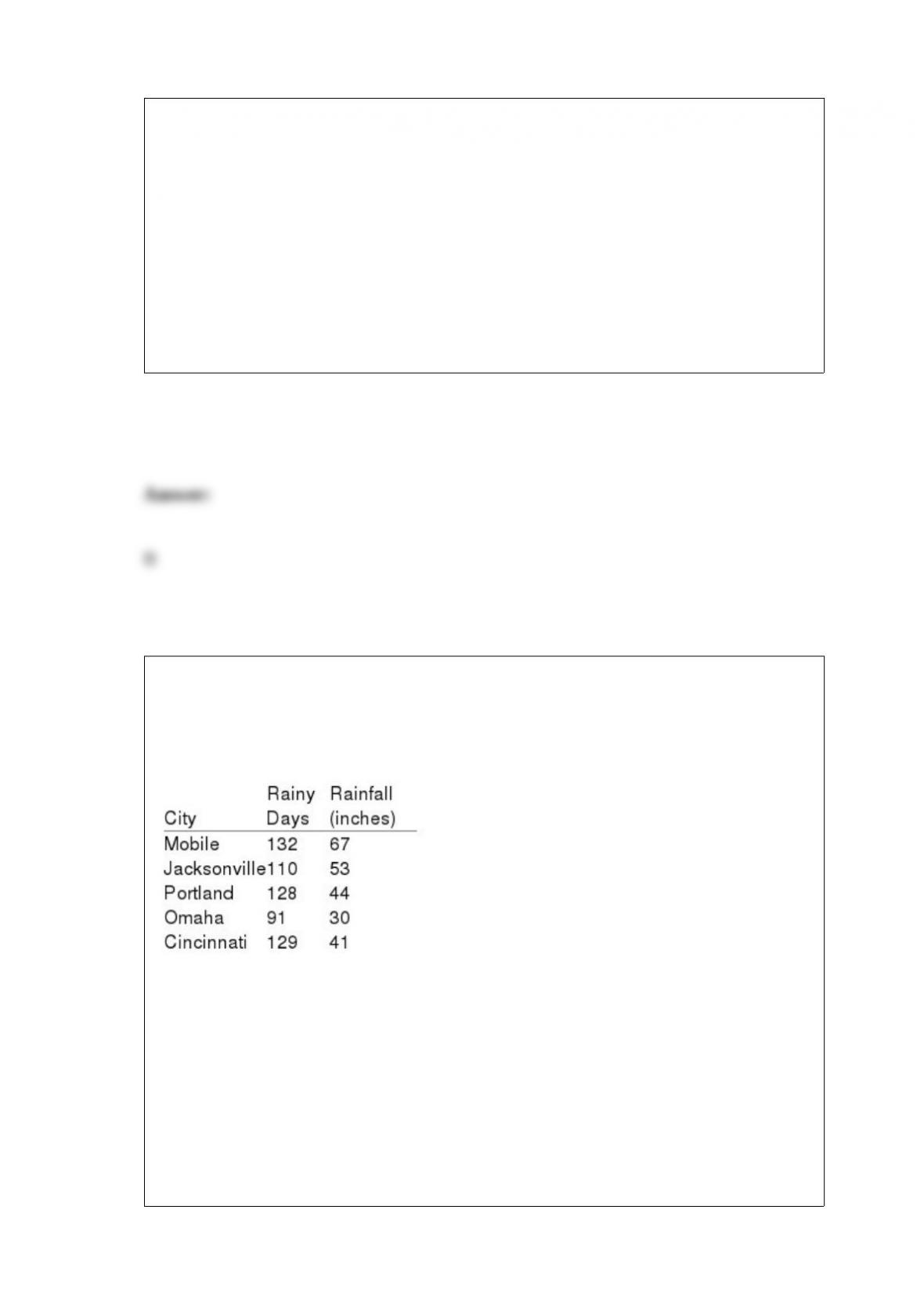
The mean annual precipitation in inches and number of days per year with measurable
precipitation by selected cities are given in the following table. If the average number of
days with rain is one greater in Tupelo than in Tucumcari, what do you estimate the
difference in average annual rainfall will be?
a. 0.5 inch.
b. 1.0 inch.
c. 0.8 inch.
d. 1.25 inches.
e. 2.0 inches.

If the annual interest rate is i, the present value of $X to be received at the end of each
future year forever is:
a. $X/(1 + i).
b. $X/i.
c. $X/(1 + i)n.
d. $X/i n.
e. $Xn/i n.
The demand for a product is more inelastic:
a. the more narrowly defined the product.
b. the longer the time period covered.
c. the lower the average income of consumers.
d. the better the available substitutes.
e. the poorer the available substitutes.

A consumer’s budget constraint changes slope whenever:
a. the consumer buys a different combination of goods.
b. relative prices change.
c. the consumer’s income increases.
d. an indifference curve is tangent to it.
e. absolute prices change.
If a representative firm with long-run total cost given by TC = 50 + 2q + 2q2 operates in
a competitive industry where the market demand is given by QD = 1,410 ” 40P, in the
long-run equilibrium there will be:
a. 60 firms.
b. 98 firms.
c. 106 firms.
d. 110 firms.
e. 120 firms.

Fred loves tomatoes. He makes soups, sauces, and stews with them; stuffs them; roasts
them; and grills them. Fred has discovered a farmer’s market where the price of a bushel
of tomatoes depends on how many bushels are purchased. The first bushel is $15; the
second, $12; the third, $10; and four or more, $9 each. Fred has $82 to spend on
tomatoes and on “all other things” during the coming week. All other things sell for $1
per unit. Assume that all other things are measured on the vertical axis. What is the
horizontal intercept of Fred’s budget constraint?
a. 14
b. 7.5
c. 8
d. 6
e. 5
In 1965, as per capita income among a particular segment of the population fell from
$10,200 to $9,800, everything else remaining constant, annual per capita consumption
of beer fell from 55 to 45 gallons; this implied an income elasticity of demand for beer
of:
a. 4.44.
b. 4.55.
c. 5.0.
d. 4.65.
e. 0.5.

A competitive market with demand Q = 120 ” 4P and supply Q = “30 + 2P is in
equilibrium. If government imposes a price ceiling at 22, what quantity will be traded
on the market?
a. 28
b. 32
c. 20
d. 14
e. None of the above.
Suppose duopolists in the market for spring water share a market demand curve given
by P = 50 ” 0.02Q, where P is the price per gallon and Q is thousands of gallons of
water per day. The marginal cost of producing water is near zero for both firms. If one
firm acts as a first mover, the second firm will produce:
a. 0 gallons of water per day per firm.
b. 625 gallons of water per day.
c. 833 gallons of water per day.
d. 1,250 gallons of water per day.
e. 2,500 gallons of water per day.

Camel Records produces records according to Q = 4L ” 0.15L2. If labor costs $5 and
records sell for $2, the optimal quantity of labor is:
a. 0
b. 2
c. 10
d. 5
e. 17
Teal Talkies, a manufacturer of designer cell phones, has determined that its total cost
of production is TC = 1,000 + 500Q“1 + 15Q2. At 5 units of output, the firm’s average
cost is:
a. $330.
b. $130.
c. $200.
d. $295.
e. $300.

The statistic that tests an individual coefficient for statistical significance is the:
a. R-squared statistic.
b. t-statistic.
c. Durbin-Watson statistic.
d. F-test statistic.
e. standard error of the estimate.
Crusty Cakes sells donuts in Eastown and Westown. Its total costs are given by TC =
10(QE + QW). The demand in each neighborhood is given by QE = 100 ” 2PE and QW =
100 ” PW . If Crusty price discriminates between the two neighborhoods, how much are
its maximized profits?
a. $850.
b. $1,200.
c. $2,475.
d. $2,825.
e. $3,250.

Repurchase tender offers require sellers to:
a. submit a sealed bid indicating the minimum amount that they would accept for their
shares.
b. submit a schedule indicating their willingness to supply different numbers of shares
at different prices.
c. accept or reject the tender offer price specified by the corporation.
d. contractually limit their opportunity to sell shares on the open market.
e. purchase warrants that specify the future price of shares.
Happiness can be produced with wine and roses according to Q = W1/2R1/4, where W is
bottles of wine and R is bouquets of roses obtained per month. If wine costs $20 per
bottle and roses cost $60 per dozen, the happiness-maximizing combination of wine and
roses costing $360 in total is:
a. W = 18 bottles, R = 0 bouquets.
b. W = 15 bottles, R = 1 bouquets.
c. W = 12 bottles, R = 2 bouquets.
d. W = 9 bottles, R = 3 bouquets.
e. W = 6 bottles, R = 4 bouquets.

In the model of monopoly, there:
a. are many firms producing differentiated products.
b. are a few firms producing undifferentiated products.
c. are a few firms producing differentiated products.
d. are many firms producing undifferentiated products.
e. is one firm producing a highly differentiated product.
If an option pays $6 one-quarter of the time and loses $6 three-quarters of the time, then
the variance s2 = :
a. 0
b. “3
c. 9
d. 12
e. 27

A supplier of fur coats estimates that the price elasticity of demand for its coats is “3.75.
The firm has determined that an additional $100,000 in advertising would generate
$275,000 in additional revenues. You would advise the firm to:
a. advertise, because the marginal revenues are greater than the cost of advertising.
b. spend only $50,000 on advertising, because the marginal revenue from an additional
dollar of advertising is less than $3.75.
c. abandon the advertising plan, because the demand elasticity is greater than 1 (in
absolute value).
d. abandon the advertising plan, because the marginal revenue from an additional dollar
of advertising is less than $3.75.
e. advertise, because the fur coats are a luxury item.
If Y = 21X1/3(25 + X4), then dY/dX is:
a. 7X “2/3(25 + X4) + 84X10/3.
b. 7X2/3(25 + X4) + 84X10/3.
c. 7X “1/3(25 + X4) + 84X10/3.
d. 7X1/3(25 + X4) + 84X10/3.
e. 7X1/3(25 + X4).
When a utility charges homeowners less than big industrial users, it is practicing:
a. first-degree price discrimination.
b. fourth-degree price discrimination.
c. third-degree price discrimination.
d. markup pricing.
e. tying.
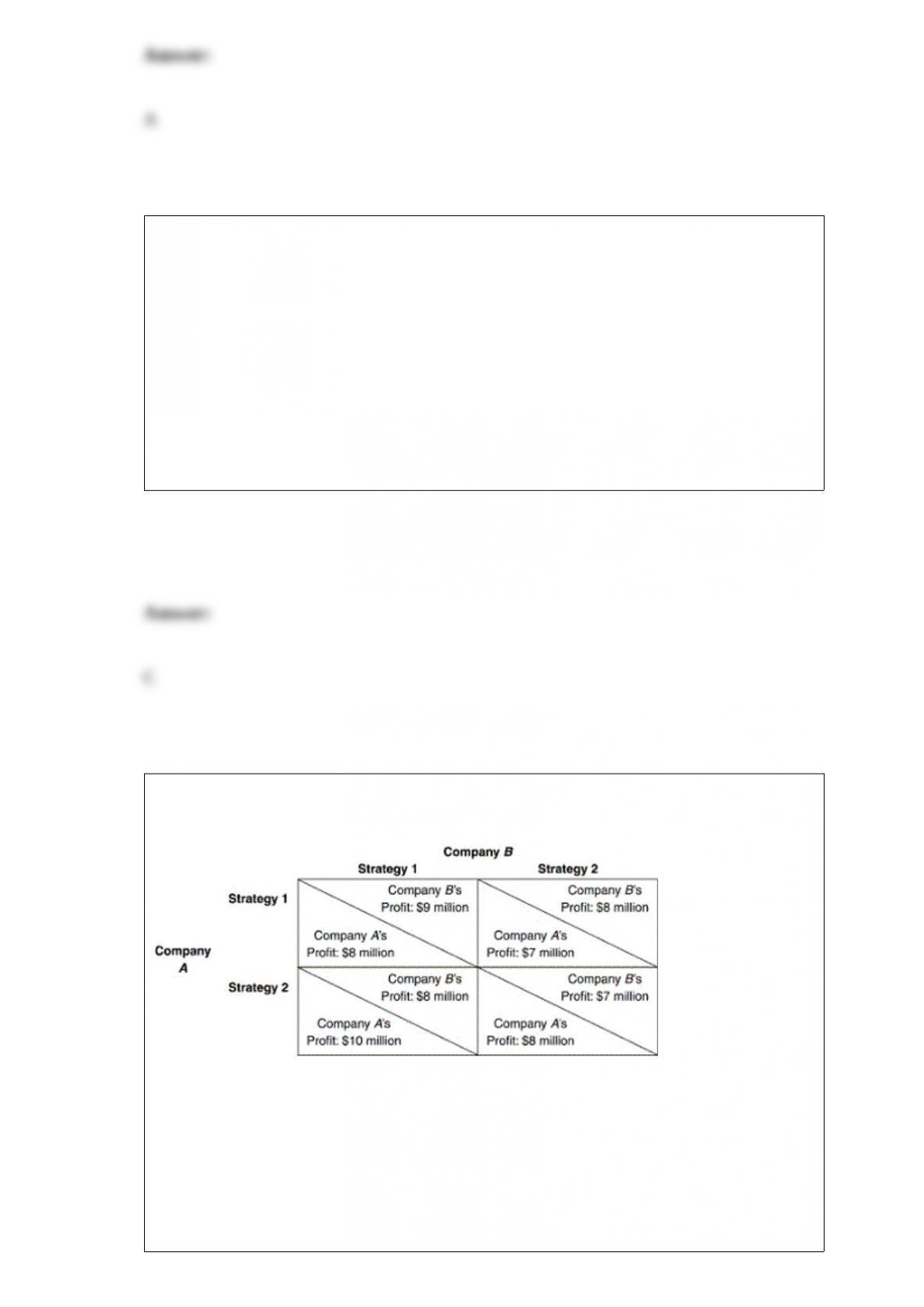
Refer to the accompanying payoff matrix. Which of the following is a Nash
equilibrium?
a. Company A chooses Strategy 1 and Company B chooses Strategy 1.
b. Company A chooses Strategy 1 and Company B chooses Strategy 2.
c. Company A chooses Strategy 2 and Company B chooses Strategy 2.
d. Company A chooses Strategy 2 and Company B chooses Strategy 1.

e. None of the above.
If labor produces output according to Q = 8L1/2, labor costs $10, and output sells for
$100, then the optimal level of L is:
a. 8.
b. 16.
c. 1,600.
d. 2.
e. 10.