
Game Matrix II
The following questions refer to the game matrix below. Player A can play the strategies
“High” and “Low,” and Player B can play the strategies “Odd” and “Even.”
Which outcomes in this game are Pareto optimal?
a. The upper right-hand corner only.
b. The lower right-hand corner only.
c. Both the upper and lower right-hand corners.
d. All outcomes except the upper left-hand corner.
Suppose that when one person consumes a good, it is possible to provide it to others at
no additional cost. Such a good is called
a. nonexcludable.
b. nonrivalrous.
c. a free good.
d. a Clarke good.

Consider the income and substitution effects corresponding to an increase in the price
of X. Which of the following are not possible?
a. The substitution effect on X is positive and the income effect is negative.
b. The substitution effect on X is positive and the income effect is negative.
c. The substitution effect on Y is negative and the income effect on X in negative.
d. The income effect on both good is positive.
In an analysis of an excise tax on soda, which of the following is an exogenous
variable?
a. The price received by sellers.
b. The price paid by buyers.
c. The quantity exchanged in the market.
d. The tax.

If people have the same abilities, then
a. they cannot gain from trade.
b. they can still gain from trade if they have different tastes.
c. they can still gain from trade as long as they specialize in different activities.
d. they can still gain from trade only if they are facing different absolute prices.
A competitive firm’s long-run supply curve is
a. horizontal at the firm’s break-even price.
b. steeper than its long-run marginal cost curve.
c. identical to its long-run average cost curve.
d. more elastic than its short-run supply curve.
With an increase in income, a consumer can increase the quantity consumed of
a. only good Y.
b. only good X.
c. either good, but not both.

d. either or both.
The volatility of stock prices, particularly in the short-run, may, according to Professor
S. Grossman, be due to
a. large numbers of stockholders fearful of losing wealth who sell at some
predetermined level.
b. some traders being better informed than others about real financial conditions.
c. either or both of the above.
d. the increasing use of stock options as compensation for corporate executives.
If the marginal rate of technical substitution of labor for capital (MRTSLK) exceeds the
relative price of labor in terms of capital (PL/PK), then
a. the firm’s long-run average cost curve is rising.
b. the firm is producing its output at the least possible cost, but the firm should reduce
its output level to increase its profits.
c. the firm has increased its output level beyond the point of diminishing marginal
returns.

d. the firm needs to use less capital and more labor to reach its expansion path.
Why is the social marginal benefit of a common property smaller than the value that
people, on average, receive from it?
a. Because use of a common property is nonrivalrous.
b. Because when one additional person uses the common property, it lowers the value
that others receive from it.
c. Because entrance fees must be taken into account when determining the social
benefit derived from a common property.
d. Because “free riders” will use the common property without contributing to its costs.
There are two people in an economy. Person A’s demand for a public good is Q = 10 – P
and person B’s demand is Q = 20 – 2P. The highest total that A and B will be willing to
pay for six units of the public good is
a. $3
b. $4
c. $7
d. $11

Cournot Problem. Consider Cournot Duopolists that produce homogeneous goods.
These firms each have constant marginal costs of $10. The market for these firms’
product has demand Q = 100 – P.
In the Nash Equilibrium, total industry output will be
a. 30 units.
b. 45 units.
c. 60 units.
d. 90 units.
If the autarkic and world relative prices are equal, then
a. consumers are better off with trade than without trade.
b. the country has the option of supplying either good in the world market.
c. no gains from trade are possible.
d. the world markets are not in equilibrium.

Suppose there are two types of people: “good risks” who have 1 to 9 odds of falling ill,
and “bad risks” who have a 1 to 3 odds of falling ill. If an insurance company cannot
distinguish good risks from bad risks, what is the best way for it to deal with this
problem?
a. Do not offer any insurance at 1 to 3 odds.
b. Make everyone purchase insurance that offers 1 to 3 odds.
c. Limit the amount of insurance that can be purchased at 1 to 9 odds.
d. Provide policies that offer 1 to 9 odds and 1 to 3 odds, allowing each group to
purchase the appropriate policy.
Excise Subsidy
The following questions refer to the accompanying diagram which shows the effects of
an excise subsidy given to firms. The initial price and quantity are P0 and Q0,
respectively. After the subsidy is granted, the equilibrium quantity is Q1, firms receive
the price Ps, and consumers pay the price Pd.
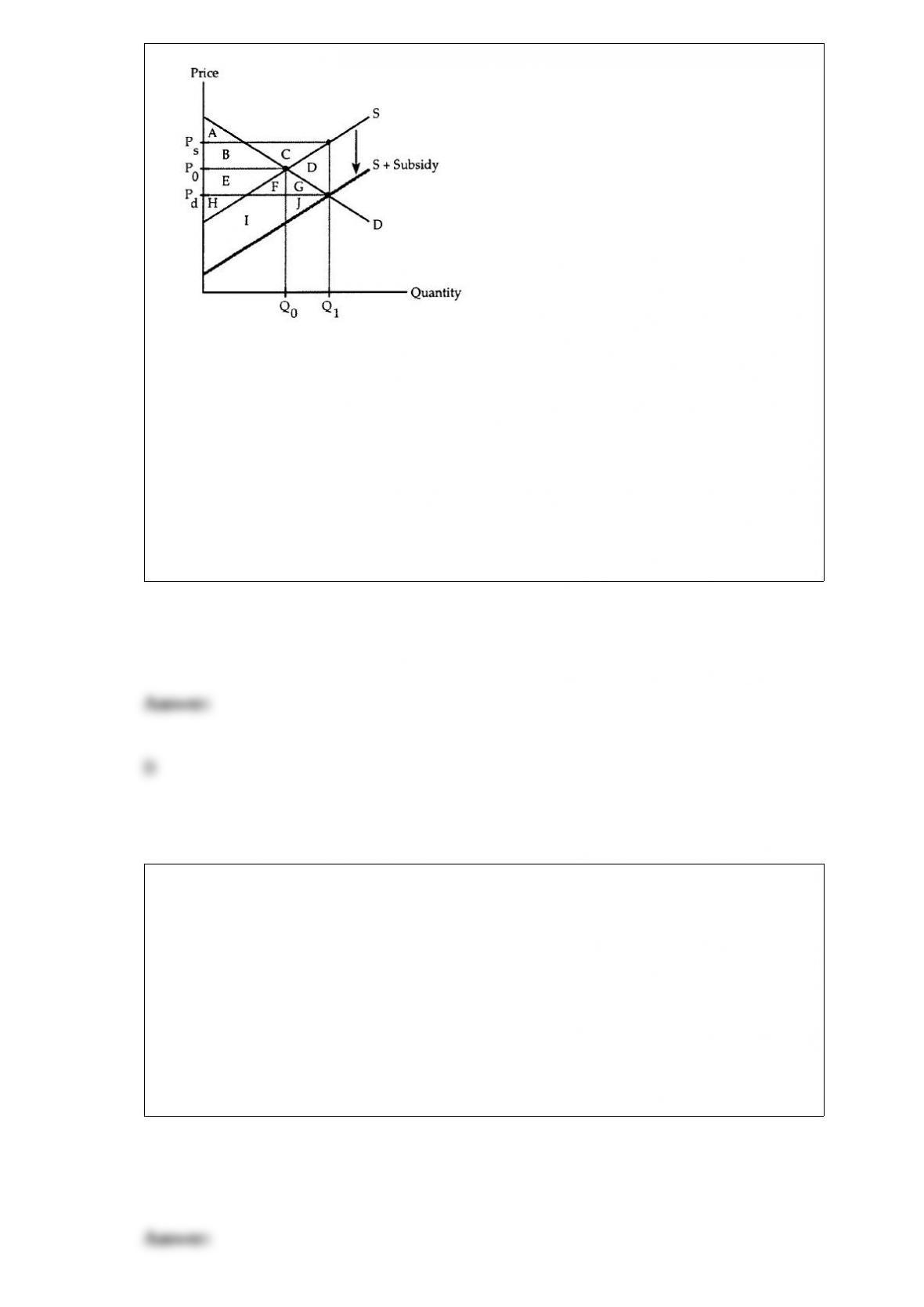
The amount of the subsidy paid to firms is given by
a. area A + B + E + H.
b. area B + C + D + E + F + G.
c. area D.
d. area F + G + I + J.
History and Adam Smith both point out that people of the same trade
a. often face the temptation to engage in collusion.
b. rarely consider engaging in collusion.
c. meet only to consider how to improve the quality of their products.
d. scrupulously avoid engaging in discussions about their trade since they are
competitors.

Mike, of Mike’s Machines has hired a consultant who informs Mike that since the total
revenue from current operations exceeds total cost, he should consider increasing
production of machines. Mike would be best off if he
a. increases production of machines until total revenue is equal to total cost.
b. increases production until net gains are equal to zero.
c. maintains his current level of production so long as marginal revenue is equal to
marginal cost.
d. decreases his current level of production if marginal revenue is only equal to
marginal cost.
Consider a portfolio with three stocks, each with the same value. The three stocks have
standard deviations of 20%, 40%, and 90%. The standard deviation of this portfolio is
a. no greater than 50%.
b. less than 20%.
c. exactly 40%.
d. more than 90%.

If a coupon bond that pays one hundred dollars at the end of the next three years is
worth three hundred dollars, then the interest rate must be
a. one percent
b. one hundred percent
c. ten percent
d. zero percent
In using the composite-good convention in an indifference curve diagram, economists
a. compare the prices of market baskets at different points in time.
b. divide the world’s production into two classes, goods and services.
c. divide the world’s goods into two classes, high quality goods and low quality goods.
d. lump together all goods but one into a single good measured in a single unit, like
dollars.
Suppose a couple’s decision about where to live was based on maximizing family
income. The wife is offered a job elsewhere paying $35,000 more per year, but the
husband would have to take a $60,000 pay cut to move with her so they stay. The fact

that the wife’s salary is lower than average in her field is a result of
a. compensating differentials.
b. supply decisions by the workers.
c. gender discrimination.
d. differences in human capital.
An increase in fixed costs will lower a firm’s
a. total cost.
b. output.
c. prices.
d. profit.
The imposition of a sales tax on eggs will:
a. Cause a parallel shift downward in demand for eggs.
b. Cause a parallel shift upward in demand for eggs.
c. Lead to an increase in the slope of the demand curve for eggs.

d. Have no effect in demand or sales of eggs since they are a small part of any family’s
budget.
Which of the following goods is an example of a good that is nonexcludable but not
nonrivalrous?
a. National defense.
b. A fishing lake.
c. A lighthouse.
d. A radio broadcast.
What is one problem with using a Clarke tax to finance government provision of a
public good?
a. People tend to overstate their preferences for the public good when a Clarke tax is
imposed.
b. The government may decide against providing the public good, even when it would
be efficient to do so.
c. The Clarke tax is not a fair tax, because everyone pays the same amount regardless of
income.
d. The revenues collected from the Clarke tax may not cover the cost of the public
good.
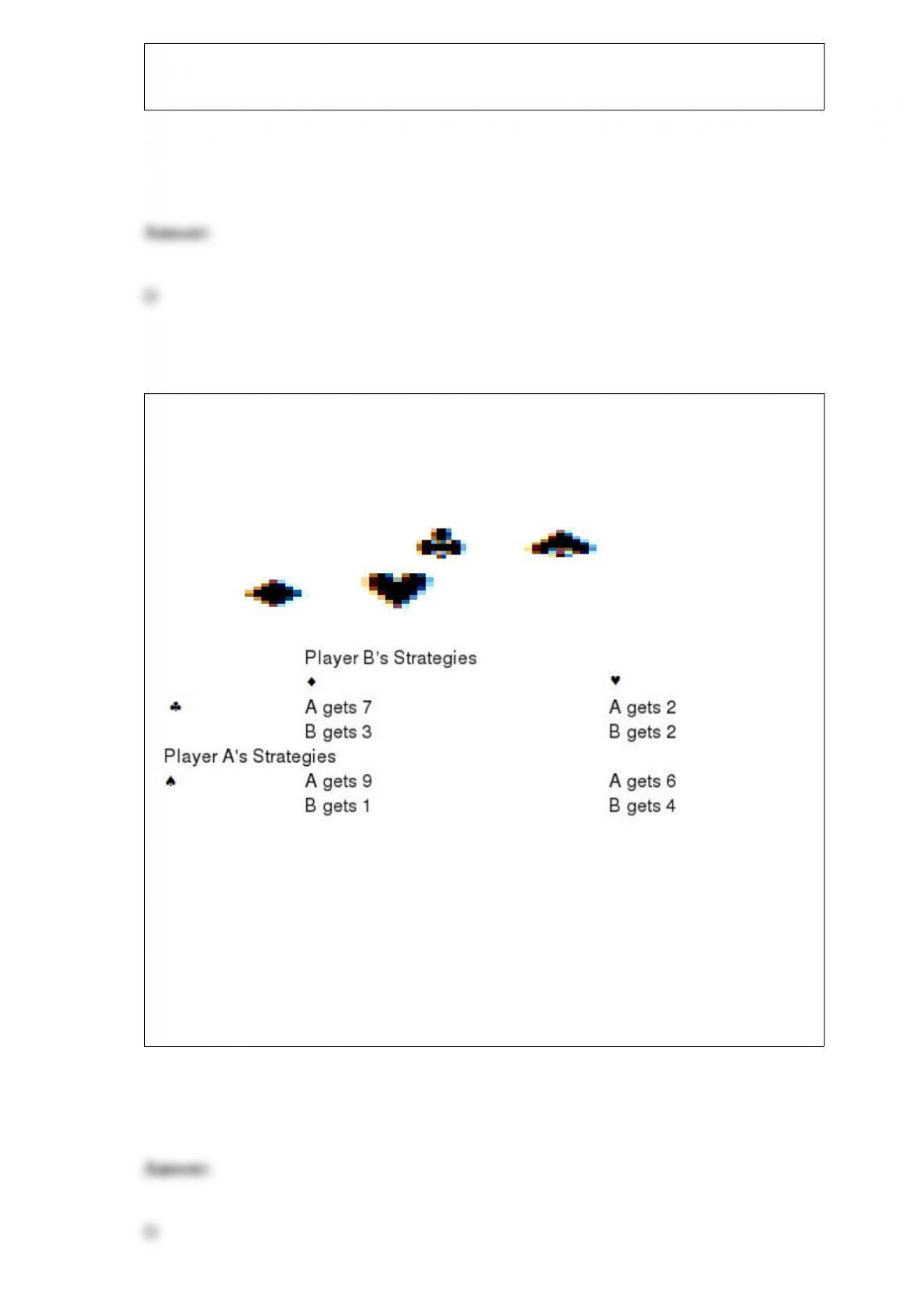
Game Matrix I
The following questions refer to the game matrix below.
Player A can play the strategies and , and Player B can play the
strategies and .
The only Nash equilibrium for this game is in
a. the upper left-hand corner.
b. the upper right-hand corner.
c. the lower left-hand corner.
d. the lower right-hand corner.

Changes in the demand for an industry’s output are felt most by those factors that
a. are inelastically supplied.
b. are paid the highest factor prices.
c. earn relatively little economic rent.
d. have a sizable number of alternative uses.
Consider a theory of discrimination based on the assumption that white employees
dislike associating with black employees. Such a theory would predict that
a. blacks will be paid a lower wage than whites.
b. the workforce will be heavily segregated.
c. white workers will have better capital than black workers.
d. black unemployment will be higher than white unemployment.
Free riding would be an appropriate description of which of the following behaviors?
a. People who enjoy having nature conserved by The Nature Conservancy but who do
not contribute to the organization.
b. People crowding into a public park on a nice summer day.
c. A fisher putting a more powerful motor on her boat so as to get to the fishing grounds
before others.
d. Computer software developers who do not charge for their finished programs.
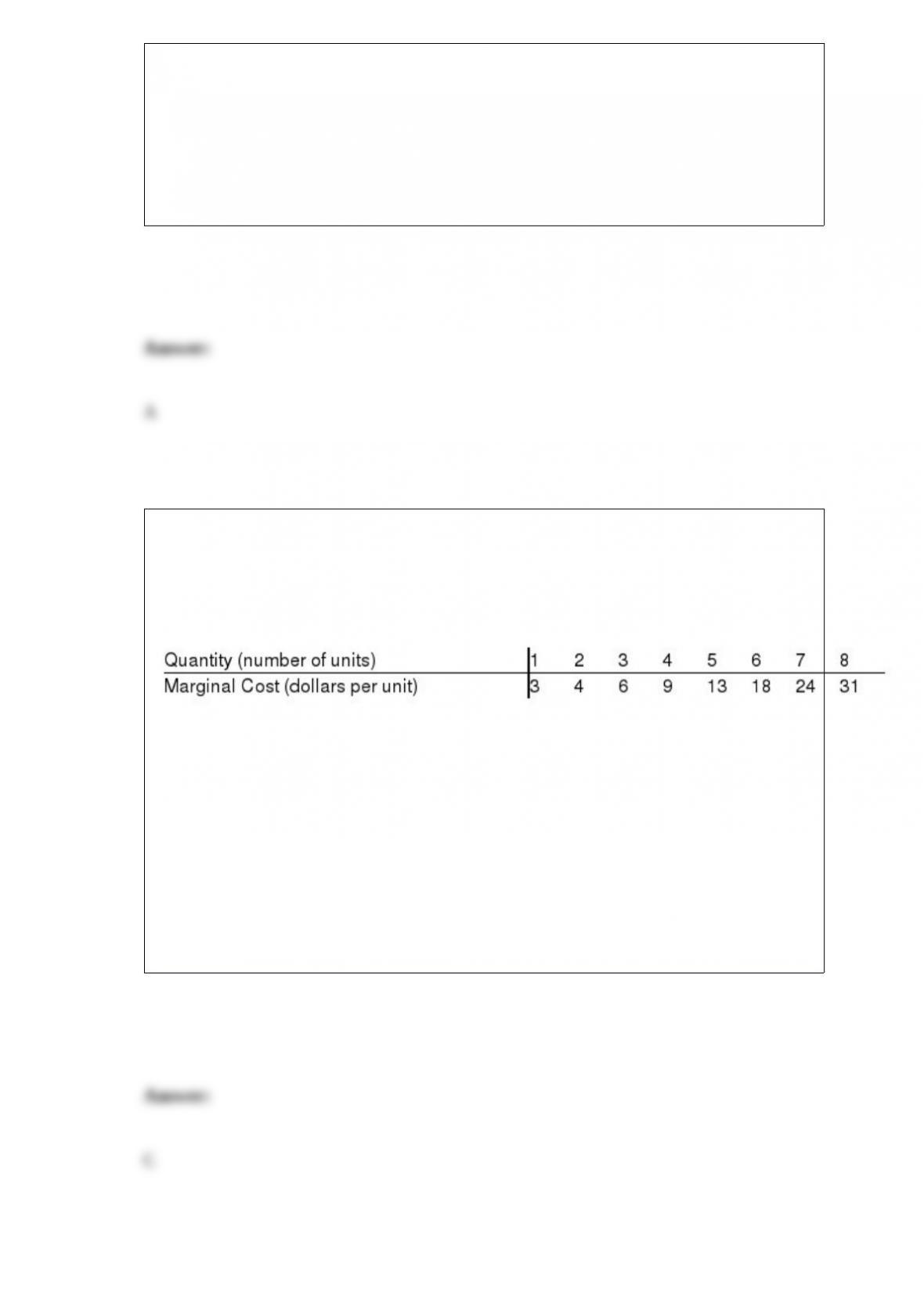
Marginal Cost of Production
The following questions refer to the following table which shows a firm’s marginal cost
of production.
Suppose demand for the firm’s product is horizontal at a price of $18 per unit. How
much output should the firm produce in order to maximize its profit?
a. 3 units.
b. 4 units.
c. 6 units.
d. 7 units.

A Negative Externality Problem
Demand for a good is given by Q = 100 – P. The private marginal cost of production is
MCP = 10 + Q. There is a $10 per unit negative production externality in this situation.
Absent any intervention, the competitive market will produce
a. 40 units.
b. 45 units.
c. 55 units.
d. 60 units
Which of the following would cause a positive change in quantity demanded?
a. A rise in supply.
b. A fall in supply.
c. A rise in demand.
d. A fall in demand.

Goods X and Y
For the following questions, assume that good X is on the horizontal axis and good Y is
on the vertical axis in the consumer-choice diagram. PX denotes the price of good X, PY
is the price of good Y, and I is the consumer’s income. Unless otherwise stated, the
consumer’s preferences are assumed to satisfy the standard assumptions.
When the price of good X rises, what happens to the budget line?
a. The budget line shifts in, with no change in the slope.
b. The budget line becomes flatter, and the horizontal intercept moves to the right.
c. The budget line becomes steeper, with no change in the vertical intercept.
d. The budget line pivots about the horizontal intercept, with the vertical intercept
moving up.
The industry’s short-run supply curve is identical to the horizontal sum of the individual
firms’ short-run supply curves as long as there are no
a. entry and exit.
b. fixed costs.
c. differences among firms.
d. factor-price effects.

A perfectly competitive market has demand Q = 100 – P and supply Q = P – 10. An
individual firm has MC = 10 + 2Q.
(a) What is the market equilibrium price and quantity?
(b) How much output should the individual firm produce?
(c) Although it is has been claimed that this market is perfectly competitive, do your
answers to parts (a) and (b) suggest differently?
The Fabian argument that confiscation of rents would not lower social welfare
overlooks the costs of resource misallocation.
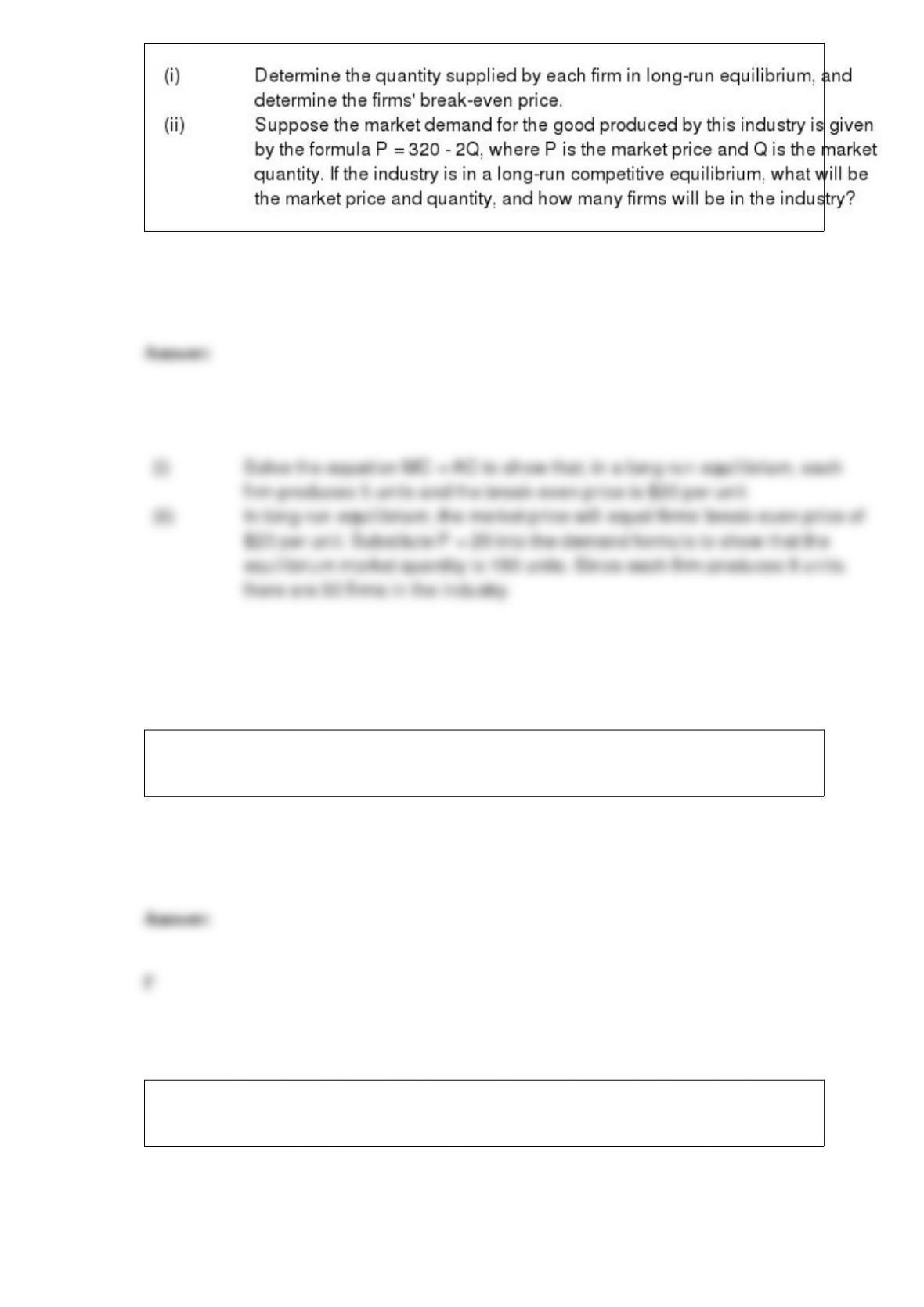
Consider a competitive constant-cost industry in which each firm’s marginal and
average costs are given by the formulas MC = 4q and AC = 2q + 50/q , where q
represents the quantity supplied by the firm.
The Peltzman study shows consumers overall have benefited from the requirement that
drug manufacturers prove the safety and effectiveness of their products.
Although a sales tax hurts both producers and consumers, their losses are fully offset by
the benefits created by the tax revenues.

If good wines can be produced in Turkey at costs lower than in the wine exporting
countries, but the local population drinks little wine, then Turkey should not produce
wine.
If labor and capital are complements in production, additions to capital will increase
both the total and marginal products of labor.
How does a Pigou tax work? Why might a Pigou tax fail to achieve an efficient
outcome?

Strict liability is the liability that exists when it can be proven beyond a reasonable
doubt that the defendant was negligent.
A firm has monopoly power when it is the single seller of a good or service.
For prices greater than the minimum value of average variable cost, the firm’s short-run
supply curve coincides with its short-run marginal cost curve.

There is only one possible market portfolio-the portfolio consisting of all the risky
assets in the economy.
One effect of a tax is that output in the market which is taxed falls.
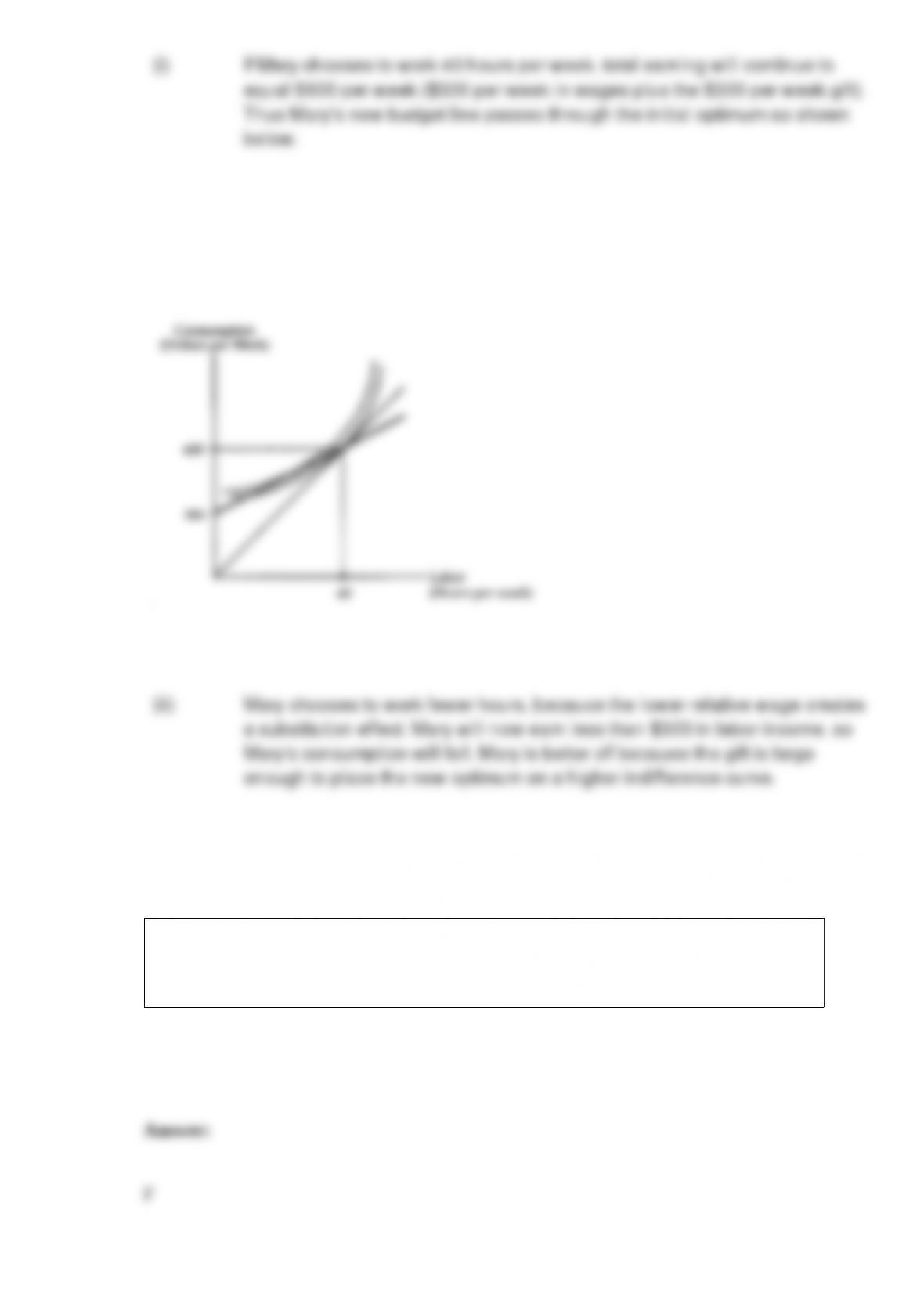
Mary is a waitress who, when tips are included, earns $15 per hour. Mary chooses to
work 40 hours per week. Assume there are no taxes, so Mary earns $600 per week. A
slowdown in the restaurant’s business cuts Mary’s hourly wage in half, to $7.50 per
hour. To compensate Mary for the lost income, Mary’s rich parents begin sending a gift
of $300 per week.
The Sherman Act of 1890 and the Clayton Act of 1914 gave courts the power to prevent
mergers that reduce competition and provided clear criteria to apply in determining
when a merger would do so.

If only materials and workers are used to make a computer and the materials cost $100
and labor costs $200, then the cost of making the computer is $300.
Both ex ante and ex post preferences depend solely on the individual’s tastes.
Define the term moral hazard. If moral hazard were not present, would the number of
insurance claims be more likely to go up, go down, or stay the same as when it is
present? Would insurance be more expensive, less expensive, or cost the same?