Briefly describe are the 6 main provisions of the Patient Protection and Affordable Care
Act (ACA)?
Arnold Harberger was the first economist to estimate the loss of economic efficiency
due to market power. Harberger found that
A) the loss of economic efficiency in the U.S. economy due to market power was less
than 1 percent of the value of production.
B) because of the increase in the average size of firms since World War II, the loss of
economic efficiency has been relatively large, about 10 percent of the value of total
production in the United States.
C) although the number of monopolies was small, the large number of other
non-competitive firms in the United States resulted in a large loss of economic
efficiency, about 20 percent of the value of total production.

D) the loss of economic efficiency in the U.S. economy due to market power was small
around 1973, about 1 percent of the value of production, but has since grown to about
10 percent.
According to ________, in a market with an externality, private parties would
voluntarily negotiate an efficient outcome without government intervention.
A) A. C. Pigou
B) Adam Smith
C) Ronald Coase
D) John Maynard Keynes
Which type of business has the least government rules and regulations affecting it?
A) sole proprietorship
B) partnership
C) corporation
D) They all have the same set of rules and regulations affecting them.
When you purchase a new pair of jeans you do so in the
A) factor market.
B) input market.
C) product market.
D) resource market.
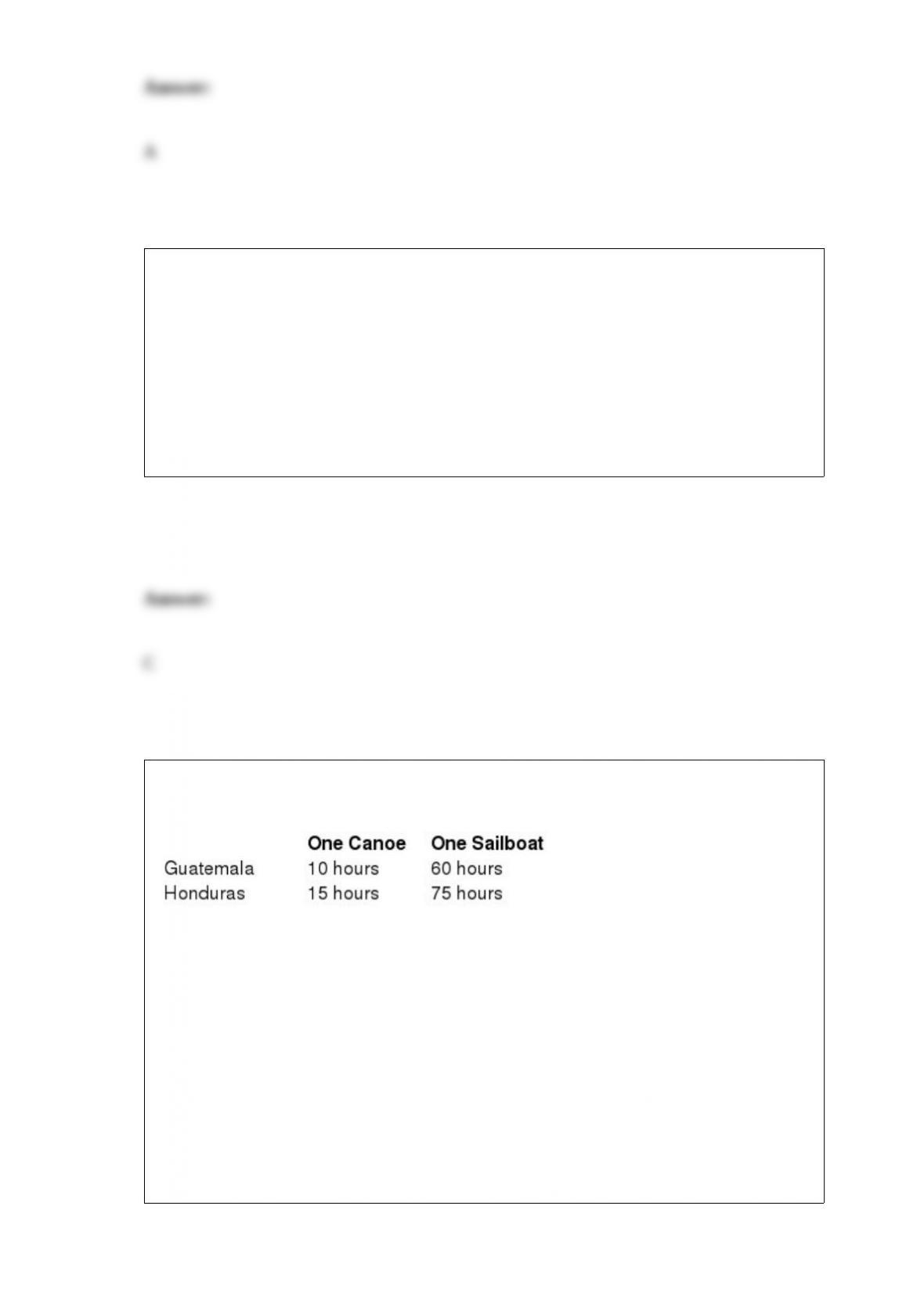
Table 2-9
Table 2-9 shows the number of labor hours required to produce a canoe and a sailboat in
Guatemala and Honduras.
Refer to Table 2-9. What is Honduras’s opportunity cost of producing one canoe?
A) 1/5 of a sailboat
B) 1.5 sailboats
C) 5 sailboats
D) 6 sailboats

What is moral hazard?
A) It refers to the private, self-interested actions that people pursue, which when taken
collectively leads to a loss in economic surplus.
B) It refers to the actions people take after they have entered into a transaction that
makes the other party to the transaction worse off.
C) It refers to the situation in which one party to a transaction takes advantage of
knowing more than the other party to the transaction.
D) It refers to the actions people take before they enter into a transaction so as to
mislead the other party to the transaction.
The distribution of income primarily determines which of the fundamental economic
questions?
A) What goods and services are to be produced?
B) How the goods and services are to be produced?
C) Who will receive the goods and services produced?
D) How to plan the economy?

In the short run, a profit-maximizing firm’s decision to produce should be guided by
whether
A) it makes a profit.
B) its marginal profit is maximized.
C) its total revenue exceeds its fixed cost.
D) its total revenue covers its variable cost.
A patent is an example of
A) how ownership of a key input creates a barrier to entry.
B) a government-imposed barrier to entry.
C) occupational licensing.
D) how market failure can lead to oligopoly.

Which of the following is a macroeconomics question?
A) What determines the inflation rate?
B) What determines the production of DVDs?
C) What factors determine the price of carrots?
D) What determines the wage of auto workers?
The cross-price elasticity between Gillette razors and a related good is -3.4. What
happens to the demand for the related good if the price of Gillette razors falls by 10
percent?
A) The quantity demanded of the related good rises by 3.4 percent.
B) The quantity demanded of the related good falls by 34 percent.
C) The quantity demanded of the related good rises by 34 percent.
D) The quantity demanded of the related good falls by 3.4 percent.
For the monopolistically competitive firm
A) Price (P) = Marginal Revenue (MR) = Average Revenue (AR).
B) P = MR > AR.

C) P = AR > MR.
D) P > MR = AR.
Economic incentives are designed to make individual self-interest coincide with social
interest. According to economists, which of the following methods of pollution control
best uses economic incentives to reduce pollution?
A) Rewarding environmental groups for monitoring the activities of private firms that
produce products which generate pollution.
B) Imposing quantitative limits on the amount of pollution and imposing a penalty for
non-compliance with these limits.
C) Requiring the installation of specific pollution control devices.
D) Instituting a system of tradable emissions allowances.
One reason why adverse selection problems arise in health insurance markets is that
A) sick people are more likely to want health insurance than healthy people.
B) because of advances in medical technology, people are living longer. These medical
advances are costly and drive up the price of insurance for everyone.
C) the average age of citizens of the United States has increased in recent years, and
will continue to increase over the next 20 to 30 years. As older citizens retire, more and
more of their medical bills will have to be paid by younger workers.
D) fewer men and women are choosing medical careers because of the increase in the
cost of malpractice insurance.
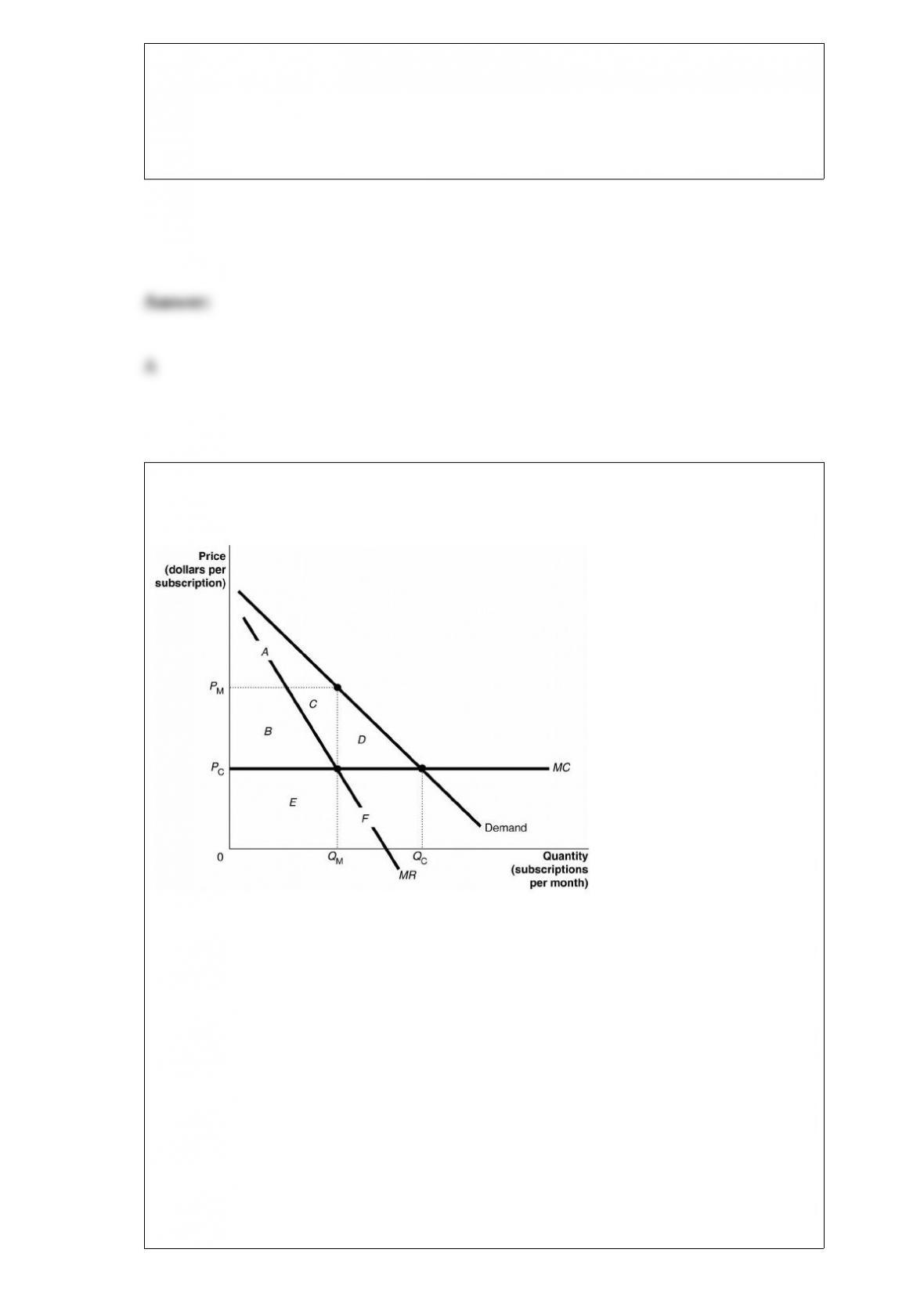
Figure 15-11
In 2011, Verizon was granted permission to enter the market for cable TV in Upstate
New York, ending the virtual monopoly that Time Warner Cable had in most local
communities in the region. Figure 15-11 shows the cable television market in Upstate
New York.
Refer to Figure 15-11. What is the size of the deadweight loss prior to Verizon entering
the market and what happens to this deadweight loss after Verizon does enter the
market?
A) The deadweight loss of area D is converted to consumer surplus.
B) The deadweight loss of area C+D is converted to consumer surplus
C) The deadweight loss of area D is converted to producer surplus.

D) The total deadweight loss is the area D+F; D is converted to consumer surplus and
F to producer surplus.
Most people would prefer to drive a luxury car that has all the options, but more people
buy less expensive cars even though they could afford the luxury car because
A) car buyers are irrational.
B) the total utility of less expensive cars is greater than that of luxury cars.
C) the marginal utility per dollar spent on the less expensive car is higher than that
spent on luxury cars.
D) luxury cars cost a lot more than non-luxury cars.
Identify the one statement that does not demonstrate how social effects influence
consumer choice.
A) Students in an Economics class are required to purchase a textbook assigned by the
professor.
B) There is utility gained from consuming goods or services that others are consuming.
C) Some products that people consume are determined by the social popularity of the
products.
D) Companies such as Zappos.com and Netflix invite their consumers to write reviews

about their experience with their products which are then posted on the internet for
others to see.
If a firm in a perfectly competitive industry experiences persistent losses, in the long
run it should
A) shut down temporarily and wait for market conditions to change.
B) exit the industry.
C) raise its price to cover average total cost.
D) continue to operate if it can raise the demand for its product through advertising and
quality improvements.
If the demand for a life-saving drug was perfectly inelastic and the price doubled, the
quantity demanded would
A) also double.
B) decrease by 50%.
C) be cut in half.
D) remain constant.

Which of the following is an example of an efficiency-equity trade-off faced by
economic agents?
A) According to an article by in the American Journal of Public Health by Edward
Kaplan and Michael Merson of Yale University School of Medicine, the federal
government’s current method of allocating HIV-prevention resources is not
cost-effective. Instead of allocating resources to states in proportion to reported AIDS
cases, resources should flow first to those activities that prevent more infections per
dollar and then to less and less effective combinations of programs and populations
until funds are exhausted, even if it means that some populations would be left without
any prevention services.
B) Concerned about the falling birth rate, the French government has pledged more
money for families with three children, in an effort to encourage working women to
have more babies.
C) Some U.S. colleges are actively recruiting foreign students for their
technology-based programs.
D) All New York City art museums are considering adopting a free-admission policy
for local residents one weekend per month.
A firm will break even when
A) P = ATC.
B) P > ATC.
C) P < AVC.

D) P = AVC.
Jake sells Star Wars memorabilia on eBay. His annual revenue is $42,000 per year, and
the explicit costs of his business are $10,000. What is his accounting profit?
A) $10,000
B) $22,000
C) $32,000
D) $42,000
Some policymakers have argue that products like cigarettes, alcohol, and sweetened
soda generate negative externalities in consumption. If the government decided to
impose a tax on soda, the government will cause
A) consumers to internalize the externality.
B) producers to internalize the externality.
C) the external cost to drinking soda to become a private cost paid by the government.
D) the external cost to drinking soda to become a private cost paid by producers.
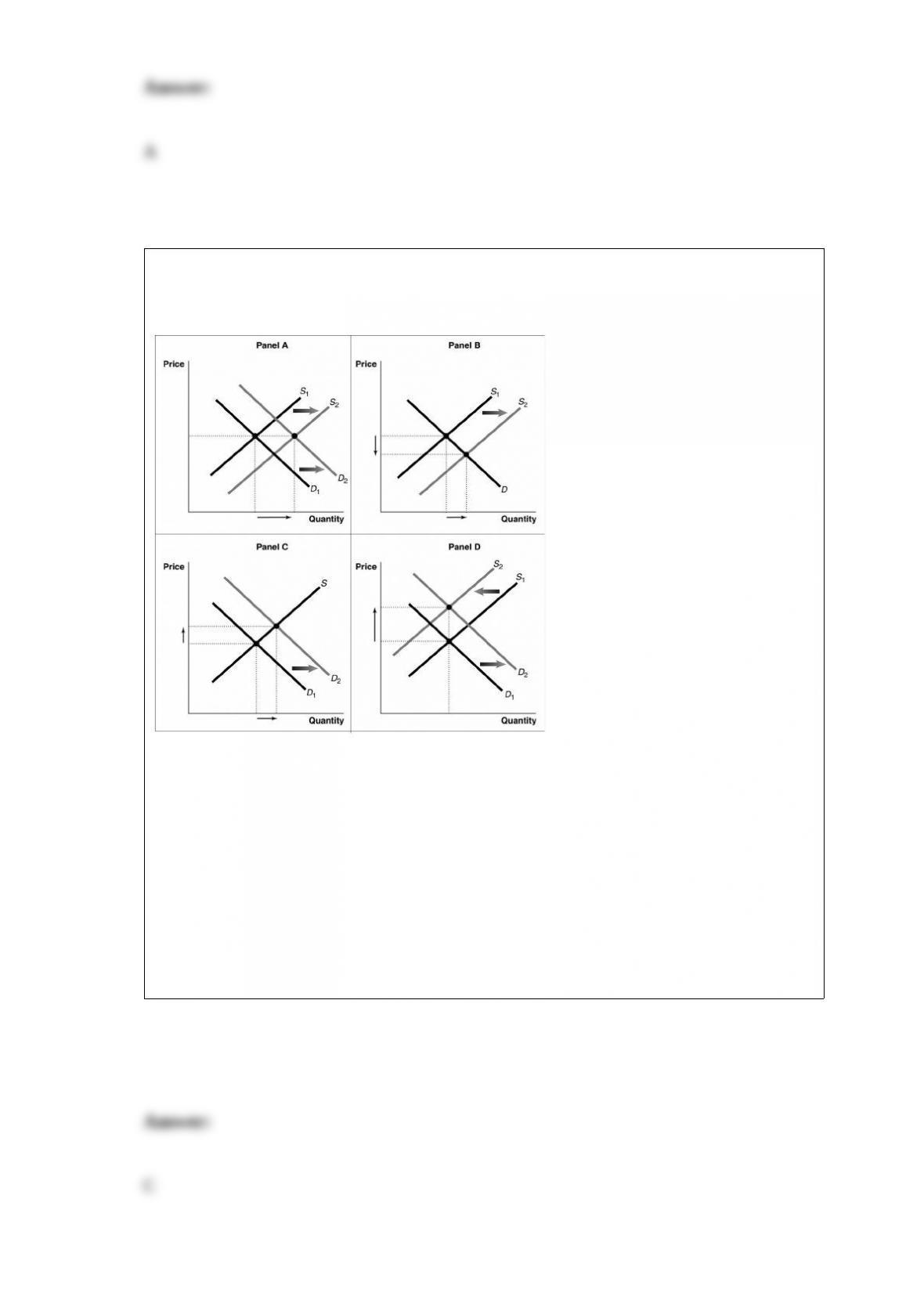
Figure 12-16
Refer to Figure 12-16. Which panel best represents the perfectly competitive organic
produce market in which firms are breaking even, economically, organic produce is
considered a normal good, and the average income level of consumers is rising?
A) Panel A
B) Panel B
C) Panel C
D) Panel D

Publishers practice price discrimination when they sell books at high prices to
A) early adopters.
B) local bookstores.
C) large chain bookstores.
D) online book sellers.
Which of the following is a characteristic of a firm in a perfectly competitive market?
A) The firm cannot make a profit in the short run because it is too small a part of the
total market.
B) The firm can make a profit in the long run but not in the short run.
C) The firm can sell as much as it wants without having to lower its price.
D) The firm must lower its price in order to increase quantity demanded.
If you pay $2,000 in taxes on an income of $20,000, and a tax of $2,700 on an income
of $30,000, then over this range of income the tax is
A) regressive.
B) proportional.

C) progressive.
D) There is insufficient information to answer the question.
Which of the following would shift the supply curve for MP3 players to the right?
A) an increase in the price of a substitute in production
B) an increase in consumer income (assuming that all MP3 players are normal goods)
C) a decrease in the number of firms that produce MP3 players
D) a decrease in the price of an input used to produce MP3 players
Figure 6-3
Refer to Figure 6-3. Using the midpoint formula, calculate the absolute value of the
price elasticity of demand between e and f.
A) 0.32
B) 0.4
C) 2.5
D) 3.125
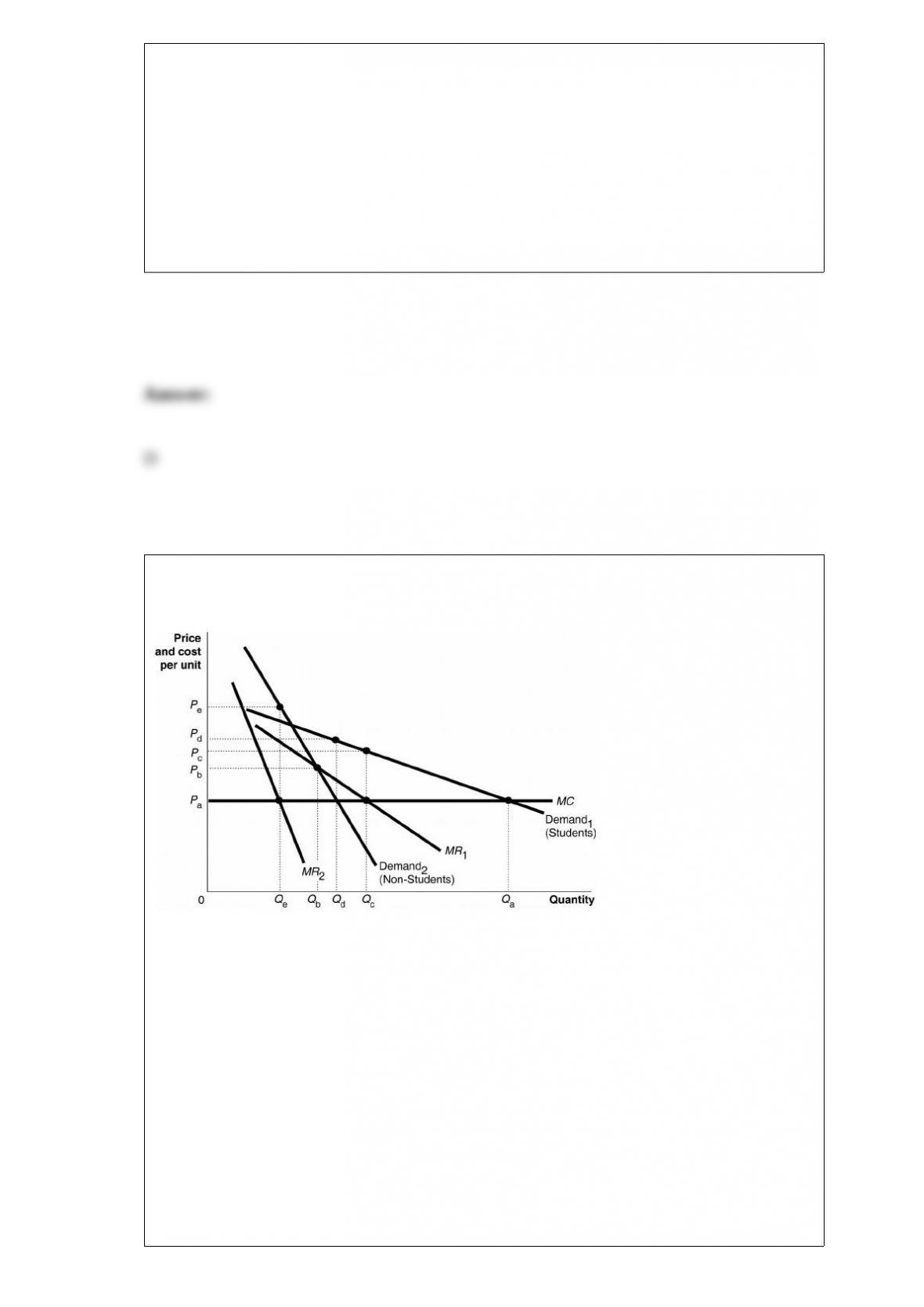
Figure 16-2
Plato Playhouse, a theatre company in the university town of Wegg, caters to two
groups of customers: students and the non-student population. Figure 16-2 shows the
demand curves for the two groups of customers.
Refer to Figure 16-2. Suppose Plato Playhouse price discriminates. Which of the
following statements is true?
A) By charging two different prices, the theatre company has redistributed some profits
from those who can pay higher prices to those who cannot, thereby increasing
economic efficiency.
B) By charging two different prices, the theatre company essentially allows those
willing to pay higher prices to subsidize those who are not.

C) By charging two different prices, the theatre company has redistributed some profits
from those who can pay higher prices to those who cannot, thereby improving equity.
D) Plato Playhouse will earn higher profits if it charges a single price an average of the
two prices instead of charging two different prices to the two different groups of
customers.
In many business situations one firm will act first, and then other firms will respond. To
help analyze these types of situations economists use
A) retaliation games.
B) follow-the-leader-games.
C) sequential games.
D) bargaining games.