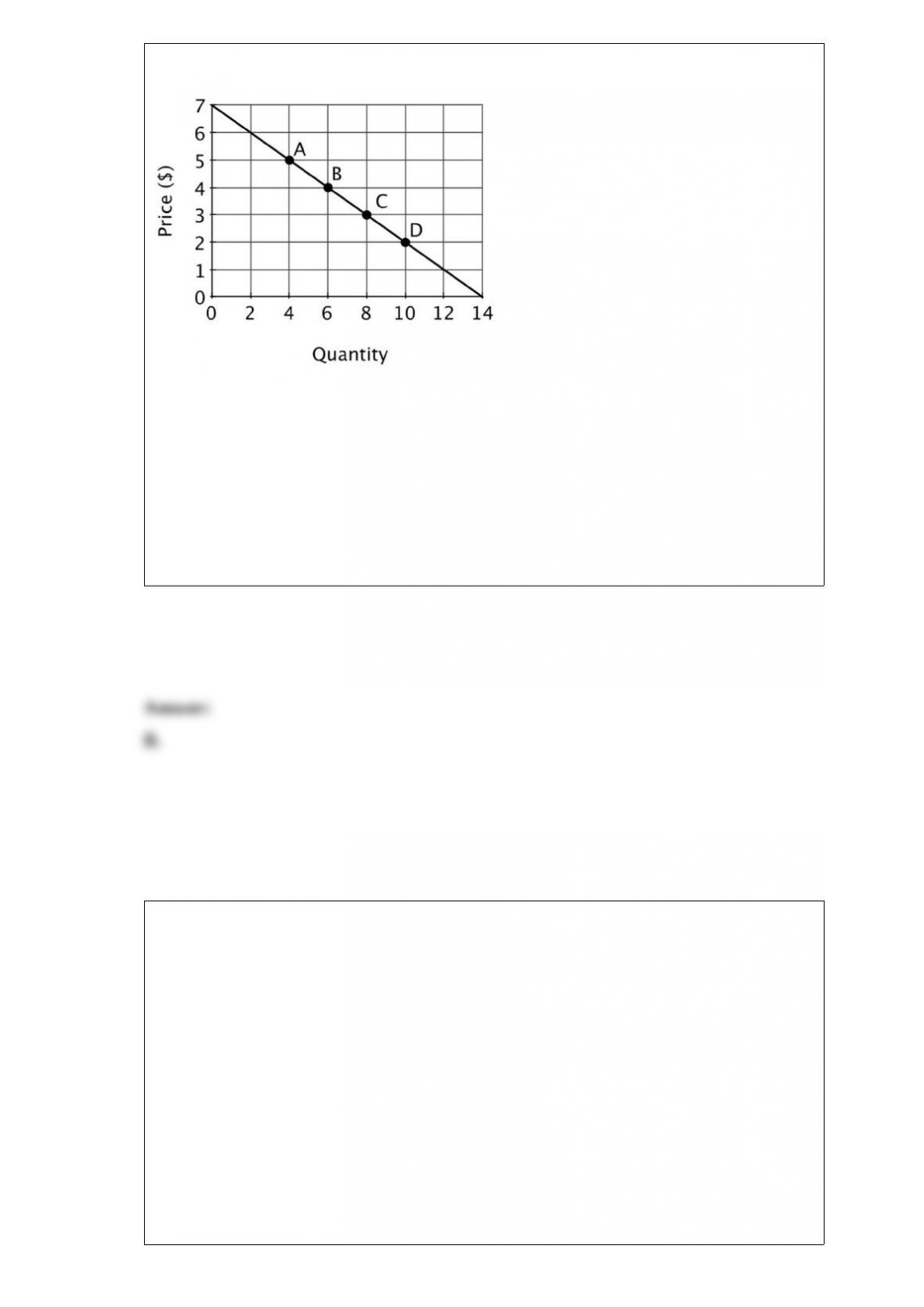
The following graph depicts demand.
At point A, demand is:
A. inelastic.
B. elastic.
C. unit elastic.
D. perfectly elastic.
Larry was accepted at three different graduate schools, and must choose one. Elite U
costs $50,000 per year and did not offer Larry any financial aid. Larry values attending
Elite U at $60,000 per year. State College costs $30,000 per year, and offered Larry an
annual $10,000 scholarship. Larry values attending State College at $40,000 per year.
NoName U costs $20,000 per year, and offered Larry a full $20,000 annual scholarship.
Larry values attending NoName at $15,000 per year. Larry maximizes his economic
surplus by attending:
A. Elite U.
B. State College.
C. NoName U because he has a full scholarship there.
D. NoName U because the annual cost is only $20,000.

As the real interest rate increases, the quantity of saving supplied ______ and the
quantity of saving demanded ____.
A. increases; increases
B. increases; decreases
C. does not change; does not change
D. decreases; increases
The labor force divided by the working age population equals the:
A. unemployment rate.
B. employment rate.
C. participation rate.
D. population rate.
The payoff matrix below shows the payoffs (in millions of dollars) for two firms, A and
B, for two different strategies, investing in new capital or not investing in new capital.
An industry spy comes to firm B and offers to pay B in exchange for B’s certain and
enforceable promise to not invest. How much must the spy pay B?
A. $0
B. At least $15 million.
C. At least $35 million.
D. At least $50 million.
Compared to patients covered by conventional health insurance plans, patients in
HMOs might receive fewer medical services because HMOs:
A. have legal protection from malpractice lawsuits.
B. employ lower quality doctors.
C. receive a fixed annual fee regardless of the amount of medical services provided.
D. save costs by purchasing lower quality medical equipment.

The table below shows the relationship between the number of times you get your car
washed each month and your total monthly benefit from car washes.Each car wash
costs $15.
How many times a month should you get your car washed?
A. 1
B. 2
C. 3
D. 4
In which of the following markets is the presence of asymmetric information of little
concern to the buyer?
A. The market for used textbooks
B. The market for used houses
C. The market for used computers
D. The market for used cars

Refer to the figure below. When this market is in equilibrium, total producer surplus in
the market is ______ per day.
A. $500
B. $375
C. $250
D. $0
Curly pays $12,000 in taxes and earns $150,000. Moe pays $7,000 in taxes. If the tax
system is proportional, then Moe’s income is:
A. $56,000.
B. $125,000.
C. $87,500.
D. $98,000.

The lemons model is used to analyze:
A. the market for citrus fruit.
B. markets with asymmetric information.
C. markets in which search is costly.
D. the Low-Hanging-Fruit Principle.
Suppose a perfectly competitive firm is producing 37 units output, and the marginal
cost of the 37th unit is $3. If the firm can sell each unit of output for $5 and the firm’s
revenue is sufficient to cover its variable cost, the firm should:
A. lower its price.
B. decrease production.
C. increase production.
D. raise its price.
If the output gap equals 1.8 percent, then:
A. cyclical unemployment equals the sum of structural and frictional unemployment.
B. there is an expansionary gap.
C. there is significant cyclical unemployment.
D. potential GDP exceeds actual GDP.
Lee and Cody are playing a game in which Lee has the first move at A in the decision
tree shown below. Once Lee has chosen either aggression or cooperation, Cody, who
can see what Lee has chosen, must choose either aggression or cooperation at B or C.
Both players know the payoffs at the end of each branch.
Suppose Cody tells Lee that if Lee chooses aggression, then Cody will also choose
aggression, and if Lee chooses cooperation, then Cody will also choose cooperation.
Cody’s statement is:
A. a commitment device.
B. not credible.
C. a description of the two equilibria in this game.
D. credible.

You expect a share of EconNews.Com to sell for $65 a year from now. If you are
willing to pay $62.73 for one share of the stock today, and you expect a dividend
payment of $4, what rate of return do you require?
A. 3.6%
B. 6.2%
C. 6.4%
D. 10%
In an open economy with a given level of real interest rates and risk, a decrease in real
interest rates abroad will ______ capital inflows and ______ the equilibrium domestic
real interest rate.
A. increase; increase
B. increase; decrease
C. decrease; decrease
D. decrease; increase
If a firm is earning zero economic profit, then:
A. the firm’s revenues are sufficient to pay its explicit costs, but not its implicit costs.
B. the owner will not be able to pay himself or herself a salary.
C. the firm will shut down in the long run, but will continue to operate in the short run.
D. the firm’s accounting profit is equal to the firm’s implicit costs.
The idea that tradeoffs have to be made when resources are scarce is reflected in the
fact that:
A. points below the production possibilities curve are efficient.
B. points below the production possibilities curve are inefficient.
C. the production possibilities curve has a negative slope.
D. the slope of a linear production possibilities is constant.
Stock prices increase when expected future dividends ____, interest rates _____, and/or
the risk premium ______.
A. increase; increase; increases
B. increase; increase; decreases
C. decrease; decrease; increases
D. increase; decrease; decreases
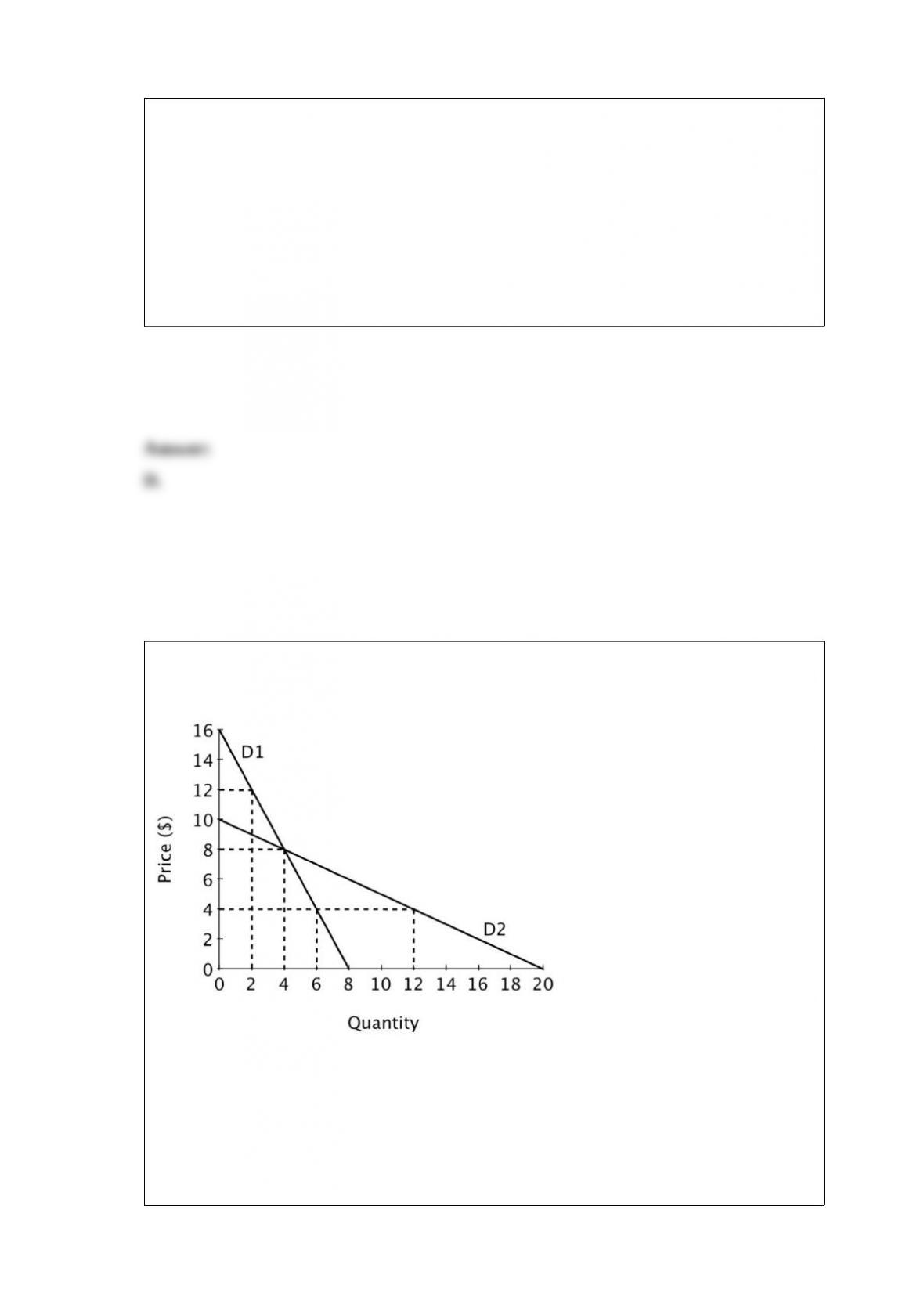
Refer to the figure below. At P = 8 and Q = 4, D1 is ______ elastic than D2, which is
shown graphically as D1 being _____ D2.
A. more; flatter than
B. more; steeper than
C. less; flatter than
D. less; steeper than
The link between the money supply and prices is strongest in:
A. the long run.
B. the short run.
C. a recession.
D. a boom.
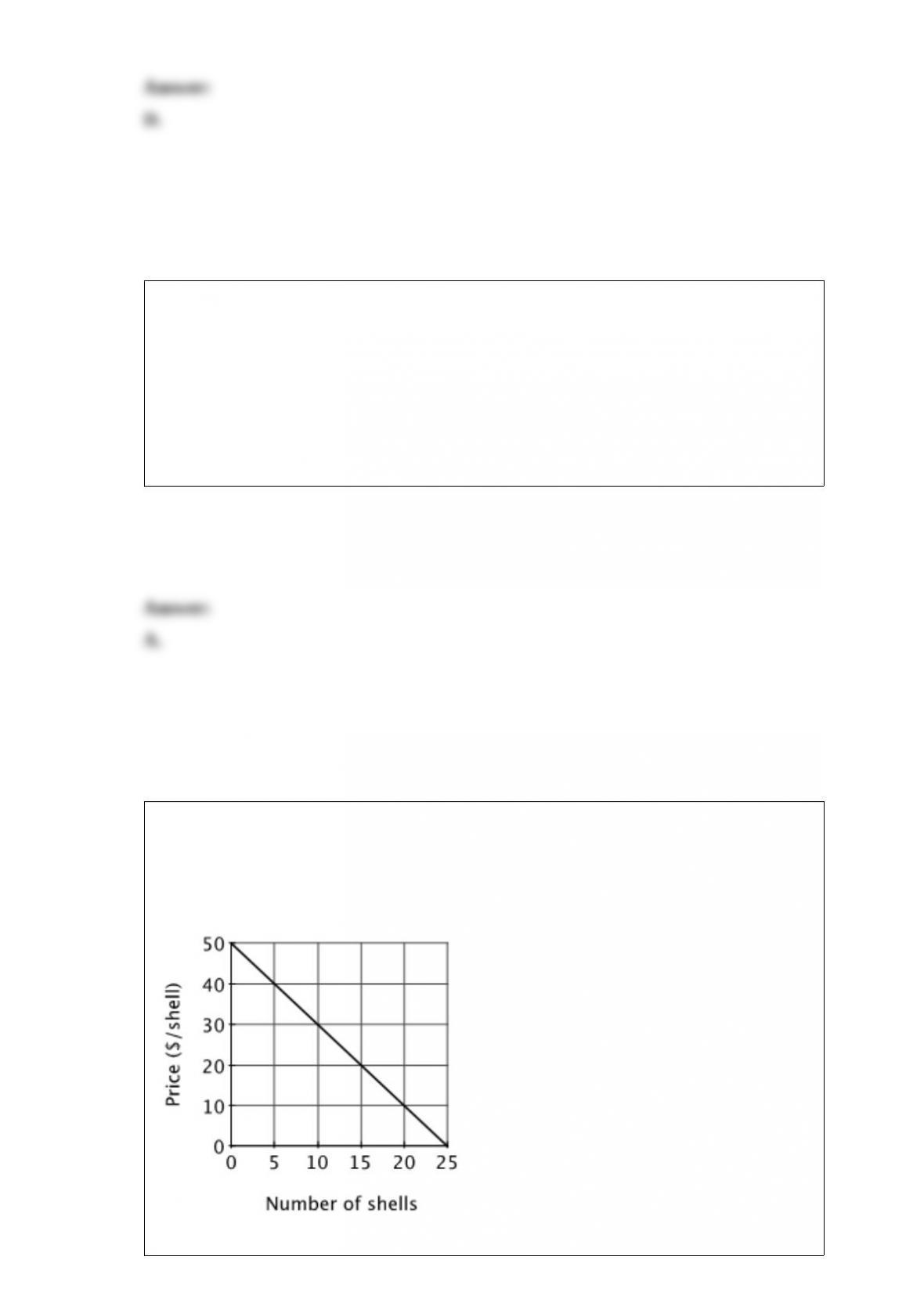
There are 20 residents in the village of Towneburg. The size of the village’s annual
fireworks display depends upon the number of shells that are fired off. Each resident’s
demand for fireworks is shown below. The total cost of the fireworks display is $1,000
plus $10 per shell.

What is the horizontal intercept of the village’s demand curve for fireworks?
A. 25
B. 50
C. 100
D. 500
Refer to the figure above. The equilibrium price and quantity for this market are:
A. $8; 6.
B. $6; 4.
C. $4; 6.
D. $2; 8.
The figure below shows the demand curve, marginal revenue curve, marginal cost curve
and average total cost curve for a monopolist.
At the socially optimal level of output, this monopolist would:
A. earn an economic profit of $16.
B. incur an economic loss of $16.
C. incur an economic loss of $64.
D. incur an economic loss of $112.
Suppose that total expenditures for coffee reach a maximum at a price of $5 per pound.
At this price, the demand for coffee is:
A. elastic.
B. inelastic.
C. unit elastic.
D. perfectly inelastic.
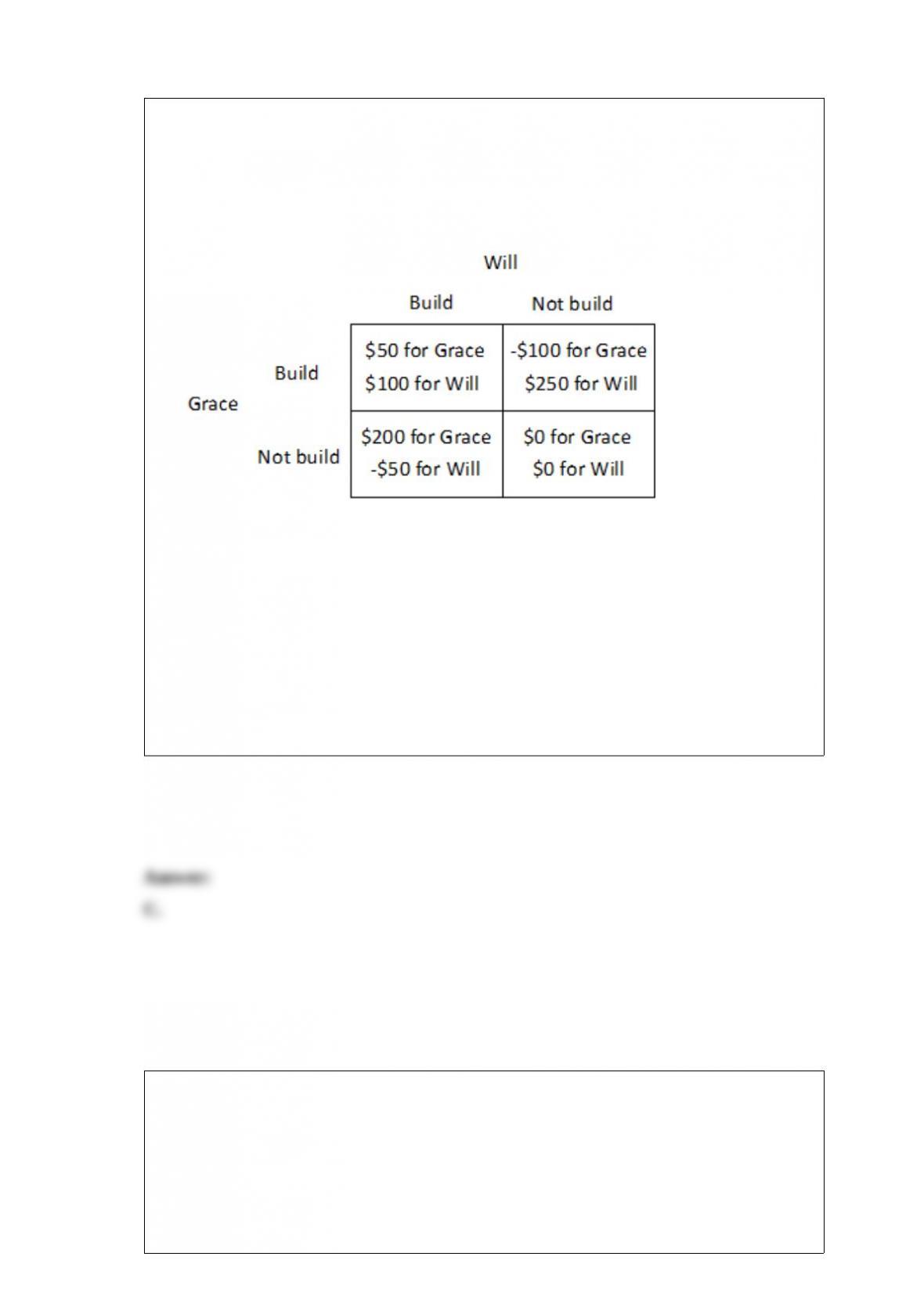
Will and Grace have adjoining unfenced back yards and each has just adopted a new
puppy. Will values a fence between their yards at $250 and Grace values a fence
between their yards at $200. The cost of building the fence is $300, which will be split
equally if they both agree to build the fence. Therefore, their payoff matrix is as
follows.
Will’s dominant strategy in this game is to:
A. build the fence.
B. help build the fence if he sees Grace building the fence.
C. not build the fence.
D. alternate between building the fence and not building the fence.
The nominal interest rate is the:
A. annual percentage increase in the dollar value of a financial asset.
B. annual percentage increase in the purchasing power of a financial asset.
C. real rate of return on an asset.
D. the real interest rate minus the inflation rate.
Suppose the total benefit of watching 1 baseball game is 100, the total benefit of
watching 2 games is 120, and the total benefit of watching 3 games is 125. In this case,
the marginal benefit of watching the 3rd game is:
A. 125
B. 5
C. 41.67
D. 375
In the basic Keynesian model, an increase in government purchases:
A. reduces short-run equilibrium output.
B. increases short-run equilibrium output.

C. reduces potential output.
D. increases potential output.
Kate and Ali can live together a two-bedroom apartment for $600 per month, or they
can each rent a one-bedroom apartment for $400 per month. Apart from the rent, they
are indifferent between living together and living apart, except for one problem: Kate
hates Ali’s taste in music. Kate would be willing to pay up to $100 a month to avoid
hearing Ali’s music. Ali would give up listening to her music for no less than $300 per
month. If Kate and Ali decide to live together, is it socially optimal for Ali play her
music in the apartment?
A. Yes, because the benefit to Ali of listening to her music is greater than the cost to
Kate.
B. No, because the benefit to Ali of listening to her music is less than the cost to Kate.
C. Yes, because the benefit to Ali of listening to her music is less than the cost to Kate.
D. No, because the benefit to Ali of listening to her music is greater than the cost to
Kate.
If either the production or consumption of a good generates an external benefit, then
the:
A. social demand curve will lie to the right of the private demand curve.
B. social demand curve will lie to the left of the private demand curve.
C. social marginal cost curve will lie to the left of the private marginal cost curve.
D. social marginal cost of the good will equal zero.
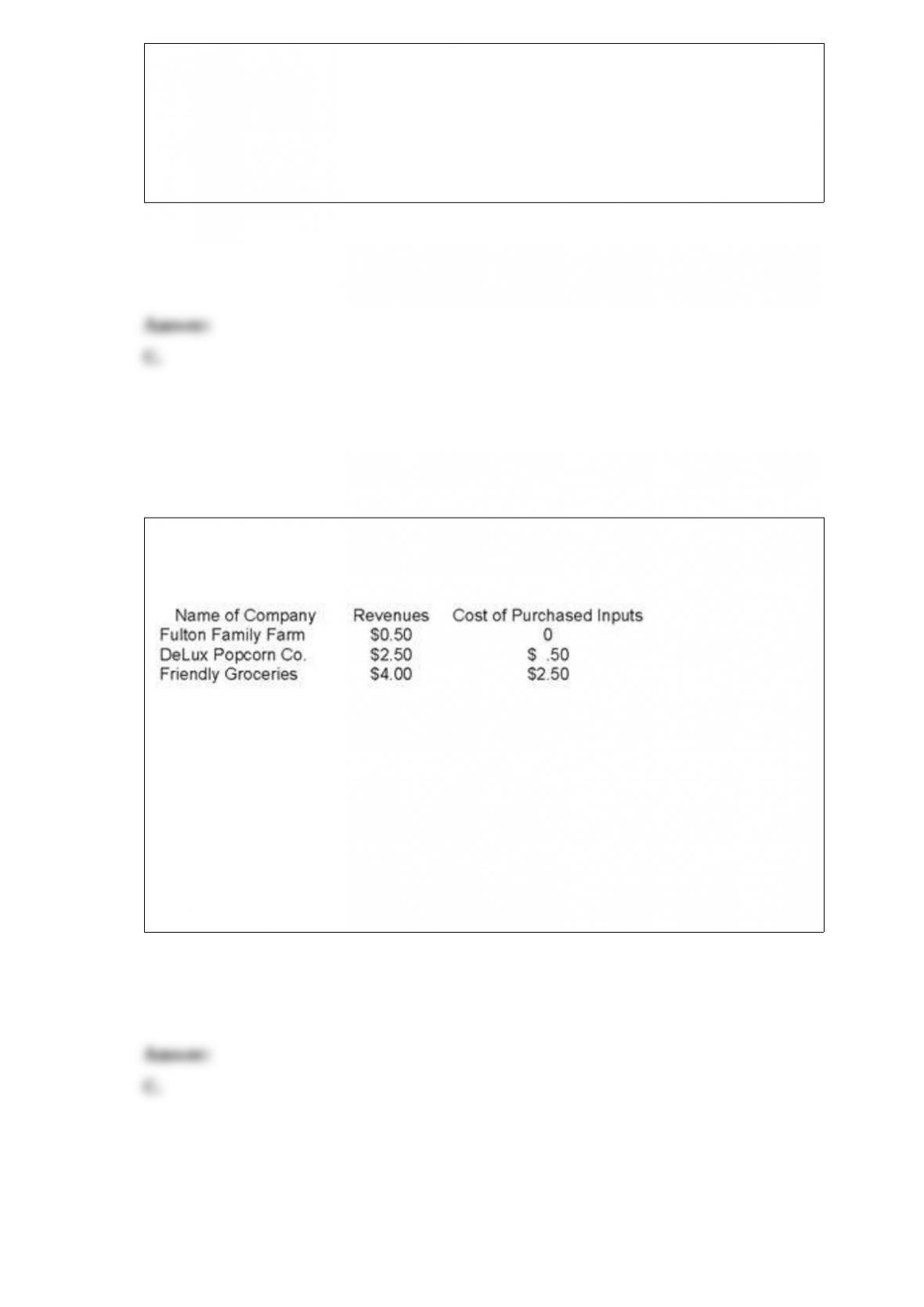
Suppose a jar of DeLux popcorn that is ultimately sold to a customer at Friendly
Groceries is produced by the following production process:
If the corn was grown and the jar of popcorn produced in the year 2015, but the jar was
sold at Friendly Groceries in the year 2016, what is the contribution of these
transactions to GDP in the year 2016?
A. $0.00
B. $0.50
C. $1.50
D. $4.00
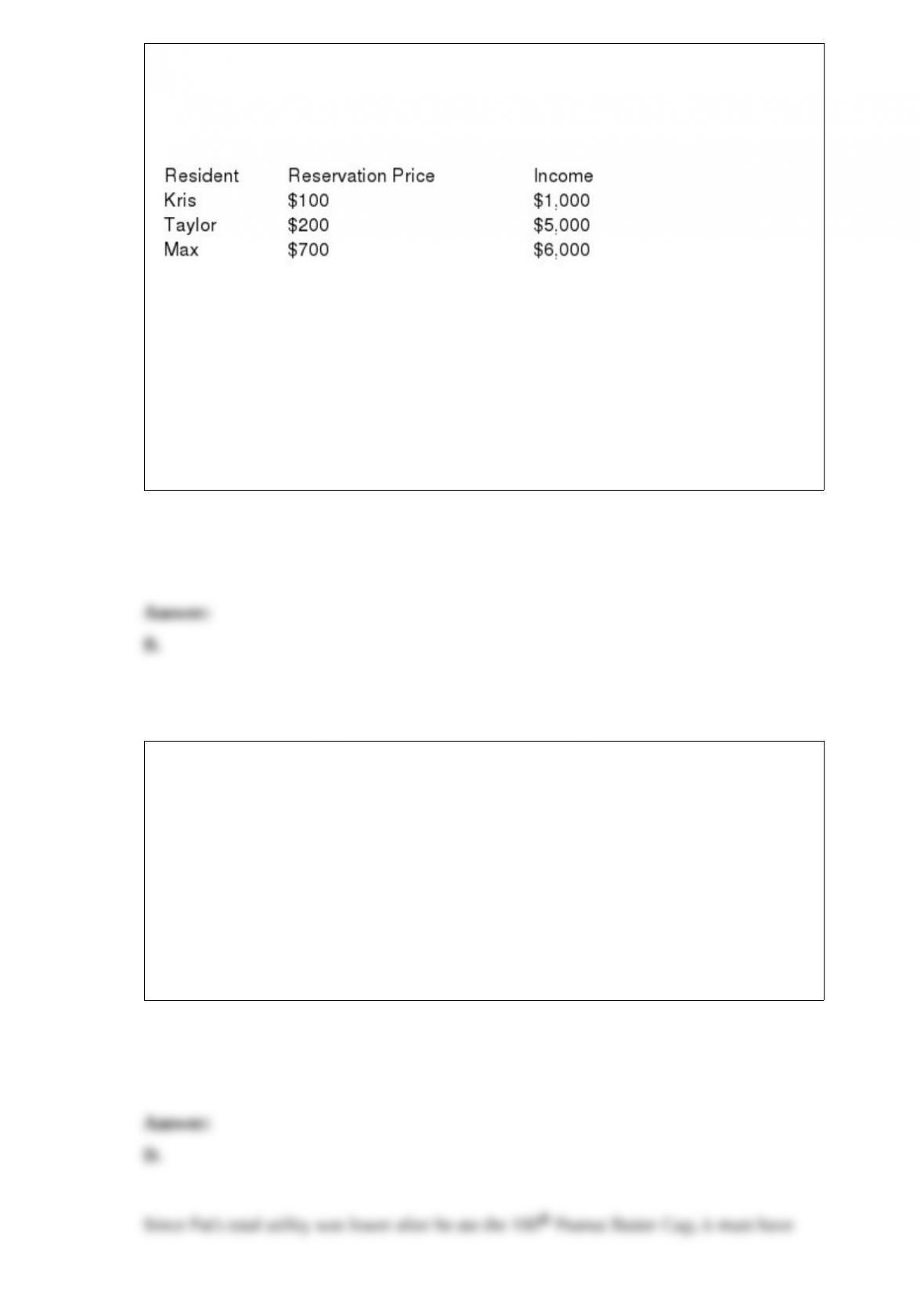
Kris, Taylor and Max are the only three residents in a neighborhood. A public good that
would benefit all of them has a one-time installation cost of $900. The value of the
public good to each resident is shown in the table below. Any tax plan must be
approved by simple majority.
If the government proposes to pay for the public good with a head tax of $300 per
resident, then
A. all three will vote in favor of the tax.
B. Max will vote in favor of the tax, but Kris and Taylor will vote against it.
C. Max will vote against the tax, but Kris and Taylor will vote in favor of it.
D. all three residents will vote against the tax.
Pat’s total utility after eating 99 Reese’s Peanut Butter Cups was greater than his total
utility after eating 100 Reese’s Peanut Butter Cups. Therefore, Pat’s marginal utility
from the 100th peanut butter cup was:
A. positive, but less than one.
B. positive, but less than his marginal utility for the 99th peanut butter cup.
C. zero.
D. negative.