
Article Summary
Concerned about slow economic growth, the Fed announced in September 2013 that it
would postpone winding down its $85 billion a month bond purchasing program which
has been a key component of its monetary stimulus package. Fed Chairman Ben
Bernanke would not commit to a timeline for reducing the bond purchases, stating that
the program was “not on a preset course.” The Fed’s forecasts of economic growth have
been lowered for 2013 and 2014, and the Fed does not expect to raise interest rates until
2015. Since late 2008, the Fed has held its benchmark interest rate near zero, while its
balance sheet has tripled to more than $3.6 trillion. The Fed also stated that so long as
inflation did not become a threat, it would not raise interest rates until the
unemployment rate dropped to 6.5 percent. At the time of the announcement, the
unemployment rate was 7.3 percent.
Source: Pedro da Costa and Alister Bull, “Fed Surprises, sticks to stimulus as it cuts
growth outlook,” Reuters, September 18, 2013.
Refer to the Article Summary. The Fed announced that it would postpone winding down
its $85 billion per month bond purchasing program. The Fed’s purchasing of long-term
treasury bonds and other government-backed securities in an effort to keep long-term
interest rates low is a strategy known as
A) securitization.
B) contractionary spending.
C) indirect finance.
D) quantitative easing.
Between September 2007 and March 2008 there was a substantial reduction in the
demand for housing. What action did the Fed take in response to the reduction in the
demand for housing?
A) The Federal Reserve decreased the required reserve rate.
B) The Fed conducted open market sales of Treasury securities.
C) The Federal Reserve cut the federal funds rate seven times.
D) The Federal Reserve raised the discount rate by 3 percentage points.

When the coupon rate on newly issued bonds increases relative to older, outstanding
bonds, what happens?
A) The market price of the older bond falls in the secondary market.
B) The market price of the older bond rises in the secondary market.
C) Older bonds can still be sold at their face value.
D) Older bonds will sell for less than their face value.
Globalization is positively associated with
A) poverty.
B) declining rates of investment.
C) declining standards of living.
D) economic growth.

If real GDP per capita in Ireland is estimated to be $7,400 in 2014, what will real GDP
per capita be in 2019 if real GDP per capita grows at an annual rate of 2.8%?
A) $7,607
B) $8,496
C) $9,472
D) $20,720
Which of the following would shift a nation’s production possibilities frontier outward?
A) discovering a more efficient process to desalinate water
B) an increase in the minimum wage
C) a decrease in the unemployment rate
D) more restrictive immigration policies
Economies where goods and services are traded directly for other goods and services
are called ________ economies.
A) trade
B) barter
C) direct
D) seigniorage
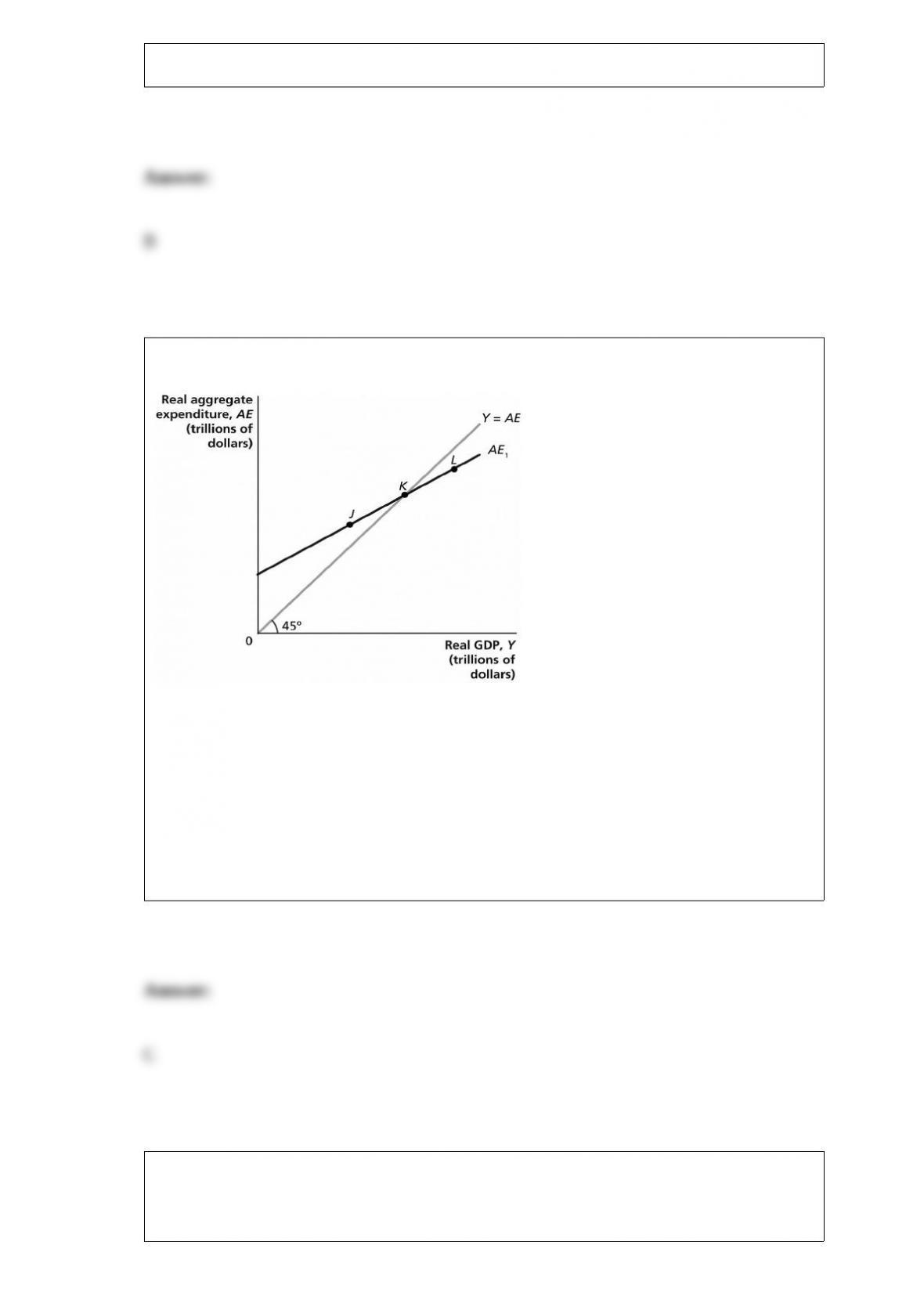
Figure 12-1
Refer to Figure 12-1. At point L in the figure above, which of the following is true?
A) Aggregate expenditure is greater than GDP.
B) The economy has achieved macroeconomic equilibrium.
C) Actual inventories are greater than planned inventories.
D) GDP will be increasing.
Which of the following will result in an increase in labor productivity?
A) a decrease in the number of people attending institutions of higher education
B) a decline in the amount of human capital per worker
C) an increase in technology
D) a decline in the capital stock per hour worked
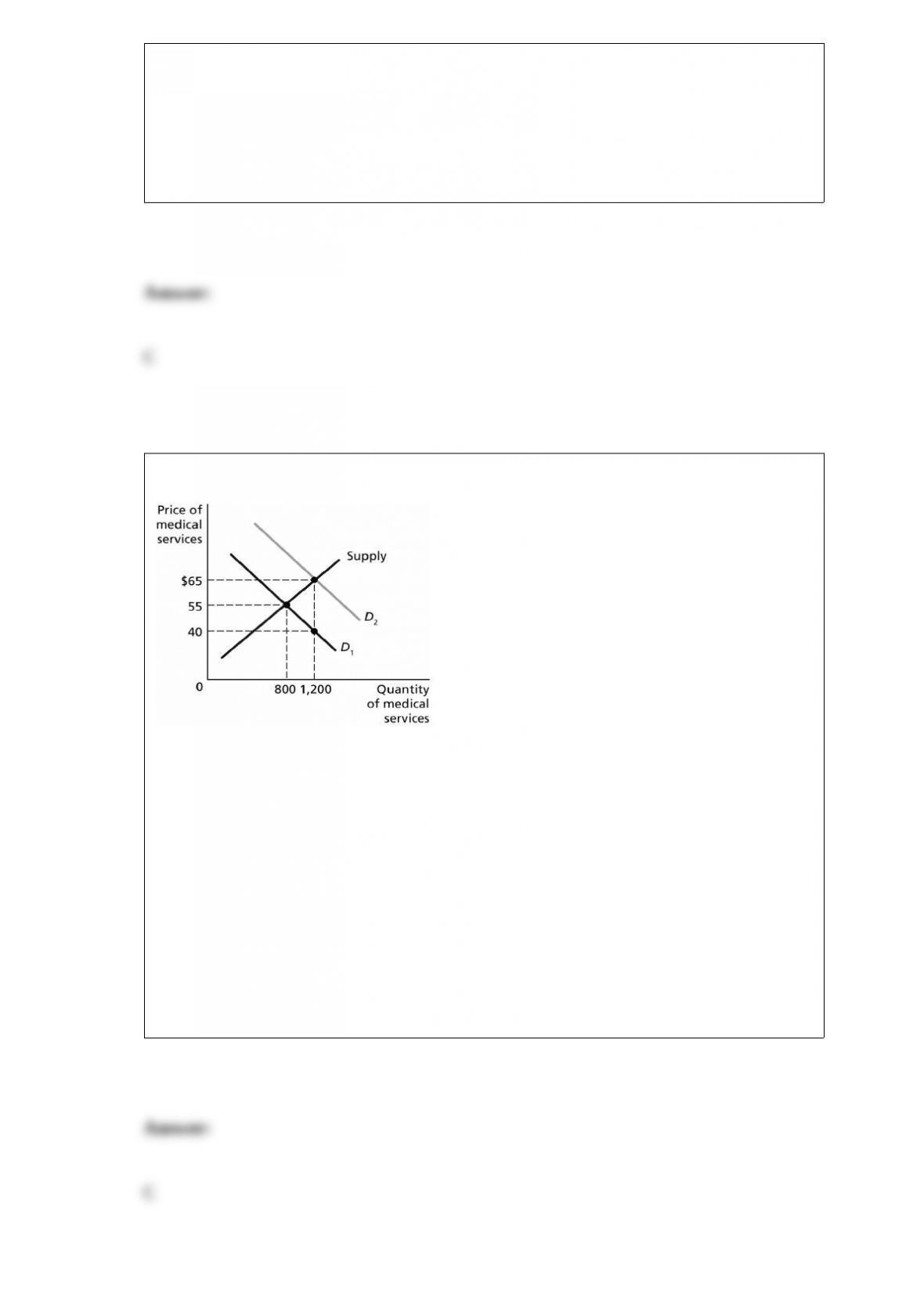
Figure 5-3
Figure 5-3 represents the market for medical services with and without insurance, and
the effect of a third-party payer system on the demand for medical services.
Refer to Figure 5-3. With insurance and a third-party payer system, the equilibrium
quantity of medical services is
A) 400.
B) 800.
C) 1,200.
D) >1,200.