
The law of one price states that identical products should sell for the same price
everywhere as long as transactions costs are zero.
Answer:
The process of countries becoming more open to foreign trade and investment is known
as outsourcing.
Answer:
In 1995, the General Agreement on Tariffs and Trade (GATT) was replaced by the
World Trade Organization (WTO).
Answer:
Foreign currency prices of the U.S. dollar are currently determined by a managed float
exchange rate system.
Answer:

Higher wages that compensate workers for unpleasant aspects of a job are called
compensating differentials.
Answer:
The large budget deficits of the early 1990s resulted in large current account deficits.
Answer:
In the short run, if average product is at its maximum, then average variable cost is at its
minimum.
Answer:
A decrease in the number of firms in a market will cause supply to increase.
Answer:

Any output combination along a production possibility frontier is associated with
overused or unattainable resources.
Answer:
The idea that two taxpayers in the same economic circumstances should pay the same
level of taxes is known as the
A) ability-to-pay principle.
B) vertical-equity principle.
C) horizontal-equity principle.
D) benefits-received principle.
Answer:
Figure 30-6
Which of the following would cause the change depicted in the figure above?

A) Lack of investment in infrastructure causes Mexican productivity to fall relative to
American productivity.
B) A possibility of diseased poultry in Mexico causes U.S. consumers to decrease their
preferences for Mexican-raised chickens relative to U.S.-raised chickens.
C) A new trade agreement with Mexico results in the United States removing all tariffs
on sugar imported from Mexico.
D) An expansionary monetary policy in Mexico causes an increase in the price level of
Mexican goods relative to U.S. goods.
Answer:
If Alan Shaw reduces his work hours when his salary increases, then
A) the income effect of his salary increase dominates the substitution effect.
B) the substitution effect of his salary increase dominates the income effect.
C) the income effect of his salary increase is completely offset by the substitution
effect.
D) leisure is an inferior good to Alan.
Answer:
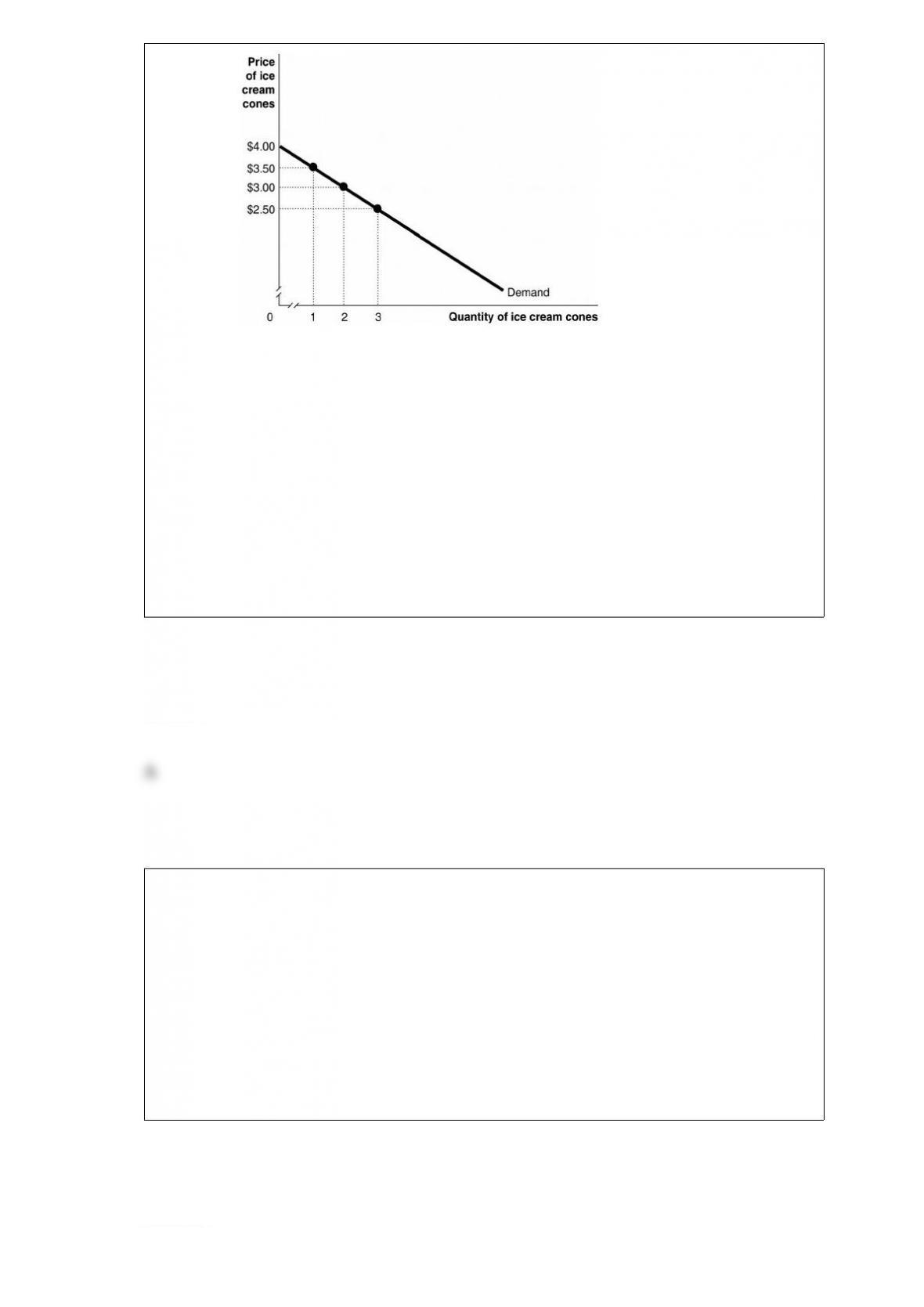
Figure 4-1 Figure 4-1 shows Kendra’s
demand curve for ice-cream cones.
If the market price is $3.50, what is the maximum number of ice cream cones that
Kendra will buy?
A) 1
B) 2
C) 3
D) 4
Answer:
If, as a perfectly competitive industry expands, it can supply larger quantities at the
same long-run market price, it is
A) a constant-cost industry.
B) an increasing-cost industry.
C) a decreasing-cost industry.
D) a fixed-cost industry.
Answer:

If the short-run aggregate supply increases by less than the long-run aggregate supply,
then, at the short-run equilibrium,
A) GDP will be below potential GDP.
B) aggregate demand will increase.
C) GDP will be above potential GDP.
D) GDP will be equal to potential GDP.
Answer:
The basic economic problem of scarcity
A) has always existed and will continue to exist.
B) will eventually disappear as technology continues to advance.
C) is a problem only in developing economies.
D) does not apply to the wealthy in society.
Answer:
Scenario 1-1 Suppose a t-shirt manufacturer currently sells 5,000 t-shirts per week and
makes a profit of $10,000 per week. A manager at the plant observes, “Although the last
400 t-shirts we produced and sold increased our revenue by $4,000 and our costs by
$4,800, we are still making an overall profit of $10,000 per week so I think we’re on the

right track. We are producing the optimal number of t-shirts.” Using marginal analysis
terminology, what is another economic term for the incremental revenue received from
the sale of the last 400 t-shirts?
A) gross earnings
B) marginal revenue
C) sales revenue
D) gross profit
Answer:
Assume that you own a small boutique hotel. In an attempt to raise revenue you reduce
your rates by 20 percent. However, your revenue falls. What does this indicate about the
demand for your boutique hotel rooms?
A) Boutique hotel rooms are inferior goods.
B) Demand is inelastic.
C) The demand curve for your hotel rooms is vertical.
D) Demand is elastic.
Answer:
Rayburn Reed is a highly talented photographer. He has chosen to specialize in
photography because of all of the followingexcept
A) he obviously has a comparative advantage in photography.
B) his opportunity cost of pursuing another career is very low.

C) for him, this is the most lucrative way to purchase the products that he wants to
consume.
D) his photographs are highly esteemed by art lovers who are willing to pay very high
prices.
Answer:
Figure 5-9
Companies producing toilet paper bleach the paper to make it white. The bleach is
discharged into rivers and lakes and causes substantial environmental damage. Figure
5-9 illustrates the situation in the toilet paper market.
Suppose the government wants to use a Pigovian tax to bring about the efficient level of
production. What should the value of the tax be?
A) (P2-P1 per ton of output
B) (P2-P0 per ton of output
C) (P1-P0 per ton of output
D) P1 per ton of output
Answer:
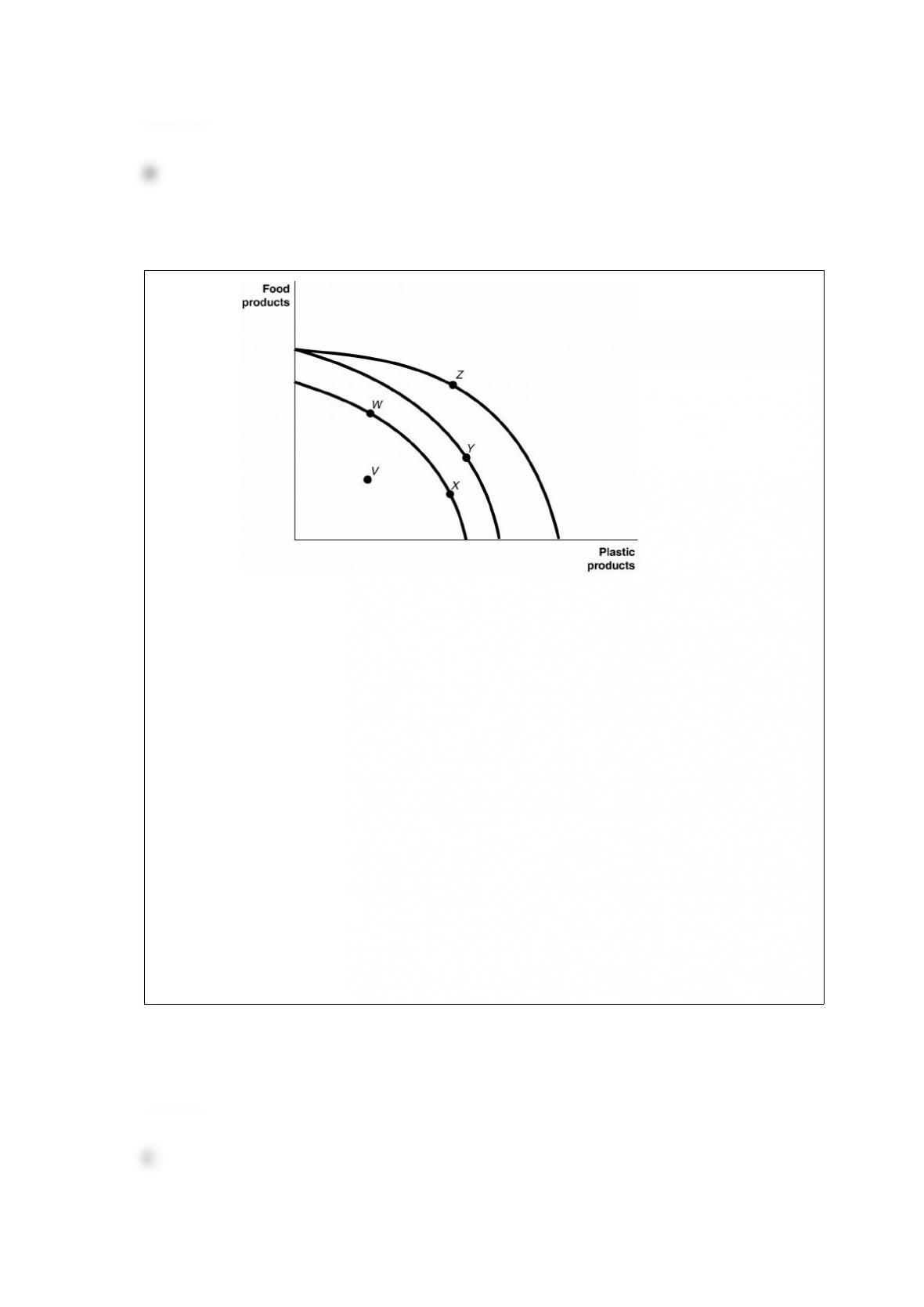
Figure 2-4 Figure 2-4 shows
various points on three different production possibilities frontiers for a nation. Consider
the following movements:
a. from point V to point W
b. from point W to point Y
c. from point Y to point Z Which of the movements listed above represents
advancements in technology with respect to both plastic production and food
production?
A) a, b, and c
B) b and c only
C) b only
D) c only
Answer:

Which of the following is evidence of a shortage of chocolate?
A) Firms lower the price of chocolate.
B) The price of chocolate is raised in order to increase sales.
C) The equilibrium price of chocolate falls due to a decrease in demand.
D) The quantity of chocolate demanded is greater than the quantity supplied.
Answer:
Suppose the U.S. GDP growth rate is faster relative to other countries’ GDP growth
rates. This will
A) move the economy up along a stationary aggregate demand curve.
B) move the economy down along a stationary aggregate demand curve.
C) shift the aggregate demand curve to the left.
D) shift the aggregate demand curve to the right.
Answer:
Which of the following statements is true?
A) Opportunity cost = explicit cost – implicit cost.
B) Total cost = fixed cost + implicit cost.
C) Total cost = fixed cost + variable cost.
D) Variable cost = wages + salaries + benefits.
Answer:
Lucinda buys a new GPS system for $250. She receives consumer surplus of $75 from
the purchase. How much does Lucinda value her GPS system?
A) $75
B) $175
C) $250
D) $325
Answer:
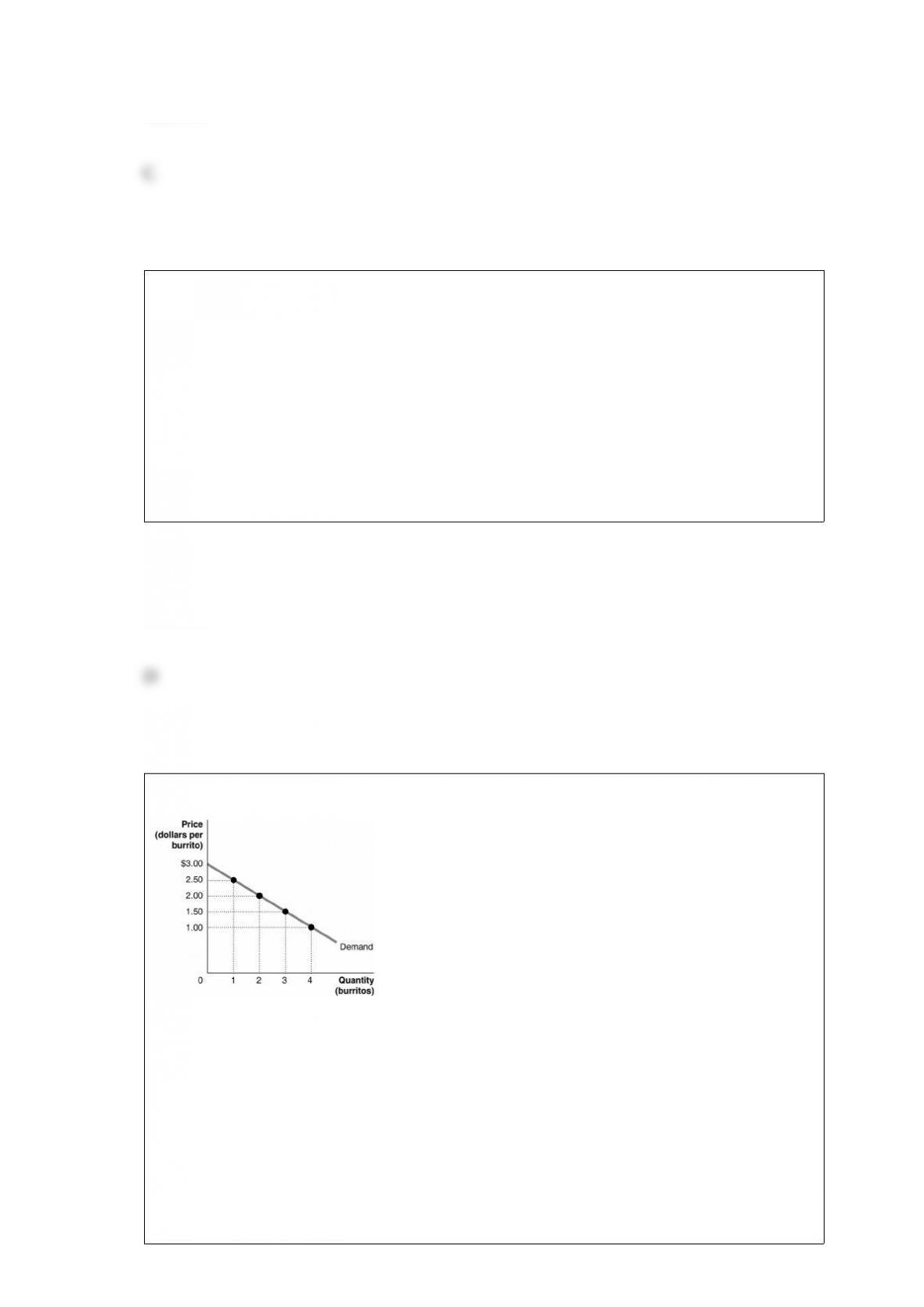
Figure 4-1
Figure 4-1 shows Arnold’s demand curve for burritos.
What is the total amount that Arnold is willing to pay for 2 burritos?
A) $2.00
B) $4.50
C) $7.50
D) $10.00

Answer:
The U.S. Bureau of Labor Statistics predicts that 9 of the 20 fastest growing
occupations over the next ten years will be in
A) the medical field.
B) the travel and leisure industry.
C) education.
D) construction.
Answer:
In September 2006, the Food and Drug Administration recommended that Americans
avoid eating bagged raw spinach in the wake of an outbreak of E. coli bacteria.
Following this recommendation, the food industry looked at alternatives and many
turned to arugula. One Chicago distributor claimed, “The sale of the stuff has gone
through the roof.” Based on this information,
A) arugula is a normal good while raw spinach is an inferior good.
B) the cross-price elasticity between arugula and spinach is negative.
C) the cross-price elasticity between arugula and spinach is positive.
D) the price elasticity of arugula is positive while the price elasticity of spinach falls to
zero.
Answer:

Congressman Flack votes for a program that will benefit the constituents of
Congressman Walpole. Which of the following explanations for Flack’s vote is most
consistent with the public choice model?
A) Congressman Flack did not have time to read and understand all of the legislation he
voted on. Members of Congress often depend on their staffs to read proposed legislation
and recommend how they should vote.
B) Legislators such as Congressman Flack are similar to other decision-makers in that
they sometimes make irrational choices.
C) Congressman Flack will support programs of legislators from his own party,
regardless of who benefits from these programs.
D) Congressman Flack expects Congressman Walpole’s support for programs that will
benefit Flack’s constituents.
Answer:
Starting from long-run equilibrium, use the basic aggregate demand and aggregate
supply diagram to show what happens in both the long run and the short run when there
is a decline in wealth.
Answer:
If the required reserve ratio is 100 percent, could the Federal Reserve still change the
money supply with open market operations? Explain whether they could or could not.
Answer:

What is the difference between fiscal policy and monetary policy?
Answer:
Workers at a local mining company are paid $25.60 per hour, and they have
incorporated a 3 percent annual raise in their contracts to account for expected inflation.
Explain how unexpected inflation of 5 percent will affect the real wage and the
unemployment rate.
Answer:
Are sellers who practice arbitrage taking advantage of buyers?
Answer: