
What is the gaizhi process?
a) Valuing assets according to their earnings
b) A state-owned enterprise and private enterprise entering a joint venture
c) An increase of profitability prior to sale
d) Acquisition of large firms by private organizations
e) Restructuring whereby small firms are leased or sold
Which of the following is a concept developed by Michael Porter that describes, in
broad terms, how it positions itself to compete in the market it serves?
a) Value chain
b) Generic strategy
c) Benefit leadership
d) Cost Leadership
e) Focus
Which of the following is not a benefit of tapered integration?

a) It expands the firm’s input and/or output channels without requiring substantial
capital outlays
b) Allows the firm to use information about the cost and profitability of its internal
channels to help negotiate contracts with independent channels
c) Lets the firm motivate its internal channels by threatening to expand outsourcing and,
at the same time, motivate its external channels by threatening to produce more
in-house.
d) Allows the firm to produce most efficiently in all circumstances
e) Helps the firm protect itself against holdup by independent input suppliers
What type of good is one whose quality can be assessed only after the customer has
used it for a while?
a) Apparel
b) Search good
c) Experience good
d) Office furniture
e) Airline tickets

Which of the following facets of modern financial infrastructure came as a result of
deregulation in the 1970s and 1980s?
a) Separation of commercial and investment banking
b) Enhanced role of central banks
c) Increased regulation of securities markets
d) Supply of debt and equity funding for firms that could not fund themselves through
retained earnings
e) The availability of large investment funds facilitating M&A to flourish
What type of isolating mechanisms increase the economic power of a competitive
advantage over time once a firm has acquired that advantage?
a) Scarce
b) Imperfectly mobile
c) Early-mover advantages
d) Impediments to imitation
e) Cospecialized

Which of the following statements is least true regarding the costs that regulation
imposes on firms?
a) Regulation costs include lower prices for goods that consumers pay
b) Regulation costs include costs of compliance
c) Regulation costs include increased business costs due to noncompliance
d) Regulation costs include the costs of strategic options that must be forgone because
of regulations
e) Regulation costs include potential distortions to a market that may result from the
imperfections of a given regulatory regime
Which of the following factors requires the least consideration when assessing supplier
power relative to the downstream industry it sells to?
a) Competitiveness of the output market
b) Purchase volume of downstream firms
c) Availability of substitute inputs
d) Threat of forward integration by suppliers
e) Ability of suppliers to price discriminate

What term does Ronald Burt use to describe a valued relationship between two
unconnected parties with a strategy involving spanning a structural hole and bargaining
with parties on either side for the most favorable terms?
a) Mavens
b) Nodes
c) Second who benefits
d) Tertius gaudens
e) Brokers
How have late 20th and 21st century communications technologies directly created
global markets from products and services?
a) Created paperless communications
b) Created seamless and instantaneous communications
c) Decreased coordination for interfirm alliances
d) Increased worker productivity
e) Unflattened the world

What term describes a policy in which a firm is prepared to match whatever change in
strategy a competitor makes?
a) Response strategy
b) Always cooperate strategy
c) Always aggress strategy
d) Tit-for-tat strategy
e) Trigger strategy
Which of the following best describes economies of scope?
a) The average cost declines as output increases
b) The average cost increases as output increases
c) The average cost remains constant as output increases
d) Savings are achieved when a firm produces a wider variety of goods
e) Savings are achieved when a firm produces a decreased variety of goods
What concept describes the situation where the owner of an asset grants another party
the right to use that asset, but the owner retains all controlling rights that are not

explicitly stipulated in the contract?
a) Asset specificity
b) Non-contract rights of ownership
c) Control rights agreement
d) Residual rights of control
e) Coordination
Which of the following is least likely a characteristic of profit persistence in an
industry?
a) Entry barriers exist
b) Economic profits should quickly converge to zero
c) Barriers to imitation exist
d) Firms earning above-average profits today should continue to do so in the future
e) Low profit firms today should remain low-profit firms in the future
Which of the following is a potential risk of a brand umbrella?

a) The brand umbrella reduces the incumbents sunk cost of introducing a new product
b) The umbrella brand may help the incumbent navigate the vertical chain
c) The brand umbrella allows an incumbent offset uncertainty about the quality of a
new product
d) A brand umbrella may make suppliers and distributors more willing to enter
relationship specific investments in or sell credit to incumbents
e) If a new product under the umbrella fails, consumers may become disenchanted with
the entire brand
Why might a firm not be able to react quickly to competitors’ pricing moves?
a) Lags in detecting competitors’ prices
b) Infrequent interactions with competitors
c) Ambiguities in identifying which firm among a group of firms in a market is cutting
price
d) Difficulties distinguishing drops in volume due to price cutting by rivals from drops
in volume due to anticipated decreases in market demand
e) All of the above

What term describes a decision that has a short-term impact and is easy to reverse?
a) Dedicated investment
b) Strategic commitment
c) Critical choice
d) Market investment
e) None of the above
What term describes a situation where two or more parties expend resources battling
each other?
a) Predatory pricing
b) War of attrition
c) Dumping
d) Capacity Expansion
e) Puppy Dog Ploy
The Herfindahl index solves which problem with the N-Firm ratio?

a) Inaccuracy when dealing with more than 4 firms
b) Inability to measure concentration if market shares are split evenly
c) Inability to measure concentration across borders
d) Invariance with changes in the size of the largest firms
e) High variability when firm sizes are small
What type of research looks at the changes in market valuations in response to the
announcement of diversifying acquisitions to assess the success of diversification?
a) Event studies
b) Valuation studies
c) Diversification studies
d) Market studies
e) Acquisition studies
Which of the following terms best describes a review system in which an employee and
a supervisor work together to construct a set of goals for that employee?
a) Traditional top down review system

b) 360-degree peer review system
c) Management-by-objective system
d) Subjective performance evaluation
e) Pay-for-performance
What is the term defined as the withdrawal of a product from a market?
a) Shut-down
b) Exit
c) Sale
d) Removal
e) Withdrawal
Which of the following benefits of diversification explains the idea that mergers are
more likely when there is an expectation of positive changes in market share?
a) Use of internal capital markets
b) Economies of scale and scope

c) Economizing on transaction costs
d) Diversifying shareholder portfolios
e) Identifying undervalued firms
Which of the following structures best describes a small group of people where the
members of the work group are paid based on individual actions?
a) Complex hierarchy
b) Individual
c) Self-managed team
d) Hierarchy of authority
e) Divisional
What form of communication was integral to the growth of multistory headquarter
buildings?
a) Telegraph
b) Mail

c) Telephone
d) Morse code
e) Intercom
Which of the following is least true with regard to presidential power?
a) Presidential power is the ability to influence the people who make and implement
government policies
b) Presidential power only consists of the president taking direct action on some front
c) The bargaining advantage that comes with the presidential office enables the
president to persuade others to work in his interest
d) A source of presidential power is professional reputation, which comprises the
expectations of professional politicians, bureaucrats, and others in the political
community regarding the president’s power and his willingness to use it
e) The president’s prestige among the public is a source of presidential power
Which of the following is not a characteristic of a complete contract?
a) The contract allows for a party to exploit weaknesses in another party’s position as
the transaction unfolds

b) Elimination of opportunistic behaviors
c) Stipulation of each party’s responsibilities and rights
d) Binding instruction for each party on courses of action as the transaction unfolds
e) Must be enforceable
Which of the following statements is least true regarding the conditions John Barney
identifies under which culture can be a source of sustained competitive advantage?
a) Culture should be imitable
b) Culture must be valuable for the firm
c) If culture is common to most firms in the market, so that it reflects the influence of
the national or regional culture, then it is unlikely to lead to a relative competitive
advantage
d) If factors of a firm’s culture are easy to copy, other firms will begin to do so, which
will nullify any advantage for the firm where the culture first developed
e) Something about the firm’s culture and values must be linked to the value the firm
creates for customers
What term describes the situation when a firm earns a higher rate of economic profit
than the average rate of economic profit of other firms competing within the same

market?
a) Industry effect
b) Competitive advantage
c) Business unit effect
d) Competitive position
e) Market profitability economics
Which of the following is a component of the Value Net?
a) Suppliers
b) Customers
c) Competitors
d) Complementors
e) All of the above
Suppose you manufacture 10 million hard drives per year specifically for Dell laptop
computers. Suppose your average variable cost C=$20/unit and annualized cost of
investment to build a hard drive factory I=$30 million. If Dell agrees to purchase the 10

million hard drives at a price P*=$25/unit, what is your company’s “rent?
Suppose a firm’s plant produces Q units in any given year. The plant itself operates with
annualized costs of $10M and other annual fixed expenses totaling $3M. In addition,
the firm’s variable costs depend on Q and are given by the formula 5Q2+3Q. What is the
formula for the firm’s Average Variable Costs?
Suppose you manufacture 10 million hard drives per year specifically for Dell laptop
computers. Suppose your average variable cost C=$20/unit, annualized cost of
investment to build a hard drive factory I=$30 million, and the market price (bailout
market price in the event Dell does not buy) Pm=$22/unit. If Dell agrees to purchase the
10 million hard drives at a price P*=$25/unit and subsequently renegotiates to only
purchase for $22.50/unit, what is your company’s new “rent”?

Suppose a firm has $50 million to invest in a new market. Given market uncertainties,
the firm forecasts a high-scenario where the present value of the investment is $200
million and a low-scenario where the present value of the investment is $20 million.
Suppose that by waiting a year, the firm can learn with certainty which scenario will
arise. Assume a 10% annual discount rate. If the firm waits one year and learns that the
high-scenario will happen, what is the firm’s expected net present value of the
investment?
In a two firm market, let the marginal cost of producing a product be $20 and the
market demand for their products be given by Q1=12-P1+P2 and Q2=12-P2+P1. What is
the Bertrand equilibrium price each firm would produce in this market?
Suppose that a firm offers secret discounts to 200 customers in a particular industry to
attract those customers from a competitor firm. If there is a 2% probability that any one
of those customers will disclose the pricing, what is the probability that the firms
competitors will hear from one of those 200 customers? Suppose there are instead 20
buyers to which discounts are offered. What is the probability then that the competitors
may find out about one of the discounts?
Suppose two hot dog stands, Al’s & Bob’s, position themselves at different ends of a
1000 yard stretch of beach. Assume there are 100 beach goers evenly distributed along
the stretch of beach and travel costs are $.01 per yard. If Al charges $1 for his hot dogs
and Bob charges $2 for his hot dogs, what is the cost of purchasing a hot dog from each
stand for a hungry beachgoer situated at a position D yards from Al’s end of the beach?
How many consumers will go to Al’s and how many will go to Bob’s?
Suppose a firm’s plant produces Q units in any given year. The plant itself operates with
annualized costs of $10M and other annual fixed expenses totaling $3M. In addition,
the firm’s variable costs depend on Q and are given by the formula 5Q2+3Q. What is the
formula for the firm’s Short-Run (i.e. one year) Average Costs?
Given an employee cost of effort function (where e is given in hours worked per week
and each unit of e produces an extra $100 in sales):
c(e) = 0 if e<=40
(1/3)*(e-40)2 if e>40
If the firm offers a salary-plus-commission job of $500 per week plus 20% of sales,
how can we write the employee’s payoff function? What is the employee’s total
compensation for working a 46 hour workweek (Note: This is the compensation and not
payoff net of effort costs)?

In a six-firm market, if all firms charge the monopoly price, the profit equals $120,000.
In that same six-firm market, if all firms instead charge the prevailing price, the profit is
$60,000. If the pricing period is one-month long, what is the maximum monthly
discount rate implied for each firm to still have an incentive to independently price at
the monopoly level?
In a three firm market where the market share split is 50%, 30% & 20%, what is the
Herfindahl index?
Suppose a firm has $50 million to invest in a new market. Given market uncertainties,
the firm forecasts a high-scenario where the present value of the investment is $200
million and a low-scenario where the present value of the investment is $20 million. If
the firm believes each scenario is equally likely and invests today, what is the net
present value of the investment?
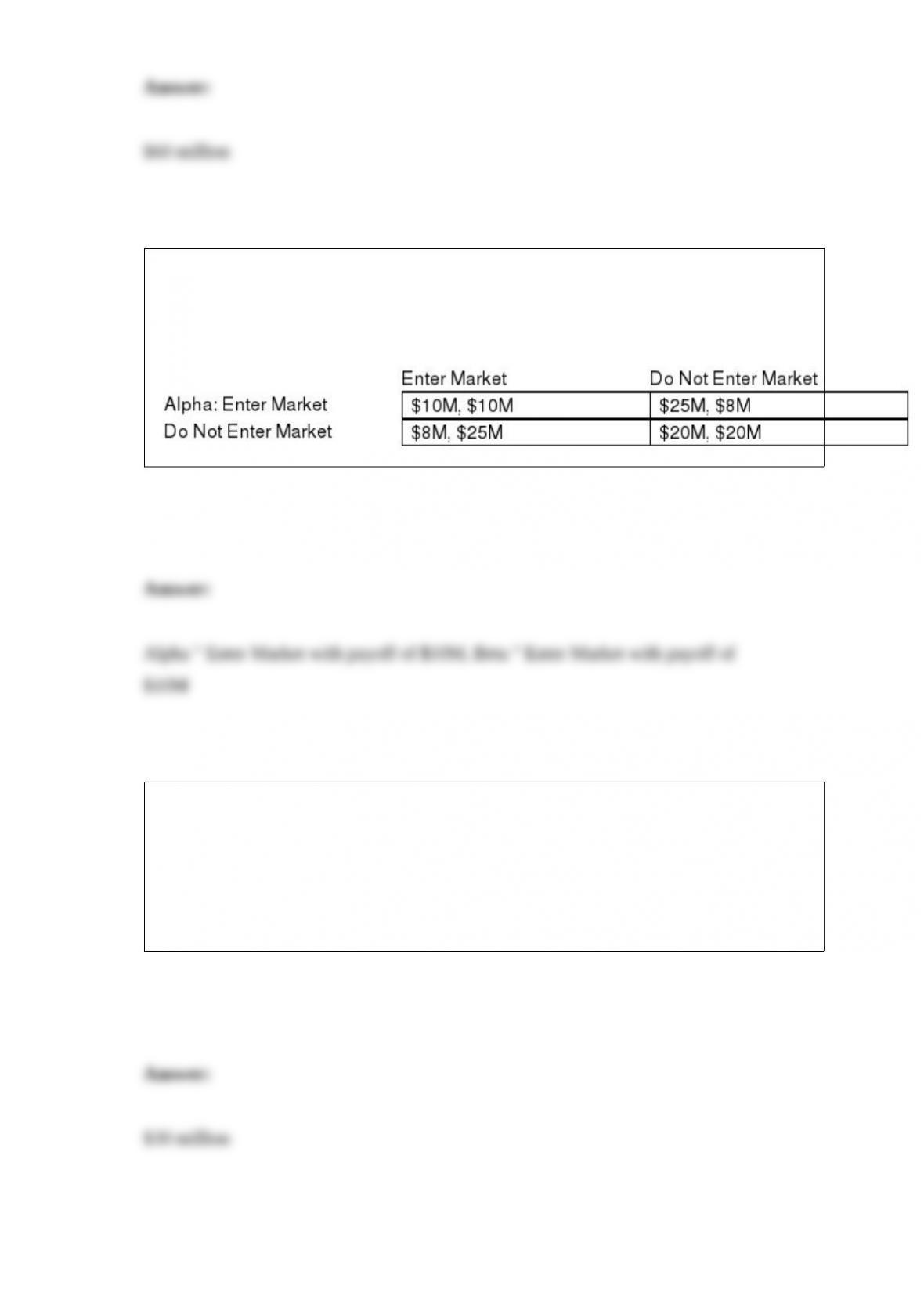
What are the Nash Equilibrium Strategies and corresponding payoffs for the following
matrix?
Beta:
Suppose you manufacture 10 million hard drives per year specifically for Dell laptop
computers. Suppose your average variable cost C=$20/unit, annualized cost of
investment to build a hard drive factory I=$30 million, and the market price (bailout
market price in the event Dell does not buy) Pm=$22/unit. If Dell agrees to purchase the
10 million hard drives at a price P*=$25/unit and the deal subsequently falls apart, what
is your company’s “quasi-rent”?

Suppose you manufacture 10 million hard drives per year specifically for Dell laptop
computers. If your average variable cost C=$20/unit, annualized cost of investment to
build a hard drive factory I=$30 million, and market price (bailout market price in the
event Dell does not buy) Pm=$22/unit, what is your company’s RSI (relationship
specific investment)?
Suppose a firm’s plant produces Q units in any given year. The plant itself operates with
annualized costs of $10M and other annual fixed expenses totaling $3M. In addition,
the firm’s variable costs depend on Q and are given by the formula 5Q2+3Q. What is the
formula for the firm’s Average Fixed Costs?
Suppose you manufacture 10 million hard drives per year specifically for Dell laptop
computers. Suppose your average variable cost C=$20/unit, annualized cost of
investment to build a hard drive factory I=$30 million, and the market price (bailout
market price in the event Dell does not buy) Pm=$22/unit. If Dell agrees to purchase the
10 million hard drives at a price P*=$25/unit and subsequently renegotiates to only
purchase for $22.50/unit, what has Dell increased its own profits by?

Given an employee cost of effort function (where e is given in hours worked per week
and each unit of e produces an extra $100 in sales):
c(e) = 0 if e<=40
(1/3)*(e-40)2 if e>40
If the firm offers a salary-plus-commission job of $400 per week (instead of $500) plus
20% of sales, at what effort level does the employee maximize their payoff?
Given an employee cost of effort function (where e is given in hours worked per week
and each unit of e produces an extra $100 in sales):
c(e) = 0 if e<=40
(1/3)*(e-40)2 if e>40
What is the cost of effort for a 37 hour week? What is the cost of effort for a 43 hour
week? If the firm offers a salary only job of $500 per week, what is the employee’s
payoff net of effort costs for a 49 hour work week?