Which of the following are positive economic statements and which are normative
economic statements?
a. An increase in the price of gasoline will decrease the quantity of gasoline purchased.
b. The government should eliminate the minimum wage.
c. All states should raise the minimum wage to at least $10 per hour.
d. The government should scrap its current income tax structure in favor of a flat tax.
e. Unemployment has increased since the onset of the recession.
f. The government should not bail out investment banks during a financial crisis.
If the balance on the current account in the United States is $750 billion, which of the
following is most likely to be true?
A) The balance on the financial account is negative.
B) The trade balance is negative.
C) Net foreign investment is negative.
D) The balance on the capital account is positive.

Consider a public good such as fire protection services. Rich people may benefit more
than the poor from such a service because rich people stand to lose more from a fire that
destroys property. In this case,
A) the ability-to-pay principle may support the rich paying more taxes than the poor,
but not the benefits-received principle.
B) the benefits-received principle may support the rich paying more taxes than the poor,
but not the ability-to-pay principle.
C) both the benefits-received and the ability-to-pay principles may support the rich
paying more taxes than the poor.
D) neither the benefits-received nor the ability-to-pay principles may support the rich
paying more taxes than the poor.
Which of the following describes the Difference between ‘scarcity” and ‘shortage”?
A) There is no Difference; either word can be used to describe the situation that exists
when there is less of a good or service available than people want.
B) In the economic sense, almost everything is scarce. A shortage of a good or service
occurs when the quantity demanded is greater than the quantity supplied at the current
market price.
C) There is a shortage of almost everything. Scarcity occurs only if the quantity
demanded of a good or service is greater than the quantity supplied at the current
market price.
D) In the economic sense, almost everything is scarce. A shortage of a good or service
occurs when the quantity demanded is greater than the quantity supplied at the
equilibrium price.

The Federal Reserve cut the federal funds rate seven times between September 2007
and March 2008. What event led the Fed to make these reductions in the federal funds
rate?
A) It was in response to reductions in the discount rate, which was also lowered seven
times over the same time period.
B) The chairman of the Federal Reserve System persuaded members of the Federal
Open Market Committee to lower interest rates in order to reduce the price of oil in
international markets.
C) During this period there was a substantial reduction in the demand for housing.
D) Several large investment banks failed during this time period.
In the United States, the bulk of health care spending is paid by health insurance
companies. Such a system is also called a third-party payer system where consumers of
health care pay a nominal fee and the rest are paid by the health insurance provider.
Why might such a system lead to an inefficient outcome?
A) Health insurance companies have an incentive to control cost and therefore tend to
deny consumers many cutting edge medical treatments.
B) Consumers have an incentive to over-consume health care services because they pay
prices well below the cost of providing these services.
C) Physicians concerned that insurance companies may not approve payments tend not
to order expensive tests for their patients.
D) Consumers fearing that excessive use of health care services may lead to a rise in
insurance premiums tend to under-consume health care services.
An increase in the price level will
A) shift the short-run aggregate supply curve to the left.
B) shift the short-run aggregate supply curve to the right.
C) move the economy up along a stationary short-run aggregate supply curve.
D) move the economy down along a stationary short-run aggregate supply curve.
If national saving increases, ________. (Assume that the capital account is zero and net
transfers are zero.)
A) the sum of domestic investment and net exports must decrease
B) the sum of domestic investment and foreign investment must increase
C) the sum of domestic investment and foreign investment must decrease
D) foreign investment must decrease to cover the gain
Which of the following is a positive economic statement?
A) U.S. citizens should only buy products which are produced in the United States.
B) The government should ban the production and sale of incandescent light bulbs.
C) Raising the tax on gasoline raises the selling price of gasoline.
D) The government should revamp its immigration policies.
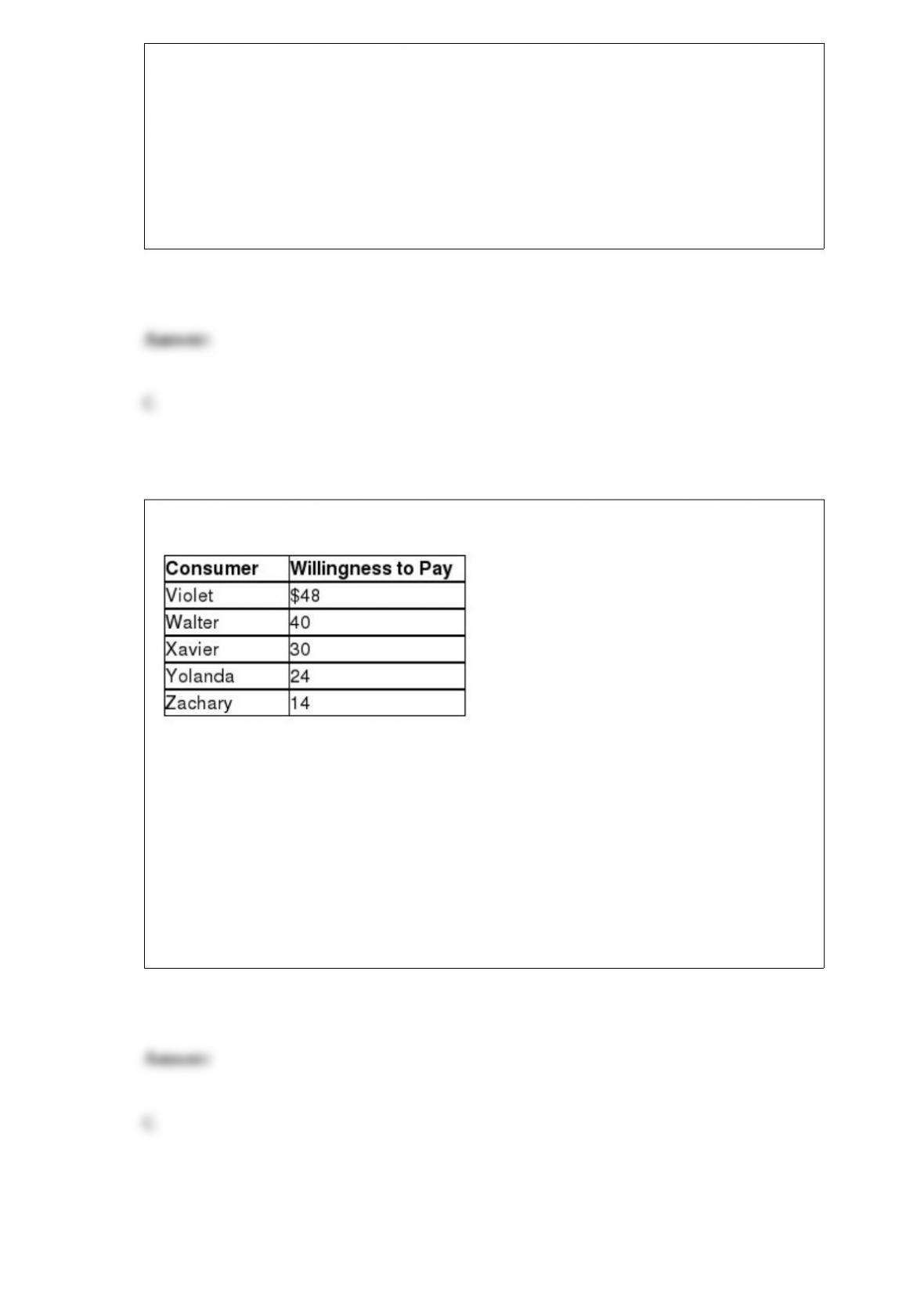
Table 4-5
The table above lists the highest prices five consumers are willing to pay for a concert
ticket. If the price of one ticket falls from $50 to $20,
A) only three tickets will be sold.
B) consumer surplus decreases from $48 to $24.
C) consumer surplus increases from $0 to $62.
D) everyone will buy a ticket.