
Suppose you are deciding whether or not to buy a particular bond for $2,990.08. If you
buy the bond and hold it for 5 years, then at that time you will receive a payment of
$5,000. You will buy the bond today if the interest rate is
a. no less than 9.48 percent.
b. no greater than 9.48 percent.
c. no less than 10.83 percent.
d. no greater than 10.83 percent.
Suppose the demand for construction workers increased and the demands for textile and
steel workers diminished. This is an example of
a. frictional unemployment created by efficiency wages.
b. structural unemployment created by efficiency wages.
c. frictional unemployment created by sectoral shifts.
d. structural unemployment created by sectoral shifts.
If a tax shifts the supply curve upward (or to the left), we can infer that the tax was
levied on
a. buyers of the good.

b. sellers of the good.
c. both buyers and sellers of the good.
d. We cannot infer anything because the shift described is not consistent with a tax.
If soybean farmers know that the demand for soybeans is price inelastic, in order to
increase their total revenues they should
a. use more fertilizers and weed killers to increase their yields.
b. plant additional acres to increase their output.
c. reduce the number of acres they plant to decrease their output.
d. Both a and b are correct.
The efficient markets hypothesis implies
a. that all stocks are fairly valued all the time and that no stock is a better buy than any
other.
b. that all stocks are fairly valued all the time, but that some stocks may be better buys
than other.
c. that some stocks may be better buys than others and stock experts can determine
which ones.
d. that no stock is efficiently valued.
If the unemployment rate rises, which policies would both be appropriate to reduce it?
a. increase taxes, increase government spending
b. increase taxes, decrease government spending
c. decrease taxes, increase government spending
d. decrease taxes, decrease government spending
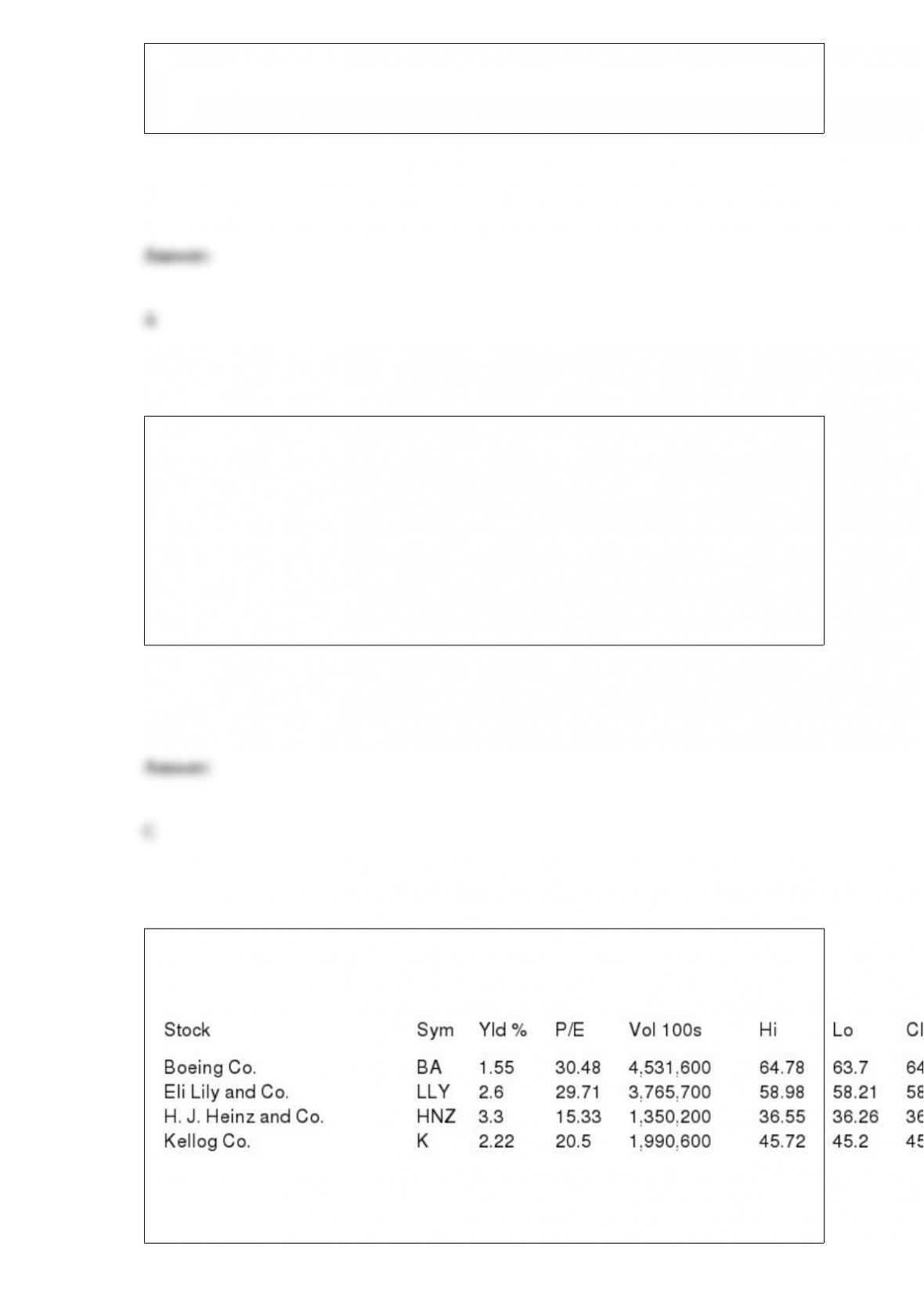
Table 13-2
Refer to Table 13-2. Which company had the lowest earnings per share?
a. Boeing Co.

b. Eli Lilly and Co.
c. H. J. Heinz and Co.
d. Kellog Co.
Which of the following counts as part of the supply of loanable funds?
a. bank deposits and purchases of bonds
b. bank deposits but not purchases of bonds
c. purchases of bonds but not bank deposits
d. neither purchases of bonds nor bank deposits
Consider two cars manufactured by Chevrolet in 2009. During 2009, Chevrolet sells
one of the two cars to Sean for $24,000. Later in the same year, Sean sells the car to
Kati for $19,000. The second automobile, with a market value of $30,000, is unsold at
the end of 2010 and it remains in Chevrolet’s inventory. The transactions just described
contribute how much to GDP for 2009?
a. $24,000
b. $43,000

c. $54,000
d. $73,000
The law of demand states that, other things equal, an increase in
a. price causes quantity demanded to increase.
b. price causes quantity demanded to decrease.
c. quantity demanded causes price to increase.
d. quantity demanded causes price to decrease.
Figure 6-5
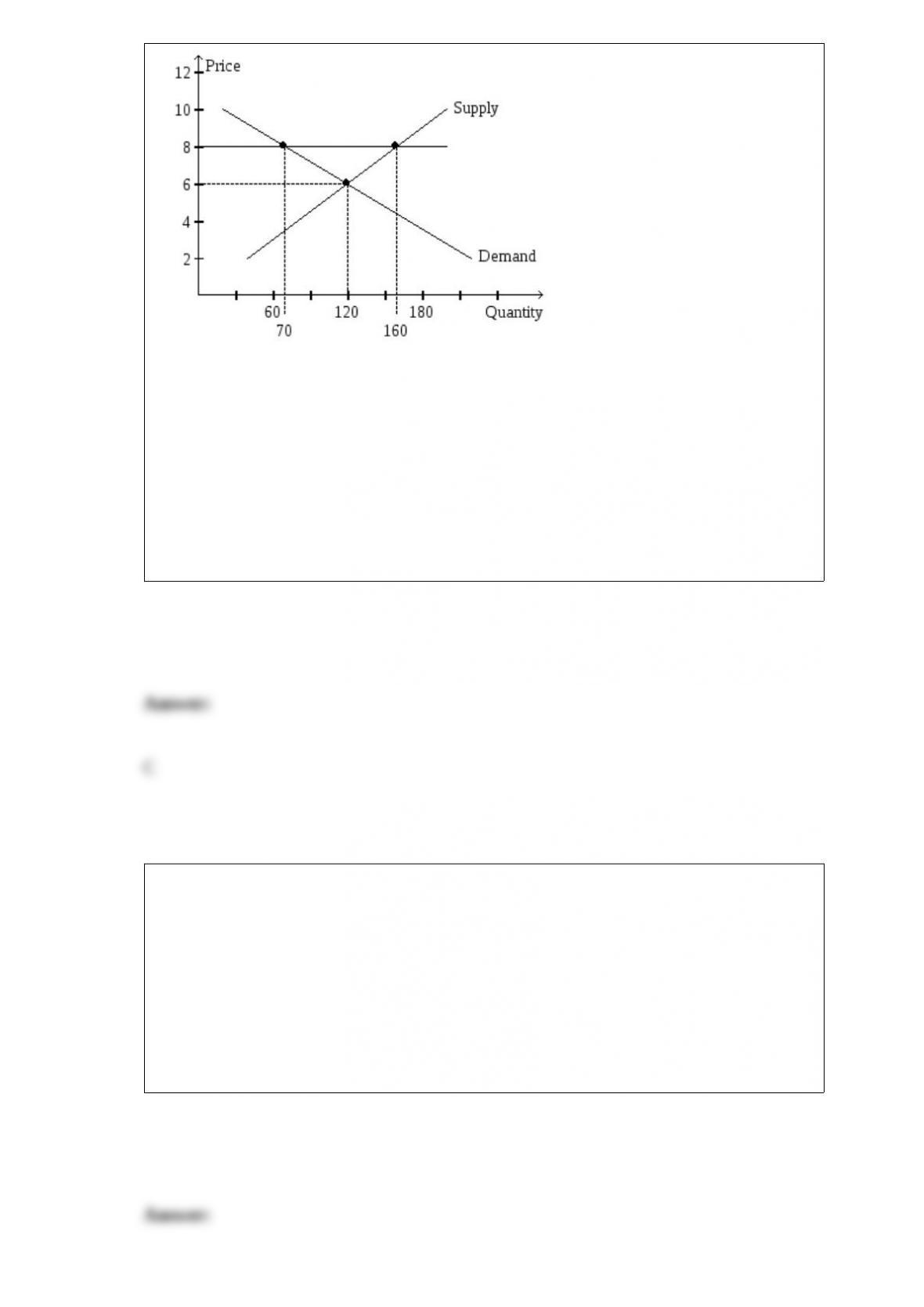
Refer to Figure 6-5. If the horizontal line on the graph represents a price floor, then the
price floor is
a. binding and creates a shortage of 40 units of the good.
b. binding and creates a surplus of 50 units of the good.
c. binding and creates a surplus of 90 units of the good.
d. not binding but creates a surplus of 40 units of the good.
The minimum wage, if it is binding, lowers the incomes of
a. no workers.
b. only those workers who become unemployed.
c. only those workers who have jobs.
d. all workers.
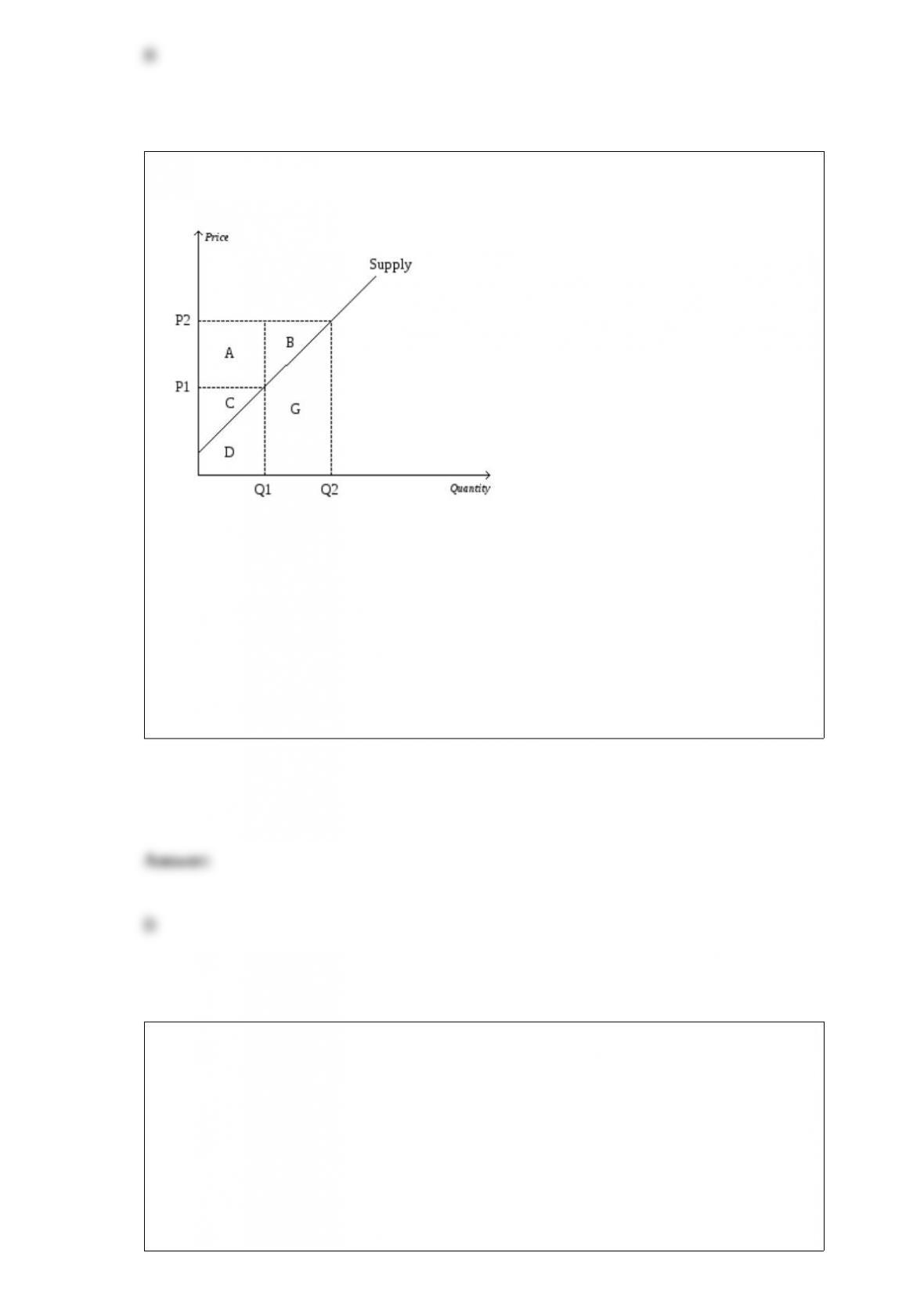
Figure 7-12
Refer to Figure 7-12. When the price is P1, producer surplus is
a. A.
b. C.
c. A+B.
d. C+D.
On goods and services, Harry spent $32,000 in 2004 and $39,000 in 2009. The
consumer price index was 192 for 2004 and 217 for 2009. Harry’s 2009 spending in
2004 dollars is about
a. $34,507.
b. $35,911.
c. $36,167.

d. $37,578.
An alternative to rent-control laws that would not reduce the quantity of housing
supplied is
a. the payment by government of a fraction of a poor family’s rent.
b. higher taxes on rental income earned by landlords.
c. a policy that prevents landlords from evicting tenants.
d. a policy that allows government to confiscate residential property for the purpose of
commercial development.
As the aggregate demand curve shifts rightward along a given aggregate supply curve,
a. unemployment and inflation are higher.
b. unemployment and inflation are lower.
c. unemployment is higher and inflation is lower.
d. unemployment is lower and inflation is higher.
When a country experiences capital flight, its net capital outflow,
a. which is part of the demand for loanable funds, increases.
b. which is part of the supply of loanable funds, increases.
c. which is part of the demand for loanable funds, decreases.
d. which is part of the supply of loanable funds, decreases.
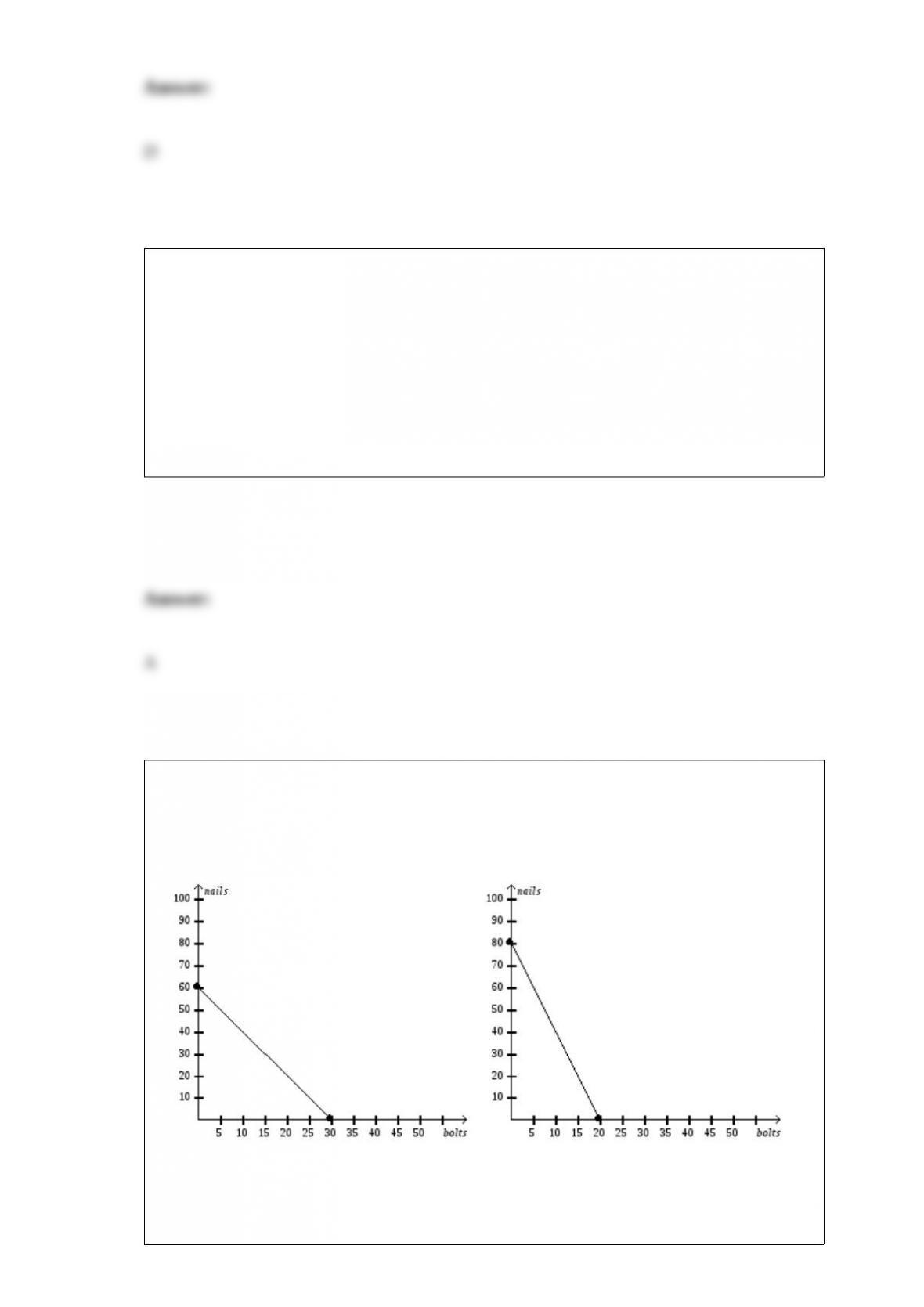
Figure 3-9
Uzbekistan’s Production Possibilities Frontier Azerbaijan’s Production
Possibilities Frontier
Refer to Figure 3-9. Uzbekistan should specialize in the production of
a. bolts and import nails.

b. nails and import bolts.
c. both goods and import neither good.
d. neither good and import both goods.
Which of the following Fed actions would both increase the money supply?
a. buy bonds and raise the reserve requirement
b. buy bonds and lower the reserve requirement
c. sell bonds and raise the reserve requirement
d. sell bonds and lower the reserve requirement
If the government removes a tax on a good, then the quantity of the good sold will
a. increase.
b. decrease.
c. not change.
d. All of the above are possible.

The percentage change in the price level from one period to another is called
a. the growth rate.
b. the inflation rate.
c. the GDP deflator.
d. the unemployment rate.
If there is a surplus in the market for loanable funds, the resulting change in the real
interest rate
a. reduces both the quantity of loanable funds supplied and the quantity of loanable
funds demanded.
b. reduces the quantity of loanable funds supplied and raises the quantity of loanable
funds demanded
c. raises both the quantity of loanable funds supplied and the quantity of loanable funds
demanded.
d. raises the quantity of loanable funds supplied and reduces the quantity of loanable
funds demanded.

Between 1880 and 1896 the average level of prices in the U.S. economy
a. fell 23 percent.
b. fell 4 percent.
c. rose 23 percent.
d. rose 50 percent.
Scenario 5-3
Milk has an inelastic demand, and beef has an elastic demand. Suppose that a
mysterious increase in bovine infertility decreases both the population of dairy cows
and the population of beef cattle by 50 percent.
Refer to Scenario 5-3. The change in equilibrium quantity will be
a. greater in the milk market than in the beef market.
b. greater in the beef market than in the milk market.
c. the same in the milk and beef markets.
d. Any of the above could be correct.

Tom and Anthony are both U.S. citizens. Tom buys construction machinery from a
company in Canada to use for his U.S construction company. Anthony opens a cafe in
Portugal. Whose action is an example of U.S. foreign direct investment
a. Tom’s but not Anthony’s.
b. Anthony’s but not Tom’s.
c. Anthony’s and Tom’s.
d. Neither Anthony’s nor Tom’s.
Credit cards are
a. a medium of exchange.
b. counted as part of M2 but not as part of M1.
c. important for analyzing the monetary system.
d. All of the above are correct.

The federal government uses the revenue from the FICA (Federal Insurance
Contribution Act) tax to pay for
a. unemployment compensation.
b. the salaries of members of Congress.
c. Social Security and Medicare.
d. housing subsidies for low-income people.
The discovery of a new hybrid wheat would increase the supply of wheat. As a result,
wheat farmers would realize an increase in total revenue if the
a. supply of wheat is elastic.
b. supply of wheat is inelastic.
c. demand for wheat is inelastic.
d. demand for wheat is elastic.
Figure 2-7
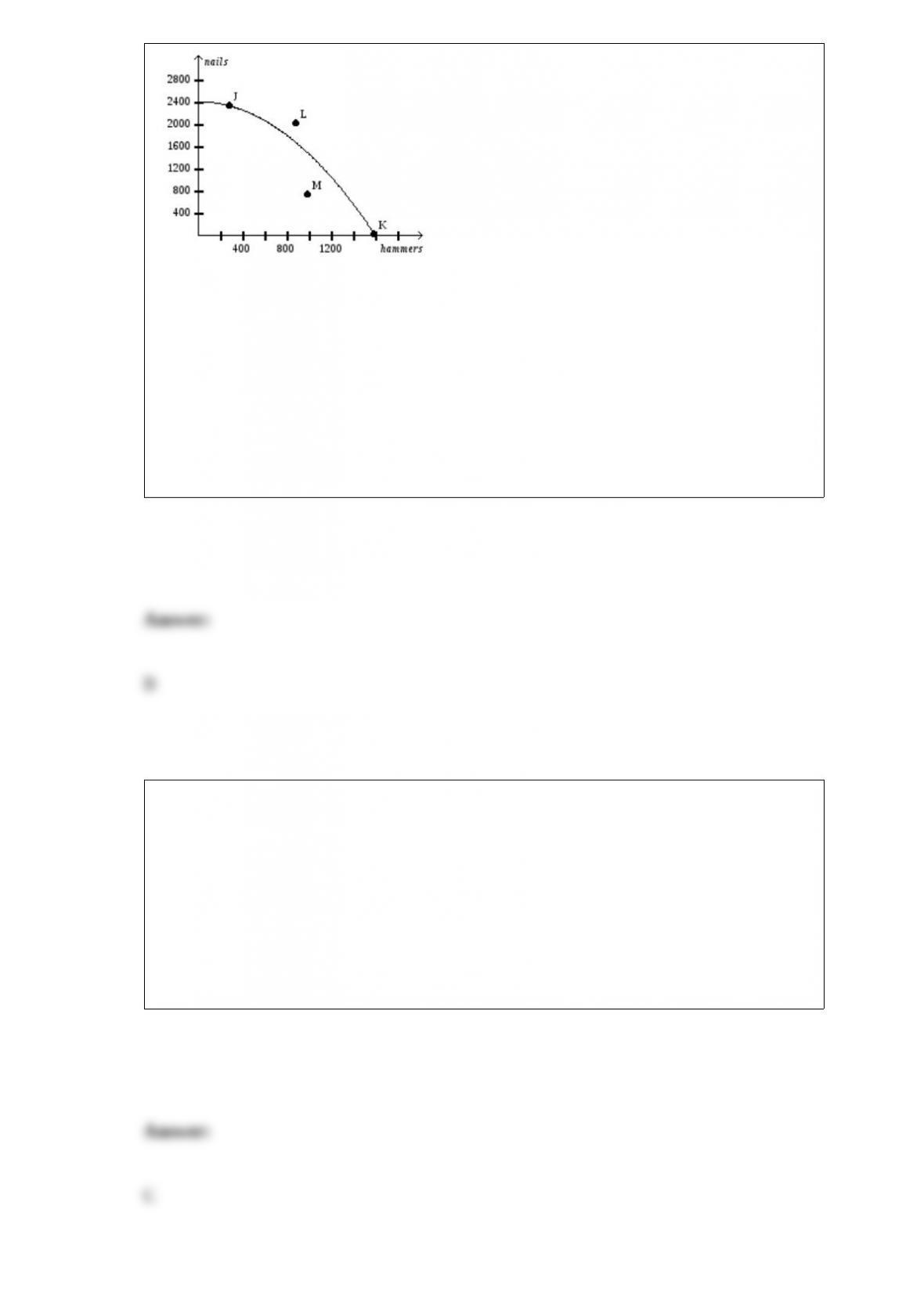
Refer to Figure 2-7. Efficient production is represented by which point(s)?
a. J
b. J, K
c. J, K, L
d. J, K, M
If citizens of a country are not saving much, it is better to
a. force citizens to save.
b. reduce investment.
c. have foreigners invest in the domestic economy than no one at all.
d. to prevent opportunities for citizens to buy capital assets abroad.

Table 16-4.
The First Bank of Roswell
Refer to Table 16-4. If the bank faces a reserve requirement of 10 percent, then the
bank
a. is in a position to make a new loan of $15,000.
b. has fewer reserves than are required.
c. has excess reserves of $10,000.
d. None of the above is correct.
In a closed economy, if Y and T remained the same, but G rose, and C fell but by less
than the rise in G, what would happen to public and national saving?
a. public and national saving would rise
b. public and national saving would fall
c. public saving would rise and national saving would fall
d. public saving would fall and national saving would rise

In the circular-flow diagram, one loop represents the flow of goods and services, and
the other loop represents the flow of factors of production.
According to the efficient markets hypothesis, the number of people who think a stock
is overvalued exactly balances the number of people who think a stock is undervalued.
Whether a tax is levied on sellers or buyers, buyers and sellers usually share the burden
of taxes.
The aggregate demand and aggregate supply model helps us to understand both
short-run economic fluctuations and how the economy moves from the short to the long
run.

In some countries such as Chad, Gabon, and Senegal real GDP per person has been
stagnant for many years.
Taxes levied on sellers and taxes levied on buyers are equivalent.
List and define any two of the costs of high inflation.
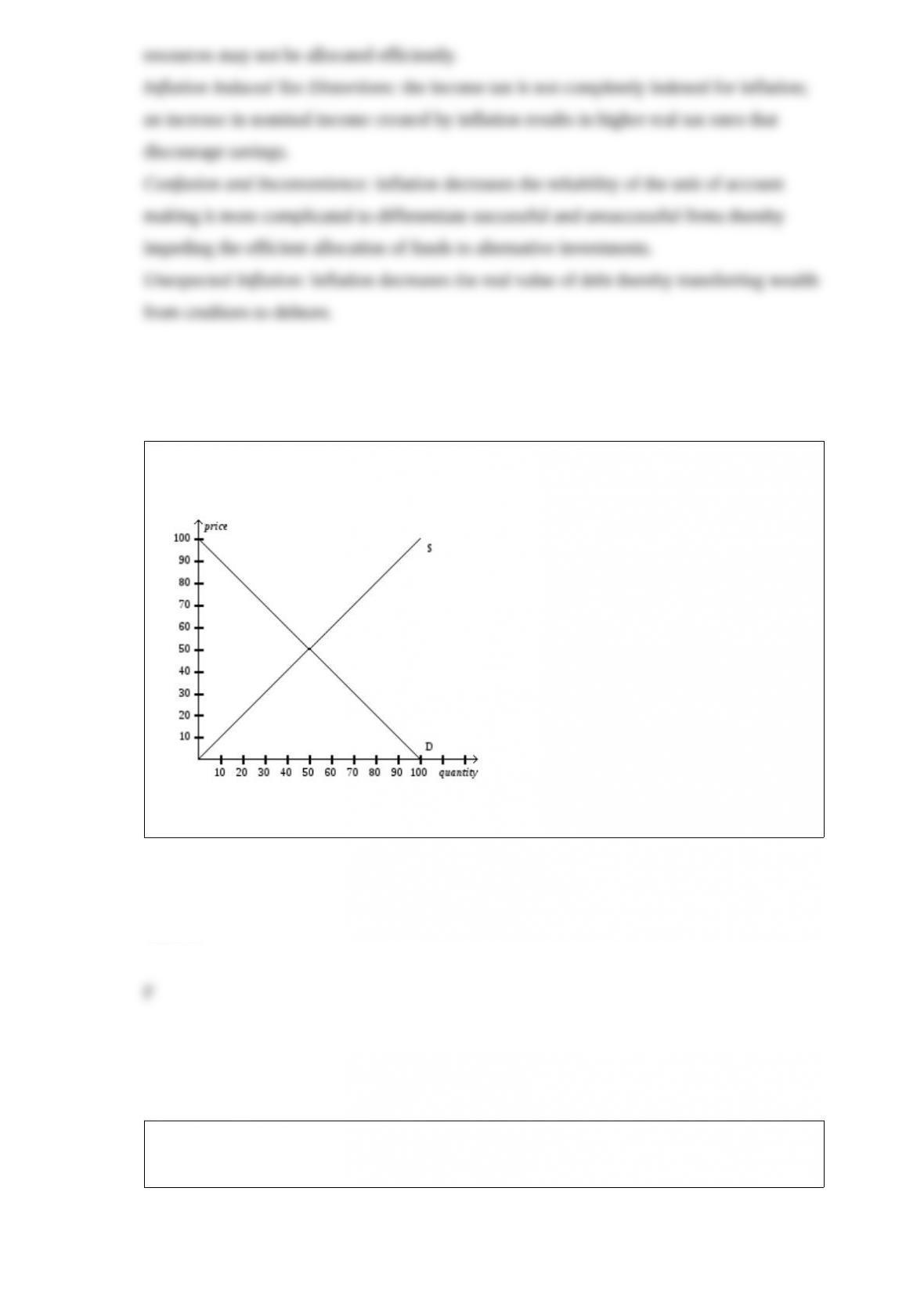
Figure 6-26
Refer to Figure 6-26. A price ceiling set at $70 would create a shortage of 40 units.
Since it is counted as investment, why doesn’t the purchase of earthmoving equipment
from China by a U.S. corporation increase U.S. GDP?

Price ceilings are typically imposed to benefit buyers.
If we observe that when consumers’ incomes rise by 10%, the quantity demanded of ice
cream increases by 5%, then ice cream is an inferior good.
The series of bank failures in 1907 occurred despite the creation of the Federal Reserve
many years earlier.

Fluctuations in real GDP are caused only by changes in aggregate demand and not by
changes in aggregate supply.
Microeconomics is the study of how households and firms make decisions and how
they interact in specific markets.
The producer price index measures the cost of a basket of goods and services bought by
firms rather than consumers.
If Darby values a soccer ball at $50, and she pays $40 for it, her consumer surplus is

$90.
The sum of consumer and producer surplus measures the total benefits that buyers and
sellers receive from participating in a market.