Which of the following statements is not correct?
a. Trade allows for specialization.
b. Trade has the potential to benefit all nations.
c. Trade allows nations to consume outside of their production possibilities curves.
d. Absolute advantage is the driving force of specialization.
Which of the Ten Principles of Economics does welfare economics explain more fully?
a. The cost of something is what you give up to get it.
b. Markets are usually a good way to organize economic activity.
c. Trade can make everyone better off.
d. A country’s standard of living depends on its ability to produce goods and services.
The second number in any ordered pair is
a. the xcoordinate.
b. the ycoordinate.
c. the horizontal location of the point.
d. the slope.
Figure 216
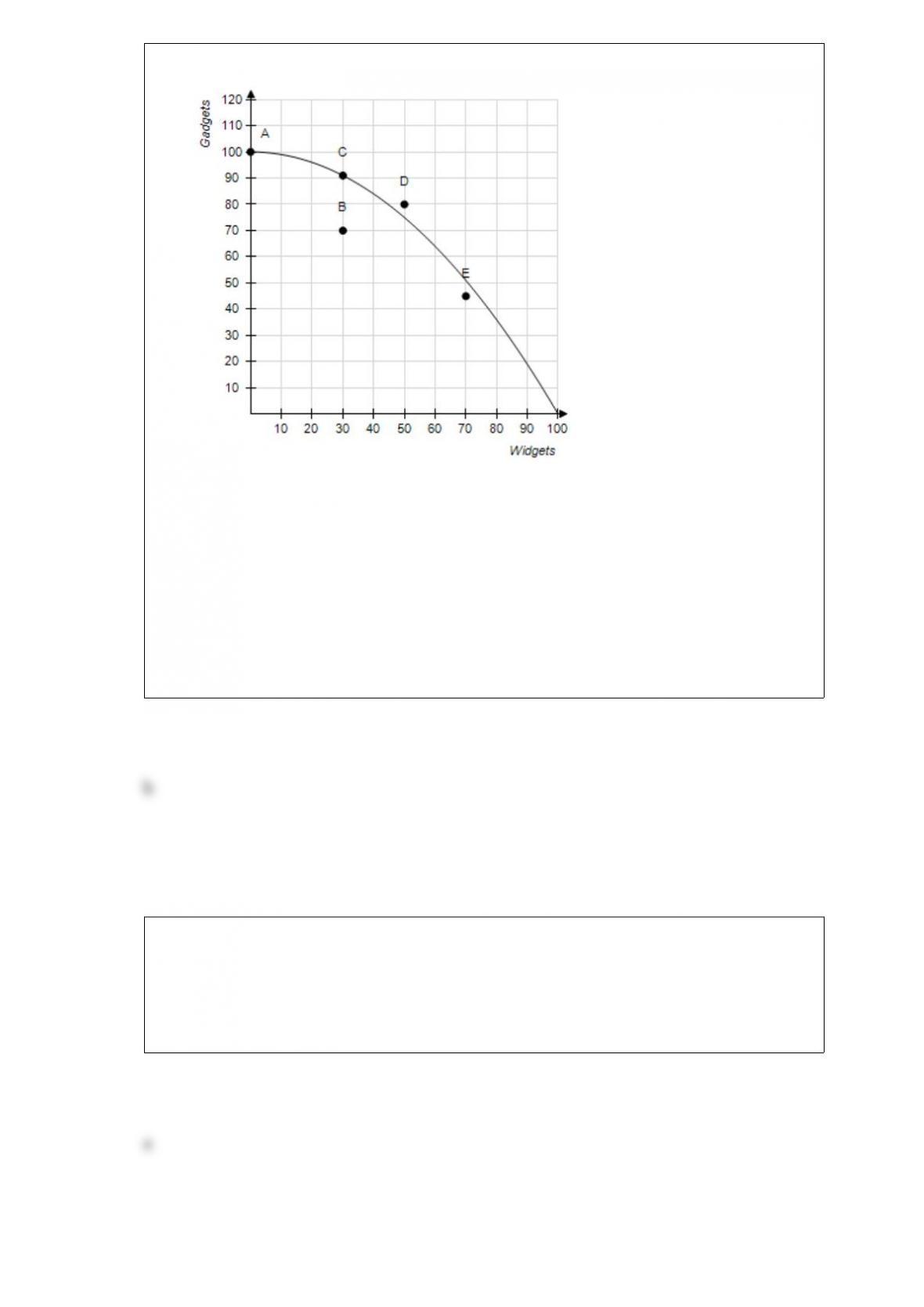
Refer to Figure 216. Which of the following statements is true about the opportunity
cost of obtaining approximately 20 additional gadgets by moving from point B to point
C?
a. The opportunity cost is the 70 gadgets that are no longer produced.
b. The opportunity cost is zero because the economy does not give up producing
widgets to go from producing at point B to point C.
c. The opportunity cost is greater than zero widgets but less than 70 gadgets.
d. The opportunity cost is greater than 70 gadgets.
Which of the following is likely to have the most price elastic demand?
a. latts
b. doctor’s visits
c. eggs
d. natural gas
The amount of deadweight loss that results from a tax of a given size is determined by
a. whether the tax is levied on buyers or sellers.
b. the number of buyers in the market relative to the number of sellers.
c. the price elasticities of demand and supply.
d. the ratio of the tax per unit to the effective price received by sellers.
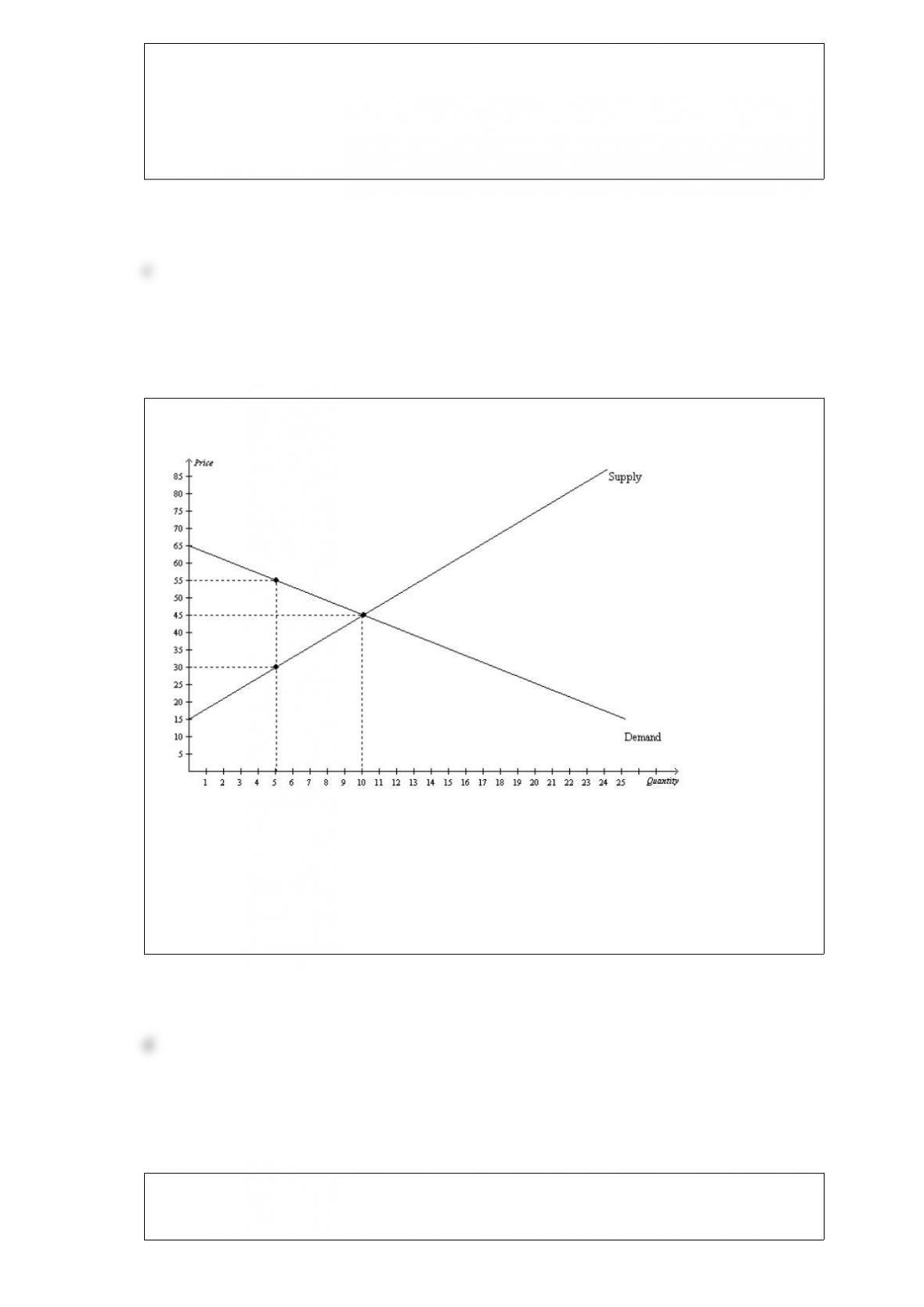
Figure 719
Refer to Figure 719. If the government imposes a price floor of $55 in this market,
then total surplus will be
a. $100.00 higher than it would be without the price floor.
b. $50.00 lower than it would be without the price floor.
c. $125.00 lower than it would be without the price floor.
d. $62.50 lower than it would be without the price floor.
Crossprice elasticity of demand measures how
a. the price of one good changes in response to a change in the price of another good.
b. the quantity demanded of one good changes in response to a change in the quantity
demanded of another good.
c. the quantity demanded of one good changes in response to a change in the price of
another good.
d. strongly normal or inferior a good is.
HTMLENTITY#8203HTMLENTITYSuppose that a binding rent control law is
repealed in San Francisco. As a result, we would expect the total number of units rented
in the city to
a. HTMLENTITY#8203HTMLENTITYincrease.
b. HTMLENTITY#8203HTMLENTITYdecrease.
c. HTMLENTITY#8203HTMLENTITYremain unchanged.
d. HTMLENTITY#8203HTMLENTITYdecrease, then increase.
Table 323
Assume that the farmer and the rancher can switch between producing pork and
producing tomatoes at a constant rate.
Labor Hours Needed to Make 1 Pound of Pounds Produced in 24 Hours
PorkTomatoesPorkTomatoes
Farmer6348
Rancher4466
Refer to Table 323. The rancher has an absolute advantage in the production of
a. pork.
b. tomatoes.
c. both goods.
d. neither good.
Suppose Katie, Kendra, and Kristen each purchase a particular type of cell phone at a
price of $80. Katie’s willingness to pay was $100, Kendra’s willingness to pay was $95,
and Kristen’s willingness to pay was $80. Which of the following statements is correct?
a. For the three individuals together, consumer surplus amounts to $35.
b. Having bought the cell phone, Kristen is better off than she would have been had she
not bought it.
c. Had the price of the cell phone been $95 rather than $80, Katie and Kendra definitely
would have been buyers and Kristen definitely would not have been a buyer.
d. The fact that all three individuals paid $80 for the same type of cell phone indicates
that each one placed the same value on that cell phone.
What will happen to the equilibrium price of new textbooks if more students attend
college, paper becomes cheaper, textbook authors accept lower royalties, and fewer
used textbooks are sold?
a. Price will rise.
b. Price will fall.
c. Price will stay exactly the same.
d. The price change will be ambiguous.
An increase in the price of a good will
a. increase supply.
b. decrease supply.
c. increase quantity supplied.
d. decrease quantity supplied.
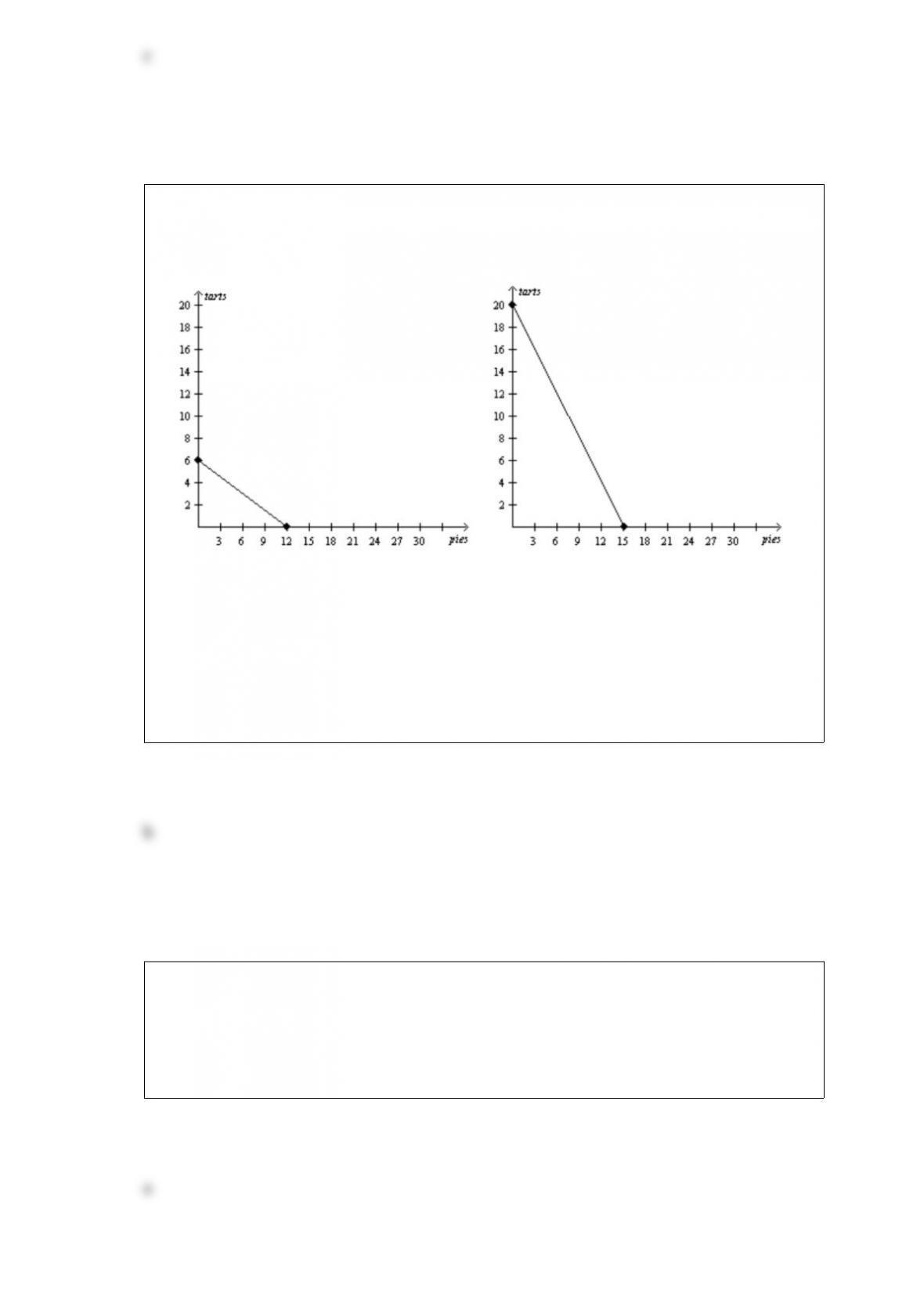
Figure 36
Maxine’s Production Possibilities FrontierDaisy’s Production Possibilities Frontier
Refer to Figure 36. If the production possibilities frontiers shown are each for one day
of work, then which of the following combinations of pies and tarts could Maxine and
Daisy together not make in a given day?
a. 2 pies and 25 tarts
b. 10 pies and 22 tarts
c. 12 pies and 15 tarts
d. 15 pies and 16 tarts
As a result of a decrease in price,
a. new buyers enter the market, increasing consumer surplus.
b. new buyers enter the market, decreasing consumer surplus.
c. existing buyers exit the market, increasing consumer surplus.
d. existing buyers exit the market, decreasing consumer surplus.
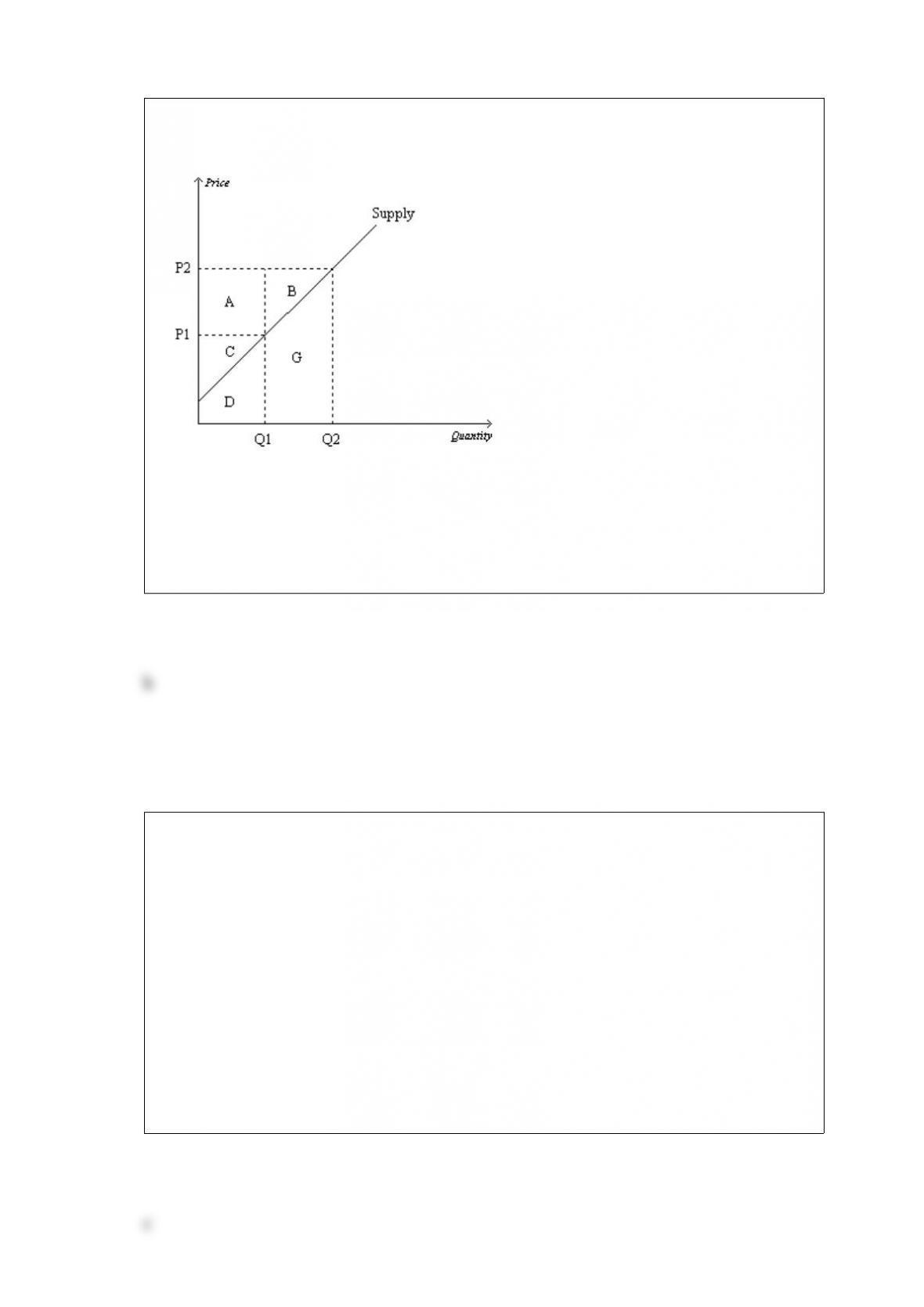
Figure 715
Refer to Figure 715. When the price is P1, producer surplus is
a. A.
b. C.
c. A+B.
d. C+D.
Table 81
MarketCharacteristic
ADemand is very elastic.
BDemand is very inelastic.
CSupply is very elastic.
DSupply is very inelastic.
Refer to Table 81. Suppose the government is considering levying a tax in one or more
of the markets described in the table. Which of the markets will allow the government
to minimize the deadweight loss(es) from the tax?
a. market A only
b. markets A and C only
c. markets B and D only
d. market C only
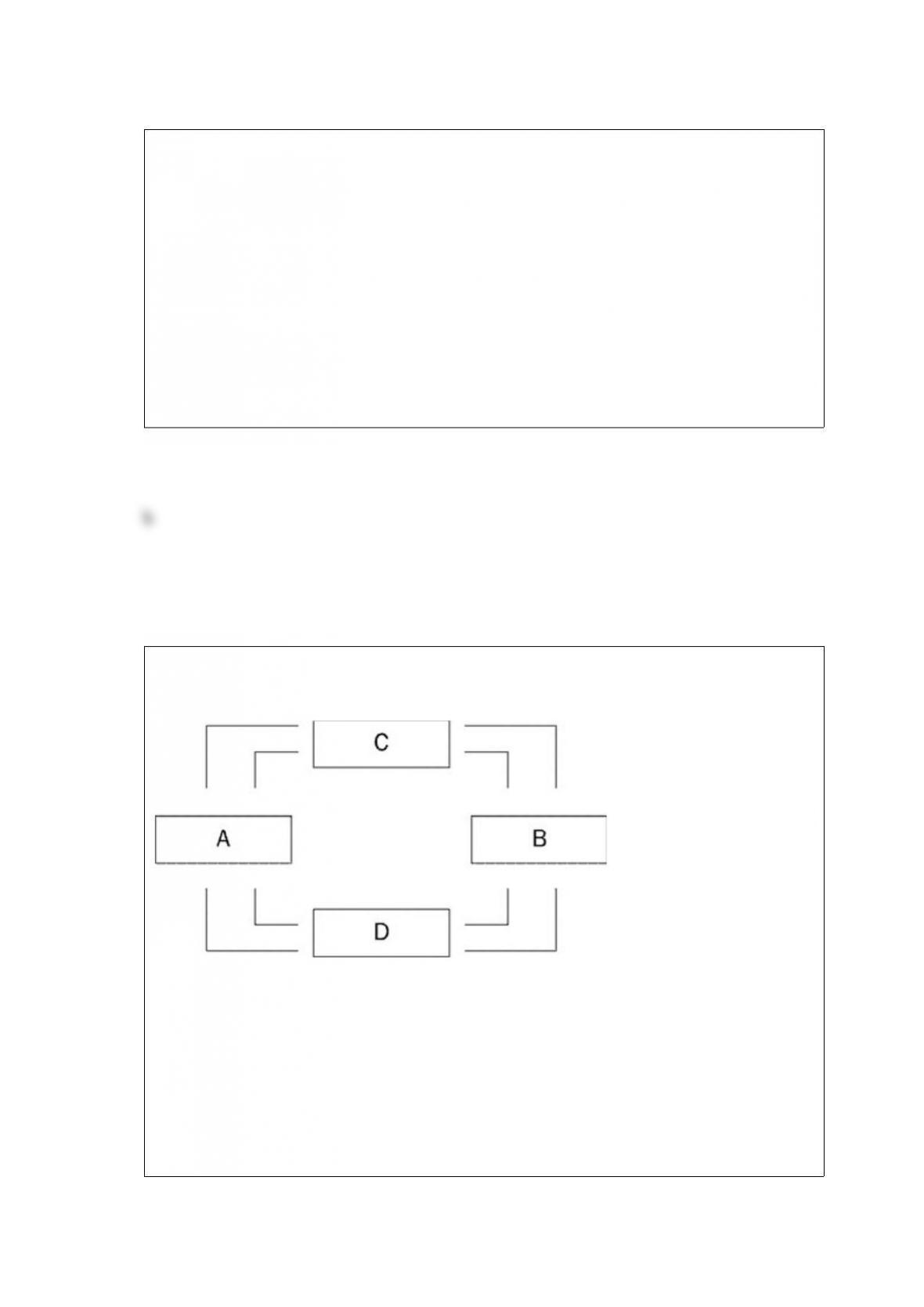
Table 71
BuyerWillingness To Pay
Calvin$150.00
Sam$135.00
Andrew$120.00
Lori$100.00
Refer to Table 71. If the price of the product is $130, then who would be willing to
purchase the product?
a. Calvin
b. Calvin and Sam
c. Calvin, Sam, and Andrew
d. Calvin, Sam, Andrew, and Lori
Figure 22
Refer to Figure 22. Carla regularly buys fruits and vegetables at a grocery store.
Roberto regularly pays a lawncare company to mow his lawn. If the flow of fruits and
vegetables from the grocery store to Carla is represented by an arrow from Box C to
Box B of this circularflow diagram, then the money paid by Roberto to the lawncare
company is represented by an arrow
a. from Box A to Box D.
b. from Box B to Box C.
c. from Box C to Box B.
d. from Box D to Box A.
What must be given up to obtain an item is called
a. outofpocket cost.
b. comparative worth.
c. opportunity cost.
d. absolute value.
Most markets in the economy are
a. markets in which sellers, rather than buyers, control the price of the product.
b. markets in which buyers, rather than sellers, control the price of the product.
c. perfectly competitive.
d. highly competitive.
The tax burden will fall most heavily on sellers of the good when the demand curve
a. is relatively steep, and the supply curve is relatively flat.
b. is relatively flat, and the supply curve is relatively steep.
c. and the supply curve are both relatively flat.
d. and the supply curve are both relatively steep.
In which of these instances is demand said to be perfectly inelastic?
a. An increase in price of 2% causes a decrease in quantity demanded of 2%.
b. A decrease in price of 2% causes an increase in quantity demanded of 0%.
c. A decrease in price of 2% causes a decrease in total revenue of 0%.
d. An increase in price of 2% causes a decrease in quantity demanded of 1/2%.
If the United States imports televisions and the U.S. government imposes a tariff on
televisions, then
a. total surplus in the American television market decreases.
b. producer surplus in the American television market increases.
c. U.S. imports of foreign televisions decrease.
d. All of the above are correct.
What will happen to the equilibrium price and quantity of new cars if the price of
gasoline rises, the price of steel rises, public transportation becomes cheaper and more
comfortable, and autoworkers negotiate higher wages?
a. Price will fall, and the effect on quantity is ambiguous.
b. Price will rise, and the effect on quantity is ambiguous.
c. Quantity will fall, and the effect on price is ambiguous.
d. Quantity will rise, and the effect on price is ambiguous.
If the demand for textbooks is inelastic, then a decrease in the price of textbooks will
a. increase total revenue of textbook sellers.
b. decrease total revenue of textbook sellers.
c. not change total revenue of textbook sellers.
d. There is not enough information to answer this question.
To increase living standards, public policy should
a. ensure that workers are well educated and have the necessary tools and technology.
b. make unemployment benefits more generous.
c. move workers into jobs directly from high school.
d. ensure a greater degree of equality, taking all incomeearners into account.
An example of a price floor is
a. the regulation of gasoline prices in the U.S. in the 1970s.
b. rent control.
c. the minimum wage.
d. any restriction on price that leads to a shortage.
A farmer has the ability to grow either corn or cotton or some combination of the two.
Given no other information, it follows that the farmer’s opportunity cost of a bushel of
corn multiplied by his opportunity cost of a bushel of cotton
a. is equal to 0.
b. is between 0 and 1.
c. is equal to 1.
d. is greater than 1.

Table 338
Output produced in one growing season
CornSoybeans
Iowa 3045
Nebraska 4080
Refer to Table 338. Iowa and Nebraska can both produce corn and soybeans, and can
switch between the production of corn and soybeans at a constant rate. The table
illustrates the amount of corn or soybeans each state can produce in one growing
season. At which of the following prices would both Iowa and Nebraska be able to gain
from trade with each other?
a. 1 bushel of soybeans for 1.7 bushels of corn.
b. 2.5 bushels of soybeans for 1 bushel of corn,
c. 3 bushels of corn for 1 bushel of soybeans.
d. 1.8 bushels of soybeans for 1 bushel of corn.
Whether a good is a luxury or necessity depends on the
a. price of the good.
b. preferences of the buyer.
c. intrinsic properties of the good.
d. scarcity of the good.