
The fear that continued growth at current rates will exhaust basic resources is
diminished by
a. data contained in the Club of Rome’s The Limits to Growth report.
b. the knowledge that amounts of the most basic resources are virtually unlimited.
c. the fact that the price system provides incentives to conserve and develop
replacements for our resources.
d. the law of diminishing returns.
e. a slowdown in technological change that reduces the demand for these resources.
A major union weapon to force a favorable settlement is the threat of
a. a lockout.
b. an open shop.
c. featherbedding.
d. a strike.
e. collective bargaining.
The following questions are based on the following information regarding the gross
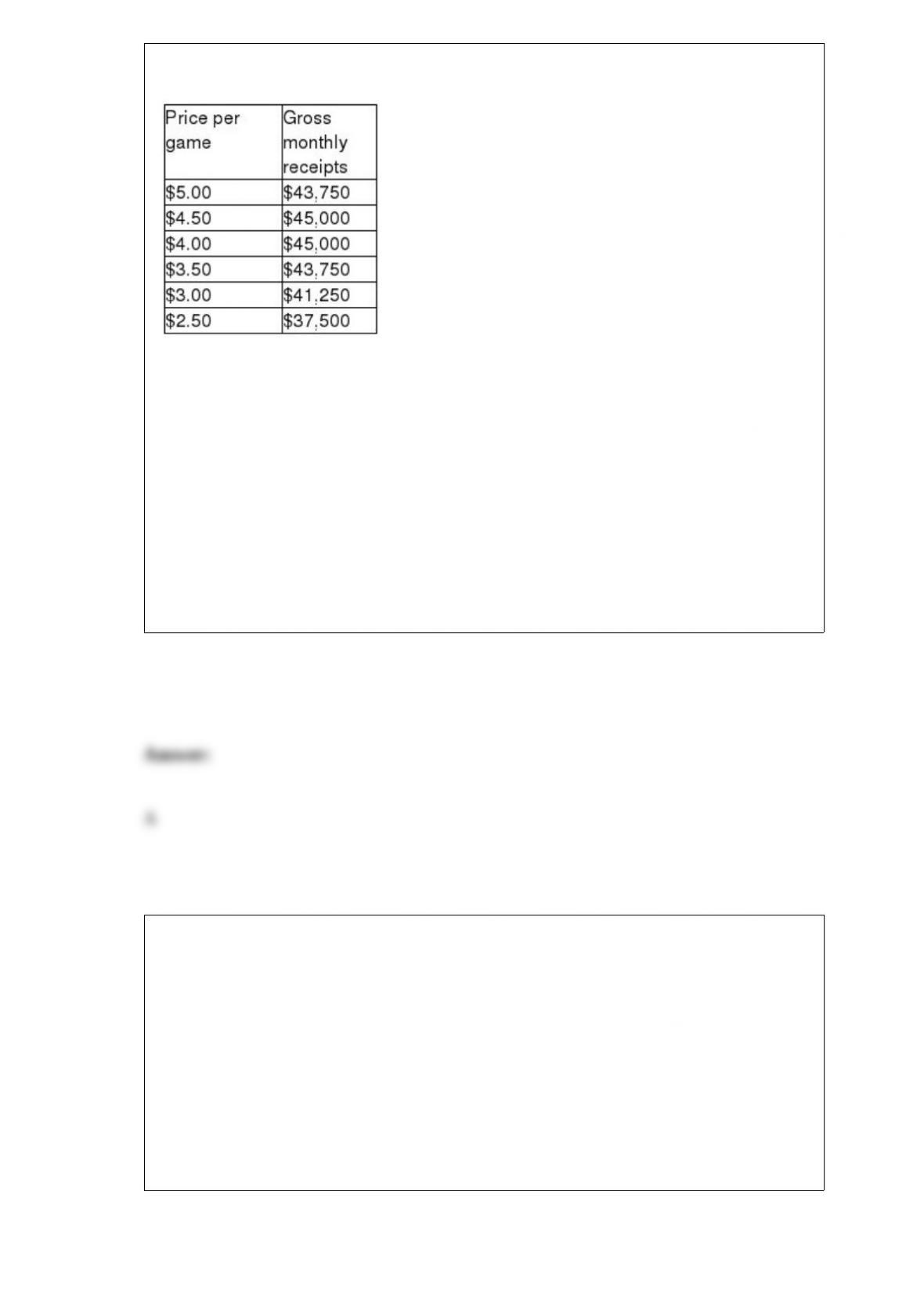
monthly receipts of a miniature golf course in a resort community at the shore.
Demand is clearly price elastic between
a. $4.50 and $5.00.
b. $4.00 and $4.50.
c. $3.50 and $4.00.
d. $3.00 and $3.50.
e. There is not enough information to tell.
The idea that, under certain circumstances, deficits can increase investment is known as
a. the structural deficit.
b. the crowd-out effect.
c. structural unemployment.
d. the crowd-in effect.
e. the Laffer effect.

The opportunity cost of holding idle money balances
a. increases as bond prices rise.
b. increases as interest rates rise.
c. decreases as profit rates rise.
d. allows individuals to benefit from rapid inflation.
e. is nonexistent for most high-income households.
The government may attempt to reduce unemployment by
a. shifting the aggregate demand curve to the left.
b. increasing the tax rate on personal income.
c. reducing private spending.
d. increasing government spending.
e. decreasing the multiplier.

The New Economy of the 1990s was characterized by
a. productivity increases and the globalization of business, which shifted the aggregate
supply curve to the right.
b. unemployment rates that rose rapidly because businesses outsourced production to
low-wage countries.
c. inflationary rates that rose steadily to more than 4.5 percent per year because of the
Fed’s easy-money policies.
d. large declines in aggregate demand that led to concerns by policy makers that
deflation was becoming a major threat.
e. increases in budget deficits that were used to finance large government expenditures
on research and development.
The activities of a self-employed physician in running a medical practice would be
considered
a. free resources. d. capital.
b. labor. e. technology.
c. land.

The expression 1/MPS is called
a. the marginal propensity to consume.
b. the saving function.
c. induced saving.
d. the multiplier.
e. the paradox of thrift.
The current thinking of economists is that the full-employment rate of unemployment in
the United States occurs when about
a. 100 percent of the labor force is employed.
b. 5 percent of the labor force is unemployed.
c. 90 percent of the total population is employed.
d. 7.5 percent of the labor force is unemployed.
e. 67 percent of production costs are the result of employed labor.

Blue-collar workers make up approximately ________ percent of the labor force in the
United States.
a. 5
b. 15
c. 33
d. 50
e. 80
A significant source of revenue for the federal government is ________ taxes.
a. personal income
b. sales
c. property
d. inheritance
e. import
The additional satisfaction received from consuming an additional unit of a commodity
is called the

a. marginal product.
b. quotient of satisfaction.
c. marginal propensity to consume.
d. elasticity of demand.
e. marginal utility.
The legal, technical, and financial difficulties a firm must overcome to participate in a
particular market are called
a. implicit costs.
b. open market operations.
c. crowding-out conditions.
d. external economies and diseconomies.
e. barriers to entry.
The International Monetary Fund was established to
a. ensure flexibility of exchange rates.

b. maintain a stable system of exchange rates.
c. make long-term loans to member countries.
d. create an international currency.
e. manage the affairs of the International Bank for Reconstruction and Development.
Economists Milton Friedman and Edmund Phelps argue that there is a natural rate of
unemployment determined by
a. a downward-sloping Phillips curve.
b. the C + I + G line.
c. the rate of inflation.
d. the length of time workers search for new jobs.
e. government proclamation.
Supply-side inflation is best illustrated by a
a. rightward shift in the aggregate supply curve.
b. rightward shift in the aggregate demand curve.

c. leftward shift in the aggregate supply curve.
d. leftward shift in the aggregate demand curve.
e. simultaneous rightward shift in the aggregate supply curve and a leftward shift in the
aggregate demand curve.
The natural monopoly characteristics of the telecommunication industry disappeared in
the last few decades, largely because of
a. the emergence of significant economies of scale in the industry.
b. increased government regulation.
c. increased foreign competition.
d. widespread losses leaving firms financially weak.
e. rapid changes in technology.
Human capital formation refers to
a. expenditures by society on formal education, on-the-job training, and health
programs.
b. acquiring machines that do not displace existing workers.

c. maintaining a full-employment level of GDP.
d. the development of humanlike robots (androids).
e. cloning humans.
Contrary to the allegations of some economists, there is evidence that the development,
promotion, and diffusion of new techniques in an industry may benefit from
a. a diversity of firm sizes in the industry.
b. the concentration of production in the hands of a regulated monopolist.
c. perfect competition.
d. allowing the industry to form a cartel.
e. the nationalization of that industry.
For a country to specialize completely in one product, it must be assumed that
a. the country consumes all the production.
b. the cost of producing the product (in terms of other goods foregone) is constant.
c. the country has an absolute advantage in the production of that good.

d. sufficient technical information is available to indicate a comparative advantage in
that good.
e. the country in question has a capitalistic system.
According to John Maynard Keynes and his followers, GDP is dependent mainly on
a. the level of intended spending.
b. current tax rates.
c. the influence of labor unions.
d. current trends in interest payments.
e. the price level.
Gross domestic product is
a. a measure of the value of all goods and services produced in a given year.
b. a measure of the value of all goods and services produced by the private sector in a
given year.
c. measured, when possible, using the prices of goods and services as a measure of
value.

d. equal to the total wage bill.
e. a measure of the total value of all market transactions in a given year.
The level of real national output demanded at each price level
a. declines as aggregate supply increases.
b. is horizontal according to the classical economists.
c. is unaffected by changes in interest rates.
d. can be calculated only when the economy is at full employment.
e. is inversely related to the price level.
The following questions are based on the following diagram:
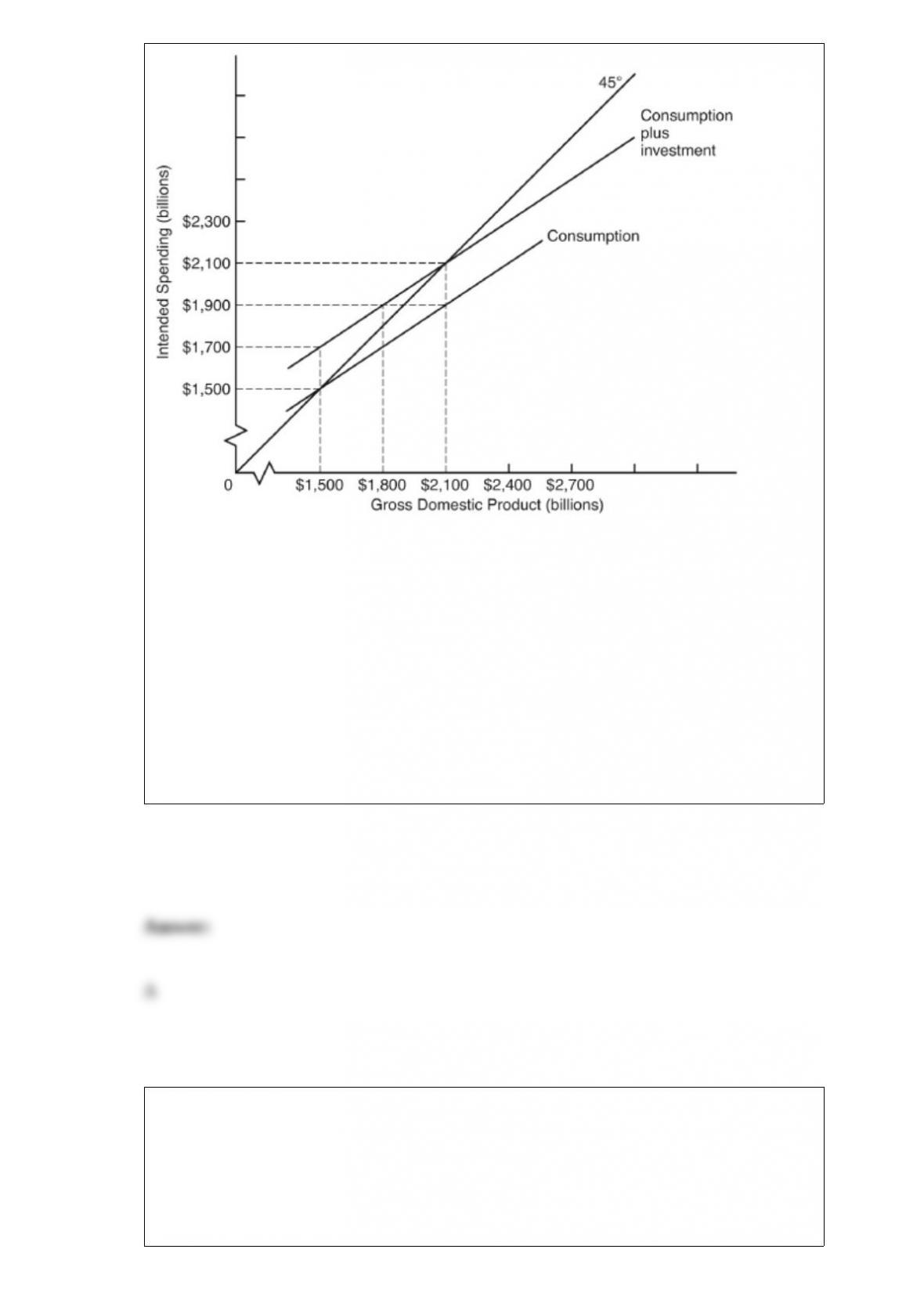
At equilibrium the amount of investment spending would be ________ billion.
a. $200
b. $300
c. $1,700
d. $1,900
e. $2,100
A case of wine costs $10 to produce and sells for $40. A bottle of prescription pills costs
$5 to produce and sells for $10. On the basis of this information, we can conclude that
the
a. pills contribute more to GDP, but it is impossible to say how much more.

b. pills contribute twice as much as the wine to GDP.
c. wine contributes twice as much as the pills to GDP.
d. wine contributes four times as much as the pills to GDP.
e. wine contributes six times as much as the pills to GDP.
Choosing an output rate at which price equals marginal cost maximizes profits for the
perfectly competitive firm because further increases in the output rate would
a. increase total cost.
b. decrease total revenue.
c. add more to total cost than it would to total revenue.
d. result in a price decline.
e. increase average fixed cost more than average variable cost.
The following schedule shows the utility Mr. Pomeroy derives from consumption of
various amounts of food per day. Use it to answer the next question.
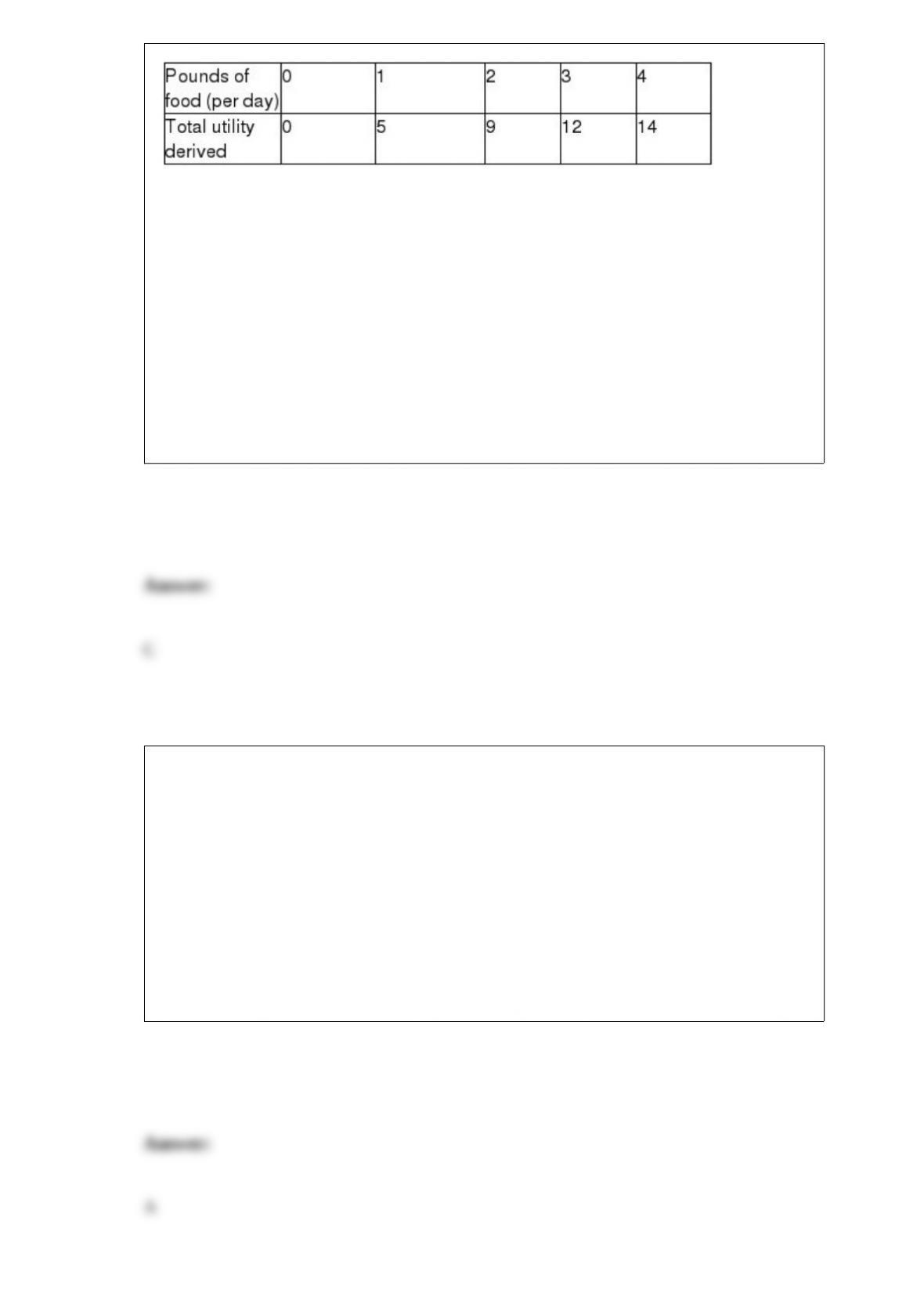
If he consumes 2 pounds of food per day, his marginal utility is
a. 2.
b. 3.
c. 4.
d. 5.
e. 9.
Two common measures of the rate of economic growth are the rates of growth of
a. real GDP and real per capita GDP.
b. income and consumption.
c. full-time unemployment and prices.
d. the money supply and income.
e. real population and full-time employment.
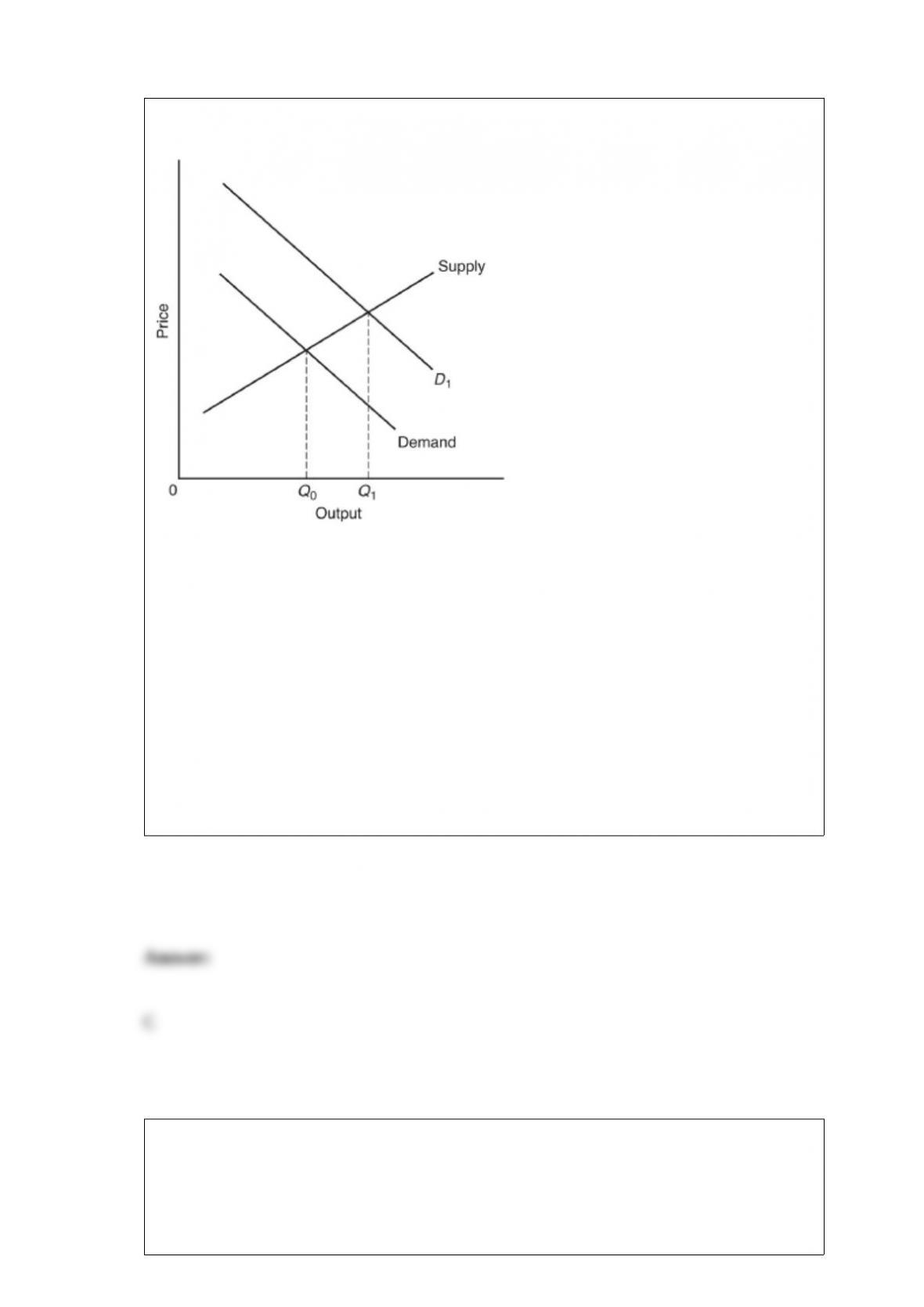
Shown in this diagram are demand and supply conditions for a competitive industry.
If the socially optimal level of output for an industry is identical to the equilibrium
output, there are
a. external internalities of substance.
b. both external internalities and internal externalities.
c. no external economies or diseconomies.
d. both external economies and diseconomies.
e. internal and external reciprocities.
If the rate of inflation is 8 percent and a lender receives $11,000 at the end of the year
for a loan of $10,000, the real rate of interest is approximately ________ percent.
a. 13

b. 11
c. 6
d. 3
e. 2
The following questions are based on the following information:
GDP = disposable incomeIntended consumption expendituresIntended investment
$1,740 billion$1,710 billion$50 billion
$1,800 billion$1,750 billion$50 billion
$1,860 billion$1,790 billion$50 billion
$1,920 billion$1,830 billion$50 billion
$1,980 billion$1,870 billion$50 billion
The equilibrium value of GDP is ________ billion.
a. $1,740
b. $1,800
c. $1,860
d. $1,920
e. $1,980