
Which of the following expressions can be used to compute the price elasticity of
demand?
a. Price elasticity of demand = • .
b. Price elasticity of demand = • .
c. Price elasticity of demand = • .
d. Price elasticity of demand = • .
Which of the following steps does an economist take when studying the economy?
a. devise theories
b. collect data
c. analyze data
d. All of the above are correct.
What is the fundamental basis for trade among nations?
a. shortages or surpluses in nations that do not trade
b. misguided economic policies
c. absolute advantage
d. comparative advantage
If the United States threatens to impose a tariff on Honduran blueberries if Honduras
does not remove agricultural subsidies, the United States will be
a. better off no matter how Honduras responds.

b. better off if Honduras gives in, and will be no worse off if it doesn’t.
c. worse off if Honduras doesn’t give in to the threat.
d. worse off no matter how Honduras responds.
Knowing that the demand for wheat is inelastic, if all farmers voluntarily did not plant
wheat on 10 percent of their land, then
a. consumers of wheat would buy more wheat.
b. wheat farmers would suffer a reduction in their total revenue.
c. wheat farmers would experience an increase in their total revenue.
d. the demand for wheat would decrease.
Table 511
Supply isDemand is
Scenario Aelasticelastic
Scenario Belasticinelastic
Scenario Cinelasticelastic
Scenario Dinelasticinelastic
Refer to Table 511. Which scenario describes the market for oil in the long run?
a. A
b. B
c. C
d. D

Table 75
For each of three potential buyers of oranges, the table displays the willingness to pay
for the first three oranges of the day. Assume Allison, Bob, and Charisse are the only
three buyers of oranges, and only three oranges can be supplied per day.
First OrangeSecond OrangeThird Orange
Allison$2.00$1.50$0.75
Bob$1.50$1.00$0.60
Charisse$0.75$0.25$0
Refer to Table 75. If the market price of an orange is $0.70, then the market quantity of
oranges demanded per day is
a. 5.
b. 6.
c. 4.
d. 7.
A payroll tax is a
a. fixed number of dollars that every firm must pay to the government for each worker
that the firm hires.
b. tax that each firm must pay to the government before the firm can hire workers and
operate its business.
c. tax on the wages that firms pay their workers.
d. tax on all wages above the minimum wage.
Which of the following is the most accurate statement?
a. Protection is necessary in order for young industries to grow up and be successful.
b. Protection is not necessary for an industry to grow.
c. Protection is necessary because if young industries are not protected, they may suffer
losses.
d. Protection may not always be necessary for infant industries, but it has proven to be
useful in most cases.

Anger over British taxes played a significant role in bringing about the
a. election of John Adams as the second American president.
b. American Revolution.
c. War of 1812.
d. “no new taxes” clause in the U.S. Constitution.
If the demand for a product decreases, then we would expect equilibrium price
a. to increase and equilibrium quantity to decrease.
b. to decrease and equilibrium quantity to increase.
c. and equilibrium quantity to both increase.
d. and equilibrium quantity to both decrease.
Suppose that a worker in Freedonia can produce either 6 units of corn or 2 units of
wheat per year, and a worker in Sylvania can produce either 2 units of corn or 6 units of
wheat per year. Each nation has 10 workers. For many years the two countries traded,
each completely specializing according to their respective comparative advantages.
Now, however, war has broken out between them and all trade has stopped. Without
trade, Freedonia produces and consumes 30 units of corn and 10 units of wheat per
year. Sylvania produces and consumes 10 units of corn and 30 units of wheat. The war
has caused the combined yearly output of the two countries to decline by
a. 10 units of corn and 10 units of wheat.
b. 20 units of corn and 20 units of wheat.
c. 30 units of corn and 30 units of wheat.
d. 40 units of corn and 40 units of wheat.

If the price elasticity of supply is zero, then
a. supply is more elastic than it is in any other case.
b. the supply curve is horizontal.
c. the quantity supplied is the same, regardless of price.
d. a change in demand will cause a relatively small change in the equilibrium price.
In a free, competitive market, what is the rationing mechanism?
a. seller bias
b. buyer bias
c. government law
d. price
If textbooks and study guides are complements, then an increase in the price of
textbooks will result in
a. more textbooks being sold.
b. more study guides being sold.
c. fewer study guides being sold.
d. no difference in the quantity sold of either good.
The sum of all the individual demand curves for a product is called
a. income demand.
b. equilibrium demand.
c. complementary demand.
d. market demand.
Consumer surplus is equal to the
a. Value to buyers Amount paid by buyers.
b. Amount paid by buyers Costs of sellers.
c. Value to buyers Costs of sellers.
d. Value to buyers Willingness to pay of buyers.
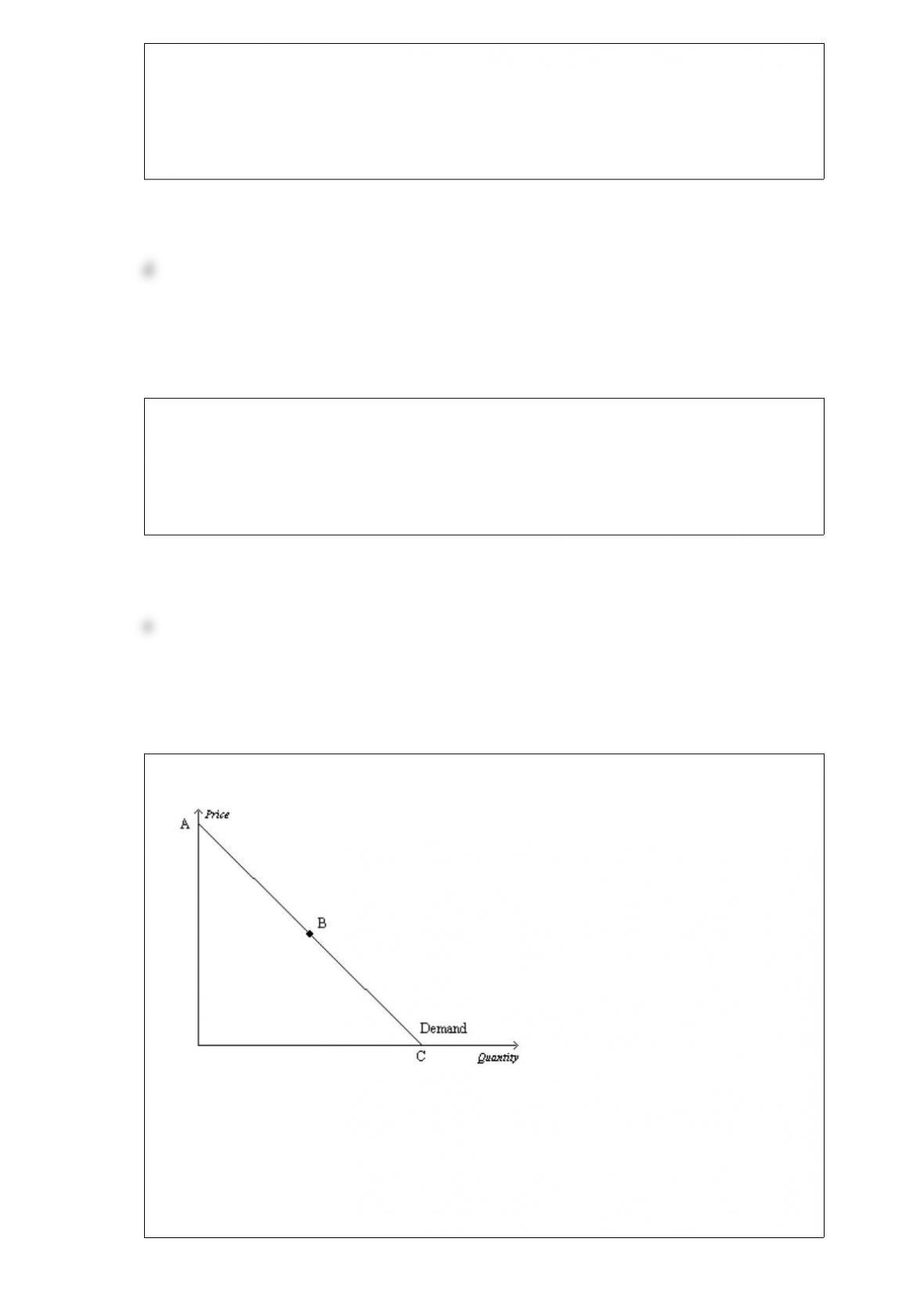
Figure 54
Refer to Figure 54. If the price decreases in the region of the demand curve between
points B and C, we can expect total revenue to
a. increase.
b. stay the same.
c. decrease.
d. first increase, then decrease until total revenue is maximized.

Which of the following demonstrates the law of demand?
a. After Jon got a raise at work, he bought more pretzels at $1.50 per pretzel than he did
before his raise.
b. Melissa buys fewer muffins at $0.75 per muffin than at $1 per muffin, other things
equal.
c. Dave buys more donuts at $0.25 per donut than at $0.50 per donut, other things
equal.
d. Kendra buys fewer Snickers at $0.60 per Snickers after the price of Milky Ways falls
to $0.50 per Milky Way.
Suppose a typical worker in India can produce 32 units of product in an eighthour day,
while a typical worker in Bangladesh can produce 30 units of product in a 10hour day.
We can conclude that
a. worker productivity in Bangladesh is higher than in India.
b. the standard of living will likely be higher in India than in Bangladesh.
c. productivity is 4 units per hour for the worker in Bangladesh and 3 units per hour for
the worker in India.
d. there will be no difference between the standard of living in India and Bangladesh.
Figure 63
Panel (a)Panel (b)
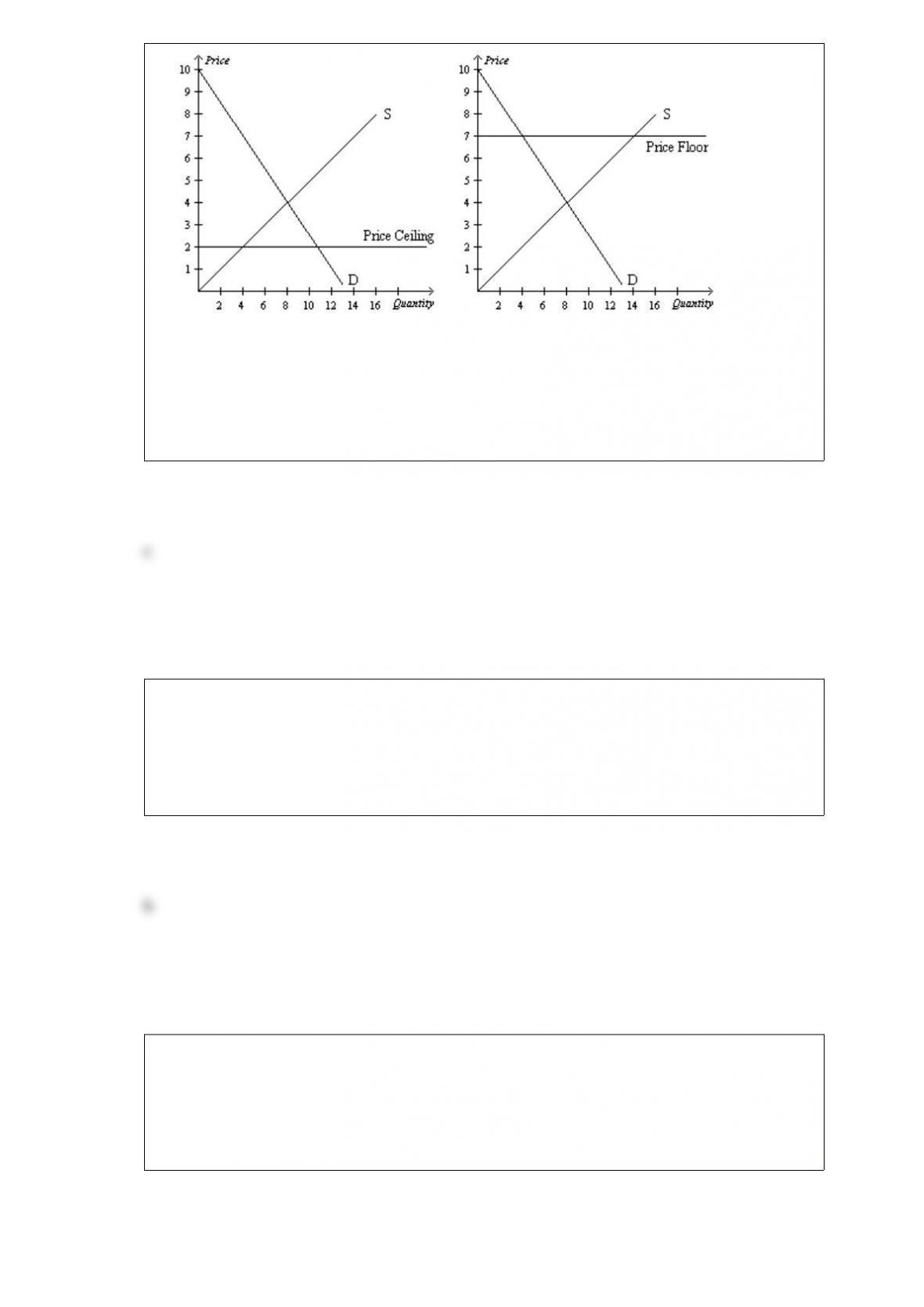
Refer to Figure 63. In panel (b), there will be
a. a shortage.
b. equilibrium in the market.
c. a surplus.
d. lines of people waiting to buy the good.
A decrease in the price of a good would
a. increase the supply of the good.
b. increase the quantity demanded of the good.
c. give producers an incentive to produce more to keep profits from falling.
d. shift the supply curve for the good to the left.
A tax on the buyers of sofas
a. increases the size of the sofa market.
b. decreases the size of the sofa market.
c. has no effect on the size of the sofa market.
d. may increase, decrease, or have no effect on the size of the sofa market.

Abby bakes brownies and Liam grows flowers. In which of the following cases is it
impossible for both Abby and Liam to benefit from trade?
a. Abby does not like flowers and Liam does not like brownies.
b. Abby is better than Liam at baking brownies and Liam is better than Abby at growing
flowers.
c. Liam is better than Abby at baking brownies and at growing flowers.
d. Both Abby and Liam can benefit from trade in all of the above cases.
Oil is used to produce gasoline. If the price of oil increases, consumer surplus in the
gasoline market
a. decreases.
b. is unchanged.
c. increases.
d. may increase, decrease, or remain unchanged.
When can two countries gain from trading two goods?
a. when the first country can only produce the first good and the second country can
only produce the second good
b. when the first country can produce both goods, but can only produce the second good
at great cost, and the second country can produce both goods, but can only produce the
first good at great cost
c. when the first country is better at producing both goods and the second country is
worse at producing both goods
d. Two countries could gain from trading two goods under all of the above conditions.

Josh is willing to pay $500 for a set of tire, but he is able to pay $300 at the local tire
store. His consumer surplus is
a. $800.
b. $300.
c. $200.
d. $500.
Table 710
The following table represents the costs of five possible sellers.
SellerCost
Abby$1,600
Bobby$1,300
Dianne$1,100
Evaline$900
Carlos$800
Refer to Table 710. Suppose each of the five sellers can supply at most one unit of the
good. The market quantity supplied is exactly 4 if the price is
a. $860.
b. $1,050.
c. $1,650.
d. $1,400.
As more people become selfemployed, which allows them to determine how many
hours they work per week, we would expect the deadweight loss from the Social
Security tax to
a. increase, and the revenue generated from the tax to increase.
b. increase, and the revenue generated from the tax to decrease.
c. decrease, and the revenue generated from the tax to increase.
d. decrease, and the revenue generated from the tax to decrease.
You and your college roommate eat three packages of Ramen noodles each week. After
graduation last month, both of you were hired at several times your college income.
Your roommate still enjoys Ramen noodles very much and buys even more, but you
plan to buy fewer Ramen noodles in favor of foods you prefer more. When looking at
income elasticity of demand for Ramen noodles, yours would
a. be negative and your roommate’s would be positive.
b. be positive and your roommate’s would be negative.
c. be zero and your roommate’s would approach infinity.
d. approach infinity and your roommate’s would be zero.
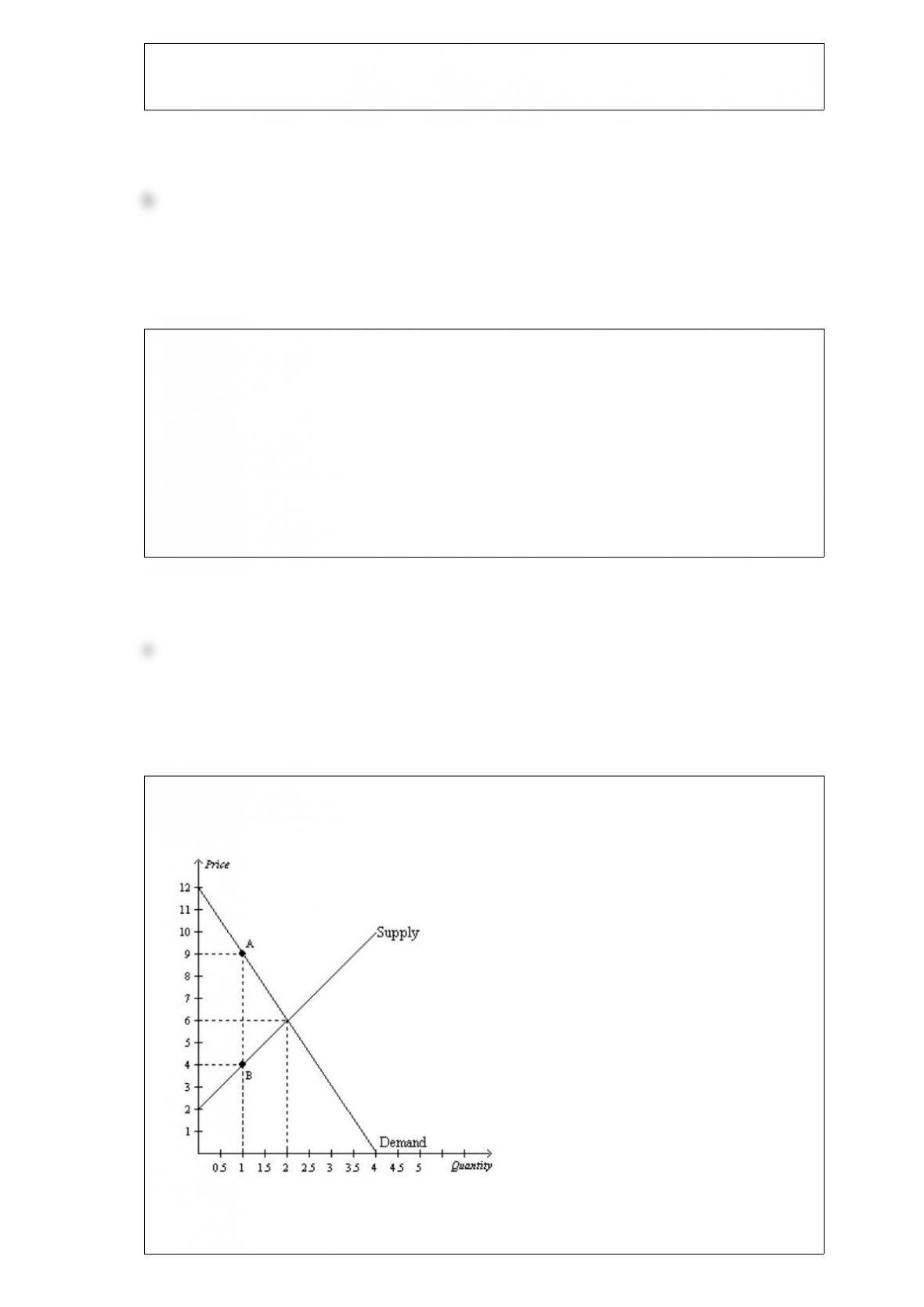
Figure 82
The vertical distance between points A and B represents a tax in the market.
Refer to Figure 82. The amount of the tax on each unit of the good is
a. $1.

b. $4.
c. $5.
d. $9.
Prior to the collapse of communism, communist countries worked on the premise that
economic wellbeing could be best attained by
a. a market economy.
b. a strong reliance on prices and individuals’ selfinterests.
c. a system of large privatelyowned firms.
d. the actions of government central planners.
In which of the following situations would supply be the most elastic?
a. An auto parts manufacturer is operating at capacity.
b. A real estate developer in Boston is looking to build condos on the waterfront.
c. A furniture manufacturer is operating its factory 8 hours per day.
d. A hotel has all of its rooms booked for each night of the next 3 months.