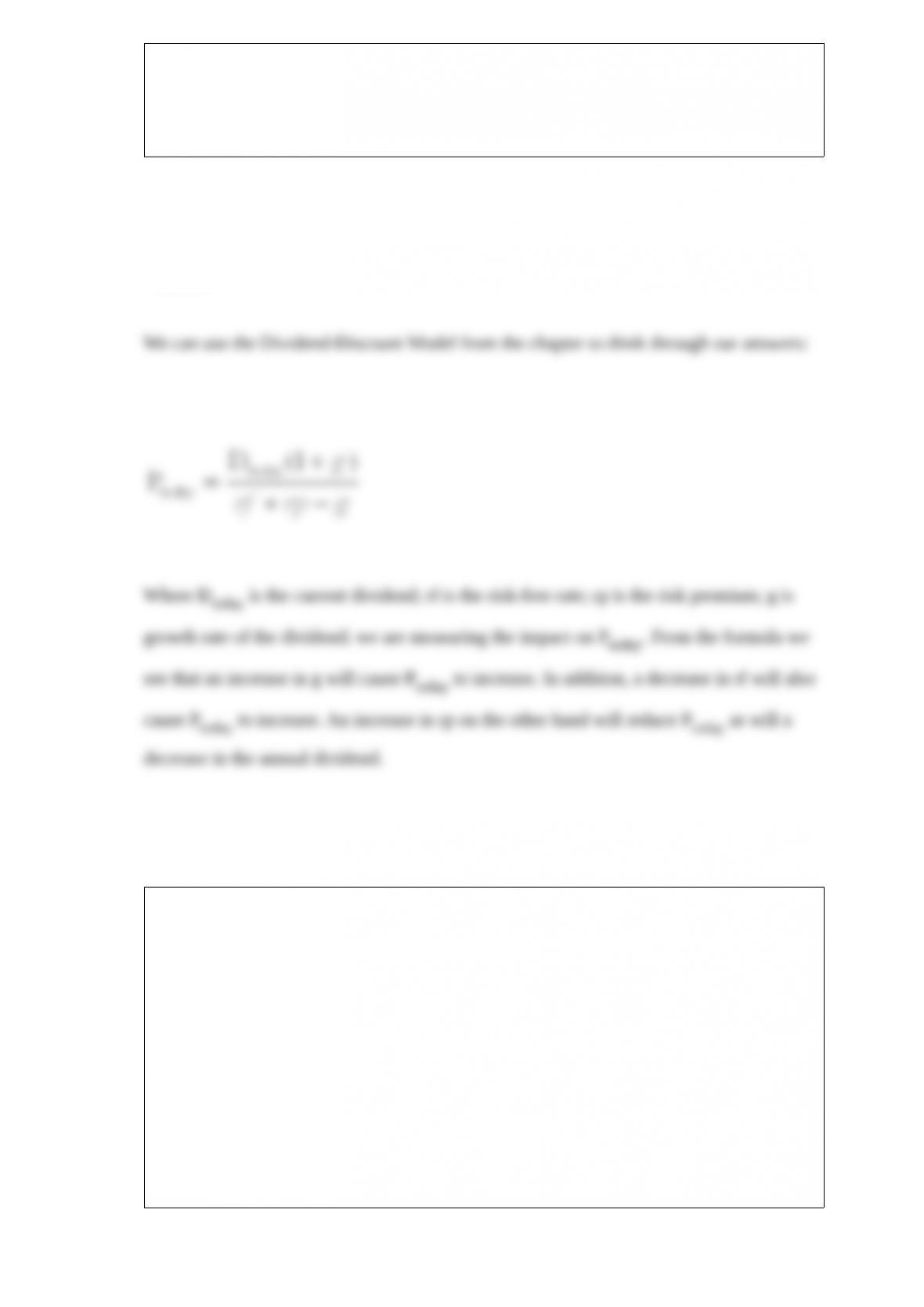
Discuss the effects on the current price of a stock from each of the following: a) An
increase in the growth rate of the dividend; b) A decrease in the risk-free interest rate; c)
An increase in the equity-risk premium; and finally d) A decrease in the annual
dividend.
Answer:
If your bank offers you free checking if your average balance is at least $1000 and you
would normally carry an average balance of $500, what is the annual cost to you of free
checking if bonds are paying a 5.0% return?
A. $50.00
B. $0.00
C. $20.00
D. $25.00

Answer:
The importance of the bank-lending channel of monetary policy transmission:
A. becomes more important the more important banks are as a source of funds for
firms and individuals.
B. is likely to become more important with the growth of loan brokers and
asset-backed securities.
C. has become more important as technology has solved the problems of information
and moral hazard.
D. none of the answers given is correct.
Answer:
The lower the interest rate, i, the:
A. lower is the present value.
B. greater must be n.
C. higher is the present value.

D. higher is the future value.
Answer:
If inflation in the United States averages more than inflation in the euro area over a long
period of time, we should expect:
A. the dollar to appreciate relative to the euro.
B. the euro/U.S. dollar exchange rate to fluctuate in a narrow range set by the European
Central Bank.
C. the dollar to depreciate relative to the euro.
D. no effect; there isn’t a link between inflation and exchange rates over the long run.
Answer:
The primary purpose of meetings of the FOMC is to:
A. set the required reserve rate.

B. set the discount rate.
C. decide on how to influence financial conditions.
D. set the prime rate.
Answer:
Which of the following is true?
A. Long-term bond yields move together but short-term yields do not.
B. Short-term bond yields move together but long-term yields do not.
C. U.S. Treasury bill yields are lower than the yields on commercial paper.
D. Long-term bond yields are usually the same as short-term yields.
Answer:
Which of the following statements is incorrect?

A. The point where the short-run and long-run supply curves intersect corresponds to
the potential level of output.
B. Any point on the short-run aggregate supply curve reflects current inflation equals
target inflation.
C. Inflation and output are unrelated in the long run.
D. In the long run, inflation is determined by monetary policy.
Answer:
To say monetary policy is transparent implies:
A. that anyone could figure out what the correct policy should be.
B. monetary policy should not be so difficult that most people couldn’t understand it.
C. policymakers offer plausible explanations for their decisions along with supporting
data.
D. that when faced with the same problem, policymakers will always react the same
way.
Answer:

Stock market bubbles impact consumers by:
A. encouraging greater consumption and greater saving.
B. encouraging greater consumption and less saving.
C. encouraging more work and delaying retirement.
D. resulting in less investment in home ownership and more into stocks.
Answer:
Which of the following statements most accurately describes the state of banking in the
U.S.?
A. A large number of large banks and a small number of small banks
B. A large number of large and small banks
C. A small number of large and small banks
D. A large number of small banks and a small number of large banks
Answer:

Which of the following could not be commodity money?
A. Gold coins
B. Cigarettes
C. U.S. Currency
D. Silk
Answer:
Deflation compounds information problems because it:
A. increases a company’s net worth.
B. tends to understate a company’s assets and overstate their liabilities.
C. reduces the dollar value of assets while the dollar value of liabilities stays constant.
D. always harms lenders.
Answer:

The number of central banks that exist in the world today is:
A. less than 10.
B. about 250.
C. over 170.
D. over 50 but less than 100.
Answer:
The principal in an interest rate swap is:
A. always transferred from the originator to the counterparty of the swap.
B. is usually held by a clearinghouse to guarantee payment.
C. usually borrowed from a third party.
D. is not borrowed, lent, or exchanged. It just serves as the basis for the calculation of
cash flows.
Answer:

A stock has an annual dividend of $10.00 and it is expected not to grow. It is believed
the stock will sell for $100 one year from now, and an investor has a discount (interest)
rate of 6% (0.06). The dividend discount model predicts the stock’s current price should
be:
A. $94.67
B. $116.00
C. $103.77
D. $106.60
Answer:
Which of the following statements is true?
A. While the Fed emphasizes money growth more than the ECB, both central banks
have chosen interest rates as their operating target.
B. While the Fed emphasizes money growth less than the ECB, both central banks
have chosen interest rates as their operating target.
C. Because the Fed emphasizes money growth less than the ECB, the Fed uses interest
rates as their operating target while the ECB looks at growth in money aggregates.

D. Both the Fed and the ECB use growth in money aggregates as their operating target.
Answer:
A country that exports less than it imports will:
A. have a current account deficit and a capital account deficit.
B. have a current account surplus and a capital account deficit.
C. have a current account surplus and a capital account surplus.
D. have a current account deficit and a capital account surplus.
Answer:
A country that exports more than it imports will:
A. have a current account deficit and a capital account deficit.
B. have a current account surplus and a capital account surplus.

C. have a current account deficit and a capital account surplus.
D. have a current account surplus and a capital account deficit.
Answer:
Each president of a Reserve Bank serves for a:
A. fourteen-year term.
B. five-year term.
C. seven-year term.
D. two-year renewable term.
Answer:
Money Center Banks differ from community banks in all of the following ways except:

A. they are usually much smaller.
B. they obtain their funds primarily through borrowing and not by deposits.
C. they are a much smaller percentage of the total number of banks.
D. they are actively engaged in the money market.
Answer:
Monetary policy in the United States is under the control of:
A. the U.S. Treasury.
B. the President.
C. the Federal Reserve.
D. the U.S. Senate.
Answer:
One of the reasons primary credit exists is to:

A. bail out banks which are in financial trouble.
B. provide additional reserves when the open market staff’s forecasts are off.
C. provide banks with an available source for unsecured lending.
D. provide banks with a low interest source for long-term capital.
Answer:
Stock prices are:
A. set by the company issuing the stock.
B. set by the central bank.
C. determined by market transactions.
D. unrelated to the value of the company issuing the stock.
Answer:

The usual situation in banking regarding asymmetric information is:
A. borrowers know more than lenders.
B. lenders know more than borrowers.
C. borrowers and lenders have the same information.
D. lenders and borrowers have perfect information.
Answer:
If we look at the value of money in terms of how many units of a good it takes to buy
one dollar, then inflation means:
A. it would take more goods to buy the same dollar.
B. it would take fewer goods to buy the same dollar.
C. the same number of goods would buy fewer dollars.
D. it would take fewer dollars to buy the same goods.
Answer:

Financial regulators set capital requirements for banks. One characteristic about these
requirements is:
A. every bank will have to hold the same level.
B. the riskier the asset holdings of a bank, the more capital it will be required to have.
C. the more branches a bank has, the more capital it must have.
D. the amount of capital required is inversely related to the amount of assets the bank
owns.
Answer:
The purpose of the government’s safety net for banks is to do each of the following,
except:
A. protect the integrity of the financial system.
B. eliminate all risk that investors face.
C. stop bank panics.
D. improve the efficiency of the economy.
Answer:

If the inflation rate in country A is 3.5% and the inflation rate in country B is 3.0%, we
should expect the percentage change in the number of units of country A’s currency per
unit of country B’s currency to be:
A. +0.5%.
B. -0.5%.
C. +17%.
D. +5%.
Answer:
A bank’s reserves include:
A. U.S. Treasury bills.
B. currency in the bank but not currency in the ATM machines.
C. the bank’s deposits at the Federal Reserve.
D. U.S. Treasury bills and currency in the bank.
Answer:

If a futures contract for U.S. Treasury bonds decreases by “17” in the financial page
listings, the price of the contract decreased by:
A. $531.25.
B. $170.00.
C. $340.00.
D. $1700.00.
Answer:
Identify which item is not one of the six parts of the financial system.
A. Financial markets
B. Central banks
C. Credit cards
D. Financial institutions

Answer:
From the Fisher equation we see that the nominal interest rate and expected inflation
have:
A. an inverse relationship.
B. a relationship which is direct but less than one-to-one.
C. a relationship which is direct and one-to-one.
D. no relationship.
Answer: