The optimal level of resource use comes when
a. MRP exceeds input price.
b. MRP is less than input price.
c. MRP equals input price.
d. use of the resource exhausts the producer’s funds.
Relative to a no-trade situation, if the United States exported chairs, the domestic price
of chairs
a. would rise, and domestic output would also rise.
b. would decline, but the domestic output would rise.
c. would decline, and domestic output would decline also.
d. would rise, but domestic output would fall.
When a park is funded by visitors, but not by taxpayers in general,
a. there will be too few parks, because most people will not pay to use a park.
b. visitors will be better served, because poor service would lead to reductions in
revenues.
c. park budgets will decline.
d. park quality will decline.
The expected price level is important because
a. it is the equilibrium price level in the short run
b. it determines the actual price level in the short run
c. it determines the actual price level in the long run
d. firms and resource owners make long-term agreements based on the expected price
level
Which of the following statements is true?
a. The share of income going to labor has increased during periods when union
membership has increased as a proportion of the U.S. labor force.
b. Inflation in the United States has tended to accelerate as the proportion of the U.S.
labor force that is unionized has increased.
c. Higher wages in the unionized sectors of an economy will also push up wages in the
nonunion sectors.
d. High real wages cannot be achieved and sustained without increases in output per
worker hour.
Fiscal stimulus is most likely to direct resources into productive projects when spending
decisions are left in the hands of
a. government agencies.
b. consumers.
c. Congress.
d. lobbyists and special-interest groups.
Markets provide the efficient amount of a good or service when
a. externalities are present.
b. monopoly exists.
c. public goods are present.
d. competition is present and externalities and public goods are absent.
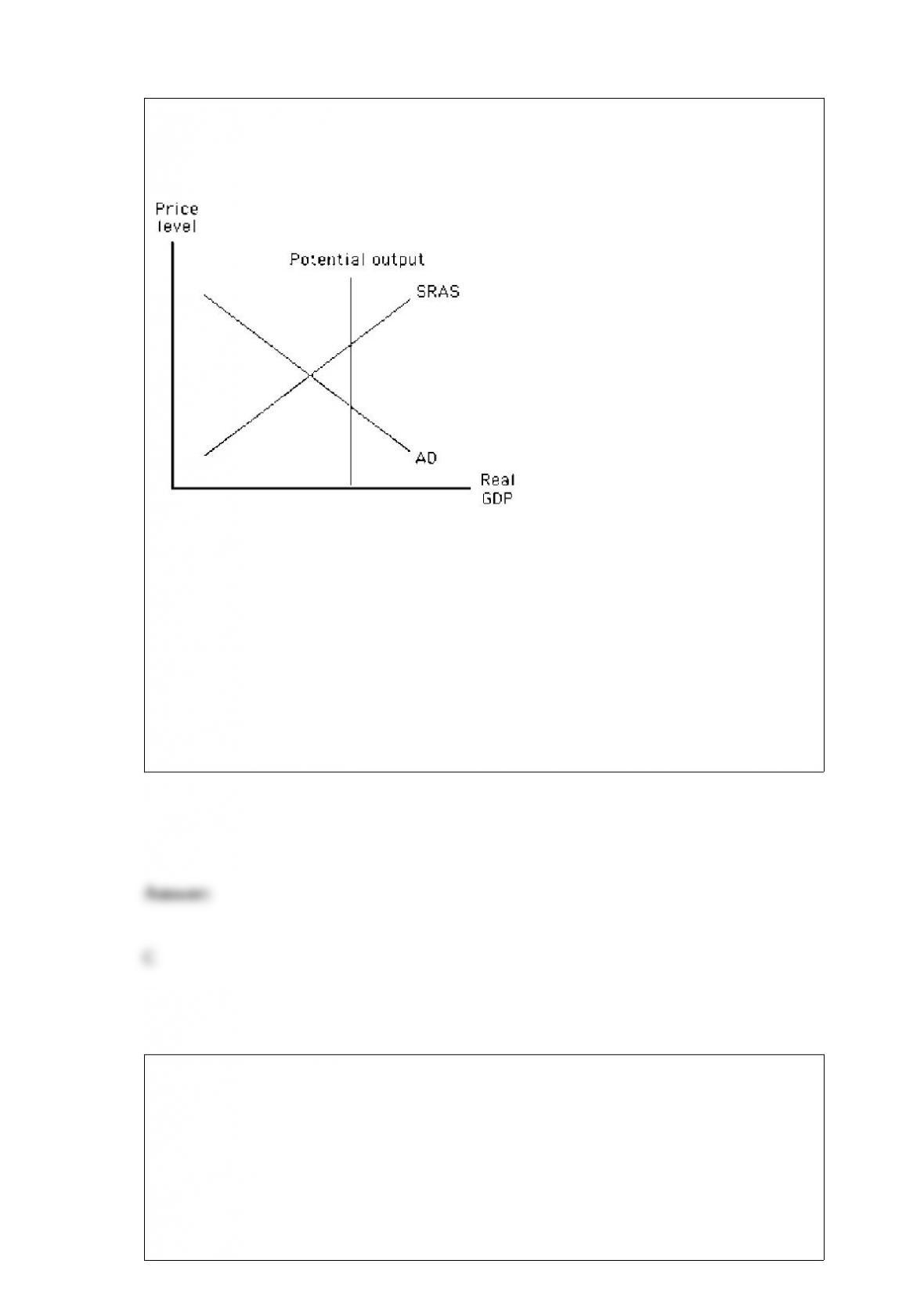
Figure 11-4
According to Keynesian analysis, which of the following policy combinations would
most likely to move the economy illustrated in Figure 11-4 to full employment?
a. increase both taxes and government transfer payments
b. reduction in government purchases and increase in taxes
c. increase in government purchases and reduction in taxes
d. increase in taxes to reduce the government deficit
In the Keynesian view, equilibrium takes place when
a. the real and nominal interest rates are equal.
b. the level of total spending in the economy is equal to current output.
c. current output is equal to the economy’s long-run potential.
d. the money supply is growing at a constant rate.
Compared to a permanent reduction in tax rates, a temporary tax cut will generally
a. exert a larger impact on output and employment because its effects are immediate,
long-lasting, and do not add much to the national debt.
b. exert a smaller impact on output and employment because the temporary cut will not
exert much impact on long-term income or the incentive to earn.
c. exert a larger impact on output and employment because the temporary tax cut will
lead to a larger budget deficit.
d. exert an identical impact on output and employment because the incentive effects
will be the same regardless of whether the tax cut is temporary or permanent.
The two conflicting tendencies that a firm has in an oligopolistic industry are the
incentive to
a. cheat to maximize joint profits and the incentive to raise prices.
b. cheat and avoid collusion and the incentive to raise price to maximize the firm’s share
of profits.
c. increase output in order to minimize per-unit costs and the incentive to reduce price
in order to maximize joint profit.
d. cooperate to maximize joint profits and the incentive to cheat on the agreement in
order to increase the firm’s share of the profit.
Which of the following contributed to the dramatic rise in housing prices between 2002
and mid-year 2006?
a. government policy made credit for housing abundant and easily available
b. the Fed’s restrictive monetary policy, which led to high interest rates
c. the tightening of loan standards by commercial lenders
d. the large amounts of reserves and equity capital being held by financial institutions in
order to back new mortgages
An appreciation of the U.S. dollar
a. is the same thing as a decrease in the consumer price level.
b. increases the purchasing power of the U.S. dollar in foreign markets for goods and
services.
c. decreases the purchasing power of the U.S. dollar in foreign markets for goods and
services.
d. is the same thing as an increase in the consumer price level.
If the value of a nation’s merchandise imports exceeds merchandise exports, the nation
is running a
a. balance of payments deficit.
b. balance of payments surplus.
c. merchandise trade deficit.
d. merchandise trade surplus.
Use the figure below to answer the following question(s).
Figure 12-3
Refer to Figure 12-3. If an economy is currently operating at Y1, which of the following
would a Keynesian economist be most likely to favor?
a. a shift in the federal budget toward a surplus
b. a shift in the federal budget toward a deficit
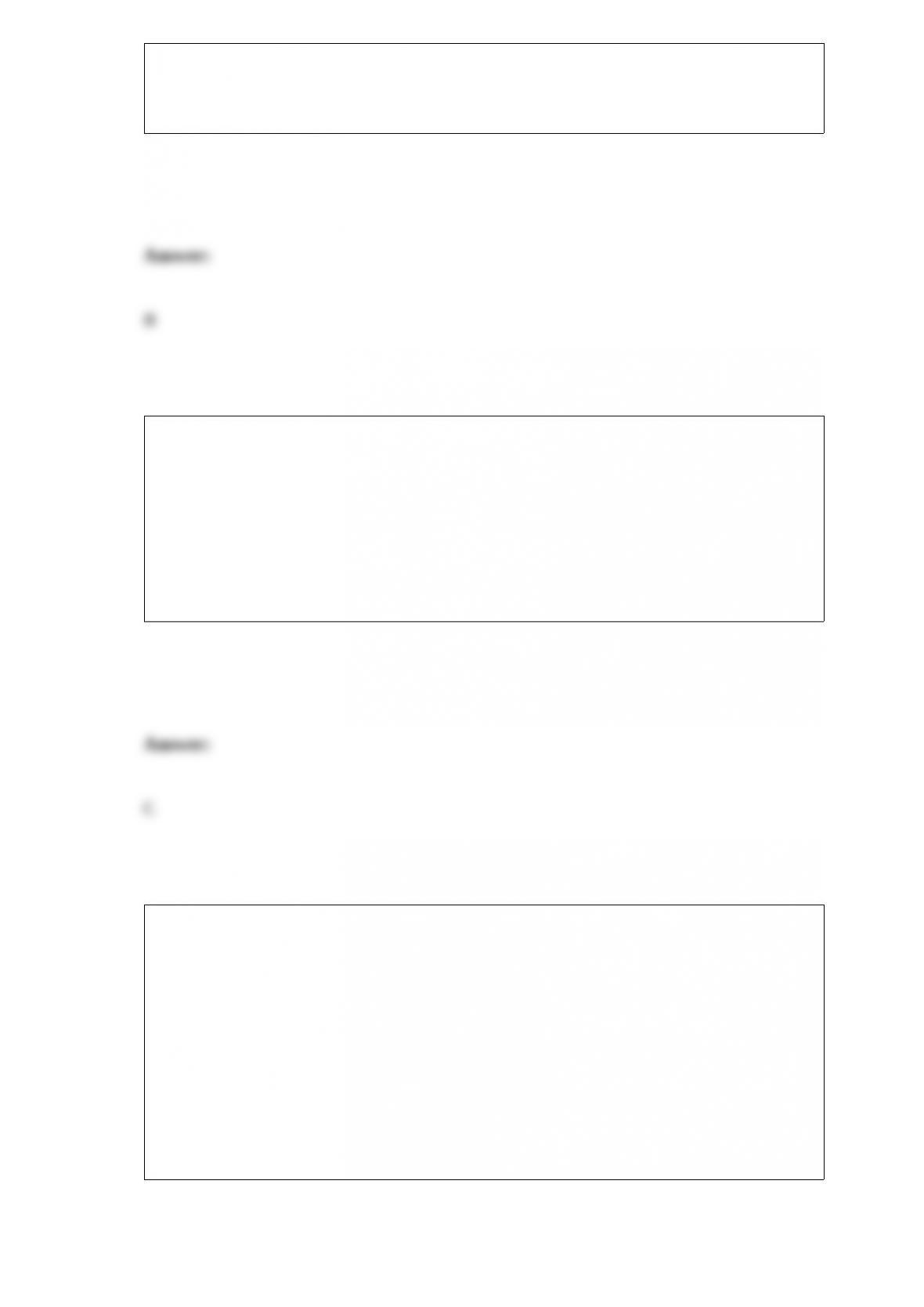
c. a balanced budget
d. an increase in taxes
The demand curve for money
a. shows the amount of money balances that individuals and businesses wish to hold at
various levels of private investment.
b. reflects the open market operations policy of the Federal Reserve.
c. shows the amount of money that households and businesses wish to hold at various
rates of interest.
d. indicates the amount that consumers wish to borrow at a given interest rate.
Which of the following would be most likely to improve the standard of living of
people in less-developed nations?
a. the development of strong labor unions
b. an increase in foreign investment
c. an increase in the share of the population under fifteen years of age
d. higher tariffs and the imposition of other restraints designed to restrict international
trade

Economists use the term “business cycle” to refer to
a. the growth of small businesses into major corporations.
b. changes in products that occur from improved technology.
c. fluctuations in the level of real output and employment.
d. periods of increases and decreases in the rate of inflation.
Based on the rising housing prices of 2000-2005, many buyers opted for interest-only
loans and variable rate mortgages with little or no down payment because
a. they expected short-term interest rates to fall substantially in the future and this
would reduce their monthly mortgage payment in the years ahead.
b. variable rate mortgages are a good way to reduce the risk accompanying your
investment when you plan to stay in the house for a long time.
c. they thought housing prices would continue to rise and therefore they would be able
to sell the house for a profit within a couple of years.
d. they could easily recoup their investment, even if there was a downturn in housing
prices in the future.
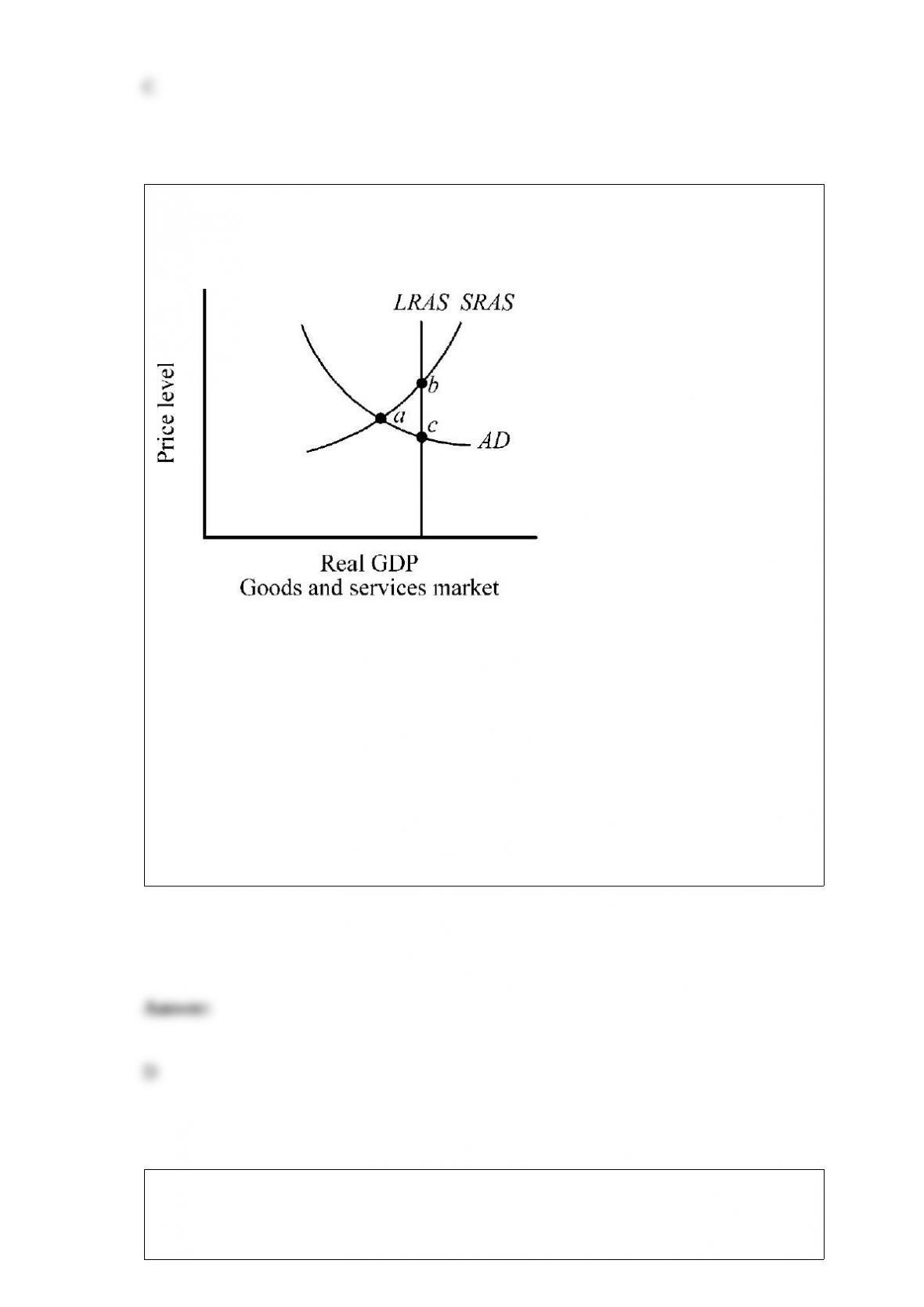
Use the figure below to answer the following question(s).
Figure 12-2
Refer to Figure 12-2. Which of the following will most likely be favored by a new
classical economist if the economy is operating at point a?
a. a tax increase to balance the budget
b. restrictive fiscal policy
c. expansionary fiscal policy
d. continuation of the current tax and expenditure policies (dependence on the
economy’s self-correcting mechanism to restore full employment)
If investment opportunities in the U.S. become more attractive to foreigners,
a. the exchange-rate value of the dollar will fall.
b. the current-account balance will shift toward a deficit.
c. the capital inflows to the U.S. will fall.
d. all of the above are true.
A compensation structure that generates much higher pay rates for the top performers,
while those whose productivity is only a little lower receive substantially less
compensation, is called
a. tournament pay.
b. competing differentials.
c. dueling executives.
d. winner take all.
Which of the following is an example of someone with inflationary expectations taking
a step designed to insulate themselves from the higher expected rates of inflation?
a. a consumer deciding to delay the purchase of a new home or automobile
b. a consumer who borrows money at a fixed interest rate in order to purchase a new
home or automobile
c. an investor who borrows funds at an adjustable money interest rate (one that
automatically increases with higher inflation)
d. a home buyer who borrows funds at a variable interest rate
The fallacy of composition is the incorrect view that
a. decisions are always made at the margin.
b. incentives matter only to those who behave selfishly.
c. if something is true for an individual, then it must also be true for the group.
d. the value of a good can be objectively measured by its cost of production.
The figure below illustrates a tariff. On the graph, Q represents quantity and P
represents price.
Figure 17-11
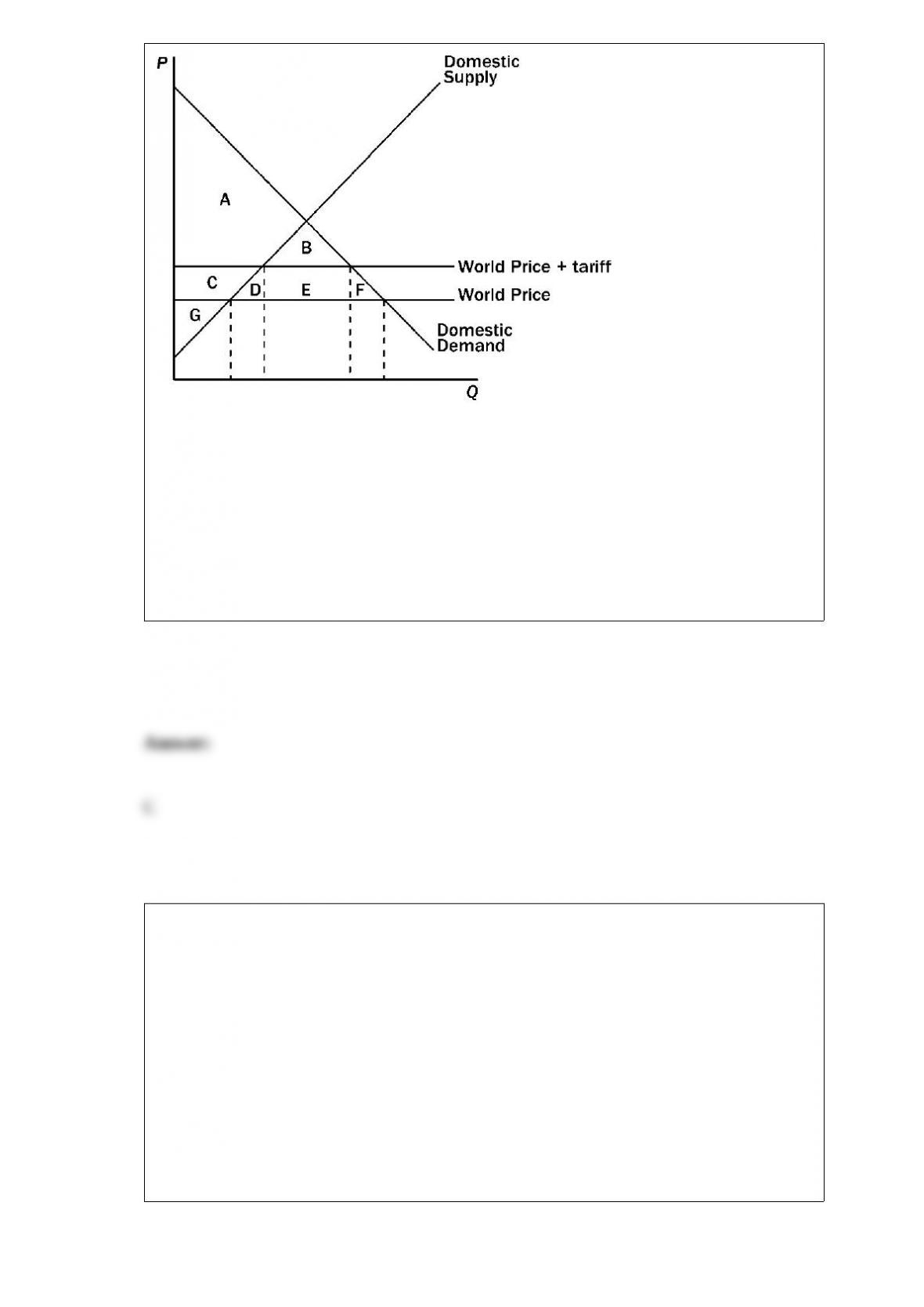
Refer to Figure 17-11. The tariff
a. decreases producer surplus by the area C and decreases consumer surplus by the area
C + D + E + F.
b. decreases producer surplus by the area C + D and decreases consumer surplus by the
area D + E + F.
c. increases producer surplus by the area C and decreases consumer surplus by the area
C + D + E + F.
d. increases producer surplus by the area B + C and decrease consumer surplus by the
area D + E + F.
Consider an economy made up of 100 people, 60 of whom hold jobs, 10 of whom are
looking for work, and 15 of whom are retired. The number counted as unemployed is
a. 10.
b. 15.
c. 40.
d. 30.
e. 90.
Which of the following is most important for the achievement of long-term economic
growth and a high level of per capita income?
a. abundant natural resources
b. foreign aid
c. policies and institutions that encourage productive activities
d. institutions and policies that control the growth of population
Which of the following states had the lowest incidence of union membership as a
percent of all wage and salary workers in 2012?
a. New York, Hawaii, and Alaska
b. South Carolina, North Carolina, and Arkansas
c. Illinois, Michigan, and Ohio
d. Nevada, Hawaii, and Alaska
The difference between the value of a country’s merchandise exports and merchandise
imports is known as the balance
a. of payments.
b. of merchandise trade.
c. on current account.
d. on capital account.
When firms use resources in an attempt to secure and maintain grants of market
protection from the government, it is called
a. rent-seeking.
b. collusion.
c. franchising.
d. resource investment.
Suppose all of the major computer manufacturers announced that beginning next month
there would be major price reductions on their computers. This would cause the current
demand for computers to
a. increase.
b. decrease.

c. remain unchanged.
d. increase if the demand for computers was relatively inelastic, but decrease if the
demand for computers was relatively elastic.
Suppose the market equilibrium price of wheat is $5 per bushel, and the government
sets a price floor of $7 per bushel to aid growers. What is the most likely result of this
action?
a. There will be a shortage of wheat.
b. There will be a surplus of wheat.
c. There will be an increase in the quantity of wheat demanded as the result of the price
floor.
d. There will be a decrease in the quantity of wheat supplied as the result of the price
floor.
Between 2001 and 2005, sub-prime (including Atl-A) mortgages ____________ as a
share of the total.
a. fell from 30 percent to less than 10 percent
b. rose from 5 percent to 10 percent
c. rose from 10 percent to more than 30 percent
d. fell from more than 20 percent to less than 10 percent
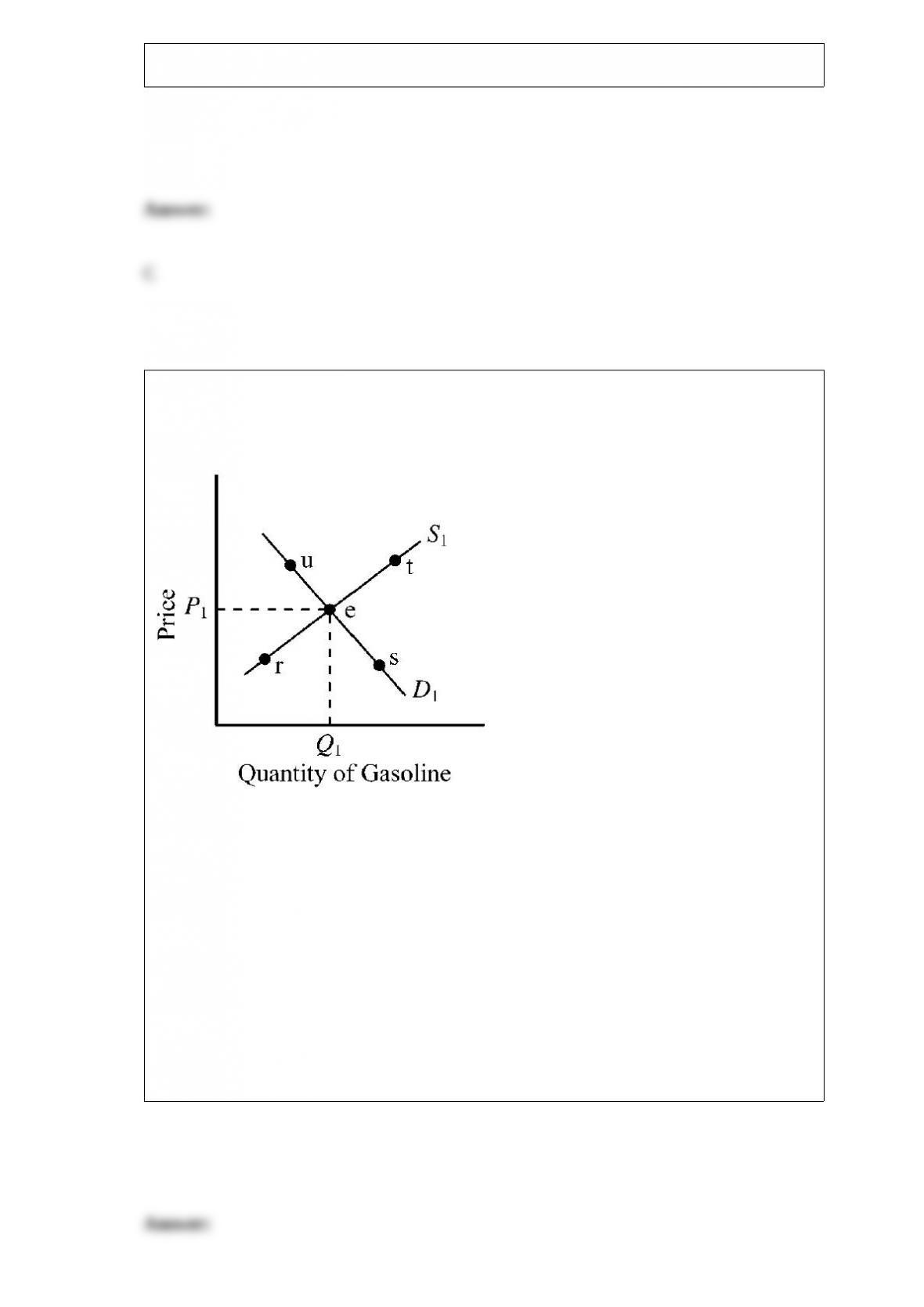
Use the figure below to answer the following question(s).
Figure 3-14
Refer to Figure 3-14. The gasoline market was initially in equilibrium at point e. Other
things constant, an increase in the popularity and use of Sport Utility Vehicles (SUVs)
that consume more gasoline per mile driven than most other types of cars would likely
move the equilibrium in this market toward point
a. r.
b. s.
c. t.
d. u.