
If supply is low relative to demand, then we can expect the equilibrium wage to be:
A) demand-determined.
B) relatively high.
C) relatively low.
D) neither high nor low, but very volatile.
Which of the following is true for both a monopolist and a perfectly competitive firm
when each is maximizing profit?
A) Price equals marginal costs.
B) Marginal revenue is less than price.
C) Marginal revenue is equal to marginal cost.
D) all of the above
Additional Application
A study done by a group from the Harvard School of Public Health in 1988 indirectly
supported the relationship between the price a consumer pays and the marginal utility
the consumer receives for medical services. The study claimed that the charges for

surgery were “too high” while charges for doctor consultations and office visits were
“too low.” An hour of a doctor’s time in surgery earned a great deal more than an hour
of consultation in the office. If more prevention through consultation could result in less
need for surgery, why should the fees for corrective medical surgery be so much greater
than the fees for diagnosis and prevention of medical problems? Therefore the Harvard
group recommended higher fees for consultation and lower fees for surgery. They
determined that such changes would more accurately reflect the value of each service.
Yet consumers willingly pay more for surgery than consultation. Why? Because the
marginal utility received from an hour of surgery is determined to be much greater than
the marginal utility from an hour of consultation. Consumers allocate their expenditures
with an awareness of the ratio of the marginal utility from a good or service to its price.
“Doctors’ Fees Called Out of Balance,” The Christian Science Monitor, September 29,
1988, p. 3.
If the results of the study are correct, a typical consumer using the equimarginal rule
would be expected to:
A) purchase fewer consultations and more surgeries.
B) purchase the same number of both services.
C) purchase more consultations and fewer surgeries.
D) purchase less of both services.
Refer to Figure 12.6. If the firm represented was to increase its price from $15 to $13:
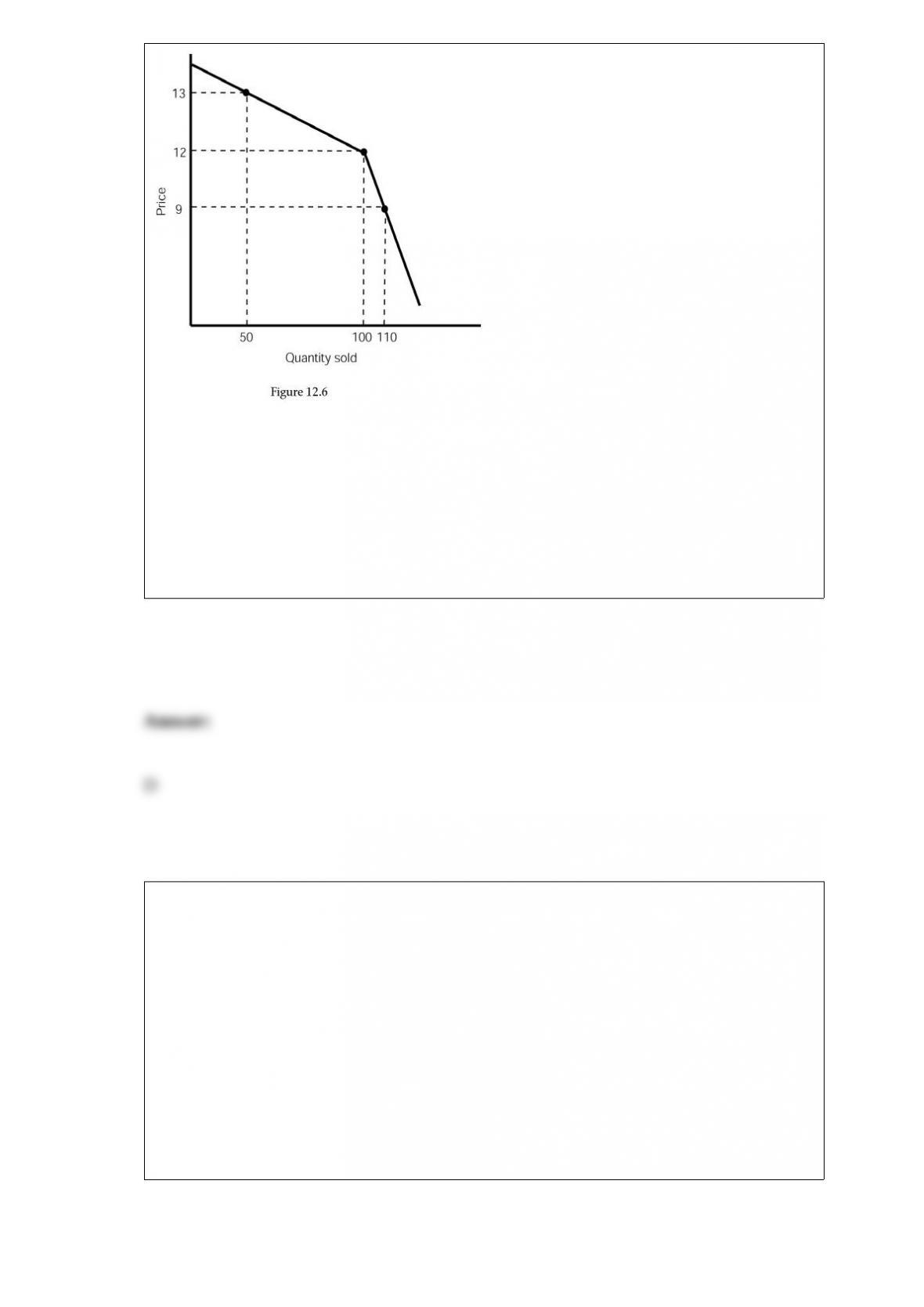
A) other firms would match the price increase.
B) other firms would lower their prices.
C) the total revenue of the firm in Figure 12.9 would increase.
D) other firms would not match the price increase.
Recall the application about global weather observation and what happens when it
comes to international borders. What kind of problem does global weather observation
face?
A) Information gathered by one country is nonrival and therefore produces a free rider
problem.
B) No single organization gathers all the information to reveal the big weather picture.
C) Some parts of the world received little to no monitoring.
D) all of the above.

The demand for a particular good depends on variables such as:
A) consumer income.
B) price of substitutes.
C) price of complements.
D) all of the above.
Which one of the following is a good example of an increasing-cost industry?
A) apartments
B) sugar
C) mining
D) all of the above
In which of the following markets is price discrimination likely? Explain.
(a) Televisions
(b) Airline travel
(c) Wheat
World’s Best Chair Co. has produced 30 chairs at a total cost of $300. The next chair
produced will add $10 to the company’s total cost. Which of the following is definitely
TRUE if the 31st chair is produced?
A) Short-run average total cost will decrease.
B) Marginal cost will decrease.
C) Average fixed cost will decrease.
D) A and C are true.
Consider two individuals, Rose and Sharon, who produce fish and coconuts. Rose and
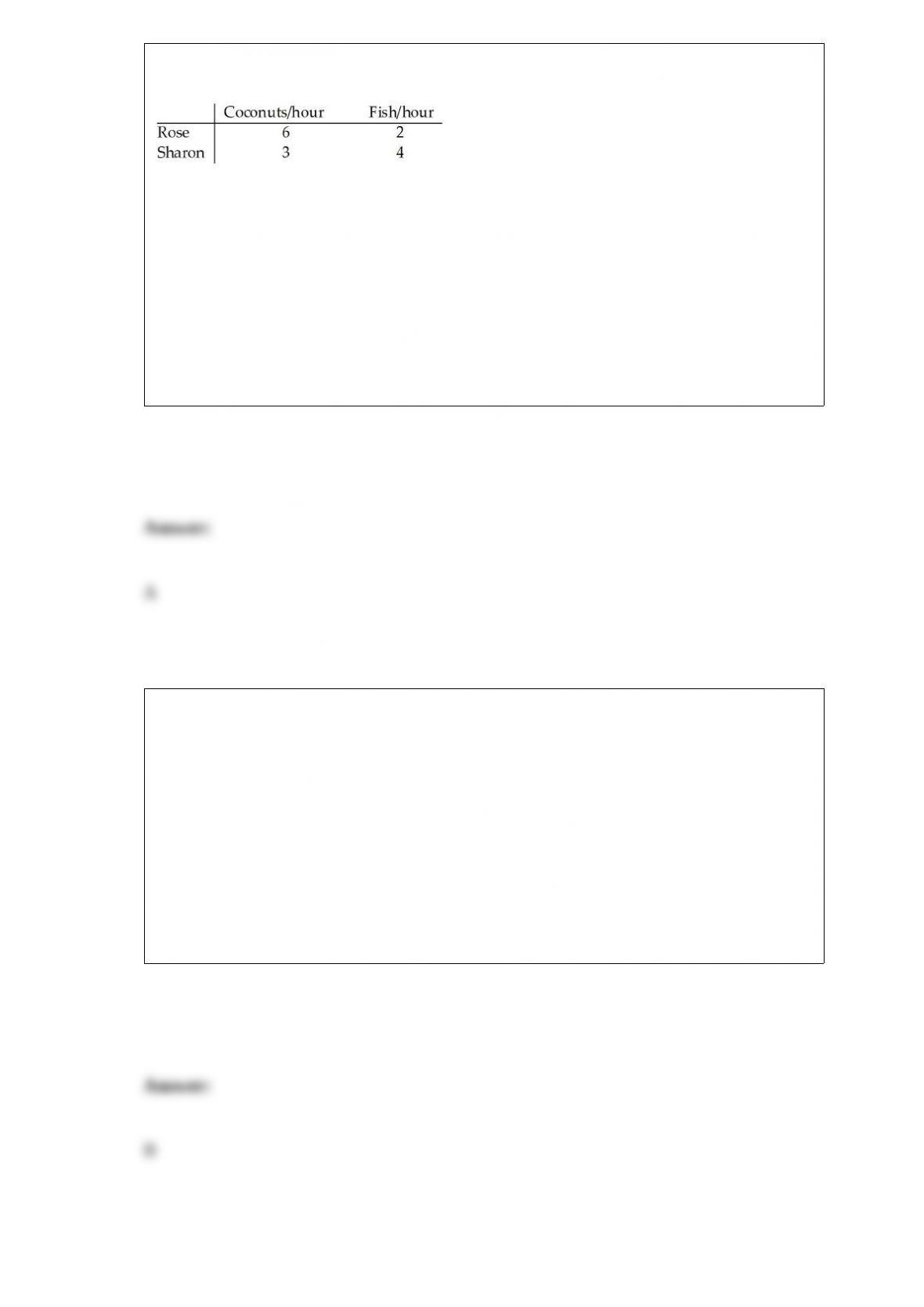
Sharon’s hourly productivity are shown in Table 3.2. Sharon’s opportunity cost of
producing 1 fish is:
Table 3.2
A) 3/4 coconut.
B) 1 1/3 coconuts.
C) 3 coconuts.
D) 4 coconuts.
According to the Application about productivity in the nation of Latvia in the
1990s,, in the 1990s EU countries had ________ in the production of all products
compared to Latvia.
A) an absolute advantage and a comparative advantage
B) an absolute advantage but not a comparative advantage
C) a comparative advantage but not an absolute advantage
D) neither an absolute advantage nor a comparative advantage

Mary has an old house built in 1950 that she would be willing to sell for $100,000. If
someone offers to buy her house for $110,000, Mary’s producer surplus would be equal
to:
A) $5,000.
B) $10,000.
C) $55,000.
D) $100,000.
Which of the following is NOT an example of price discrimination?
A) An individual finds his favorite brand of cookies on sale at the local grocery store.
B) A computer manufacturer offers a mail-in rebate for its product.
C) A local movie theater offers college students a discount on the price of admission.
D) An airline passenger who is staying on his trip over a Saturday night will pay a
lower fare than a passenger traveling only during the workweek.
If Juan purchases the same number of gallons of gasoline per week regardless of
changes in gasoline price, Juan’s demand for gasoline is:
A) perfectly elastic.

B) elastic.
C) perfectly inelastic.
D) inelastic.
Farmer Brown sells her wheat in a perfectly competitive market. Suppose the current
market price of wheat is $2.50 per bushel.
A) Farmer Brown can sell as much wheat as she likes at $2.50 per bushel.
B) Farmer Brown can charge any price for her wheat, but will maximize profit if she
sells for less than $2.50.
C) Farmer Brown should charge more than $2.50.
D) Farmer Brown can charge more than $2.50 and still sell some wheat.
Command-and-control policies mandate:
A) the use of a particular abatement control technology.
B) the level of output that the firm can produce.
C) the price that the firm can charge for its output.
D) the level of output and the price the firm can charge for its output.
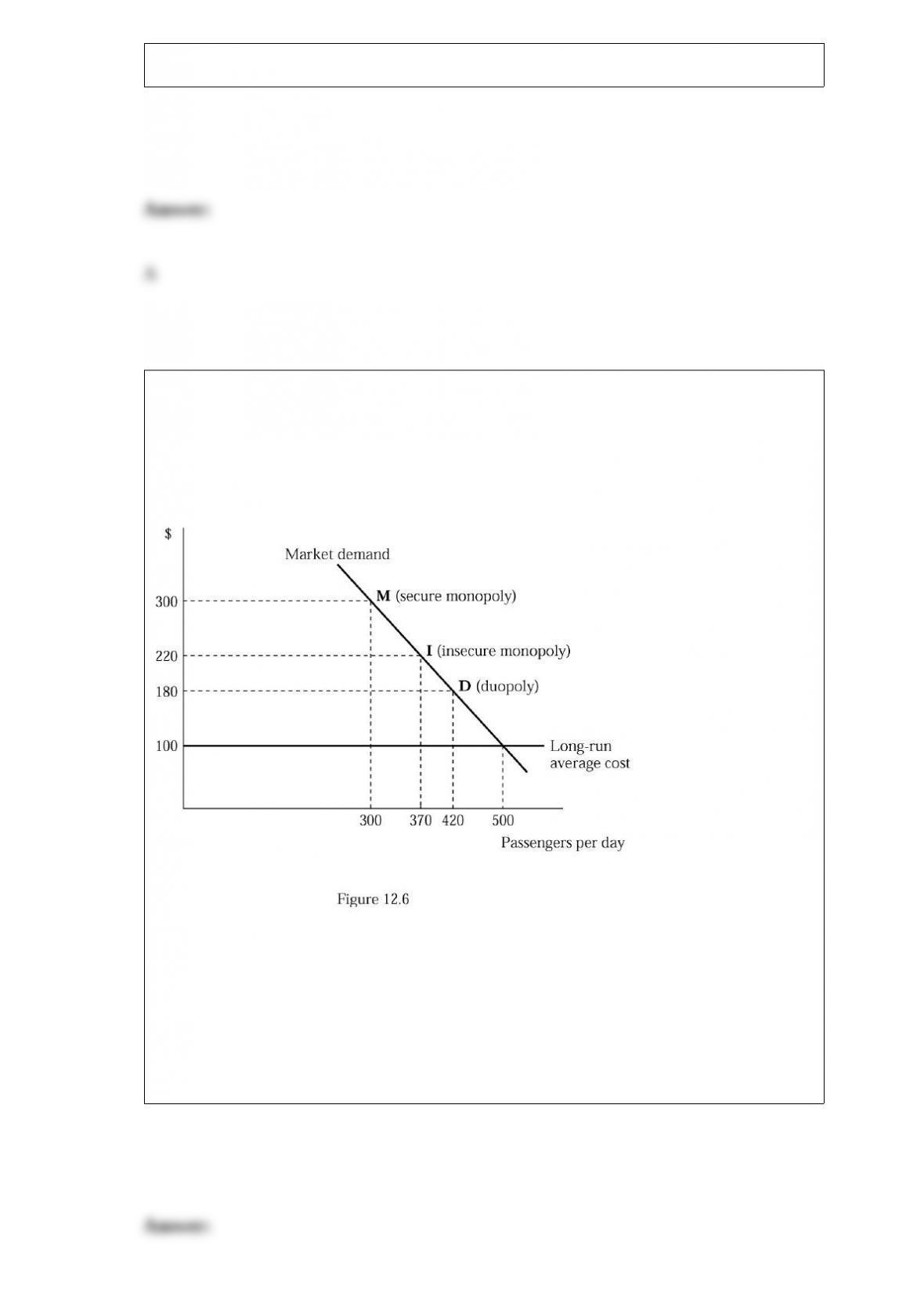
In Figure 12.6, airline Fly Smart is initially a secure monopoly between two cities X
and Y at point M, serving 300 passengers per day at the profit maximizing price of $300
per ticket. Suppose that Fly Smart discovers that a second airline is contemplating
entering the market. If the minimum market entry quantity is 130 passengers per day,
what price should Smart Fly charge to secure the entry-deterring quantity?
A) $300
B) $220
C) $180
D) $100
Which of the following is NOT a barrier to entry for monopoly?
A) a patent
B) government licensing
C) large economies of scale
D) a large number of existing firms in a market
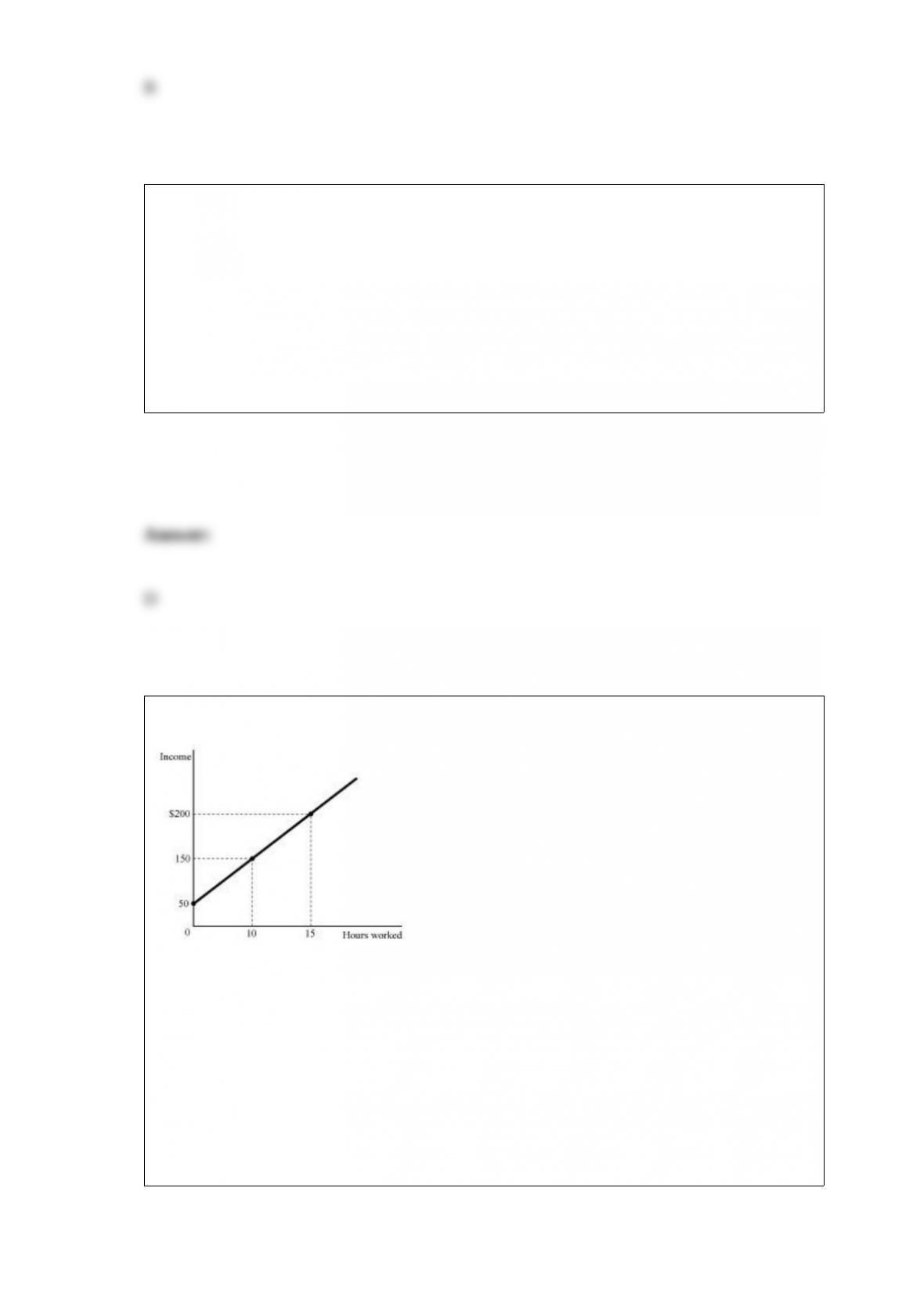
Refer to Figure 1.1. If hours worked are zero in Figure 1.1, then income is:
Figure 1.1
A) zero.
B) $200.
C) $100.
D) $50.

We expect firms with ________ to sell marketable pollution permits to firms with
________.
A) low abatement costs; high abatement costs
B) high abatement costs; low abatement costs
C) high price goods; low price goods
D) high production capacity; low production capacity
When the price of tacos went from $2 to $3 dollars each, the quantity demanded of
burritos changed from 100 to 120 a day. The cross-price elasticity of demand for
burritos calculated using the initial value method is:
A) 1.33.
B) 0.75.
C) 0.4.
D) -0.75.
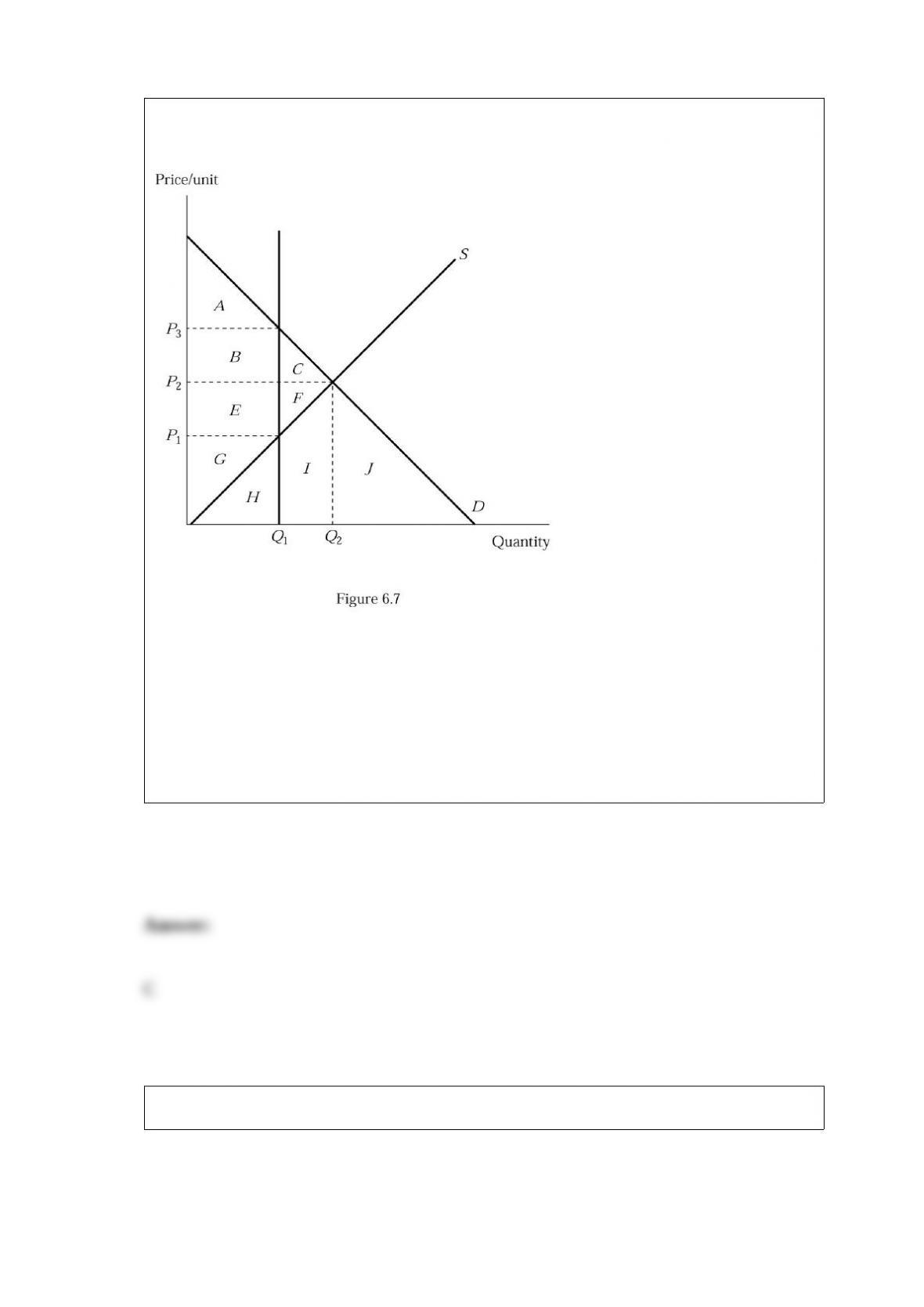
In Figure 6.7 with a quantity constraint of Q1, the dead weight loss is area:
A) A.
B) H + I + J.
C) C + F.
D) G.
The four-firm concentration ratio for the market depicted in Table 12.1 is:

Table 12.1
A) 10%.
B) 40%.
C) 82%.
D) 92%.
Assume the market for beef is perfectly competitive. Beef producers are currently
earning a zero economic profit. If consumers switch from beef to chicken, which of the
following is most likely to occur?
A) Beef producers will now incur economic losses in both the short run and the long
run.
B) Beef producers will incur economic losses in the short run. Some producers will exit
the industry until those remaining are earning a zero economic profit.
C) Beef producers will incur economic losses in the short run. Some producers will exit
the industry until those remaining are earning an economic profit.
D) Beef producers will now earn economic profits in the short run and there will be no
additional adjustments in the long run.

An import quota:
A) limits the amount of a good that can be imported, thus decreasing prices.
B) limits the amount of a good that can be imported, thus increasing prices.
C) increases the amount of a good imported, thus decreasing prices.
D) increases the amount of a good imported, thus increasing prices.
The Federal Trade Commission Act:
A) prohibited selling products at “unreasonably low prices” with the intent of reducing
competition.
B) was passed to establish a body to enforce antitrust laws.
C) outlawed stock purchases that would substantially reduce competition.
D) made it illegal to monopolize a market.
A monopolistic competitive market has the following characteristics EXCEPT:
A) no barriers to entry.

B) the product is homogeneous.
C) many sellers.
D) relatively elastic demand.
If a pollution tax imposed on a firm is smaller than external cost:
A) the externality is completely internalized.
B) the social production cost increases by the amount of the pollution tax.
C) the pollution tax transfers the full cost borne by people outside the firm back to the
firm itself.
D) the firm is producing too much from a society’s point of view.
Suppose that the equilibrium rent for apartments in San Francisco is $1200 per month.
If the City of San Francisco legislates that apartment owners cannot charge rent higher
than $1900, then the apartment market in San Francisco will experience:
A) an equilibrium.
B) a shortage.
C) an excess supply.

D) an increase in supply.
Assume that firms in an oligopoly are currently colluding to set price and output to
maximize total industry profit. If the oligopolies are forced to stop colluding, the price
charged by the oligopolies would ________ and the total output produced will
________.
A) increase; increase
B) increase; decrease
C) decrease; increase
D) decrease; decrease
Suppose that in the time it takes for him to bake a cake, Bob can sew 5 pairs of jeans. In
the time it takes for Joe to bake a cake, he can sew 8 pairs of jeans day. In this example,
who has the comparative advantage in baking a cake?
A) Joe
B) both Bob and Joe
C) Bob
D) neither Bob nor Joe

An employer can find himself in an adverse selection problem if there are too:
A) many applicants for each job.
B) few applicants for each job.
C) many qualified applicants for each job.
D) many underqualified applicants for each job.
What effect does the absence of barriers to entry in a monopolistically competitive
industry have on the existing firms’ demand and marginal revenue curves?
A) The demand and marginal revenue curves begin to shift to the right.
B) The demand curve begins to shift to the right, but the marginal revenue curve shifts
to the left.
C) Both curves shift to the left.
D) The demand curve shifts to the left, but the marginal revenue curve shifts to the
right.

Recall Application 2, “What Have Been the Local Effects of Chinese Imports?” to
answer the following questions:
According to the Application, what effects of the Chinese imports were
disadvantageous to local communities?
A) more workers receiving unemployment insurance
B) more workers receiving disability payments
C) more workers relying on food stamps from the government
D) All of the above are correct.
Recall the application about Microsoft having a virtual monopoly in the market for
personal-computer operating systems and business software. Which of the following
best represents the way Microsoft keeps other firms from entering the market?
A) Microsoft buys out small firms that have the potential to make a similar product.
B) Microsoft uses limit pricing to deter entry.
C) Microsoft has a patent that prohibits any firm from producing a similar product.
D) Microsoft is a pure monopoly where it is impossible for other firms to enter the
market.