
Recall Application 3, “The Broken Window Fallacy and Keynesian Economics,” to
answer the following questions:
In the Application, why might fixing a broken window not be good for society?
A) because the money spent on fixing the broken windows could have been spent
elsewhere
B) because the spending on the window creates a multiplier effect
C) because the government charges a tax on any new window repaired
D) because any expenditure is not good for the economy
Additional Application MAKING THE FEDERAL RESERVE MORE
TRANSPARENT What are the advantages and disadvantages of the Federal Reserve
becoming more transparent about its actions and decisions and disclosing more
information to the public? In recent years, the Fed has gradually become more open in
its deliberations. For many years, the Fed would not even say if it had changed interest
rates. These policies began to change slowly in the 1990s. Starting in 2000, after each
FOMC meeting the Fed announces its target for the federal funds rate and makes a brief
statement explaining its actions. But should the Fed go further in describing its intended
future policies? There was enough interest on this very topic for the FOMC to hold a
special meeting—the first since 1979—to discuss the issue. Some members of the
FOMC, including the current chairman Ben Bernanke, believed that the financial
markets needed more information so that they would have a clearer idea of what future
Fed policy—and short-term interest rates—were likely to be. Other members, including
William Poole, the president of the St. Louis Federal Reserve Bank, disagreed. Poole
felt that the financial markets understood the implicit rules that the Fed followed and
that issuing a more complex public statement would just confuse
matters. The special meeting did not lead to any dramatic change in the Fed’s
communication policies. But now the members of the FOMC participate in drafting
statements. The Fed clearly recognizes that its statements may be just as important as its
actions. According to the application, the Federal Reserve started announcing its
targeted federal funds rate only after:
A) 1970.
B) 1980.
C) 1990.
D) 2000.
Based on growth accounting, which of the following would not cause a reduction in
output?
A) a reduction in employment
B) a reduction in the capital stock
C) a reduction in the number of hours worked
D) a reduction in interest rates
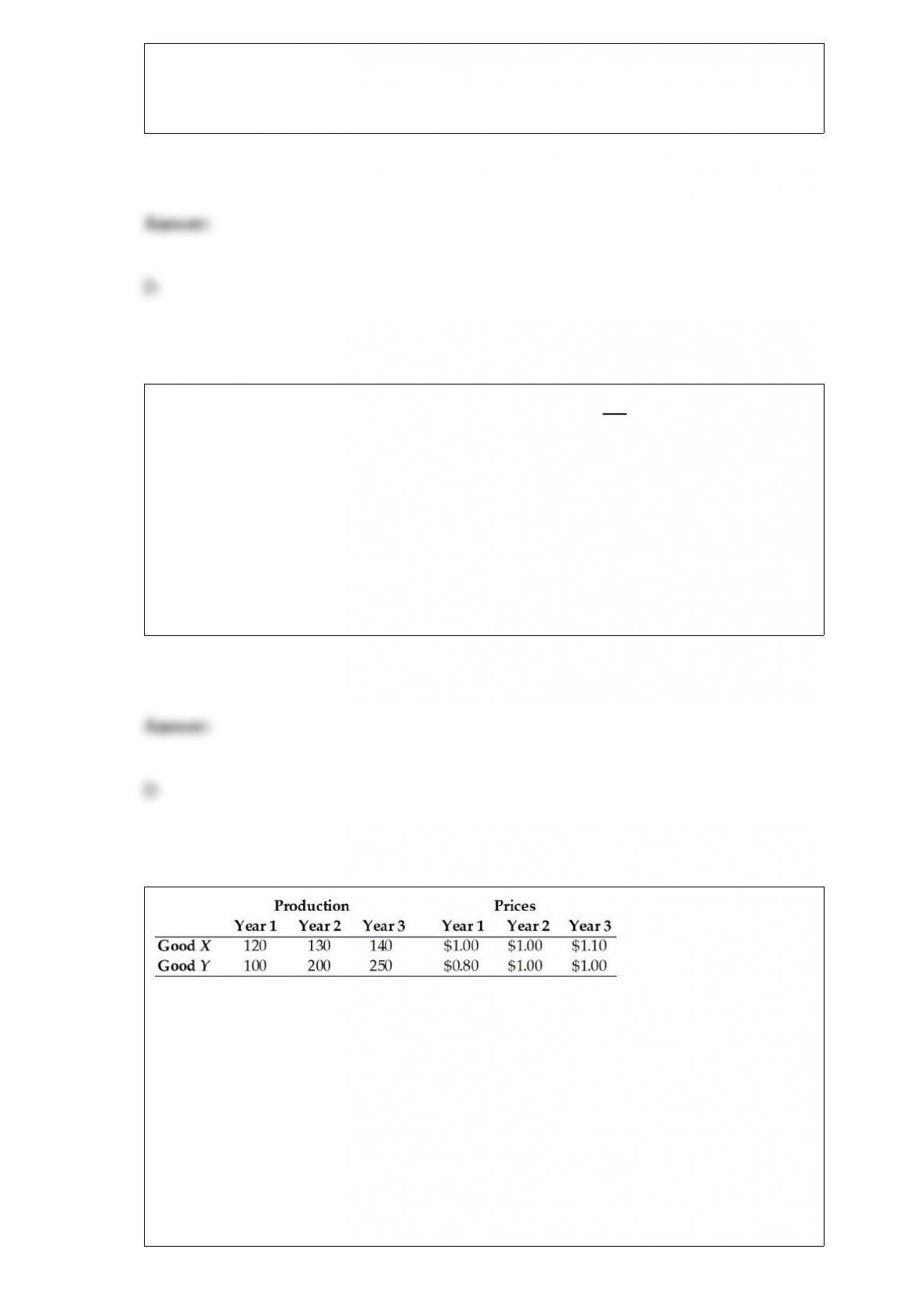
Table 5.3
Refer to Table 5.3. Suppose this economy produces only the two goods X and Y.
Nominal GDP in year 3 is:
A) $208.
B) $350.
C) $404.
D) $510.

The largest source of federal revenue is:
A) corporate income taxes.
B) individual income taxes.
C) social insurance taxes.
D) estate and gift taxes.
The decisions concerning the money supply are made by:
A) the FOMC.
B) the Board of Governors.
C) the presidents of the district central banks.
D) Congress.

An increase in the discount rate
A) reduces the cost of reserves borrowed from the Fed.
B) signals the Fed’s desire to increase the money supply.
C) signals the Fed’s desire to lend increased reserves to banks.
D) increases the cost of reserves borrowed from the Fed.
Recall Application 2, “Elections, Political Parties, and Voter Expectations,” to answer
the following questions:
According to the application, which political party puts more emphasis on making the
economy grow?
A) Republicans
B) Democrats
C) Green
D) Libertarians
Keynes expressed doubts that that the economy would
A) ever return to full-employment.
B) ever move away from full-employment.

C) recover from a major recession without active policy.
D) recover from the effects of higher prices.
Suppose an economy that has been operating at full employment has been experiencing
4 percent annual inflation. If output later exceeds potential output, prices generally will
begin to rise at
A) a rate of 4 percent.
B) a rate greater than 4 percent.
C) a rate less than 4 percent.
D) a rate of 0 percent.
If the reserve ratio is designated by “r,” how much of a deposit can banks lend out?
A) 1 /
B) (1 – )
C) 1 / (1 – )
D) / (1 – )
Identify whether each of the following would lead to an appreciation or depreciation of
the dollar. In each case, explain why the currency either appreciates or depreciates.
(a) U.S. citizens switch from buying stock in British companies to buying stock in U.S.
companies.
(b) The inflation rate in the United States increases relative to the inflation rate in
England.
(c) The money supply is increased in the United States.
As the Indian rupee depreciates relative to the dollar, total spending on Indian goods
and assets will increase. Therefore, in the foreign exchange market, the
A) supply curve of dollars is upward sloping.
B) demand curve for dollars is upward sloping.
C) supply curve of euros is downward sloping.
D) demand curve for euros is upward sloping.

________ unemployment is NOT associated with economic fluctuations.
A) Structural
B) Cyclical
C) Frictional
D) both A and C