
All two-dimensional graphs must have an origin, a horizontal axis, and a vertical axis.
a. True
b. False
A depreciation of the U.S. dollar has the same effect on aggregate supply as an increase
in foreign prices.
a. True
b. False
Graphs are useful because of the way they
a. facilitate interpretation and analysis of data.
b. clarify interpretation and analysis of ideas.
c. permit a person to easily see relationships.
d. convey an idea that might otherwise take many words.
e. All of the above are correct.

Input-output analysis is a technique used to solve complicated market equations.
a. True
b. False
Pure monopoly is defined as a
a. one-firm industry.
b. market structure in which there are many substitute products.
c. market structure maintained by entry of many rival firms.
d. market structure created by special government sanctions.
A firm can always increase its output by one unit at a marginal cost of $10. Its marginal
cost curve is

a. a horizontal line.
b. a vertical line.
c. a ray with slope equal to 10.
d. exactly one-tenth as steep as its total cost curve.
Speculators play a role in the economy similar to that played by
a. farmers.
b. investment banks.
c. insurance companies.
d. stockbrokers.
Taking advantage of the built-in-loophole in emission taxes implies
a. opportunity to save on taxes by reducing emissions.
b. opportunity to avoid taxes even without cutting emissions.
c. opportunity to increase emission by paying more tax.

d. opportunity to pay less by increasing emission.
Which of the following statements about the national debt has the most validity?
a. Our large national debt can bankrupt the nation.
b. If only Americans hold the debt, then payments of interest and principal are simply
transfers from some Americans to other Americans.
c. Our large national debt can lead to subjection by the people (especially foreigners)
who hold the debt.
d. The national debt represents a burden to future generations who will have to make
huge payments of interest and principal.
An efficient allocation of resources requires each product’s price to equal its marginal
cost.
a. True
b. False
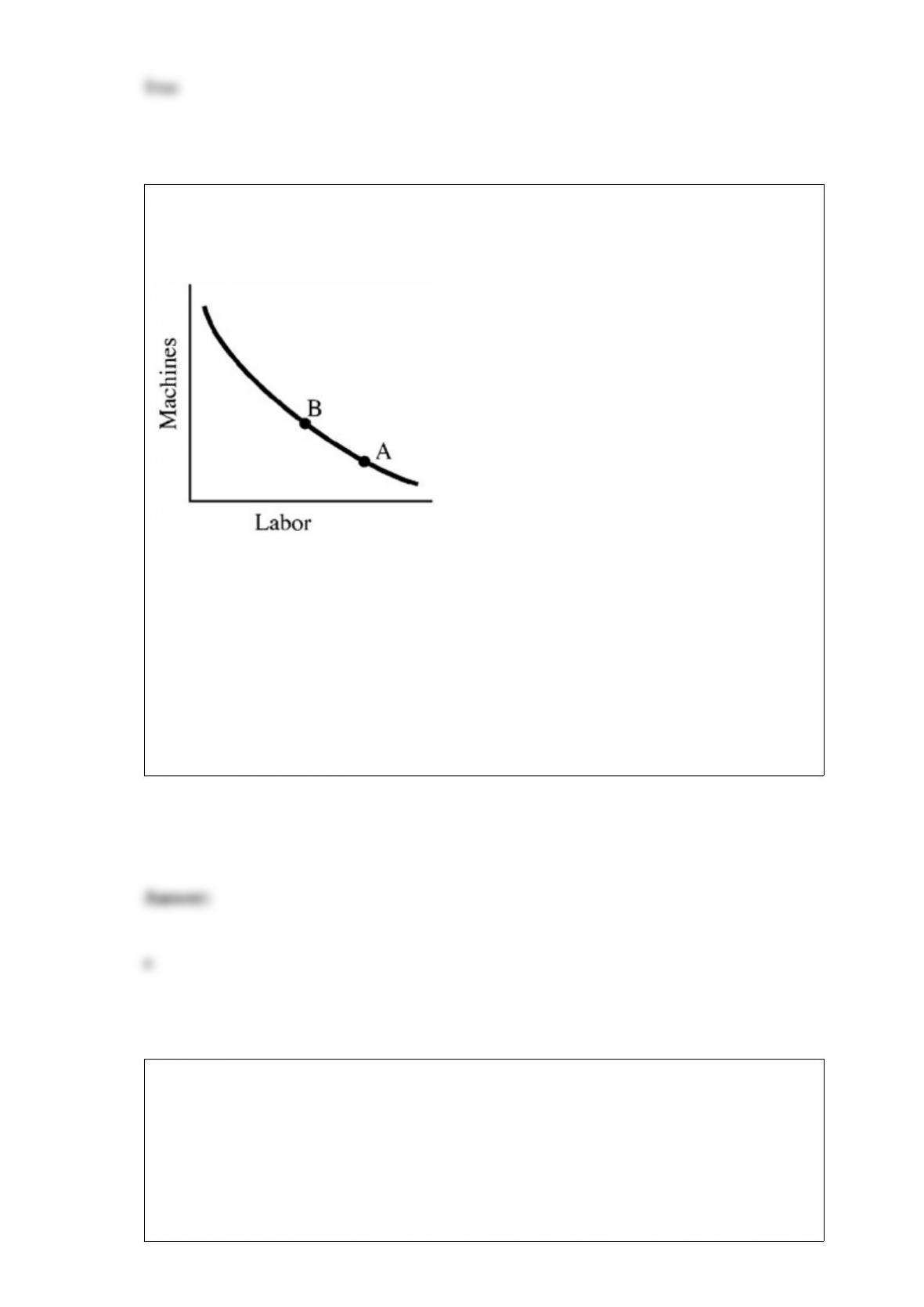
Figure 7-15
In Figure 7-15, we would expect a move of the budget line from A to B if
a. the price of machines falls.
b. the price of labor falls.
c. output falls.
d. the product price rises.
Market economies produce outcomes that
a. are virtually ideal in all respects.
b. are inferior to most other systems.
c. are, in some respects, far from ideal.

d. are virtually indistinguishable from command economies.
Many economists believe that
a. once a negative income tax system was in place, the United States could increase
economic equality indefinitely without reducing economic efficiency.
b. a negative income tax would be less efficient than the current welfare system.
c. replacing the current welfare system with a negative income tax would increase both
economic efficiency and economic equality.
d. None of the above is correct.
The former communist countries of eastern Europe and the Soviet Union
a. have a better track record in environment protection than market economies.
b. have a dismal environmental record.
c. epitomize the ability of planned economies to protect the environment.
d. have no water pollution problems.

In an effort to balance the federal budget, an increase in Social Security taxes is passed.
What is the most likely effect of this on equilibrium GDP?
a. GDP will increase.
b. GDP will decrease.
c. GDP will not change but prices will rise.
d. GDP will not change but employment will increase.
Some nations that seek to produce all of their own needs face the problem that
a. people don’t want a wide variety of choices when buying.
b. some industries are too small to be efficient.
c. other countries may want to buy from them.
d. All of the above are true.

The price system automatically leads to an efficient allocation of inputs among the
different production processes.
a. True
b. False
The payroll tax is the federal government’s biggest source of revenue.
a. True
b. False
Price controls are usually enacted in response to
a. popular opinion.
b. governmental studies.
c. scholarly research on the effects of high prices.
d. laws enacted in other countries.
e. All of the above are correct.

A well-functioning market will have high monetary costs applied to high opportunity
costs.
a. True
b. False
The dollar appreciates against the euro when U.S. demand for European goods
increases.
a. True
b. False
Firms will borrow to finance capital expansion until the MRP of the investment equals
the
a. MRP of labor.

b. marginal cost of the finished good.
c. marginal physical product of capital.
d. interest payment charged for borrowing.
____ is an object in use as a medium of exchange, but which also has a substantial
value in alternative uses.
a. IOU
b. A commodity money
c. Fiat money
d. Deposit certificate
Which of the following would tend to shift the production function upward?
a. an increase in the number of hours worked
b. an increase in population
c. an increase in the size of the labor force
d. an increase in the level of technology

Equilibrium GDP will not exist where output exceeds aggregate demand because
businesses will notice that
a. their profits are positive.
b. inventory stocks are building up.
c. inventory stocks are being depleted.
d. their level of depreciation is rising.
An increase in AD will trigger more inflation under which of the following conditions?
a. AD is relatively steep.
b. AD is relatively flat.
c. AS is relatively steep.
d. AS is relatively flat.

Marginal cost curves and average cost curves are both purely upward sloping.
a. True
b. False
International capital flows in an open economy have the effect of
a. increasing the power of fiscal policy.
b. reducing the power of fiscal policy.
c. reducing the power of fiscal policy in an expansion, and increasing it in a contraction.
d. increasing the power of fiscal policy in an expansion, and reducing it in a
contraction.
Congress is debating whether to raise taxes by $100 billion or decrease spending by
$100 billion in order to eliminate a budget deficit. Which action will have the larger
effect on equilibrium GDP?
a. the increase in taxes
b. the decrease in spending

c. the effects will be equal
d. not possible to determine without knowing the multiplier
The economy in the period 1950 to 1998 behaved differently than the economy in the
1870 to 1940 time period. Economists explain this difference
a. in part because of the use of stabilization policy.
b. because of increases in U.S. population due to the “baby boom.”
c. in part because of the globalization of the economy.
d. in part because of the use of competition policy.