
Contractionary fiscal policy is used to decrease aggregate demand in an attempt to fight
rising inflation.
As a percentage of GDP, health care spending on Medicare and Medicaid is expected to
double over the next 40 years unless health care costs begin to grow at a slower rate.
The CPI in 2010 was 218, while the CPI in 1980 was 82. If you had $5,000 in 1980, its
equivalent purchasing power in 2008 would be $10,850.
Technological change is the key to sustaining economic growth.

As spending on government purchases increases, income rises and money demand falls.
Ceteris paribus, a decrease in the government’s budget deficit will increase domestic
investment and net foreign investment.
Government spending on transfer payments is included in government purchases when
calculating GDP because it results in the production of new goods and services.
An easy way to determine if a currency is undervalued at a point in time is to use the
model of purchasing power parity.

The productivity slowdown experience in the United States from the mid-1970s to the
mid-1990s was actually a global phenomenon.
The relationship between GDP and the money supply has gotten stronger since the
1980s.
An increase in the price level in the United States will reduce exports and increase
imports.
The values of real GDP and real GNP are almost the same in countries where a
significant fraction of domestic production takes place in foreign-owned firms.

The natural rate of unemployment consists of frictional unemployment plus structural
unemployment.
Seth’s grandmother gave him a $50 savings bond for his birthday. The bond pays $50 at
maturity, which is in five years. If the interest rate is 5%, the bond has a present value
of $43.19.
If the United States is a “net borrower” from abroad,
A) the United States must be exporting more than it is importing.
B) net capital flows must be negative.
C) domestic saving is less than domestic investment.
D) net foreign investment must be positive.

The National Restaurant Association states that the restaurant industry has economic
effect of more than $1.7 trillion annually in the United States, with every dollar spent in
restaurants generating an estimated total of $2.05 in spending in the economy. This
indicates that the spending multiplier for the restaurant industry is equal to
A) 1.21.
B) 1.70.
C) 2.05.
D) 4.25.
In each of the following situations, list what will happen to the equilibrium price and
the equilibrium quantity for a particular product, which is an inferior good.
a. The population decreases and productivity increases
b. The income increases and the price of inputs increase
c. The number of firms in the market decreases and income decreases
d. Consumer preference decreases and the price of a complement increases
e. The price of a substitute in consumption increases and the price of a substitute in
production increases

Which of the following will increase the real interest rate?
A) an increase in the supply of loanable funds
B) an increase in household saving
C) an increase in the demand for loanable funds
D) an increase in the budget surplus
________ is the ability to produce more of a good or service than competitors when
using the same amount of resources.
A) Absolute advantage
B) Comparative advantage
C) Trade superiority
D) Trade autarky
When the Federal Reserve System was established in 1913, its main policy goal was
A) encouraging strong economic growth.

B) promoting price stability.
C) preventing bank panics.
D) keeping employment high.
During a business cycle expansion, total production ________ and total employment
________.
A) increases; increases
B) increases; decreases
C) decreases; increases
D) decreases; decreases
A barter economy is an economy where
A) goods and services are exchanged for money.
B) money is exchanged for goods and services.
C) goods and services are exchanged for other goods and services.
D) goods and services are exchanged for liabilities.

The U.S. unemployment insurance program
A) increases the amount of time the unemployed spend searching for a job.
B) decreases the level of frictional unemployment.
C) pays the unemployed a benefit equal to twice the average wage.
D) eliminates structural unemployment.
Suppose a bank has $100 million in checking account deposits with no excess reserves
and the required reserve ratio is 10 percent. If the Federal Reserve reduces the required
reserve ratio to 4 percent, then the bank can make a maximum loan of
A) $0.
B) $4 million.
C) $6 million.
D) $10 million.

When unemployment is below its natural rate, the inflation rate will eventually
A) increase.
B) decrease.
C) move to its natural rate.
D) become equal to the natural rate of unemployment.
When lumber from Brazilian forests is used by a U.S.-owned company to produce
furniture in Canada, the value of the furniture produced will be counted as a final good
in
A) U.S. GDP.
B) Canada’s GDP.
C) Brazil’s GDP.
D) Brazil’s GNP.
What is the government purchases multiplier if the tax rate is 0.1 and the marginal
propensity to consume is 0.9? Assume the economy is closed.
A) 5.3
B) 10
C) 11.1

D) 100
Scenario 14-2
Imagine that Kristy deposits $10,000 of currency into her checking account deposit at
Bank A and that the required reserve ratio is 20%.
Refer to Scenario 14-2. As a result of Kristy’s deposit, checking account deposits in the
banking system as a whole (including the original deposit) could eventually increase up
to a maximum of
A) $8,000.
B) $10,000.
C) $50,000.
D) $100,000.
Social Security
A) has not been successful in reducing poverty among elderly Americans.
B) is a system whereby current retirees are paid from taxes collected from current
workers.
C) has a greater number of workers per retiree today as compared to when it started.
D) currently pays retirees benefits equal to what they paid into the system.
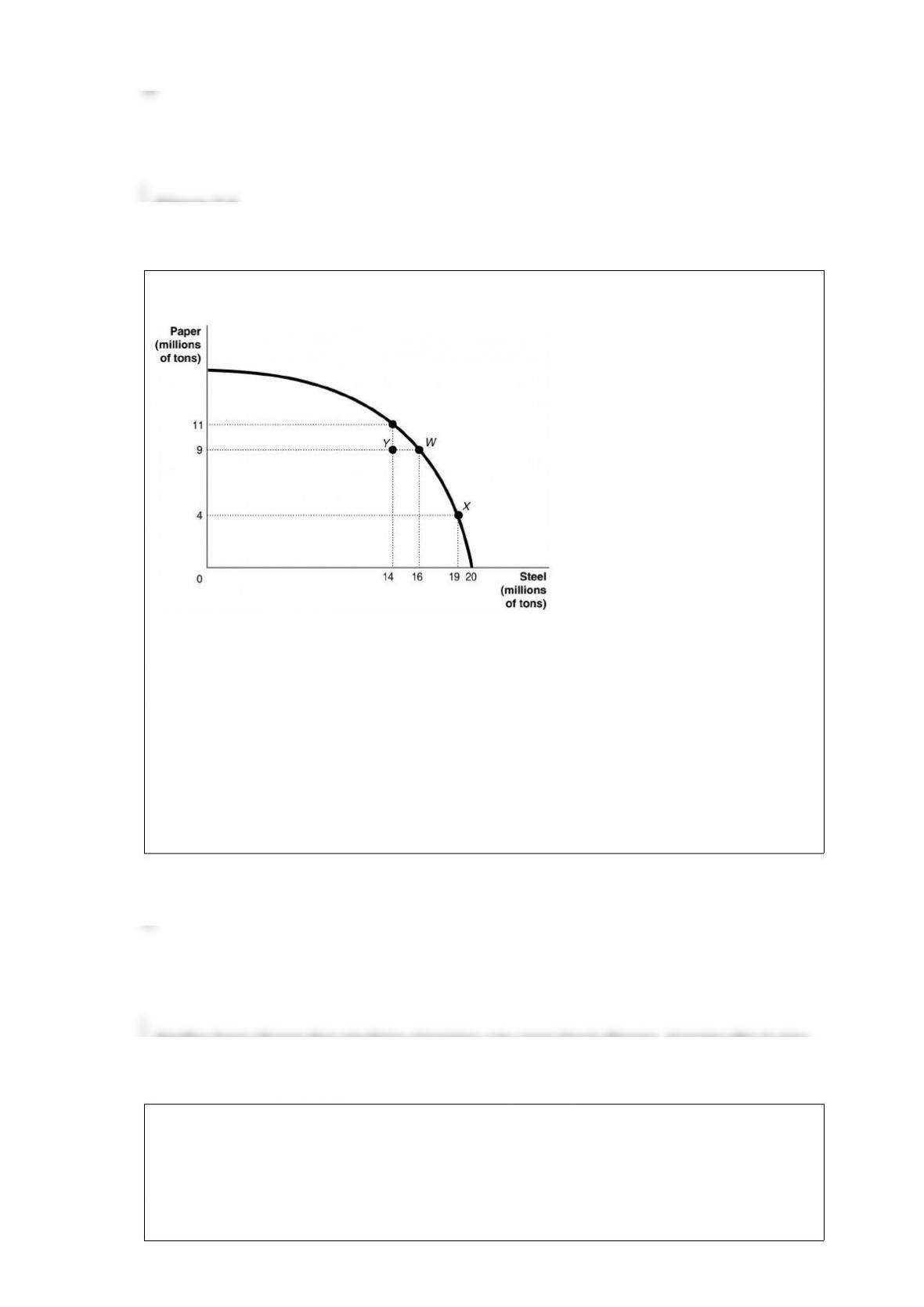
Figure 2-5
Refer to Figure 2-5. If the economy is currently producing at point Y, what is the
opportunity cost of moving to point X?
A) 5 million tons of steel
B) 9 million tons of paper
C) 5 million tons of paper
D) 19 million tons of steel
Studies have shown that smoking cigarettes can cause heart disease. Assume this is true,
and favorable weather has increased the tobacco harvest in North Carolina. In the
market for cigarettes, these two developments would
A) decrease demand and decrease supply, resulting in an increase in the equilibrium

quantity and a decrease in the equilibrium price of cigarettes.
B) increase demand and increase supply resulting in an increase in the equilibrium
quantity and an uncertain effect on the equilibrium price of cigarettes.
C) decrease demand and increase supply, resulting in a decrease in the equilibrium price
and an uncertain effect on the equilibrium quantity of cigarettes.
D) decrease demand and increase supply, resulting in an increase in both the
equilibrium price and the equilibrium quantity of cigarettes.
How does a market system prevent people from getting as many goods and services as
they wish?
A) Governments interfere with the market mechanism to influence the allocation of
goods and services.
B) In a market system, firms can charge any price they want, thus preventing poor
people from getting as many goods and services as they wish.
C) The market system allocates goods and services to those who are able to pay for
those products and therefore income is a limiting factor.
D) The government imposes taxes on those who earn beyond a certain amount of
income.
How has organizing a successful firm in a market economy changed over the last
century?
A) It has become easier as more and more firms discover how to do it.
B) As government intervention has decreased, firms now have more freedom.
C) There has been no change one way or the other over the last century.
D) It has become more difficult to organize an efficient and successful firm.
If expectations are adaptive, how will the economy adjust to a new long-run
equilibrium in response to contractionary monetary policy? Support your answer with a
graph of the Phillips curve.
In the Taylor rule, does the target for the federal funds rate respond differently for a
recession caused by a decrease in aggregate demand and for a recession caused by a
decrease in short-run aggregate supply? Explain whether there is or is not a difference
in how the target for the federal funds rate changes.
Explain why international capital markets have expanded since the 1980s.
One of the results of Paul Romer’s new growth theory is that investment in research and
development will be too low in an economy. Explain how he comes to this conclusion.
Suggest two policies the government could pursue to help increase the accumulation of
knowledge.
If workers accurately predict the rate of inflation, is there a short-run trade-off between
inflation and unemployment, as predicted by the Phillips curve? Why or why not?
What is the difference between aggregate expenditure and consumption spending?