
An advantage of Microsoft windows is its compatibility with the widest range of
hardware and software. The dominance of Windows is self-reinforcing: hardware and
software manufacturers ensure that their products are compatible with Windows in
order to have access to the large number of Windows users. Which principle best
describes this scenario?
A) endowment effects
B) endorsement effects
C) economies of scale
D) network externalities
Which of the following statements is true?
A) Economic efficiency would be increased if the United States eliminated all of its
trade restrictions, but only if all other countries eliminated their trade restrictions too.
B) The U. S. economy would gain from the elimination of its tariffs but not from the
elimination of its quotas.
C) Eliminating its tariffs and quotas unilaterally would not benefit the United States
because this would remove the leverage it would have to persuade other countries to
eliminate their trade restrictions.
D) The U.S. economy would gain from the elimination of tariffs and quotas even if
other countries do not reduce their tariffs and quotas.
The number of people receiving Medicare is expected to grow to 80 million by the year
A) 2105.
B) 2020.
C) 2030.
D) 2075.
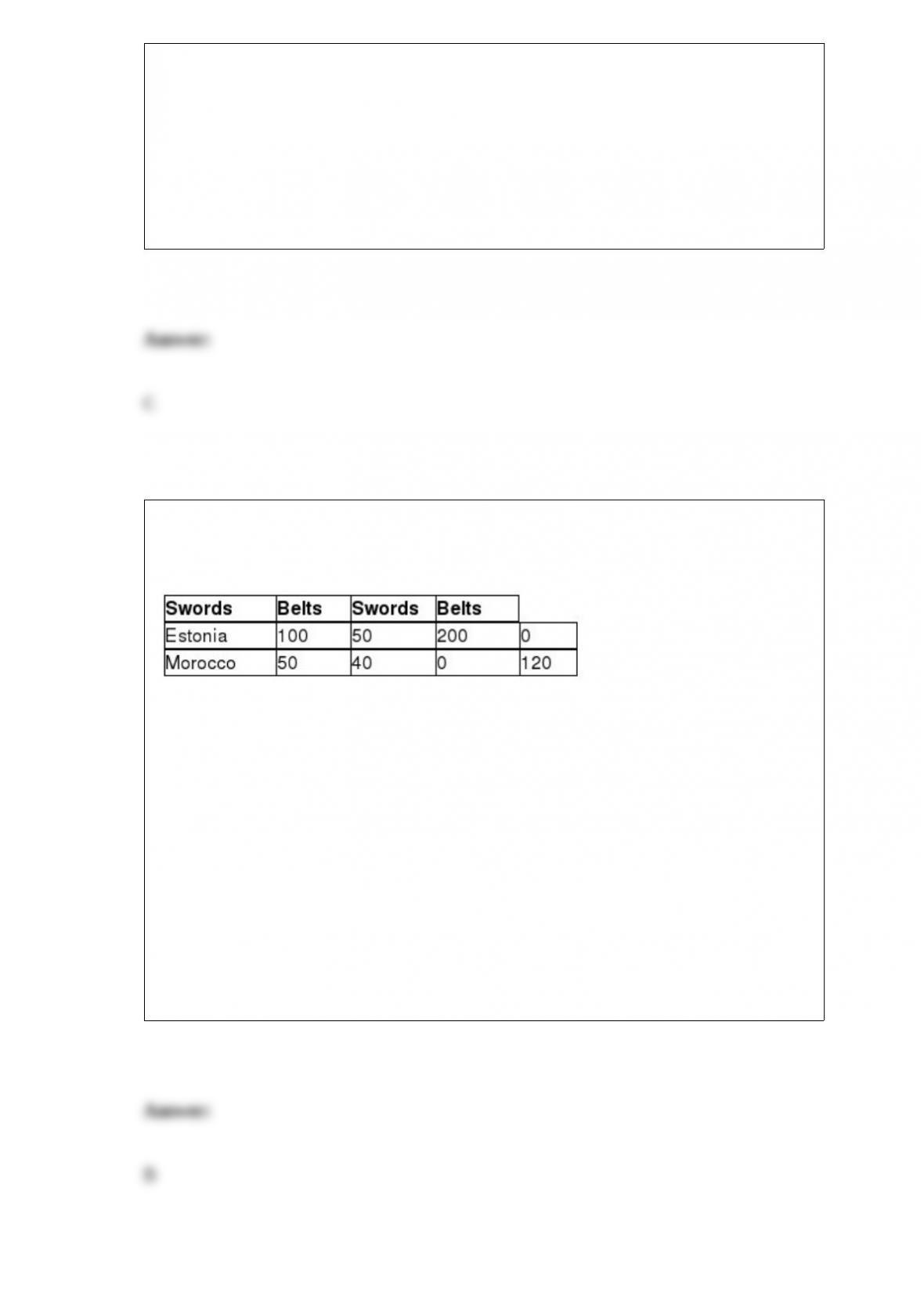
Table 9-12Production and
Consumption Production
Without Trade With Trade
Estonia and Morocco can produce both swords and belts. Table 9-12 shows the
production and consumption quantities without trade, and the production numbers with
trade.
If the actual terms of trade are 1 belt for 1.5 swords and 70 belts are traded, how many
swords will Morocco consume?
A) 50
B) 95
C) 105
D) 200

A perfectly competitive industry achieves allocative efficiency because
A) goods and services are produced at the lowest possible cost.
B) goods and services are produced up to the point where the last unit provides a
marginal benefit to consumers equal to the marginal cost of producing it.
C) it produces where market price equals marginal production cost.
D) firms carry production surpluses.
In both monopolistically competitive and perfectly competitive industries,
A) firms produce products for which there are no close substitutes.
B) there are high barriers to entry.
C) there are many buyers and sellers.
D) firms are price takers.
If a doctor knows that an insurance company will pay for most of a patient’s bill, the
doctor has more of an incentive to require additional medical procedures and tests, even
if the patient may not require them. This is an example of
A) moral hazard.
B) the principle-agent problem.
C) asymmetric information.

D) adverse selection.
Which of the following is not a common mistake made by consumers?
A) the failure to take into account the implicit costs of an activity
B) the failure to ignore sunk costs
C) being overly optimistic about their future behavior
D) being overly pessimistic about their future behavior
________ is defined as national income + transfers – taxes.
A) Gross private domestic investment
B) GDP
C) Personal income
D) Disposable income

The informal sector can be a significant drag on the economies of developing countries
because the firms in the informal sector
A) produce goods and services no one wants.
B) sell their goods and services to citizens in other countries.
C) do not pay taxes to the government.
D) employ illegal immigrants from other countries.
Under the Bretton Woods system, central bankers could obtain foreign currency loans
from the
A) U.S. Treasury Department.
B) World Trade Organization.
C) International Monetary Fund.
D) Bank of England.
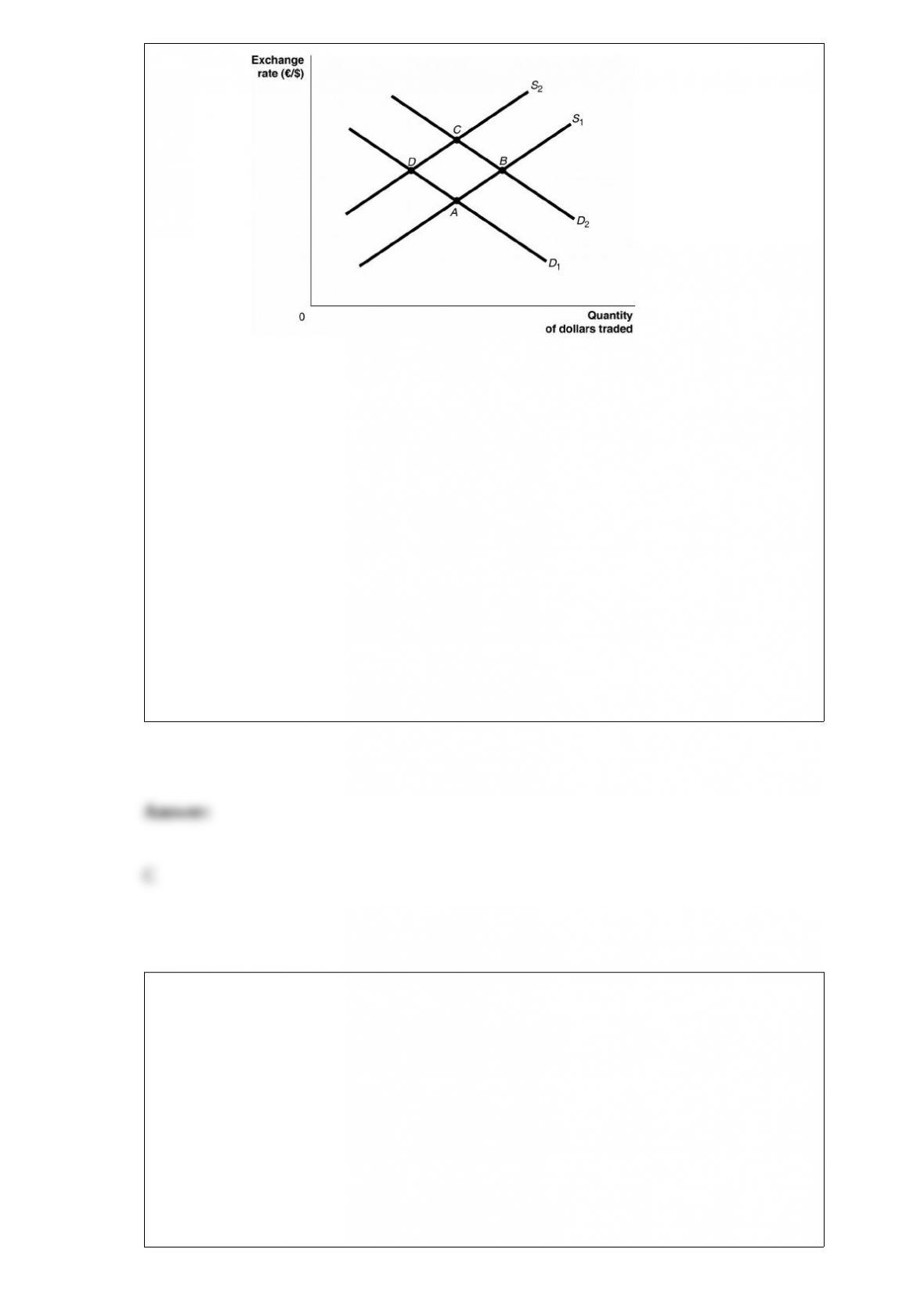
Figure 29-1
Suppose that the U.S. government deficit causes interest rates in the United States to
rise relative to those in the European Union. Assuming all else remains constant, how
would this be represented?
A) Supply would decrease, demand would decrease and the economy moves from B to
C to D.
B) Supply would increase, demand would decrease and the economy moves from C to
B to A.
C) Supply would decrease, demand would increase and the economy moves from A to
D to C.
D) Supply would increase, demand would increase and the economy moves from D to
A to B.
Suppose Barry is maximizing his utility from consuming used paperback novels and
audio books. The price of a used novel = $4 and the price of an audio book = $8. If the
marginal utility of the last novel was 32 units of utility (utils) what was the marginal
utility of the last audio book purchased?
A) 2 utils
B) 12 utils
C) 16 utils

D) 64 utils
In the 1973 movie Save the Tiger, Jack Lemmon plays Harry Stoner, the CEO of a
clothing manufacturer whose business has fallen on hard times. At one point in the
movie, Stoner convinces his partner to hire someone to burn one of their buildings to
collect on their insurance policy. What term refers to the information problem that led
the insurance company to sell a policy for this building to Stoner and his partner?
A) rational ignorance
B) the principal-agent problem
C) adverse selection
D) moral hazard