1) the law of increasing opportunity costs is reflected in a production possibilities curve
that is:
a.an upsloping straight line.
b.a downsloping straight line.
c.concave to the origin.
d.convex to the origin.
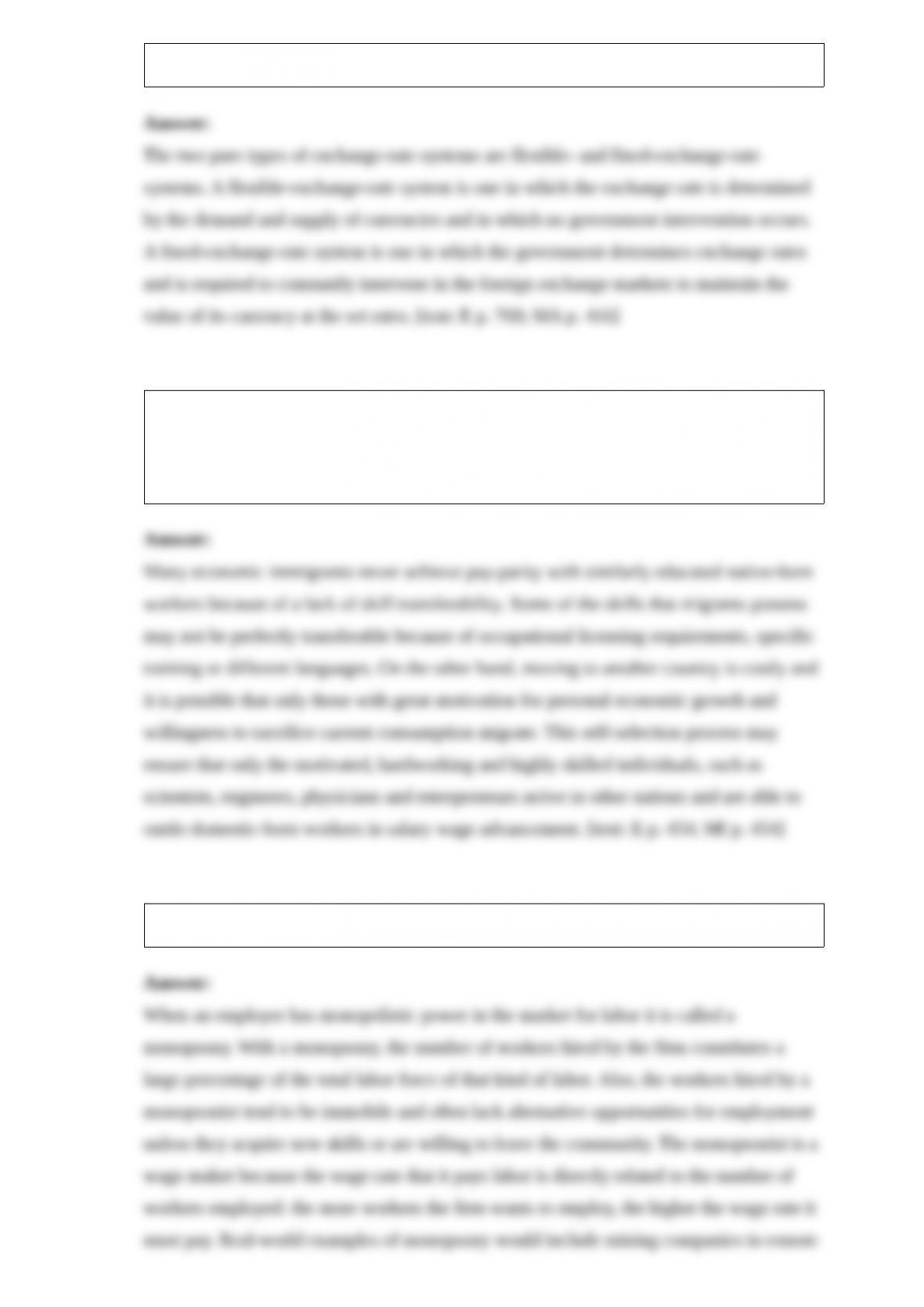
2) Suppose the full employment level of real output (Q) for a hypothetical economy is
$500, the price level (P) initially is 100, and that prices and wages are flexible both
upward and downward. Use the following short-run aggregate supply schedules to
answer the next question(s).
Refer to the information above. In the long run, a fall in the price level from 100 to 75
will:
A.decrease real output from $500 to $440.
B.increase real output from $500 to $620.
C.change the aggregate supply schedule from (a) to (c) and produce an equilibrium
level of real output of $500.
D.change the aggregate supply schedule from (a) to (b) and produce an equilibrium
level of real output of $500.
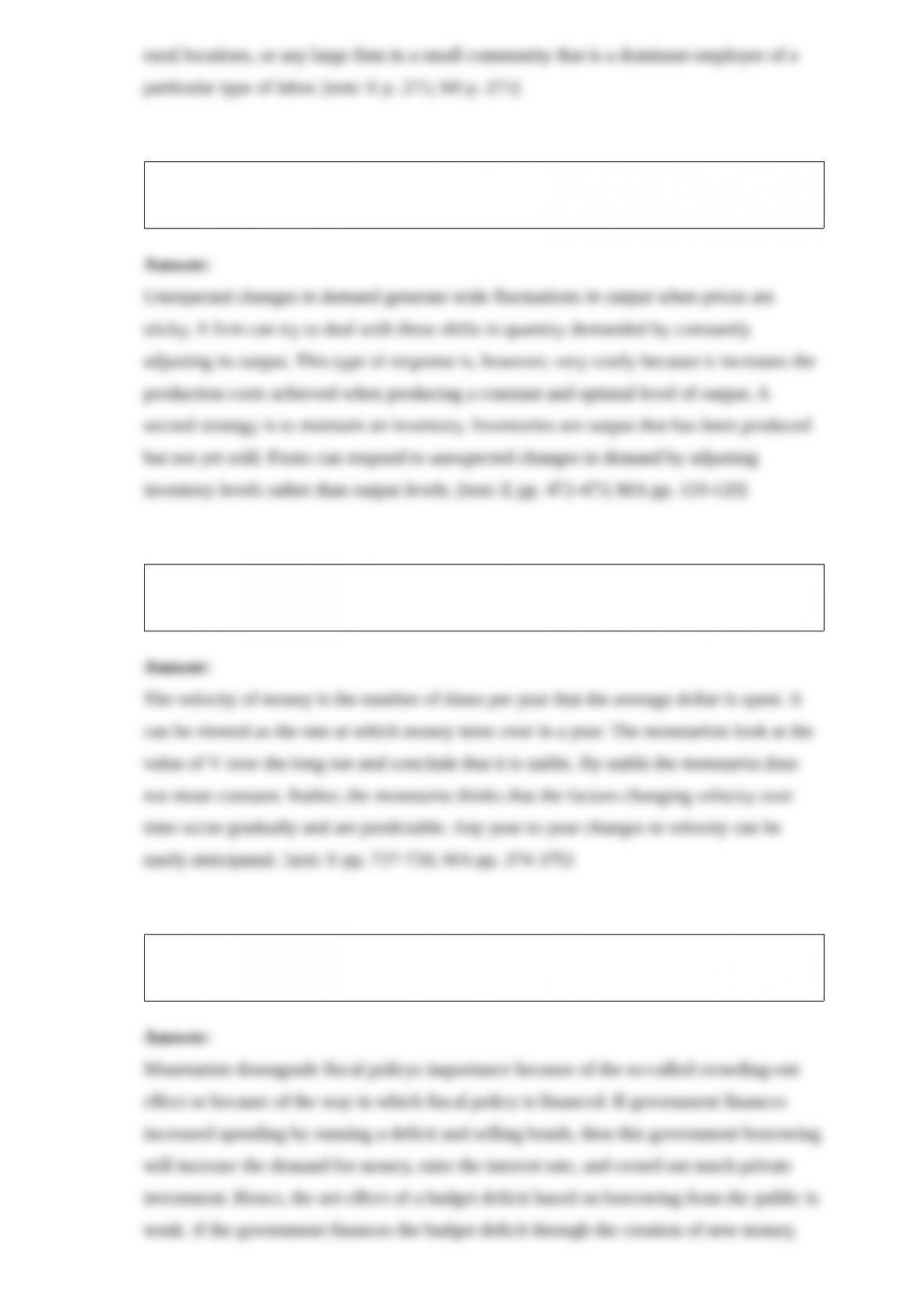
3)
Refer to the above data. The 10 percent proportional tax on income would cause:
A.both consumption and saving to increase by larger and larger absolute amounts as
GDP rises.
B.both consumption and saving to increase by smaller and smaller absolute amounts as
GDP rises.
C.consumption to decrease by larger amounts and saving to decrease by smaller
amounts as GDP rises.
D.no change in the amounts consumed and saved at each level of GDP.

4) about ________ of recent annual population growth in the united states is the result
of immigration.
a.one-tenth
b.one-fifth
c.one-third
d.one-half
5) in constructing models, economists:
a.make simplifying assumptions.
b.include all available information.
c.must use mathematical equations.
d.attempt to duplicate the real world.
6) which of the above diagrams illustrate(s) the effect of a decrease in incomes on the
market for secondhand clothing?
a.a and c
b.a only.
c.b only.
d.c only.
7) which of the following statements is correct?
a.both cash and noncash gift-giving cause value losses.
b.neither cash nor noncash gift-giving cause value losses.
c.noncash gift-giving create a value loss, but cash gifts do not.
d.cash gifts creates a value loss, but noncash gifts do not.
8) The government was successful in gaining an antitrust conviction in the:
A.U.S. Steel case.
B.IBM case.

C.Alcoa case.
D.DuPont cellophane case.
9) Suppose that a bank’s actual reserves are $5 million, its checkable deposits are $5
million, and its excess reserves are $3 million. The reserve requirement must be:
A.40 percent.
B.20 percent.
C.10 percent.
D.5 percent.
10) “macroeconomics is the part of economics concerned with individual units such as a
person, a household, a firm, or an industry.” this statement is:
a.positive, but incorrect.
b.positive and correct.
c.normative, but incorrect.
d.normative and correct.
11) Which of the following does not help explain growing income inequality since
1970?
A.the entry of unusually large numbers of less experienced workers into the labor force
B.increased import competition
C.declining returns to education as college graduates have trouble finding jobs
D.increased immigration
12) The idea of compensating differences is used:
A.by inclusive unions as an argument in bargaining for wage rate increases.
B.to justify the application of minimum wages to low-wage labor markets.
C.to explain the divergence between wage rates and marginal resource cost.
D.to explain wage rate differences based on differing nonmonetary aspects of jobs.
13) Define the two pure types of exchange-rate systems.
14) The sizeable and continuous flow of immigrants into the United States seems to
indicate that there is a positive return to moving. Many economic immigrants, however,
never achieve pay-parity with similarly educated native-born workers while others
eventually outdo domestic-born workers in salary wage advancement. Explain.
15) What is a monopsony and what are its basic characteristics?
16) How do companies deal with unexpected shifts in quantity demanded when prices
are sticky?
17) Define the velocity of money. Explain the monetarist view with regard to the
stability of velocity.
18) What reasons do monetarists give for downgrading the importance of fiscal policy
relative to monetary policy?
19) Why would a low-wage nation oppose emigration? Why would a high-wage nation
oppose immigration?
20) Give a definition of technological advance. What role does time play in the
definition according to economists?
21) How is marginal revenue product reflected in winner-take-all markets such as in the
music industry?

22) Describe how a firms revenues and profits are increased through product
innovation. What three other points should be noted about these results?