
The input demand functions that can be derived from cost functions are referred to as
“contingent” demand functions because the functions:
a. assume input costs are constant.
b. express input demand as a function of output.
c. depend on the assumption of profit maximization.
d. assume constant returns to scale in production.
If preferences are onedimensional and preferences are single peaked, majority rule will
result in selection of the project most favored by
a. no one.
b. the median voter.
c. the average voter.
d. everyone.
When prices drop in response to a decline in demand for an increasing cost industry
a. producer surplus will increase but rents may decrease.
b. rent earned by elastically supplied inputs will decline by more than rent earned by

inelastically supplied inputs.
c. rent earned by elastically supplied inputs will decline by less than rent earned by
inelastically supplied inputs.
d. both producer surplus and rents will increase.
Consider the two following statements:
I. x is an inferior good.
II. x exhibits Giffen’s Paradox.
Which of the following is true?
a. I implies II, but II does not necessarily imply I.
b. II implies I, but I does not necessarily imply II.
c. I and II are statements of the same phenomenon.
The production function exhibits
a. increasing returns to scale and diminishing marginal products for both K and L.
b. increasing returns to scale and diminishing marginal product for L only.
c. increasing returns to scale but no diminishing marginal productivities.

d. decreasing returns to scale.
The option to delay the choice of portfolio allocation is valuable because
a. interest costs are positive.
b. volatility of returns is lower.
c. more can be placed into high return, risky assets.
d. the allocation can be based on new information.
If markets are perfect, a rational actor may reasonably conclude from the high price of a
good that the good
a. is produced by a monopoly.
b. is of better quality.
c. has a greater demand for it.
d. is not known about by other consumers.

If a firm is a price taker in both the input and output markets, its marginal revenue
product of labor is given by
a. the price of its output times labor’s marginal physical productivity.
b. the marginal value product of labor.
c. the marginal revenue product of capital times the ratio of the wage rate to the rental
rate on capital.
d. all of the other answers are correct.
Adverse selection can arise in employment situations if information about worker
quality is
a. better for employees than employers.
b. better for employers than employees.
c. perfect.
d. available at a low enough cost.

Every allocation of goods in a one good world is efficient because
a. MRSs are equalized.
b. there is enough to go around for everyone.
c. no one can be made better off without making someone else worse off.
d. it doesn’t matter to whom an extra unit of the good is given.
In a competitive market, an efficient allocation of resources is characterized by
a. a price greater than the marginal cost of production.
b. the possibility of further mutually beneficial transactions.
c. the largest possible sum of consumer and producer surplus.
d. a value of consumer surplus equal to that of producer surplus.
It is usually assumed that a perfectly competitive firm’s supply curve is given by its
marginal cost curve. In order for this to be true, which of the following additional
assumptions are necessary:
I. That the firm seek to maximize profits.

II. That the margnal cost curve be positively sloped.
III. That price exceed average variable cost.
IV. That price exceed average total cost.
a. all of the above.
b. I and II but not III and IV.
c. I and III but not II and IV.
d. I and II only.
e. I, II and III, but not IV.
A profitmaximizing firm will never hire that quantity of a factor of production for
which that factor has an increasing marginal productivity because
a. it would not be maximizing output.
b. it would not be maximizing the productivity of labor.
c. it would not be minimizing costs.
d. it would not be maximizing profits.

The present value of $1 payable in the future decreases
a. the higher is and the sooner it is to be paid.
b. the lower is and the sooner it is to be paid.
c. the higher is and the longer time until it is paid.
d. the lower is and the longer time until it is paid.
An individual whose utility function is given by
U(x, y) = 4x + 2y
For this utility function, the MRS
a. depends on the values of xand y.
b. is always 0.
c. is always 2.
d. is always 4.
The following definitions for an individual who consumes only two goods:
x = share of income spent on x.
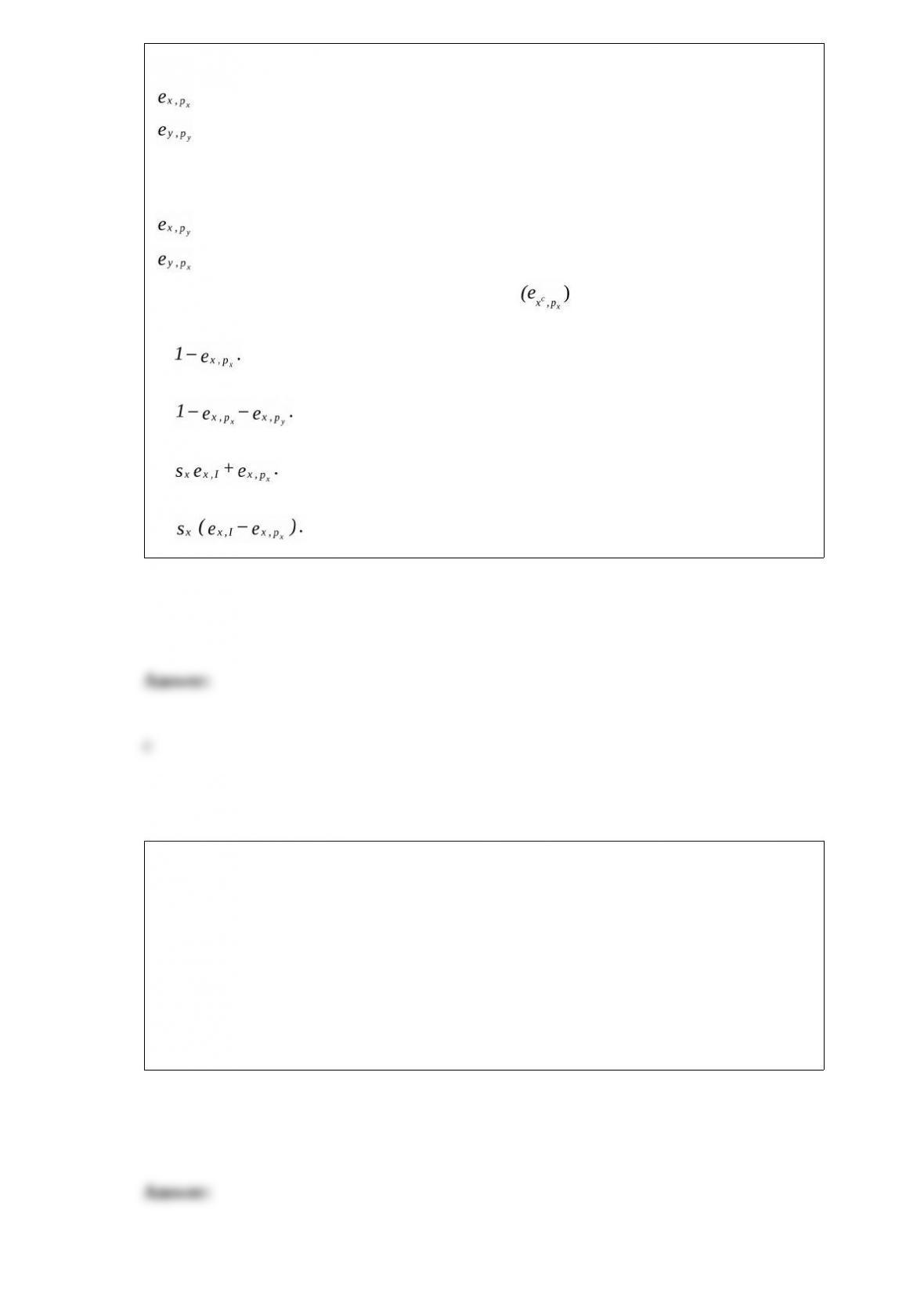
y = 1 -sx .
= price elasticity of demand for x.
= price elasticity of demand for y.
ex, I = income elasticity of demand for x.
ey, I = income elasticity of demand for y.
= cross price elasticity of demand for x.
= cross price elasticity of demand for y.
The elasticity of the compensated demand curve can be computed as
a.
b.
c.
d.
A monopoly producer of a durable good
a. can earn even greater profits than a producer of a non-durable.
b. must consider competition from its own output decisions.
c. will have higher marginal costs than most other monopolies.
d. will not set marginal revenue equal to marginal cost.

Which of the following demand functions is not homogenous of degree zero in
px, py , and I?
a. x = I / (px,+ py ).
b. .
c. .
d. .
If, in a given economy, production is taking place at a point inside the production
possibility frontier,
a. resource allocation is technically and allocatively efficient.
b. resource allocation is technically efficient but allocatively inefficient.
c. resource allocation is technically inefficient and allocatively efficient.
d. resource allocation is technically and allocatively inefficient.

If the demand faced by a firm is inelastic, selling one more unit of output will
a. increase revenues.
b. decrease revenues.
c. keep revenues constant.
d. increase profits.
If a monopoly is maximizing profits
a. price will always be greater than average cost.
b. price will always equal marginal cost.
c. price will always be greater than marginal cost.
d. price will always equal marginal revenue.
For a fixed proportion production function, at the vertex of any of the (Lshaped)
isoquants the marginal productivity of either input is
a. constant
b. zero.

c. negative.
d. a value that cannot be determined.
In a Cournot equilibrium each firm chooses an output level which
a. maximizes joint profits.
b. maximizes the price received.
c. maximizes profits given what the other firms produce.
d. maximizes revenue given what the other firms produce.
Which of the following utility functions exhibits constant absolute risk aversion?
a. U(W) = W.
b.
c. U(W) = ln W.
d. U(W) = .

Suppose you were competing in a sealed-bid, second-price auction for a Vermeer
painting, which you happen to value at $100,000. What bid should you submit?
a. Exactly $100,000.
b. Somewhat lower than $100,000 depending on the number of other bidders.
c. Somewhat higher than $100,000 depending on the number of other bidders.
d. Cannot say which of a), b), or c) is right without further information.
Suppose two individuals in an exchange economy have identical utility functions given
by Person A has an endowment of x = 9 y = 8, person B has one of x =
16 y = 2. The price ratio that will prevail in equilibrium is
a. px/ py= 2.5.
b. px/ py= 1.0.
c. px/ py = 0.4.
d. px/ py= 0.125.

Special interest groups often
a. represent broad questions of public interest.
b. pursue rent seeking behavior.
c. do not use lobbying techniques.
d. have no effect on the political process.
What factor would not help resolve the Bertrand paradox (that a perfectly competitive
outcome can emerge with as few as two firms in the market) if the basic Bertrand model
were extended to include it?
a. Repeated interaction.
b. Search costs.
c. Sequential moves.
d. Product differentiation.

One implication of the fact that profit functions are convex in prices is that firms will
always prefer
a. stable input and output prices.
b. input and output prices that fluctuate about a given level.
c. stable input prices and fluctuating output prices.
d. fluctuating input prices and stable output prices.
One possible benefit of a monopoly is
a. a more efficient allocation of resources; only one firm is needed to supply quantity
demanded.
b. greater opportunities for research due to long-run positive economic profits.
c. the government is better able to ensure that it follows laws and guidelines because
there is only one firm to monitor.
d. goods and services are provided at a lower price than under perfect competition
because of a monopoly’s decreasing average cost curve.
The price elasticity of demand for good x is defined as
a. percentage change in px / percentage change in x.
b. percentage change in x /percentage change in px .
c. percentage change in x/percentage change in income.
d. percentage change in x /percentage change in py .
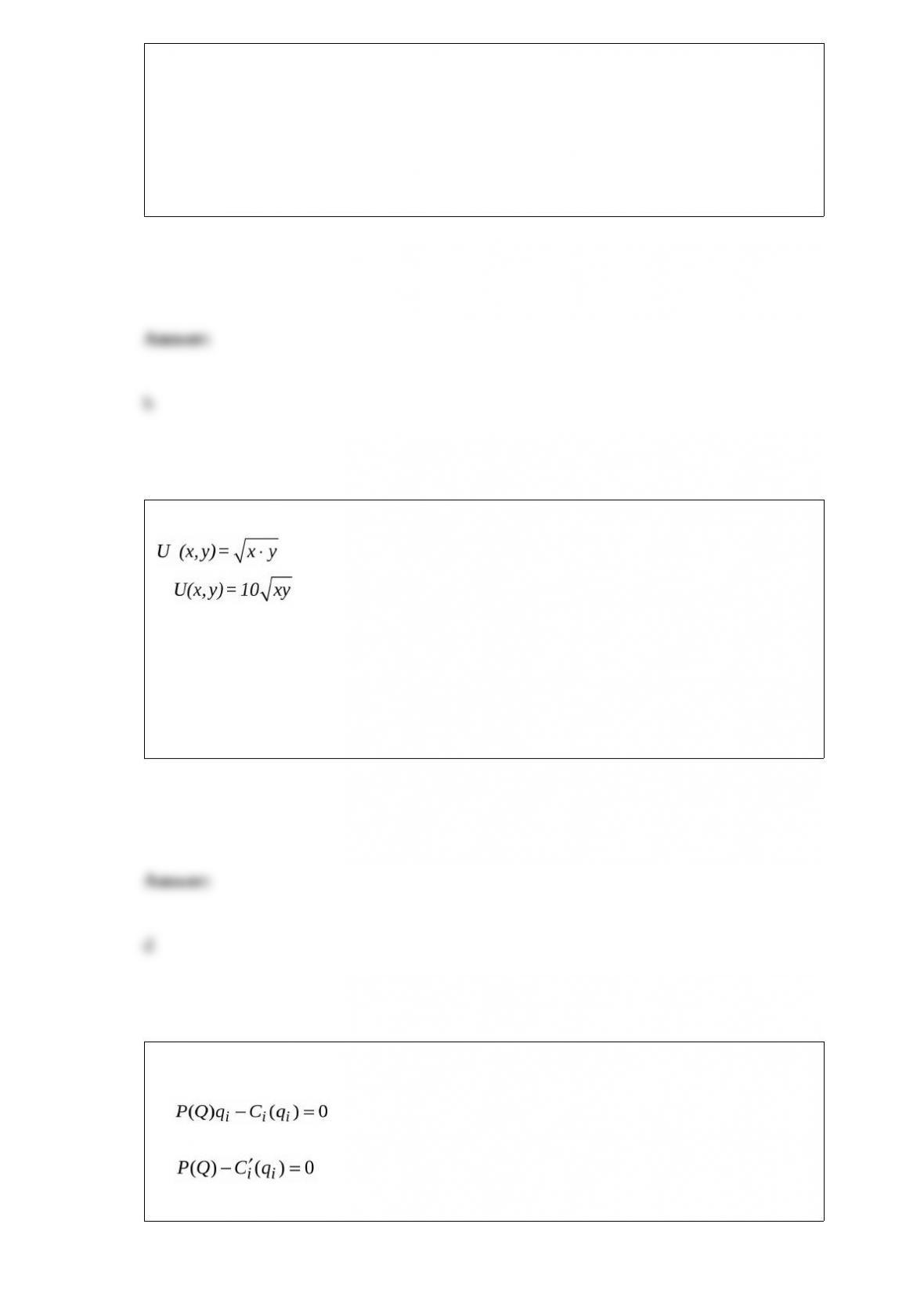
Which of the following utility functions represent the same preferences as
?
a. .
b. U(x, y) = x .y.
c. U(x, y) = ln x + ln y.
d. All of these represent the same preferences.
A firm’s first-order condition from the Cournot game with general demands and costs is
a. .
b. .
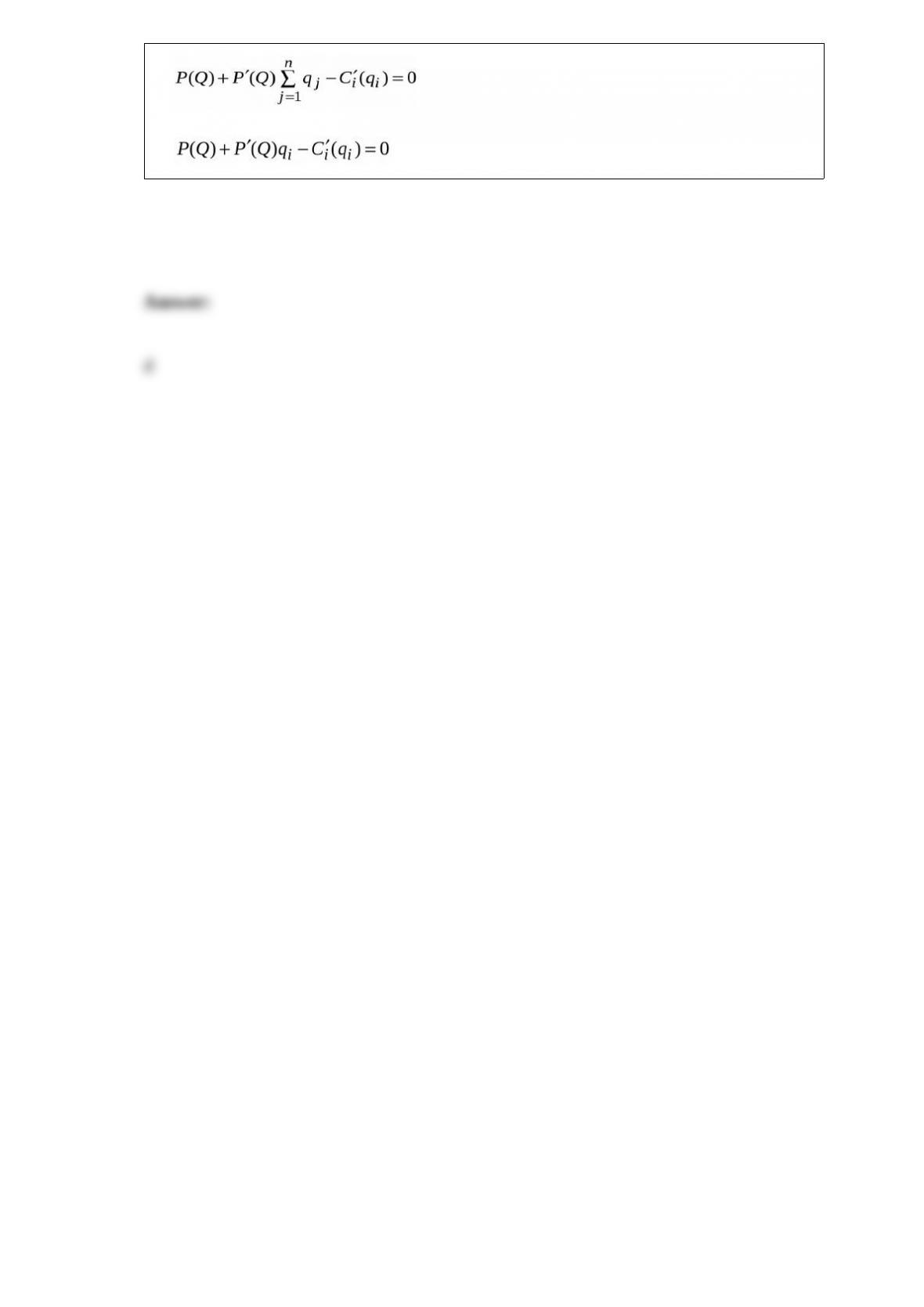
c. .
d. .