
The Clayton Act of 1936 outlawed price discrimination that reduced competition.
Answer:
The “rational expectations” school of economists, including Robert Lucas and Thomas
Sargent, argue that changes in monetary policy cannot affect unemployment rates in the
short run or long run.
Answer:
If nominal GDP is less than real GDP, then the GDP deflator will be greater than 100.
Answer:
Among countries that purchased U.S. stocks and bonds in 2012, China was the biggest
customer, accounting for over 50 percent of all purchases.
Answer:

Producer surplus is the Difference between the highest price a firm is willing to accept
for a product and the price it actually receives for the product.
Answer:
If a monopolistically competitive firm breaks even, the firm is earning as much in this
industry as it could in any other comparable industry.
Answer:
Suppose there are economies of scale in the production of a specialized memory chip
that is used in manufacturing microwaves. This suggests that the microwave industry is
a decreasing-cost industry.
Answer:
Economic profit is the difference between a firm’s revenue and its opportunity costs.
Answer:

Colleges offer merit awards to students who ordinarily would not qualify for financial
help. Some have criticized this on grounds that merit awards disproportionately benefit
students from wealthier communities with better school systems, siphoning resources
away from lower-income students with greater financial need. A college’s decision to
grant merit awards is motivated by economic efficiency.
Answer:
If the market price is at equilibrium, the producer surplus is minimized.
Answer:
Aggregate expenditure includes consumption spending, unplanned investment
spending, government purchases, and net exports.
Answer:
As a percentage of GDP, health care spending on Medicare and Medicaid is expected to
double over the next 40 years unless health care costs begin to grow at a slower rate.

Answer:
The barrier to entry that allowed Alcoa to make persistent economic profits was
ownership of an essential input.
Answer:
By offering training to workers whose firms laid them off because of competition from
foreign firms, the federal government is attempting to reduce
A) frictional unemployment.
B) structural unemployment.
C) cyclical unemployment.
D) seasonal unemployment.
E) unnatural unemployment.
Answer:
Examples of ________ show how trade between two countries can make each better
off.
A) absolute advantage
B) comparative advantage

C) autarky
D) trade barriers
Answer:
Who controls a sole proprietorship?
A) stockholders
B) bondholders
C) the owner
D) all of these
Answer:
When a firm faces a downward-sloping demand curve, marginal revenue
A) must exceed price because the price effect outweighs the output effect.
B) is less than price because a firm must lower its price to sell more.
C) equals price because the firm sells a standardized product.
D) must exceed price because the output effect outweighs the price effect.
Answer:

Suppose the U.S. government encouraged consumers to trade in their old automobiles
for more efficient, new models by paying up to $5,000 for the old automobiles. These
consumers would be exemplifying the economic idea that
A) people are rational.
B) people respond to economic incentives.
C) optimal decisions are made at the margin.
D) equity is more important than efficiency.
Answer:
Goods can be classified on the basis of whether their consumption is
A) internal and excludable.
B) rival and competitive.
C) includable and cooperative.
D) rival and excludable.
Answer:
An outward shift of a nation’s production possibilities frontier can occur due to
A) a reduction in unemployment.

B) a natural disaster like a hurricane or bad earthquake.
C) a change in the amounts of one good desired.
D) an increase in the labor force.
Answer:
The tax wedge is the difference between the
A) amount of taxes needed to balance the federal budget and the actual amount of taxes.
B) amount of taxes needed to pay off the national debt and the actual amount of taxes.
C) pretax and posttax returns to an economic activity.
D) nominal and real interest rates.
Answer:
A firm’s technology may depend on which of the following factors?
A) the skill of its managers
B) the training of its workers
C) the speed and efficiency of its equipment
D) all of the above
Answer:
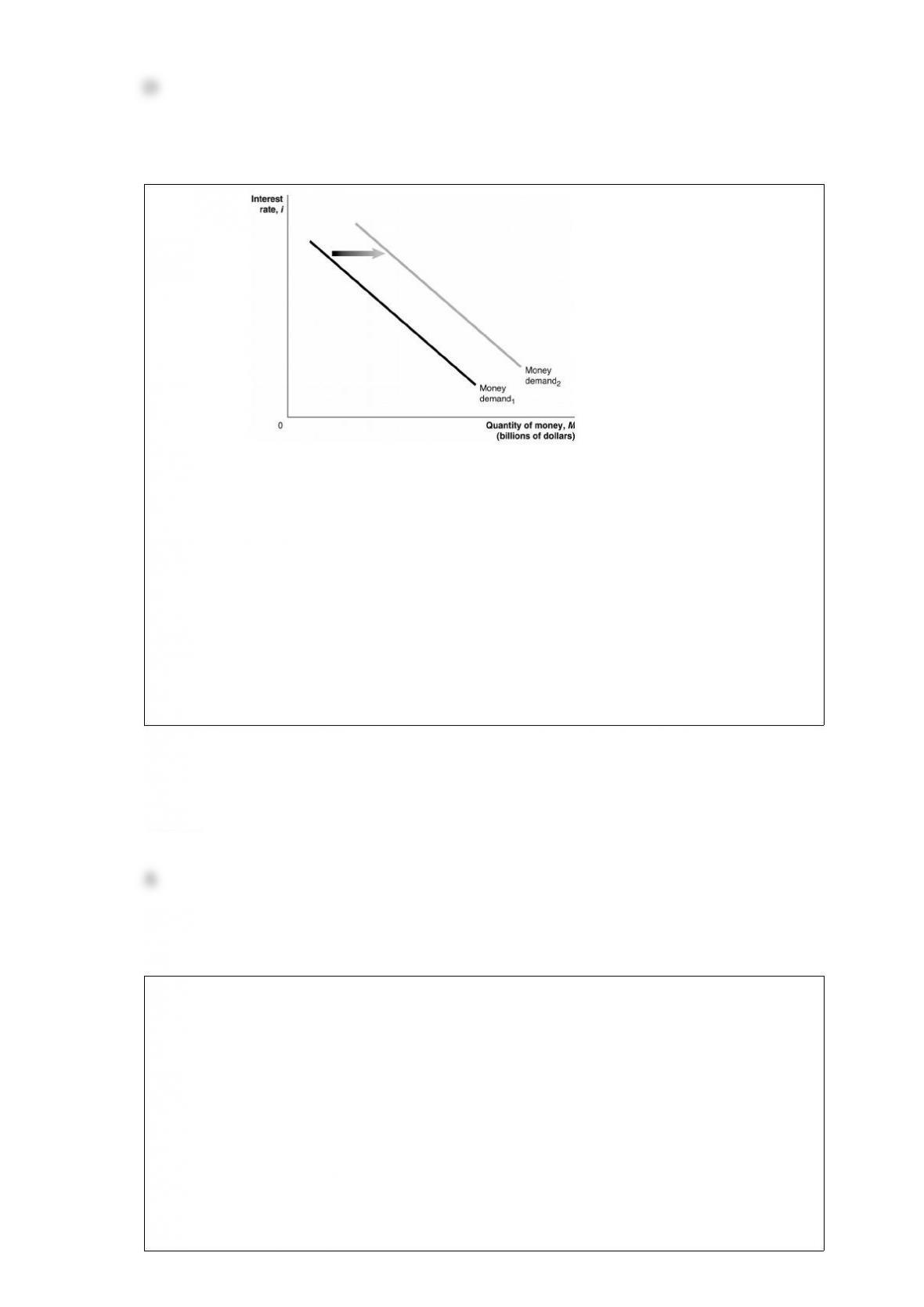
Figure 15-1
In the figure, the money demand curve would move from Money demand1 to Money
demand2 if
A) real GDP increased.
B) the price level decreased.
C) the interest rate increased.
D) the Federal Reserve sold Treasury securities.
Answer:
How are corporate profits taxed in the United States?
A) Earnings are taxed first by state sales taxes and then as corporate profits at the
Federal level.
B) Earnings are taxed first as personal income then as corporate profits at the Federal
level.
C) Earnings are taxed first as corporate profits then as personal income after dividends
are paid.

D) Corporate profits are not taxed at all.
Answer:
Which of the following explains why purchasing power parity does not completely
explain long-run fluctuations in exchange rates?
A) Some goods and services produced in any country are not traded internationally.
B) Consumer preferences for goods and services across countries are very similar.
C) Most countries do not impose barriers to trade.
D) Most countries have free markets with little, if any, government regulation.
Answer:
Article Summary. Unlike in many nations, when the financial crisis hit in 2008 the
Polish economy continued to grow, but due to a current slowdown in exports and
domestic demand, Poland is expecting a large outflow of workers. Unemployment
was expected to grow to 14 percent in Poland in 2013, and according to Krystyna
Iglicka, a demographer at Lazarski University in Warsaw, “…Poles have always
treated emigration as a way of improving their lot.” Despite earning relatively low
salaries in Western European countries, on average just over ¬2,000 (about
$2,660) a month according to the National Bank of Poland, this is still four times
more than workers would earn on average by staying in Poland. Iglicka predicts
that between 500,000 and 800,000 Poles will emigrate from Poland over the next
five years.Source: Jan Cienski, “Poland braces for fresh exodus of workers,”
Washington Post, January 22, 2013.
If, after the outflow of workers in Poland, it now takes more capital per hour worked to
get the same amount of GDP per hour worked, this indicates ________ the per-worker
production function in Poland.

A) a movement up
B) a movement down
C) an upward shift of
D) a downward shift of
Answer:
What is the difference between imports and exports?
Answer:
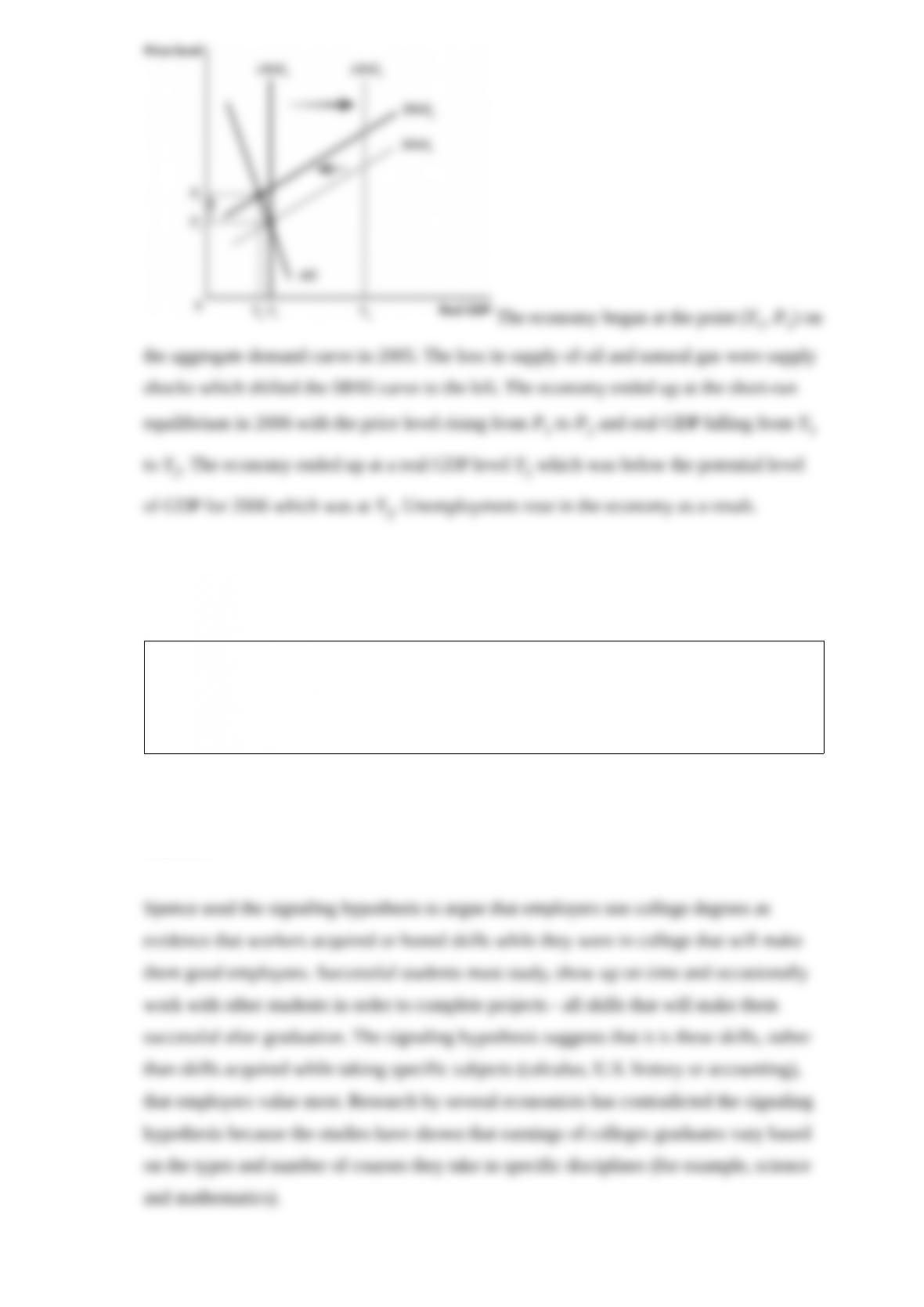
Hurricane Katrina resulted in a decline in oil production infrastructure along the gulf
coast. As a result there was an unexpected decline in oil and natural gas supplies in
2005. Suppose that this caused an increase in the price level and a decline in real GDP
in 2006. Also assume that potential real GDP continued to grow due to other factors.
You can assume the aggregate demand curve did not change. Show the macroeconomic
equilibrium for 2005 and 2006 using the dynamic aggregate supply and aggregate
demand model.
Answer:
Economist Michael Spence uses a concept called the ‘signaling hypothesis” to argue
that college graduates don’t earn high incomes because the skills they learned while in
college serve to increase their productivity. Explain the signaling hypothesis. Is there
evidence that the signaling hypothesis is not valid?
Answer:

Suppose the price elasticity of demand for methamphetamine is -0.35. If
decriminalization caused the price of methamphetamine to fall by 75 percent, what will
be the percentage increase in the quantity of methamphetamine demanded? If the price
elasticity is -3.5, what will be the percentage increase in quantity demanded?
Answer:
What area on a supply and demand graph represents producer surplus?
Answer:
Explain why the tax multiplier is different from the government purchases multiplier, in
both sign and relative magnitude.
Answer: