1) Public choice economists:
A.analyze the incidence of taxes.
B.are also known as Keynesian economists.
C.use the tools of economics to analyze decision making, politics, and elections in the
public sector.
D.are, by definition, economists employed by Federal, state, and local governments.
2) A lower equilibrium interest rate:
A.increases saving, reduces total spending, and increases total output.
B.decreases saving, increases total spending, and decreases total output.
C.increases investment, increases total spending, and increases total output.
D.decreases investment, decreases total spending, and increases total output.
3) Suppose a firm is employing all its inputs so that the MRP per dollar spent on each is
the same. This suggests that the:
A.amount of each resource employed will depend on both its price and its productivity.
B.price of each input must be identical.
C.firm is using the same quantity of each input.
D.total expenditure on each input is identical.
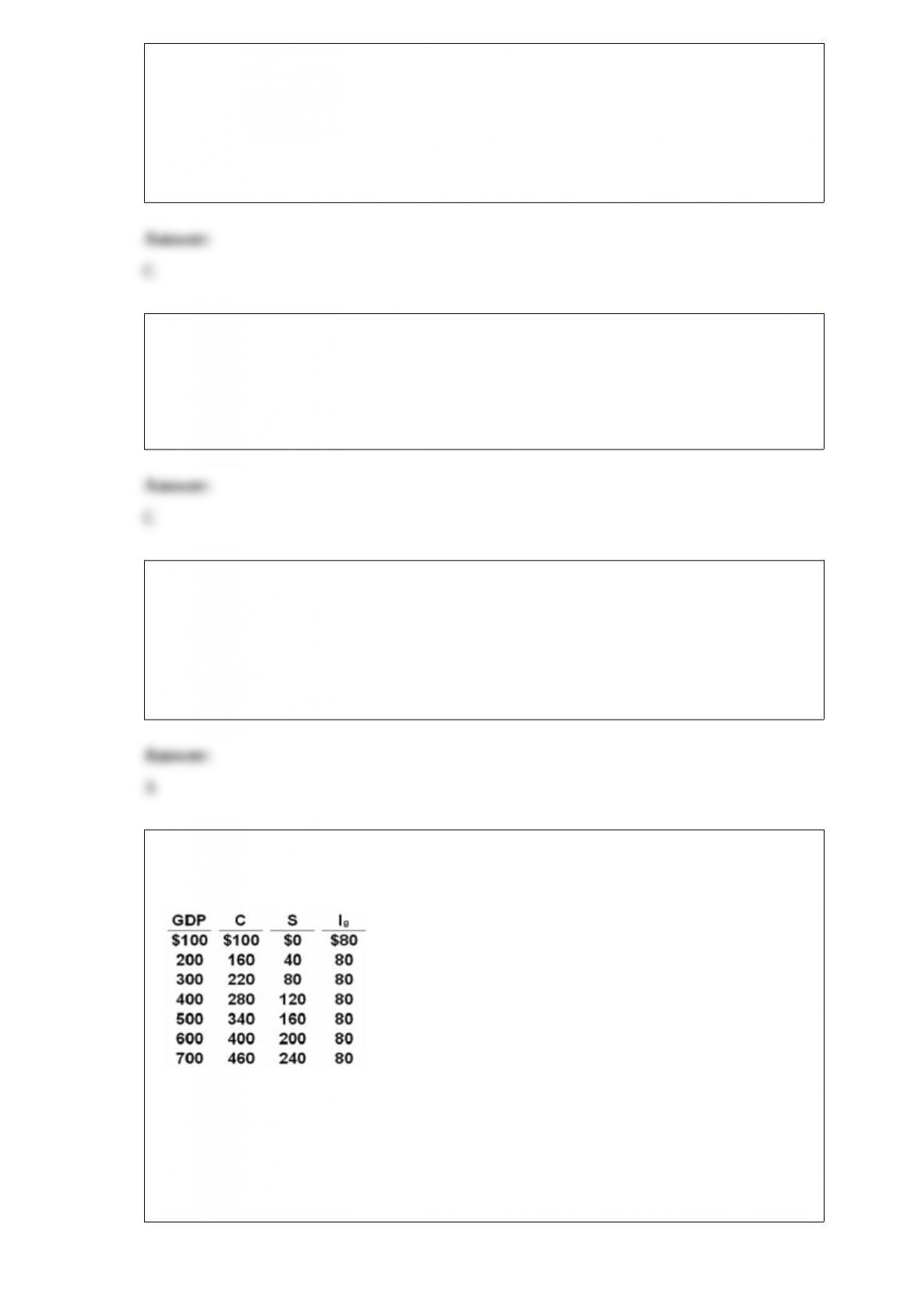
4) The following information is for a closed economy:
Refer to the above information. If government now spends $80 billion at each level of
GDP and taxes remain at zero, the equilibrium GDP:
A.will rise to $700.
B.will rise to $600.
C.will rise to $500.
D.may either rise or fall.

5) the following is cost information for the creamy crisp donut company:
entrepreneur’s potential earnings as a salaried worker = $50,000
annual lease on building = $22,000
annual revenue from operations = $380,000
payments to workers = $120,000
utilities (electricity, water, disposal) costs = $8,000
value of entrepreneur’s talent in the next best entrepreneurial activity = $80,000
entrepreneur’s forgone interest on personal funds used to finance the business = $6,000
refer to the above data. creamy crisp’s total revenues exceed its total costs, including a
normal profit, by:
a.$150,000.
b.$94,000.
c.$80,000.
d.$230,000.
6) the marginal cost curve is:
a.upsloping because of increasing marginal opportunity costs.
b.upsloping because successive units of a specific product yield less and less extra
utility.
c.downsloping because of increasing marginal opportunity costs.
d.downsloping because successive units of a specific product yield less and less extra
utility.
7) The equilibrium GDP is the level of domestic output:
A.where consumption equals saving.
B.where actual investment equals consumption.
C.which is sustainable.
D.where full employment exists.
8) The paper money used in the United States is:
A.National Bank Notes.
B.Treasury Notes.
C.United States Notes.
D.Federal Reserve Notes.

9) Examples of exports based on actual or perceived quality superiority, and not simply
on cost-advantages, include:
A.wheat from the United States and natural gas from Russia.
B.bottled water from France and chocolates from Belgium.
C.pine furniture from Mexico and textiles from China.
D.coffee from Brazil and wool from Australia.
10) all else equal, u.s. imports from germany create a:
a.demand for german marks.
b.supply of german marks.
c.demand for american dollars.
d.surplus of german marks.
11) if the output of product x is such that marginal benefit equals marginal cost:
a.the correct amount of resources is being allocated to x’s production.
b.the value of producing x exceeds the value of producing alternative products with the
available resources.
c.there can be a net gain to society by allocating either more or less resources to
producing x.
d.resources are overallocated to the production of x.
12) 1) W < MRP; W < MRC
2) W = MRP; W < MRC
3) W = MRP; W = MRC
4) W > MRP; W > MRC
Refer to the above list. The outcome in a monopsony labor market is shown by:
A.1
B.2
C.3
D.4
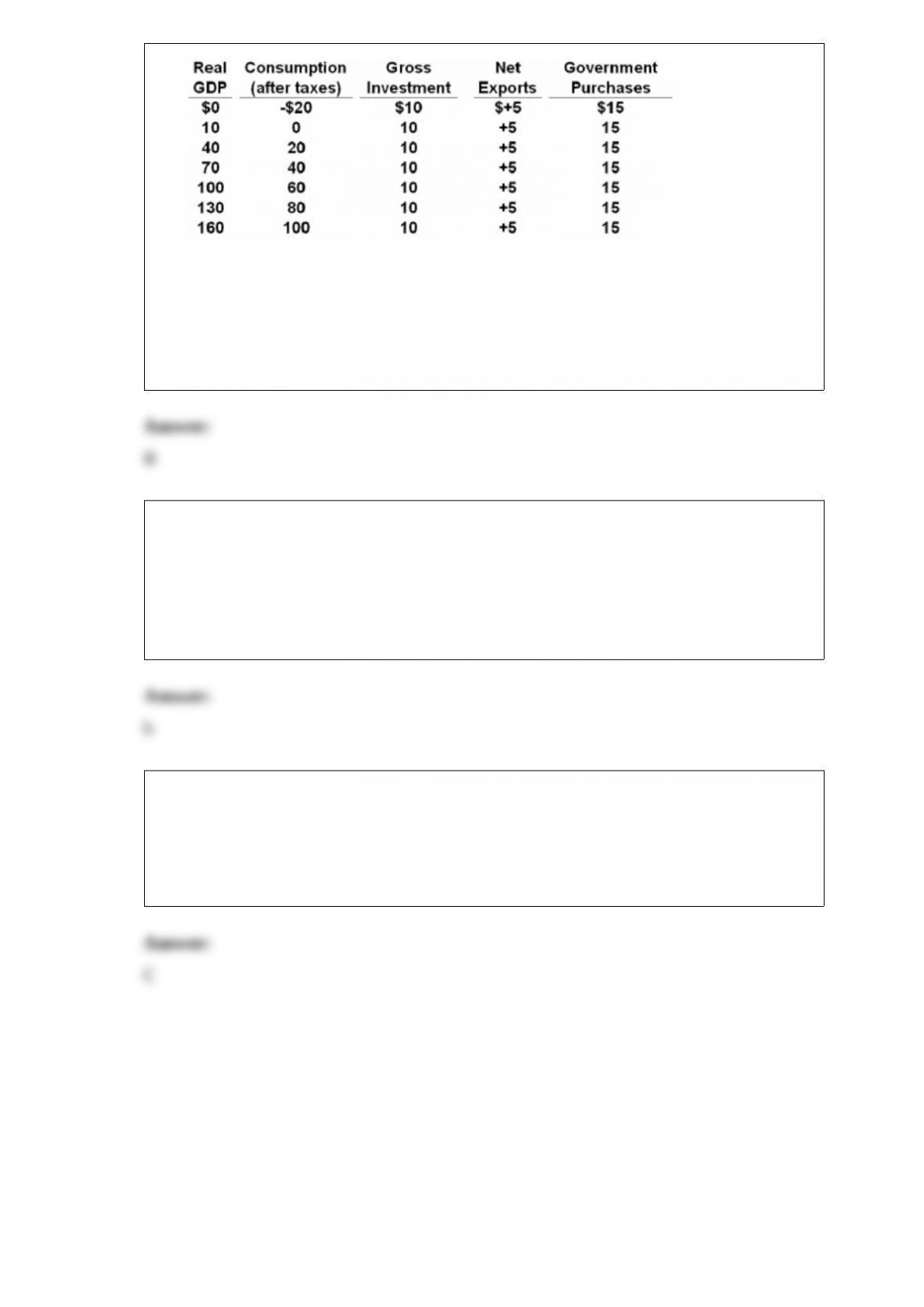
13)
Refer to the above table. Equilibrium GDP is:
A.$40.
B.$70.
C.$100.
D.$130.
14) if a firm is confronted with economic losses in the short run, it will decide whether
or not to produce by comparing:
a.marginal revenue and marginal cost.
b.price and minimum average variable cost.
c.total revenue and total cost.
d.total revenue and total fixed cost.
15) The average tax rate required to service the public debt is roughly measured by:
A.the absolute size of the debt.
B.the debt as a fraction of the GDP.
C.interest on the debt as a percentage of the GDP.
D.the ratio of government spending to the GDP.