For a person to have a comparative advantage in producing a product, he must be able
to produce that product at a higher opportunity cost than his competitors.
One example of physical capital is the amount of savings that you have.
Consumers in monopolistically competitive markets face a tradeoff between paying
prices greater than marginal costs and purchasing products that are more closely suited
to their tastes.
When voluntary exchange takes place, neither party gains from the exchange.

An increase in the price level causes a movement down the aggregate demand curve.
For a downward-sloping demand curve, marginal revenue decreases as quantity sold
increases.
The ultimatum game and the dictator game are used in economic experiments to test
whether fairness is an important influence on consumer decision-making.
Ceteris paribus, an increase in the government’s budget deficit will increase the current
account deficit.

Both first-degree price discrimination and optimal two-part tariff pricing maximize
economic surplus.
An increase in the price level shifts the aggregate demand curve to the left.
The cyclically adjusted budget is calculated at potential GDP.
The aggregate demand curve shows the relationship between the price level and the
level of planned aggregate expenditure in the economy.

In an optimal two-part tariff pricing schedule, consumer surplus is zero.
If a monopolist’s price is $50 per unit and its marginal cost is $25, then
A) to maximize profit the firm should increase output.
B) to maximize profit the firm should decrease output.
C) to maximize profit the firm should continue to produce the output it is producing.
D) Not enough information is given to say what the firm should do to maximize profit.
The size of the underground economy would tend to decrease if the government of a
country
A) decreased government regulations on businesses.
B) made over-the-counter drugs illegal.
C) increased income tax rates.
D) increased business taxes.

In 2012, global profits for McDonald’s increased by 6.3 percent when measured in local
currencies, but fell by 0.7 percent when measured in dollars. The reason for this
discrepancy is the value of the
A) euro decreased relative to the British pound.
B) British pound increased relative to the U.S. dollar.
C) U.S. dollar increased relative to most other currencies.
D) U.S. dollar decreased relative to the Japanese yen.
Which of the following correctly describes the relationship between economic
efficiency and economic equity?
A) They are both automatically achieved in a free market economy.
B) They always call for opposite outcomes.
C) There is no conflict between the two goals.
D) There is often a trade-off between the two.
If a person withdraws $500 from his/her savings account and puts it in his/her checking
account, then M1 will ________ and M2 will ________.
A) increase; decrease

B) increase; not change
C) not change; increase
D) not change; decrease
E) not change; not change
________ account(s) for between 1 and 4 percent of health care costs in the United
States.
A) The aging population
B) Uninsured patients receiving treatments at hospital emergency rooms that could have
been provided less expensively at doctor’s offices
C) The payments to settle malpractice lawsuits and the premiums doctors pay for
malpractice insurance
D) Advances in medical technology
Article Summary. Arguing that a merger would lead to higher prices, reduced
service, and significantly less competition, the Justice Department and attorneys
general from 6 states and the District of Columbia filed a lawsuit in August to
challenge the pending merger of American Airlines and US Airways. The lawsuit
took some by surprise as the Justice Department has in recent years approved the
mergers of Delta with Northwest and United with Continental. The European
Union approved the merger in August, and American and US Airways had hoped
to complete the merger by September.

Source: Even Perez, “US government seeks to block American-US Airways
merger,” CNN.com, August 13, 2013.
The standards used by the Department of Justice and the FTC to evaluate a potential
merger such as the one between American Airlines and US Airways are based on
market concentration as determined by the
A) Herfindahl-Hirschman Index.
B) Clayton Antitrust Act.
C) Anti-Collusion Task Force.
D) Robinson-Patman Act.
If you pay $2,000 in taxes on an income of $20,000, and a tax of $2,700 on an income
of $30,000, then over this range of income the tax is
A) regressive.
B) proportional.
C) progressive.
D) There is insufficient information to answer the question.
Most payments in the United States for goods and services are made using
A) currency.
B) checking account deposits.
C) traveler’s checks.
D) gold.
Consider two industries, industry W and industry X. In industry W there are five
companies, each with a market share of 20% of total sales. In industry X, there are six
companies. One company has a 50% market share and each of the other five firms has a
market share of 10%.
a. Calculate the four-firm concentration ratio for each industry.
b. Calculate the Herfindahl-Hirschman Index (HHI) for each industry.
c. What do the values of the two concentration measures imply about the degree of
market power in the two industries?
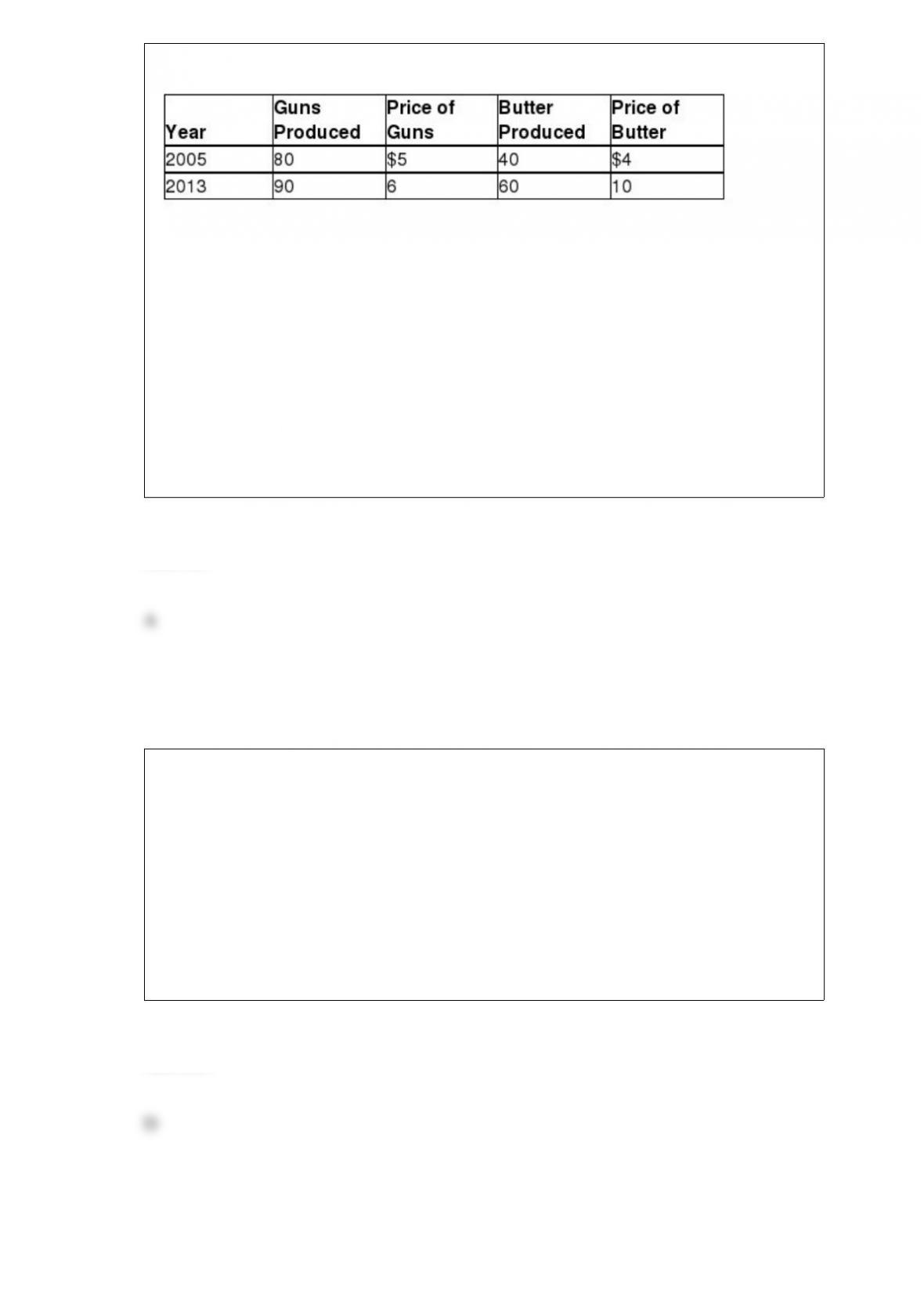
Table 19-11
Consider the following data for Tyrovia, a country that produces only two products:
guns and butter.
Nominal GDP for Tyrovia in 2013 equals
A) $1,140.
B) $880.
C) $690.
D) $560.
Which of the following factors has significantly increased the supply of labor in the
United States since 1950?
A) a large increase in the substitution effect as a result of higher wages
B) a low birth rate and an aging population
C) an increase in the number of people who have received college degrees
D) an increase in the labor force participation rate of women
Pakistan has developed a comparative advantage in the production of clothing. The
source of its comparative advantage in these products is
A) a favorable climate.
B) technology.
C) abundant supplies of natural resources.
D) a large supply of unskilled workers.
What is the difference between explicit and implicit costs?
Explain how the economy moves back to full employment from recession. Be sure to
detail what happens to short-run aggregate supply, unemployment, equilibrium GDP
and the price level.
Is it possible for a firm to have a comparative advantage in producing something
without having an absolute advantage? Why or why not?
With state and multistate lotteries, winners are typically given the choice between a
lump sum payment today or a 20 year series of annuities. How should a winner decide
which is better?
What is the formula for the multiplier? Explain why this formula is considered to be too
simple.