1) Suppose France subsidizes French wheat farmers, while Germany offers no subsidy
to German wheat farmers. As a result of the French subsidy, sales of French wheat to
Germany
a.may prompt German farmers to invoke the unfair-competition argument.
b.increase the consumer surplus of German buyers of wheat.
c.increase the total surplus of the German people.
d.All of the above are correct.
2) Who once said that taxes are the price we pay for a civilized society?
a.Milton Friedman
b.Theodore Roosevelt
c.Arthur Laffer
d.Oliver Wendell Holmes, Jr.
3) Refer to Figure 9-16. Government revenue raised by the tariff is represented by the
area
a.E.
b.B + E.
c.D + E + F.
d.B + D + E + F.
4) For a particular good, a 2 percent increase in price causes a 12 percent decrease in
quantity demanded. Which of the following statements is most likely applicable to this
good?
a.There are no close substitutes for this good.
b.The good is a luxury.
c.The market for the good is broadly defined.
d.The relevant time horizon is short.
5) Which of the following is not an example of signaling?
a.An employer calls the references of a potential employee before hiring him or her.
b.A boyfriend gives his girlfriend a necklace with her favorite gemstone for Valentine’s
Day.
c.A home flooring company advertises its high Better Business Bureau rating during its
television commercials.
d.A company advertises that it makes charitable contributions.
6) A firm in a monopolistically competitive market faces a
a.downwardsloping demand curve because the firm’s product is different from those
offered by other firms.
b.downward-sloping demand curve because there are only a few firms in the market.
c.horizontal demand curve because there are many firms in the market.
d.horizontal demand curve because firms can enter the market without restriction.
7) One way in which monopolistic competition differs from oligopoly is that
a.there are no barriers to entry in oligopolies.
b.in oligopoly markets there are only a few sellers.
c.all firms in an oligopoly eventually earn zero economic profits.
d.strategic interactions between firms are rare in oligopolies.
8) What is the difference between command-and-control policies and market-based
policies toward externalities?
a.Command-and-control policies provide incentives for private decision makers to
solve the problems on their own, whereas market-based policies regulate behavior
directly.
b.Command-and-control policies rely on taxes, whereas market-based policies rely on
quotas.
c.Command-and-control policies regulate behavior directly, whereas market-based
policies provide incentives for private decision makers to change their behavior.
d.Command-and-control policies are efficient, whereas market-based policies are
inefficient.
9) Suppose for some firm that average total cost is minimized at Q1units of output. For
a monopolistically competitive firm in long-run equilibrium, Q1
a.is also the level of output at which marginal cost equals average total cost.
b.exceeds the level of output at which there is a point of tangency between the demand
curve and the average total cost curve.
c.exceeds the level of output at which marginal revenue equals marginal cost.
d.All of the above are correct.
10) Suppose a firm in a competitive market reduces its output by 20 percent. As a
result, the price of its output is likely to
a.increase.
b.remain unchanged.
c.decrease by less than 20 percent.
d.decrease by more than 20 percent.
11) Suppose that a small county is considering adding a guard rail to a dangerous curve
by a river. The guard rail will cost $70,000. The average damage done to vehicles that
slide off the road at the curve is $10,000. It is expected that the guard rail will prevent 5
vehicles from sliding off the road during its usable life. What should the county do?
a.Install the guard rail because safety is priceless.
b.Install the guard rail because the benefits exceed the costs.
c.Do not install the guard rail because the costs exceed the benefits.
d.Do not install the guard rail at any cost because drivers can purchase private insurance
for their vehicles.
12) When we focus on labor as an input in the production process, we typically draw
the production function by measuring the
a.quantity of labor on the horizontal axis and the quantity of output on the vertical axis.
b.quantity of labor on the horizontal axis and the marginal product of labor on the
vertical axis.
c.quantity of labor on the horizontal axis and the value of the marginal product of labor
on the vertical axis.
d.value of the marginal product of labor on the horizontal axis and the quantity of
output on the vertical axis.
13) An economy’s production of two goods is efficient if
a.all members of society consume equal portions of the goods.
b.the goods are produced using only some of society’s available resources.
c.it is impossible to produce more of one good without producing less of the other.
d.the opportunity cost of producing more of one good is zero.
14) Which of the following is an economic explanation for the “beauty premium”?
a.Employers pay very attractive women less than average-looking women because they
believe them to be less intelligent.
b.Employers pay above-average-looking men more than above-average-looking
women.
c.Employers pay above-average-looking women more than average-looking women
because customers prefer to deal with better-looking women.
d.Employers pay above-average-looking men more because they signal to the market
that they are willing to spend more money on personal grooming, a sign of wealth and
stability.
15) A change in the supply of any one factor alters the earnings of all the other factors.
a.True
b.False
16) In the simple circular-flow diagram, who buys the factors of production?
a.households only
b.firms only
c.both households and firms
d.neither households nor firms
17) Figure 14-11
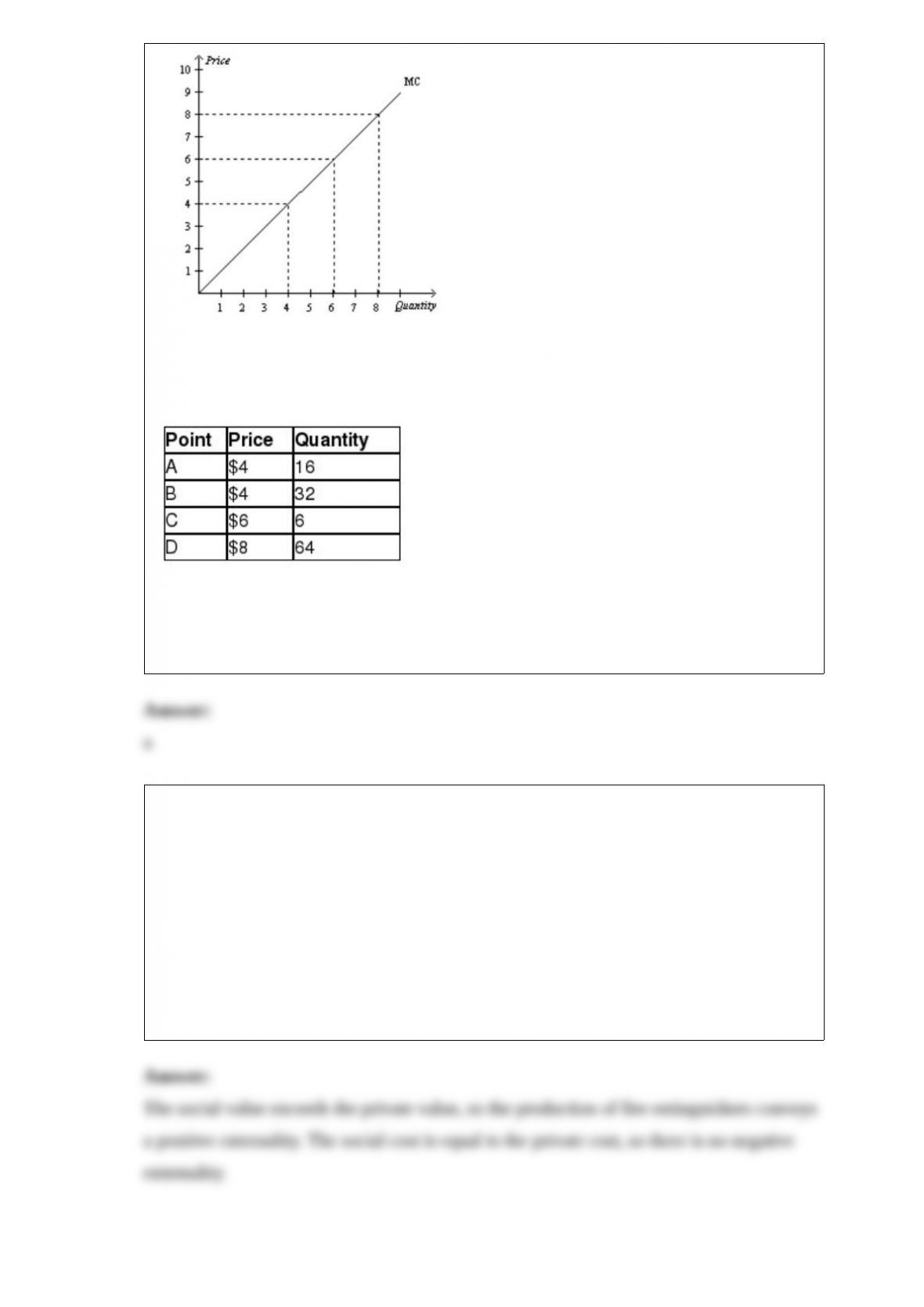
The figure above is for a firm operating in a competitive industry. If there were four
identical firms in the industry, which of the following price-quantity combinations
would be on the market supply curve?
a.A only
b.A and C only
c.B only
d.B and D only
18) Scenario 10-4
The demand curve for fire extinguishers slopes downward and the supply curve for fire
extinguishers slopes upward. The production of the 500th fire extinguisher entails the
following:
♦ a private cost of $10;
♦ an external cost of $0;
♦ a private value of $9;
♦ an external benefit of $3.
Does the production of fire extinguishers convey a positive externality, a negative
externality, or neither?
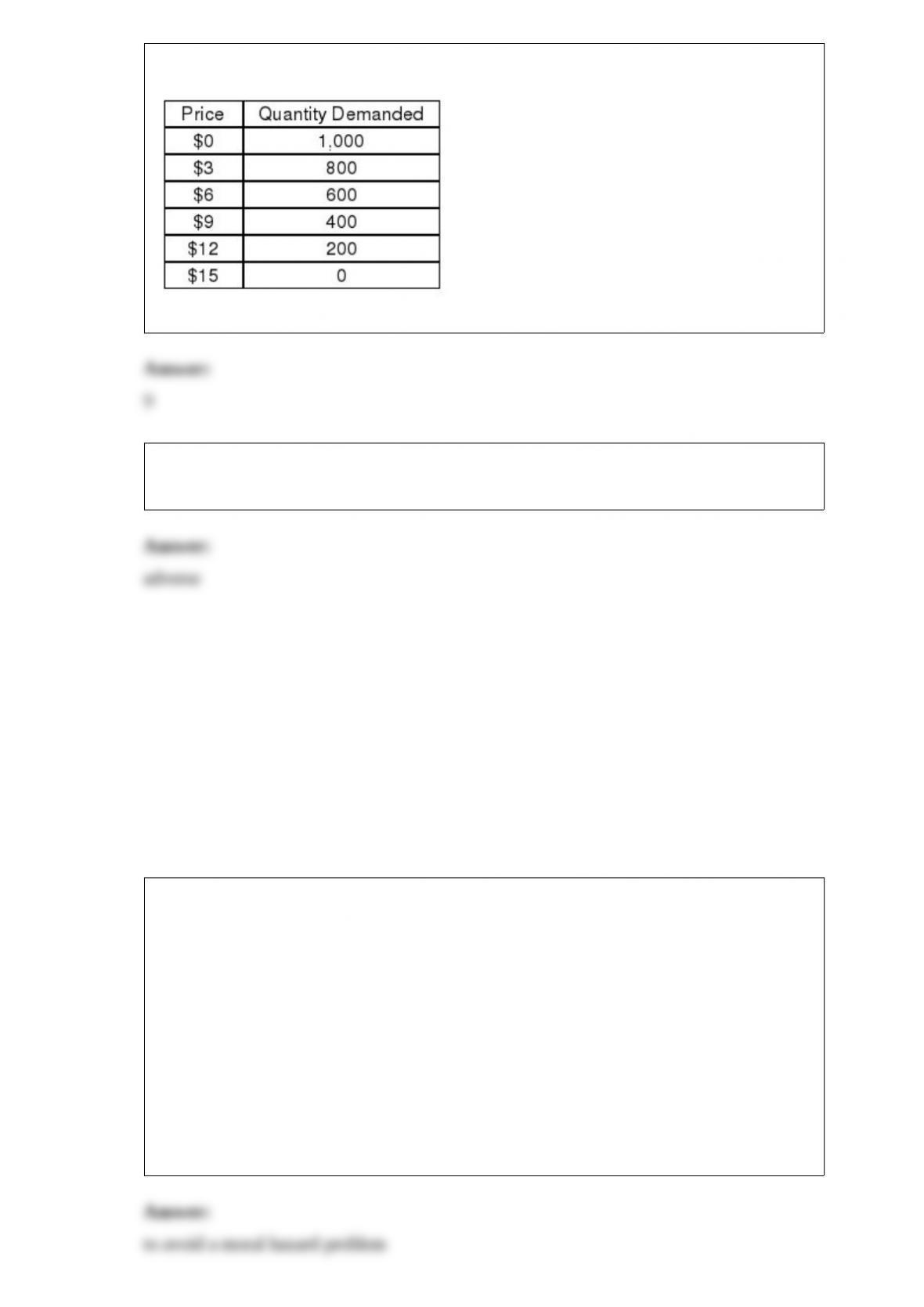
19) Consider the following demand schedule.
Using the midpoint method, what is the between $12 and $15?
20) Most economists agree that a large federal budget deficit has what type of effect on
the economy?
21) Scenario 22-6
Shana owns a boutique that sells highend women’s clothing and accessories. Katie
works part-time at the boutique and frequently is the only employee in this small store.
Shana pays Katie a wage that is higher than the market wage for this type of job. When
the store is not full of customers, Katie diligently works on displays and cleans to keep
the store looking its best. Belinda is a customer in the store who asks Katie’s opinion on
the quality of some jeans she is considering purchasing. Katie tells her the quality is
great even though she’s had several other customers return them due to flaws. Magda is
another customer who is returning a necklace without volunteering that a gem is
missing.
Refer to Scenario 22-6. Why do you suppose Shana pays Katie a wage higher than the
market wage?
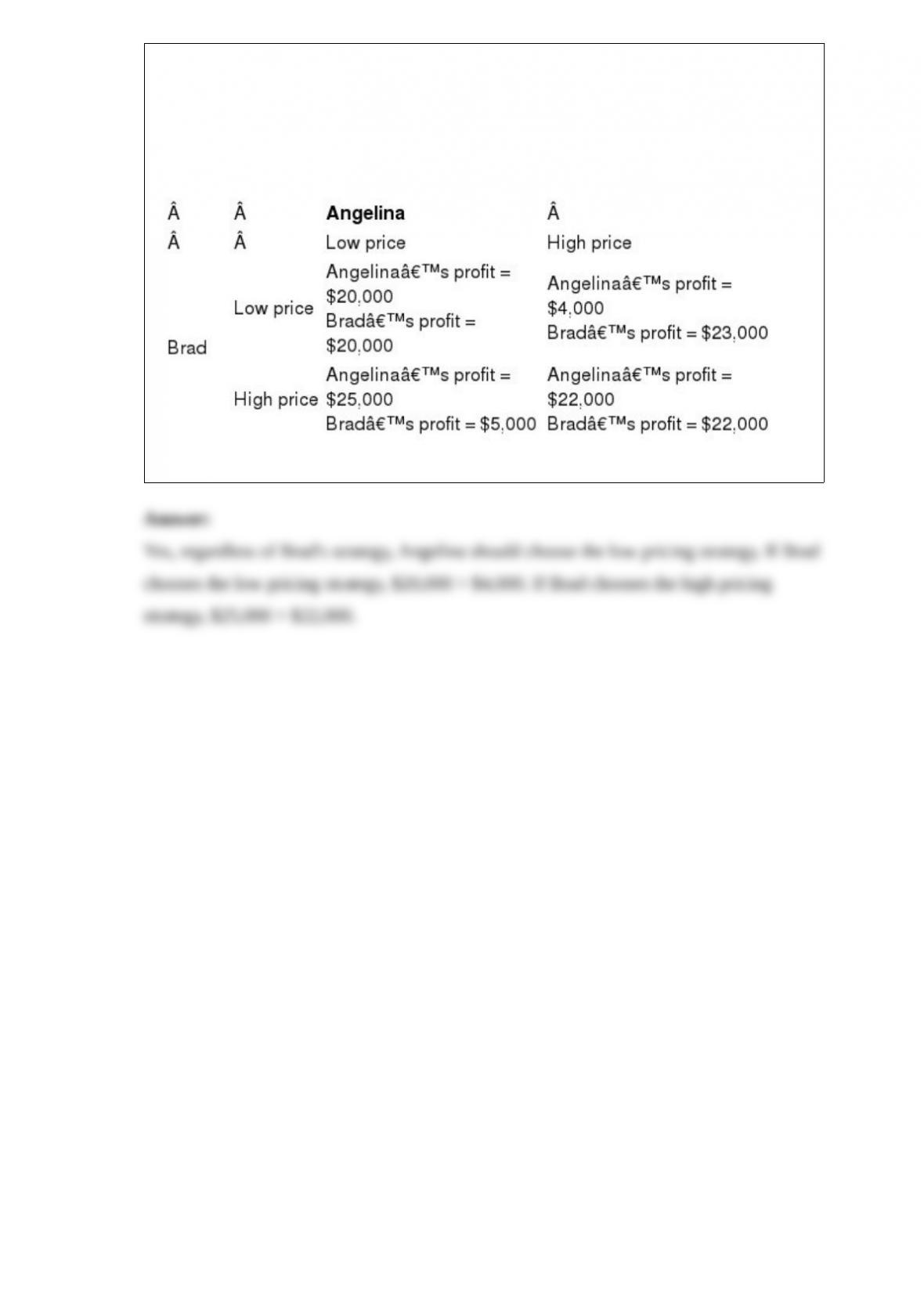
22) Table 17-32
Suppose that Angelina and Brad own the only two professional photography stores in
town. Each must choose between a low price and a high price for senior photo
packages. The annual economic profit from each strategy is indicated in the table
below:
Refer to Table 17-32. Does Angelina have a dominant strategy? If so, describe it.