1) the demand curve faced by a pure monopolist:
a.may be either more or less elastic than that faced by a single purely competitive firm.
b.is less elastic than that faced by a single purely competitive firm.
c.has the same elasticity as that faced by a single purely competitive firm.
d.is more elastic than that faced by a single purely competitive firm.
2) The basic problem portrayed by the traditional Phillips Curve is:
A.that a level of aggregate demand sufficiently high to result in full employment may
also cause inflation.
B.that changes in the composition of total labor demand tend to be deflationary.
C.that unemployment rises at the same time the general price level is rising.
D.the possibility that automation will increase the level of noncyclical unemployment.
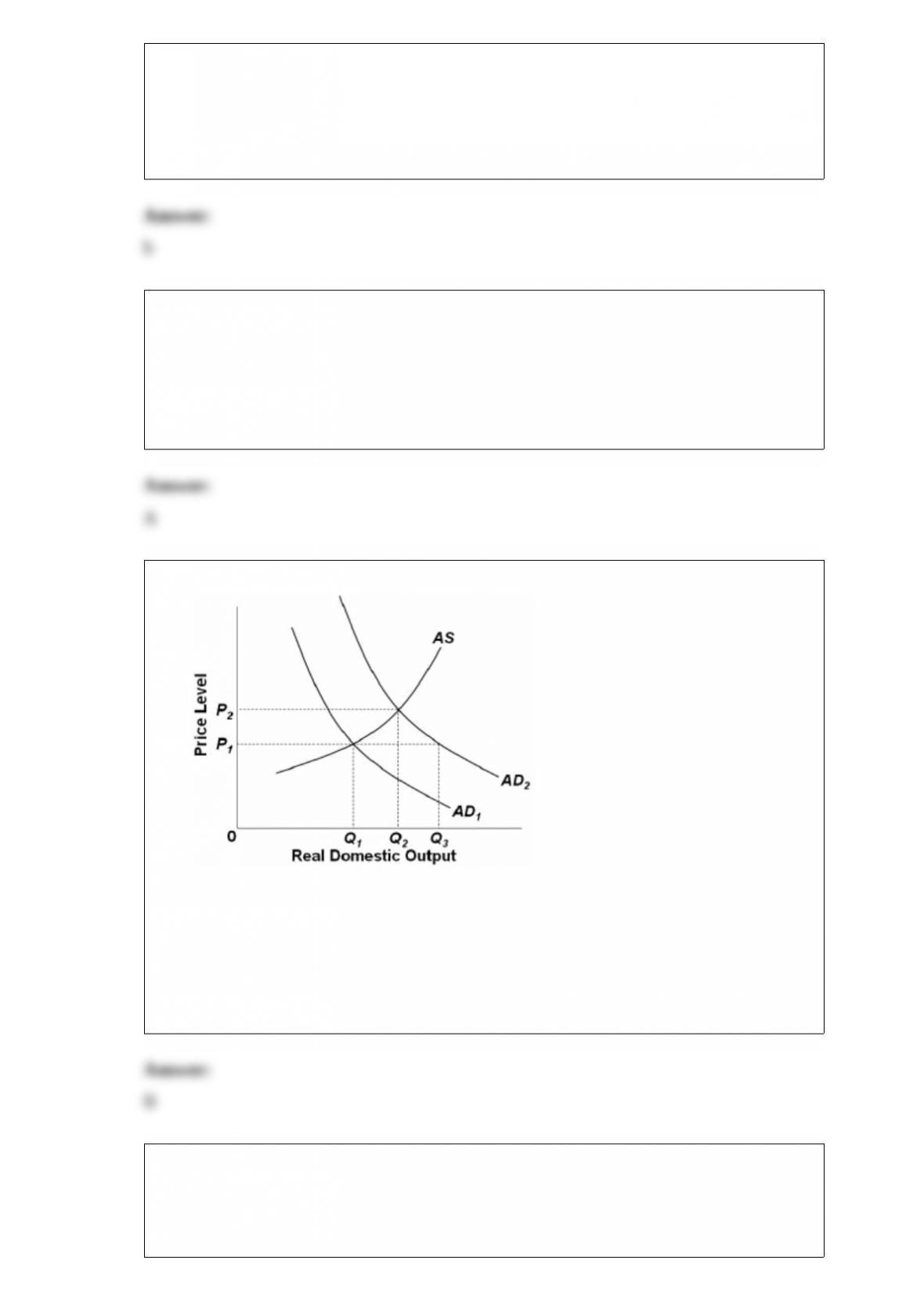
3)
Refer to the above diagram. Which of the following would shift the aggregate demand
curve from AD2 to AD1?
A.a decline in personal income tax rates
B.an increase in the international value of the dollar
C.an increase in government spending
D.an upward revision of expected rates of return on investment projects
4) The absolute income gap between the IACs and the DVCs has:
A.remained constant over time.
B.increased over time.
C.decreased over time.
D.increased in nominal terms, but decreased in real terms.
5) In the table below, assume a monopsonist has the marginal-revenue-product schedule
for a particular type of labor given in columns 1 and 2 and that the supply schedule for
labor is that given in columns 1 and 3.
(a)Compute the firms total labor costs at each level of employment and the marginal
labor cost of each unit of labor, and enter these figures in columns 4 and 5.
(b)How many units of labor will the firm hire? What will be the wage rate?
(c)If this firm hired labor in a competitive labor market, what would be the wage rate
and number of workers hired?
6) If the Federal Reserve authorities were attempting to reduce demand-pull inflation,
the proper policies would be to:
A.sell government securities, raise reserve requirements, raise the discount rate, and
reduce the amount of reserves available through the term auction facility.
B.buy government securities, raise reserve requirements, raise the discount rate, and
reduce the amount of reserves available through the term auction facility.
C.sell government securities, lower reserve requirements, lower the discount rate, and
increase the amount of reserves available through the term auction facility.
D.sell government securities, raise reserve requirements, lower the discount rate, and
increase the amount of reserves available through the term auction facility.
7) nonrivalry and nonexcludability are the main characteristics of:
a.capital goods.
b.private goods.
c.public goods.
d.consumption goods.
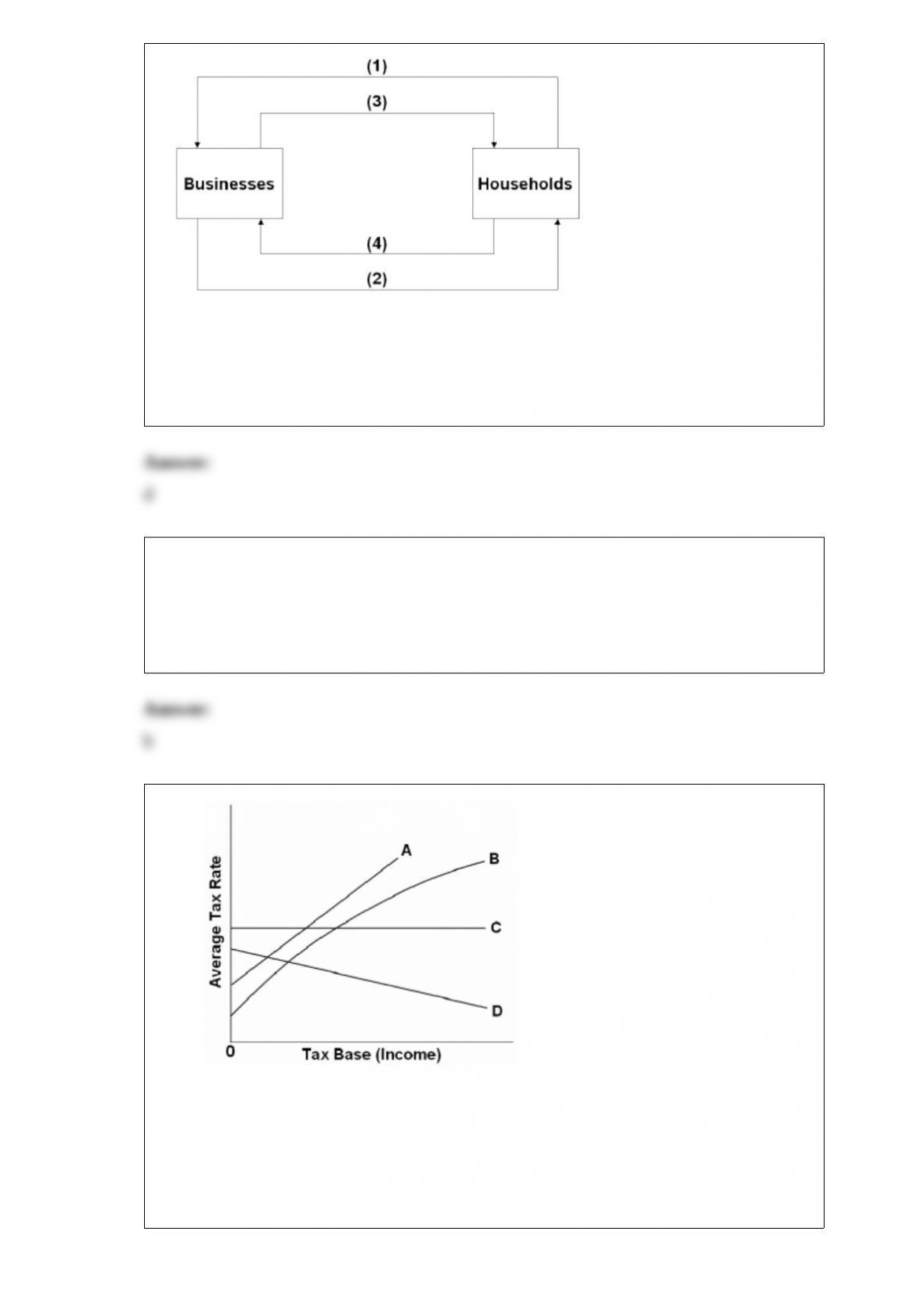
8)
refer to the above diagram. arrows (1) and (2) represent:
a.goods and resources respectively.
b.money incomes and output respectively.
c.output and money incomes respectively.
d.resources and goods respectively.
9) who is least likely to be hurt by unanticipated inflation?
a.a disabled laborer who is living off accumulated savings
b.an owner of a small business
c.a secretary
d.a pensioned steelworker
10)
Refer to the above graph. Which of the lines in the above diagram represent(s) a
regressive tax?
A.both A and B.
B.D only.
C.C only.
D.B only.

11) which of the following pairs of nations received the most remittances from their
emigrants in 2007?
a.mexico and egypt
b.china and india
c.pakistan and iran
d.vietnam and thailand