
Which of the following job market signals are less costly for high-quality workers to
send than low-quality workers?
A) Spending long hours at the office
B) Sending emails to coworkers and supervisors at night and on weekends
C) Leaving voice-mail message for colleagues before or after regular business hours
D) all of the above
Which of the following goods may have demand that is potentially affected by the
bandwagon effect?
A) Satellite radio
B) Cellular telephones
C) High-definition (HD) televisions
D) Electronic book readers
E) all of the above
Jon’s income-consumption curve is a straight line from the origin with a positive slope.
Now suppose that Jon’s preferences change such that his income-consumption curve
remains a straight line but rotates 15 degrees clockwise. Jon’s demand curve for the

good on the horizontal axis
A) will shift left.
B) will shift right.
C) will not change.
D) might do any of the above.
Scenario 10.2:
A monopolist faces the following demand curve, marginal revenue curve, total cost
curve and marginal cost curve for its product:
Q = 200 – 2P
MR = 100 – Q
TC = 5Q
MC = 5
Refer to Scenario 10.2. Suppose that a tax of $5 for each unit produced is imposed by
state government. What is the profit maximizing price?
A) $90.00
B) $10.00
C) $55.00
D) $52.50

Which incentive scheme would simultaneously elicit accurate information about
feasible plant production levels and motivate managers to perform up to potential (in
the following schemes, B is the bonus payment, Q is actual plant output, and Qf is the
manager’s estimate of feasible output)?
A) B = 0.4Q
B) B = 0.4(Q – Qf)
C) B = 0.4Qf + 0.3(Q – Qf) if Q > Qf
D) B = 0.4Qf – 0.6(Q – Qf) if Q < Qf
E) B = 0.4Qf – 0.6(Q – Qf) if Q > Qf
Based on the diagram below it can be inferred that:

A) hot dogs are a normal good for all levels of income.
B) hot dogs are an inferior good, but not a Giffen good, for all levels of income.
C) hot dogs are a Giffen good for all levels of income.
D) hot dogs are an inferior good for low levels of income, but at higher levels of
income become a normal good.
E) none of the above
The city of Econoville has 100 residents who each have the identical demand function
for lake area: P = 1,000 – 9.95Q. The marginal cost of maintaining lake area is MC(Q) =
1,500 + 5Q. Lake area is a public good. That is, if the city of Econoville provides public
access lake area, all of the residents can enjoy the area. If the city of Econoville does
not offer public lake area, how much area of lakes will each individual resident
maintain on their own? What is the optimal area of public lakes in Econoville? What
flat lake tax should Econoville implement on residents for units of lake area the city
provides? With this flat tax, what is the total contribution of each resident for the lake?

Suppose your utility function for income that takes the form U(I) = , and you are
considering a self-employment opportunity that may pay $10,000 per year or $40,000
per year with equal probabilities. What certain income would provide the same
satisfaction as the expected utility from the self-employed position?
A) $15,000
B) $22,500
C) $25,000
D) $27,500
If a monopolist’s profits were taxed away and redistributed to its consumers,

A) inefficiency would remain because output would be lower than under competitive
conditions.
B) inefficiency would remain, but not because output would be lower than under
competitive conditions.
C) efficiency would be obtained because output would be increased to the competitive
level.
D) efficiency would be obtained because output would be increased and profits
removed.
If all producers in a market are cartel members, then the demand curve facing the cartel
is
A) the market demand curve.
B) horizontal.
C) identical to the demand curve in the dominant firm model.
D) identical to the monopolist’s demand curve.
Suppose the upward sloping labor supply curve shifts leftward in a labor market with a
single employer (monopsony). What happens to the equilibrium wage and level of
employment in the market?

A) Wage and level of employment increase.
B) Wage increases and level of employment declines.
C) Wage decreases and level of employment increases.
D) Wage and level of employment decline.
Suppose a firm has market power and faces a downward sloping demand curve for its
product, and its marginal cost curve is upward sloping. If the firm reduces its price,
then:
A) consumer and producer surplus must increase.
B) consumer surplus increases, producer surplus may increase or decrease.
C) consumer surplus increases, producer surplus must decline.
D) consumer and producer surplus must decline.
Scenario 5.5:
Engineers at Jalopy Automotive have discovered a safety flaw in their new model car. It
would cost $500 per car to fix the flaw, and 10,000 cars have been sold. The company
works out the following possible scenarios for what might happen if the car is not fixed,
and assigns probabilities to those events:

Scenario Probability Cost
A. No one discovers flaw .15 $0
B. Government fines firm .40 $10 million
(no lawsuits)
C. Resulting lawsuits are lost .30 $12 million
(no government fine)
D. Resulting lawsuits are won .15 $2 million
(no government fine)
Refer to Scenario 5.5. The expected cost to the firm if it does not fix the car is
A) $0.
B) $24 million.
C) $7.9 million.
D) $2 million.
E) $3.6 million.
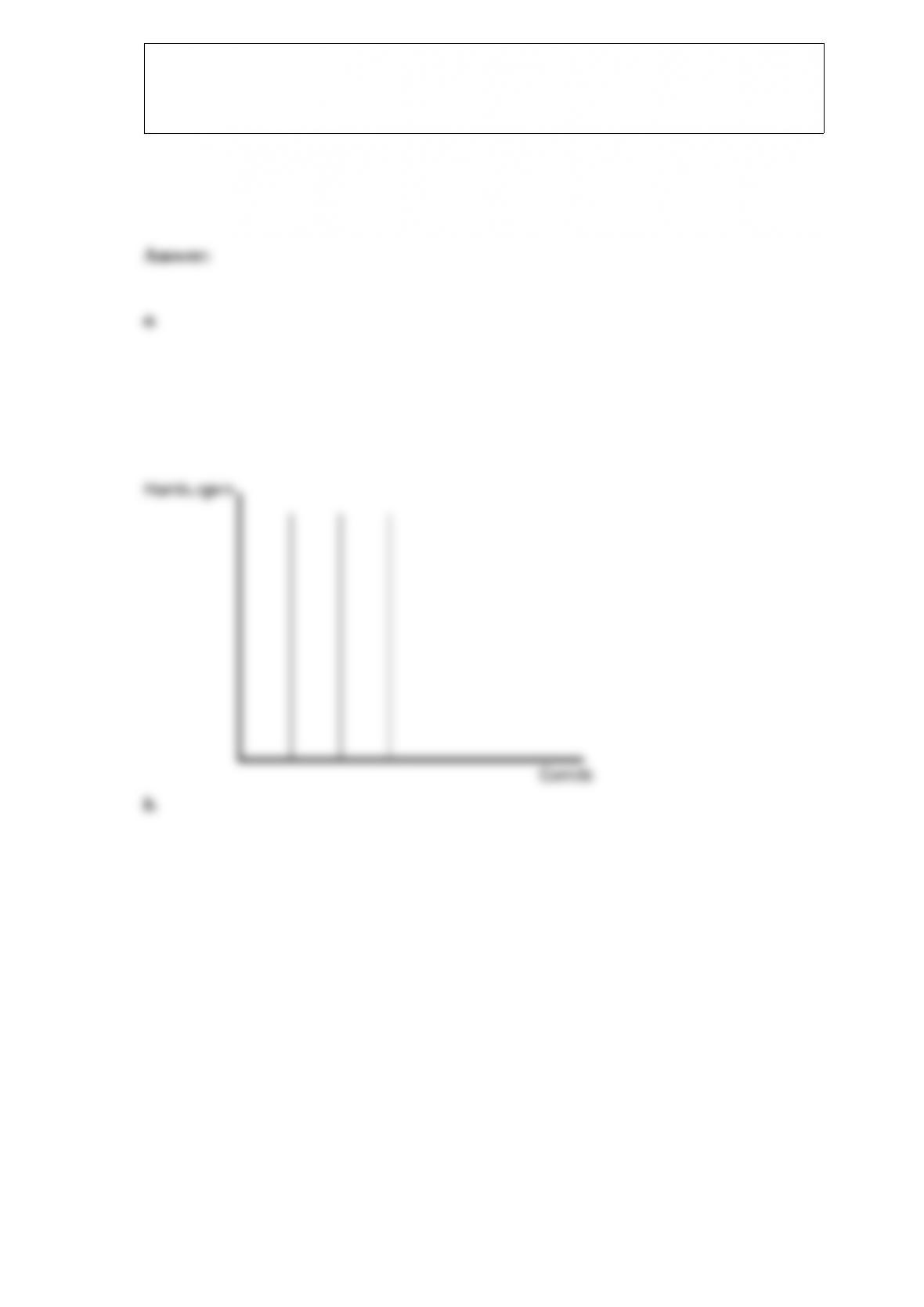
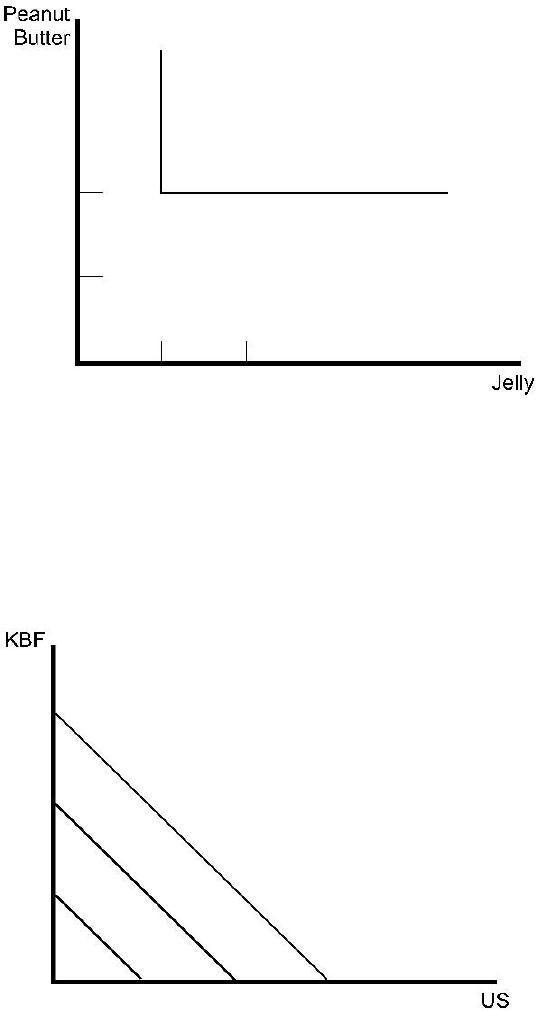
Draw a set of indifference curves for the following pairs of goods:
a. Hamburgers and carrots for a vegetarian who neither likes nor dislikes meat.
(Vegetarians do not eat meat.)
b. Peanut butter and jelly for an individual that will not eat peanut butter sandwiches or
jelly sandwiches, but loves peanut butter and jelly sandwiches made with two parts
peanut butter and one part jelly.
c. Tickets for Knott’s Berry Farm (KBF) and Universal Studios (US) for a tourist that
believes that KBF and US are perfect substitutes.
d. Ice cream and pie if these are goods that you like, but if you consume enough of
either, you get sick of them. If you are sick of a good, consuming more of it lowers your
utility.

Behavioral economists argue that asset price bubbles and other examples of herd
behavior may be due to biases resulting from the law of small numbers. In particular,
the investors may observe unusually ________ returns for some asset and use this
limited information to ________ the probability that returns will be high in the future.
A) low, over-estimate
B) low, under-estimate
C) high, over-estimate
D) high, under-estimate
Suppose the market demand curve is P = 40 – 2Q and the constant marginal cost of
production is MC = 20. Which of the following is a valid expression for the collusion
curve?
A) Q = 5
B) Q1 = 5 – Q2
C) Q1 = Q2 = 5
D) Q1 = 40 – Q2
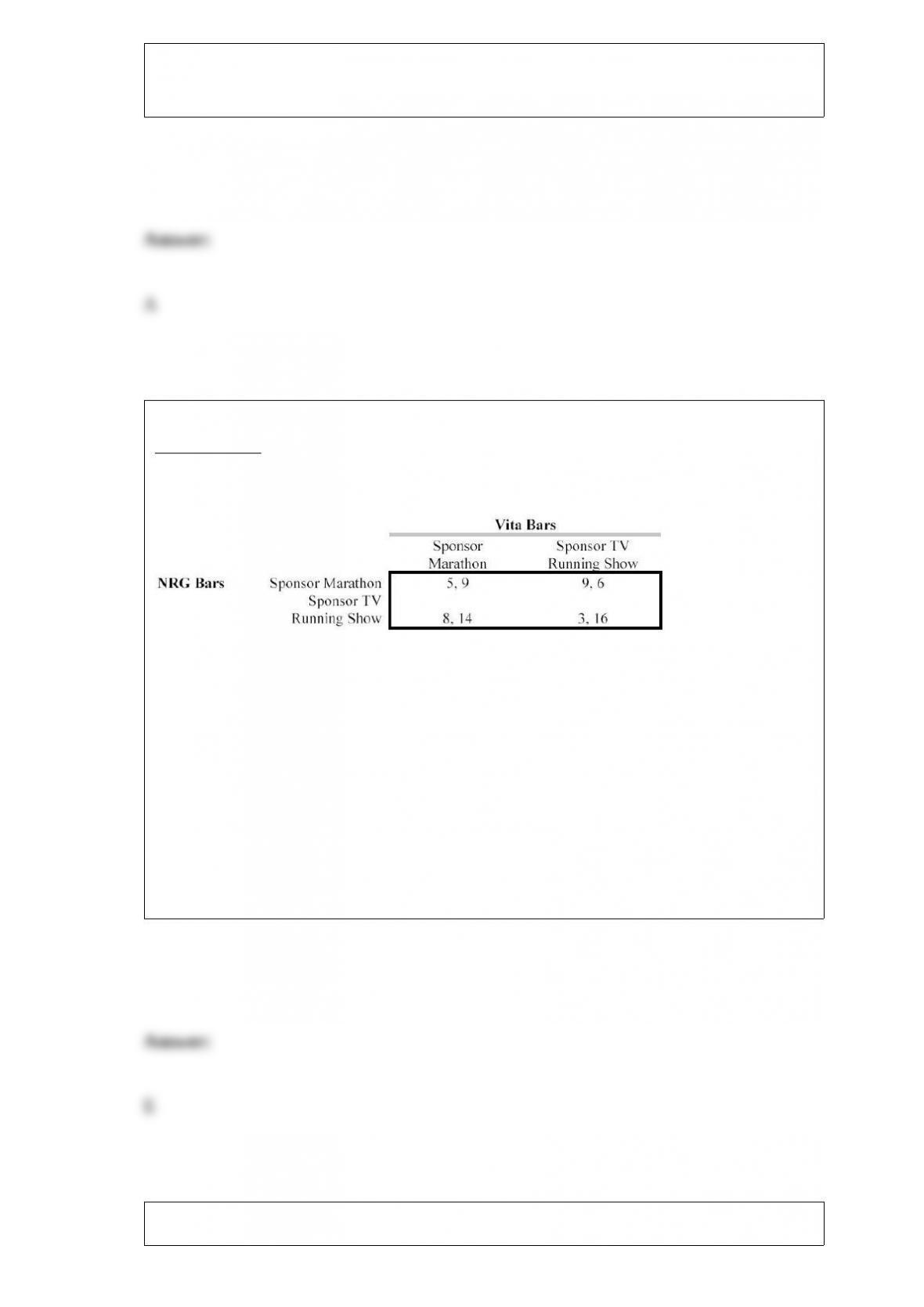
Scenario 13.4
Consider the following game:
Which of the following is TRUE for the game in Scenario 13.4?
A) NRG’s dominant strategy is to sponsor the marathon.
B) NRG’s dominant strategy is to sponsor the TV show.
C) Vita’s dominant strategy is to sponsor the marathon.
D) Vita’s dominant strategy is to sponsor the TV show.
E) Neither company has a dominant strategy.
Suppose Bob owns two factories that are located several hundred miles apart. Bob

decides to manage one of the plants himself, and he hires another person to manage the
second plant. For purposes of operating the second plant, who is the agent and who is
principal?
A) Bob is the agent and the manager is the principal.
B) Bob is the principal and the manager is Bob’s agent.
C) Both Bob and the manager are principals.
D) We need more information to determine the identities of the principal and the agent
in this case.
Repetition of a game
A) yields the same outcome, over and over.
B) can result in behavior that is different from what it would be if the game were played
only once.
C) is not possible.
D) makes cooperative games into non-cooperative games.
E) is possible only if the payoffs in the matrix change.
Which of the following claims is true at each point along a price-consumption curve?

A) Utility is maximized but income is not all spent.
B) All income is spent, but utility is not maximized.
C) Utility is maximized, and all income is spent.
D) The level of utility is constant.
Scenario 1:
It is the factory’s choice whether to install a filter. It is the choice of the nearby
fishermen whether to install a treatment plant. Dollar figures show profit. The factory
and the fishermen can negotiate costlessly, and no one else is affected by the result.
Factory Fishermen
A: No filter or treatment plant $10,000 $2,000
B: Filter; no treatment plant $6,000 $10,000
C: No filter; treatment plant $10,000 $4,000
D: Filter; treatment plant $6,000 $6,000
It would be acceptable to both parties to have the fishermen pay the factory
A) $0 to install a filter.
B) $500 to install a filter.
C) $4,000 to install a filter.
D) $6,000 to install a filter.
E) any amount greater than $4,000 and less than $6,000 to install the filter and make
both parties better off.

Which of the following ideas were central to the conclusions drawn by Thomas Malthus
in his 1798 “Essay on the Principle of Population”?
A) Short-run time period
B) Shortage of labor
C) Law of diminishing resource availability
D) Law of diminishing returns
Suppose the demand for gourmet coffee can be represented by a linear demand curve.
At the prevailing market price the income elasticity of demand for gourmet coffee is 2.
When income rises the demand curve for gourmet coffee:
A) becomes less elastic at every price.
B) becomes less elastic at the price that prevailed before the change in income
C) becomes more elastic at every price
D) becomes more elastic at the price that prevailed before the change in income

The more elastic the demand facing a firm,
A) the higher the value of the Lerner index.
B) the lower the value of the Lerner index.
C) the less monopoly power it has.
D) the higher its profit.
Which of the following is true in long-run equilibrium for a firm in a monopolistic
competitive industry?
A) The demand curve is tangent to marginal cost curve.
B) The demand curve is tangent to average cost curve.
C) The marginal cost curve is tangent to average cost curve.
D) The demand curve is tangent to marginal revenue curve.

Majority-rule voting
A) is economically efficient.
B) is never economically efficient.
C) may or may not be efficient, depending upon the preferences of the voters.
D) is economically efficient only in a democracy.
E) is economically efficient only if there is a median voter.
With respect to monopolies, deadweight loss refers to the
A) socially unproductive amounts of money spent to obtain or acquire a monopoly.
B) net loss in consumer and producer surplus due to a monopolist’s pricing
strategy/policy.
C) lost consumer surplus from monopolistic pricing.
D) none of the above
Scenario 2:
Sam and Sally are the only consumers in an economy where tee shirts and candy are the

only commodities that are consumed. The marginal utility schedule for each appears
below.
Sam tee shirts MU(tee shirts) Candy MU(Candy)
1 10 1 6
2 9 2 5
3 8 3 4
4 7 4 5
5 6 5 4
Sally tee shirts MU(tee shirts) Candy MU(Candy)
1 24 1 12
2 19 2 9
3 18 3 8
4 14 4 7
5 10 5 3
There are 7 candies and 7 tee shirts total in the economy.
Consider the case when the goods are redistributed such that Sam has 3 tee shirts and 3
candies. Sally has 4 tee shirts and 4 candies.
Is the current distribution Pareto optimal?
A) Yes.
B) No, as Sam could trade Sally a piece of candy for a tee shirt and both people would
be better off.
C) No, as Sam could trade Sally a tee shirt for a piece of candy and both people would
be better off.
D) Without the prices of each commodity it is impossible to determine if this
distribution is Pareto optimal.

A bumper-to-bumper warranty on a used car is a signaling device that
A) identifies a high-quality car as a high-quality car, because putting such a warranty on
a low-quality car would be prohibitively costly.
B) disguises a low-quality car as a high-quality car, and thus makes it easier to sell.
C) is necessary in order to sell a low-quality car at all. Without it no one would risk
buying the car.
D) isn’t necessary if there is a mix of high-quality and low-quality cars in the market.
E) helps sellers determine whether the buyer is truly looking for a high-quality car.
Price ceilings
A) cause quantity to be higher than in the market equilibrium.
B) always increase consumer surplus.
C) may decrease consumer surplus if demand is sufficiently elastic.
D) may decrease consumer surplus if demand is sufficiently inelastic.
E) always decrease consumer surplus.