
When large oligopolistic firms negotiate with the unions of their employees, the
resulting bargaining process closely resembles
a. perfect competition.
b. a dual labor market.
c. monopolistic competition.
d. bilateral monopoly.
Most economists believe that the theory of rational expectations is
a. more correct in the long run than the short run.
b. more correct in the short run than the long run.
c. correct in both the long run and short run.
d. incorrect because it is based on false logic.
Figure 20-2
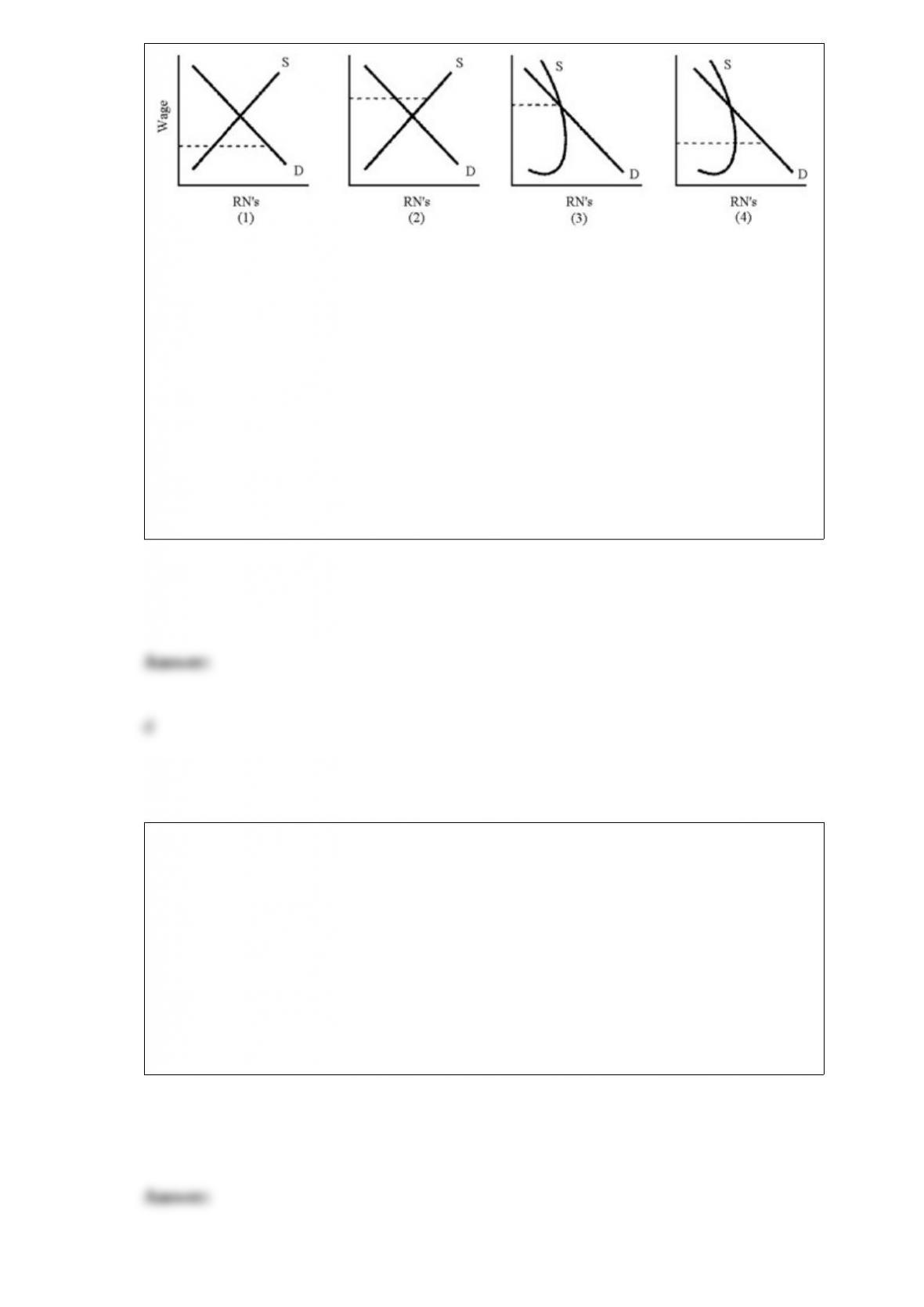
At existing wage rates, hospitals face a shortage of registered nurses. Some studies have
suggested that an increase in RN wages will actually reduce the hours supplied by
existing RNs, making it more difficult for hospitals to find RNs. Which panel in Figure
20-2, where the broken line indicates the existing wage rate, illustrates this case?
a. 1
b. 2
c. 3
d. 4
China, the last large communist society,
a. has proved that a command economy has far less pollution problems than capitalist
economies.
b. has urban smog levels higher than Los Angeles.
c. has the world’s most sophisticated pollution-control devices.
d. has lowered its level of pollution dramatically since 1980.

An economy is judged efficient if
a. it is good at producing what people want.
b. it produces things that people may not want but in the least wasteful way.
c. produces whatever people want in a way that may not be the least wasteful.
d. it is a free-market economy and not a command market.
The existence of a universal law of scarcity creates pressures on societies to
a. use their resources according to government plans.
b. economize in the use of their resources.
c. allocate their resources equitably.
d. exploit their resources.
If interest rates fall, the opportunity cost of spending money today rather than tomorrow

a. rises.
b. falls.
c. rises only if the prices of goods today rise.
d. falls only if the prices of goods today fall.
The Big Mac index uses prices of a common item to predict long-run changes in
exchange rates.
a. True
b. False
Which of the following is an example of detrimental externality?
a. A trailer’s entry onto an overcrowded road that delays the movement of other
vehicles.
b. Fall in demand for gasoline in the US softens the price of gasoline in the global
market.
c. Government investment in energy generation from non-conventional sources.
d. Society devotes huge quantity of its scarce resources for vital innovative activity.

During economic fluctuations, markets tend to move
a. together.
b. in random directions.
c. in opposite directions.
d. in many different directions.
The German inflation rate after World War I was measured in the thousands of percents.
This condition is referred to as
a. fundamental inflation.
b. environmental inflation.
c. hyperinflation.
d. episodic inflation.

American unions came under increasing pressure in the 1950s because of stronger
competition both at home and abroad.
a. True
b. False
Trade occurs only when a country has an absolute advantage and not just a comparative
advantage over another country.
a. True
b. False
If the required reserve ratio, m, is 20 percent, then the oversimplified money multiplier
is
a. 10.
b. 5.
c. 4.
d. 2.

Part of the reason that people confuse money and income is because
a. money is tangible, but income is intangible.
b. money serves as the unit of account.
c. money is abstract, but income is concrete.
d. income is almost impossible to measure.
To be efficient, outputs should be produced that minimize total cost.
a. True
b. False

The Federal Open Market Committee oversees the money supply through the purchase
and sale of government securities.
a. True
b. False
Environmental quality is
a. a public good.
b. best improved through government’s prohibiting externalities.
c. maximized when costs of pollution are external.
d. minimized when optimal levels of pollution are produced.
In general, speculators tend to make a floating exchange rate system more stable.
a. True
b. False

Which of the following is the formula for velocity?
a. Velocity = nominal GDP/real GDP
b. Velocity = real GDP/M
c. Velocity = (P Y)/(M V)
d. Velocity = nominal GDP/M
Which of the following is counted in GDP?
a. the cost of the reconstruction and cleanup following September 11, 2001.
b. the value of leisure time
c. the value of a househusband’s work at home
d. the value of your do-it-yourself work

An example of an intermediate good would be a(n)
a. new car.
b. used car.
c. new tire for a used car.
d. tire for a new car.
e. All of the above.
A market economy allocates resources primarily in accordance with orders from
government bureaucrats.
a. True
b. False
The crowding-in effect results from
a. a low MPS.
b. induced investment.
c. induced consumption.

d. rising interest rates.
If an increase in investment of $100 billion generates an increase of $500 billion in real
GDP, the multiplier is
a. 20.
b. 50.
c. 1.50.
d. 5.00.
The average tax rate is
a. the ratio of additional taxes to an additional dollar of income.
b. the ratio of taxes to income.
c. the ratio of taxes to GDP.
d. the ratio of income to direct taxes.

Paper money in the United States is
a. backed by gold in Fort Knox.
b. partially backed by gold and silver.
c. entirely fiat money.
d. fully convertible into gold at fixed prices.
Two variables that affect the slope of the aggregate demand curve are
a. government purchases and real taxes.
b. tax rates and interest rates.
c. government purchases and interest rates.
d. exchange rates and income rates.

Some authors claim that any point not on the frontier cannot be best. What is their
reasoning to support this?
a. A point inside the frontier implies that society is not facing up to the problem of
scarcity.
b. A point inside the frontier limits growth, and growth is always a goal worth pursuing.
c. A point inside the frontier represents inflation, and inflation is a dangerous situation.
d. A point inside the frontier results in fewer goods, and more is always better.
e. A point inside the frontier is inefficient, and represents wasted resources.
Market systems can be evaluated as efficient or inefficient, but not as fair or unfair.
a. True
b. False
A one-dollar tax reduction has the same effect as a one-dollar increase in government
purchases.
a. True
b. False

Equilibrium GDP in excess of potential GDP eventually will cause the aggregate
a. demand curve to shift outward.
b. supply curve to shift outward.
c. supply curve to shift inward.
d. demand curve to become flatter.
When consumers or businessmen stop collecting information to make decisions at the
point where marginal cost of data collection equals the marginal utility of the data,
economists would call the decisions based on existing data
a. perfect decisions.
b. optimally imperfect decisions.
c. joint decisions.
d. rent seeking.