
If companies from foreign countries build and operate factories in China, then China’s
productivity
a. and the wages of Chinese workers increase.
b. increases but the wages of Chinese workers decrease.
c. decreases but the wages of Chinese workers increase.
d. and the wages of Chinese workers decrease.
Economists try to address their subject with a scientist’s objectivity.
a. True
b. False
Figure 2-23
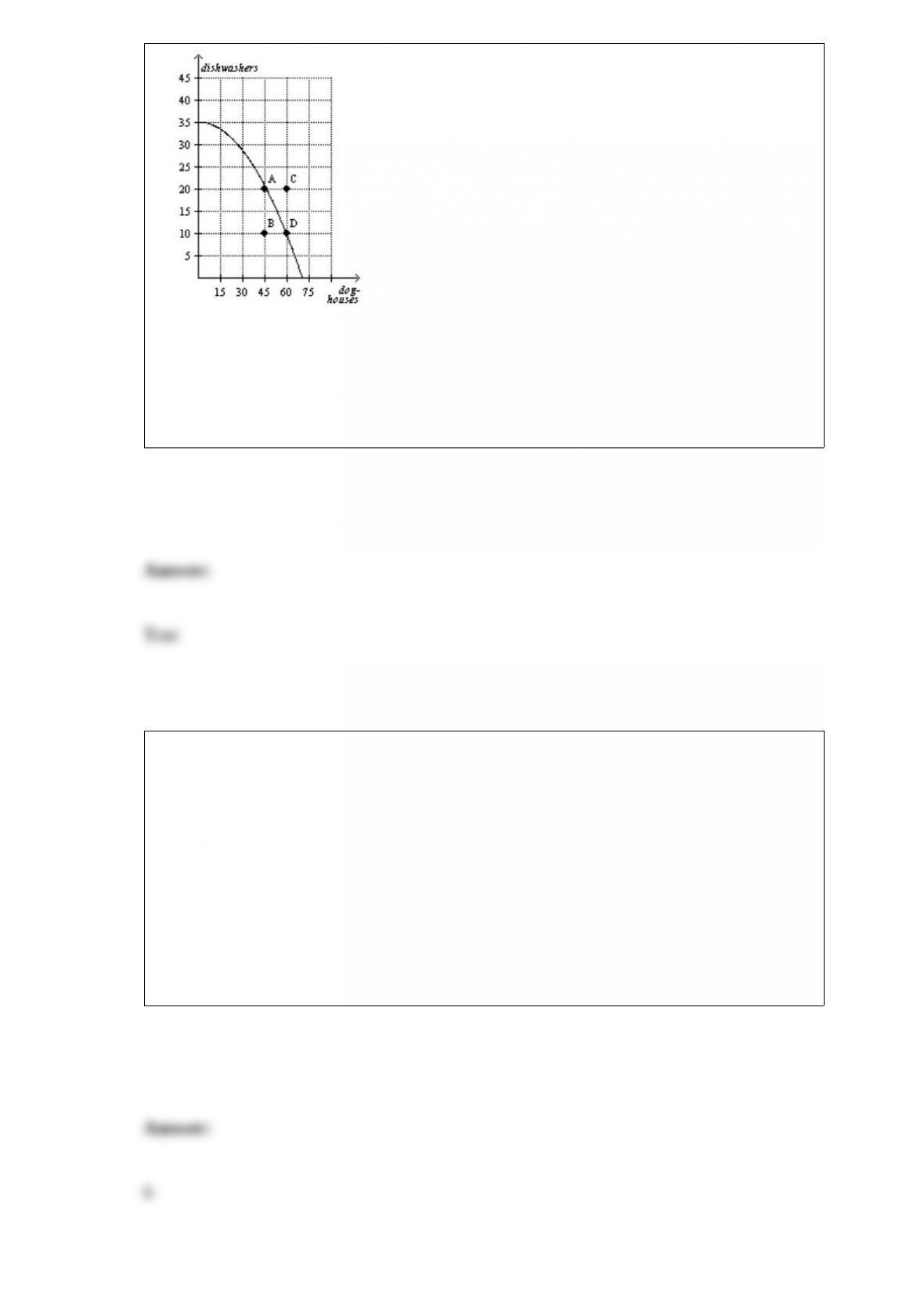
RefertoFigure2-23. Point B represents an inefficient outcome for this economy.
a. True
b. False
Because every transaction has a buyer and a seller,
a. GDP is more closely associated with an economy’s income than it is with an
economy’s expenditure.
b. every transaction contributes equally to an economy’s income and to its expenditure.
c. the number of firms must be equal to the number of households in a simple
circular-flow diagram.
d. firms’ profits are necessarily zero in a simple circularflow diagram.

The slow growth of U.S. incomes during the 1970s and 1980s can best be explained by
a. unstable economic conditions in Eastern Europe.
b. increased competition from abroad.
c. a decline in the rate of increase in U.S. productivity.
d. a strong U.S. dollar abroad, hurting U.S. exports.
The agency responsible for regulating the U.S. monetary system is the
a. U.S. Treasury
b. Federal Reserve
c. Department of Justice
d. Federal Trade Commission
As an economist working for a U.S. government agency you determine that a particular
country has a sacrifice ratio of 3. Policy-makers in that country are thinking of lowering
the inflation rate from 10% to 4%. Is this sacrifice ratio higher or lower than the typical
estimate? From your numbers, what is the amount of output that will be lost for this
country to reduce its inflation rate?
a. The sacrifice ratio is higher than the typical estimate. It will cost 30% of annual

output to reach the new inflation target.
b. The sacrifice ratio is higher than the typical estimate. It will cost 18% of annual
output to reach the new inflation target.
c. The sacrifice ratio is lower than the typical estimate. It will cost 30% of annual output
to reach the new inflation target.
d. The sacrifice ratio is lower than the typical estimate. It will cost 18% of annual
output to reach the new inflation target.
To obtain the market demand curve for a product, sum the individual demand curves
a. vertically.
b. diagonally.
c. horizontally.
d. and then average them.
According to the “In the News” article, macroprudential tools
a. allow a central bank to alter lending for specific industries.
b. allow a central bank to alter taxes.

c. limit a central bank’s power to act independently of the political process.
d. limit the policy tools available to a central bank.
Open-market purchases by the Fed make the money supply
a. increase, which makes the value of money increase.
b. increase, which makes the value of money decrease.
c. decrease, which makes the value of money decrease.
d. decrease, which makes the value of money increase.
In the aggregate demand and aggregate supply model, sticky wages, sticky prices, and
misperceptions about relative prices
a. have temporary effects.
b. explain why the short run aggregate supply curve might shift.
c. explain why the aggregate demand curve is downward sloping.
d. explain monetary neutrality.

John Maynard Keynes advocated policies that would increase aggregate demand as a
way to decrease unemployment caused by recessions.
a. True
b. False
Table 24-2
The table below pertains to Pieway, an economy in which the typical consumer’s basket
consists of 15 bushels of peaches and 10 bushels of pecans.
RefertoTable24-2. If 2013 is the base year, then the inflation rate in 2013 was
a. 22.5 percent.
b. 2.35 percent.
c. 10 percent.
d. 4.4 percent.
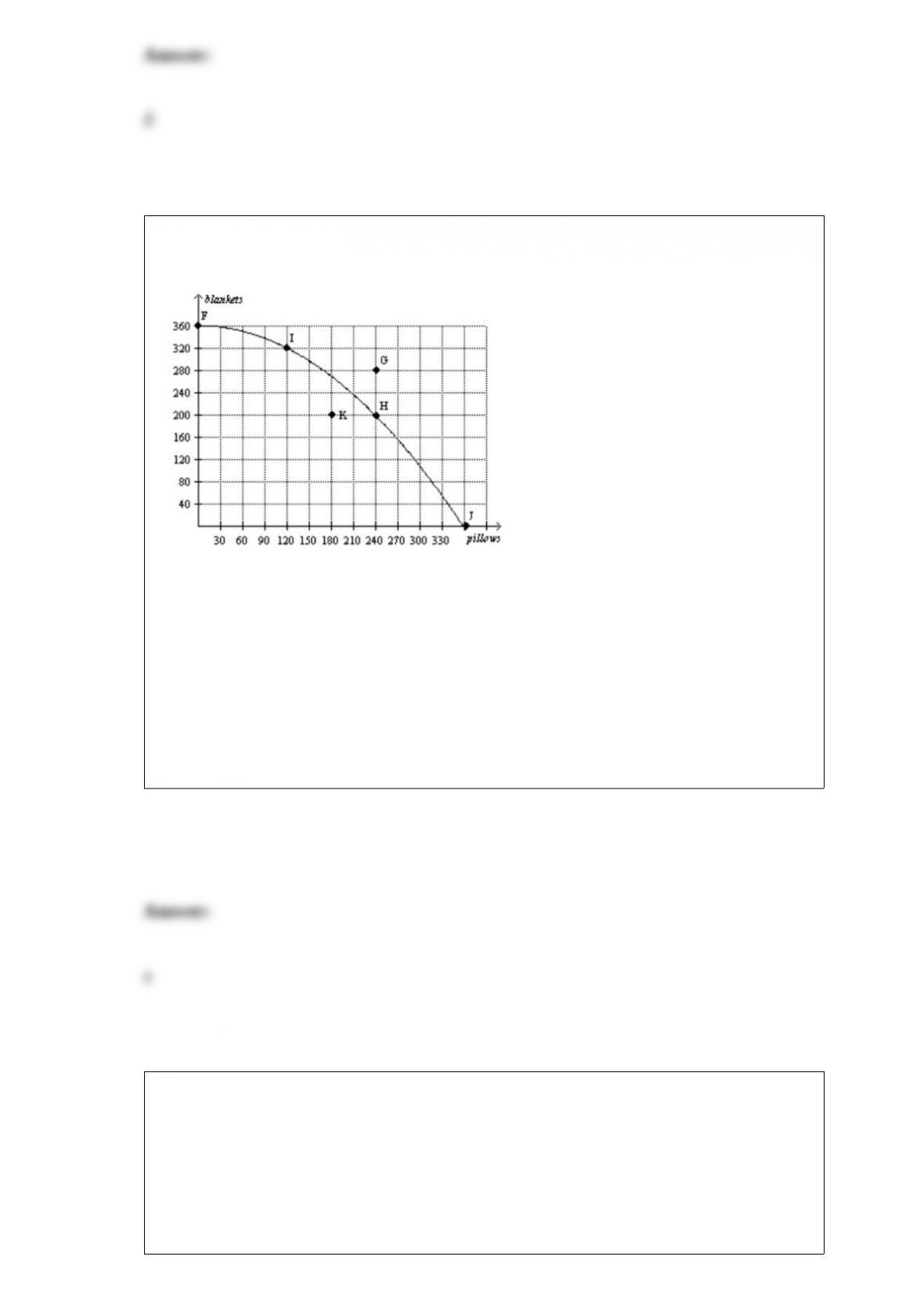
Figure 2-6
RefertoFigure2-6. A movement from point H to point K could be caused by
a. unemployment.
b. a decrease in society’s preference for pillows.
c. fewer resources available for production of pillows.
d. All of the above are correct.
An economy’s production function has the constantreturnstoscale property. If the
economy’s labor force doubled
and all other inputs stayed the same, then real GDP would
a. stay the same.

b. increase by exactly 50 percent.
c. increase by exactly 100 percent.
d. increase, but not necessarily by either 50 percent or 100 percent.
Which of the following would most likely serve as an example of a monopoly?
a. a bakery in a large city
b. a bank in a large city
c. a local cable television company
d. a small group of corn farmers
Which of the following concepts is most helpful in explaining why investment
increases when the interest rate falls?
a. deadweight loss
b. present value
c. economic growth
d. financial intermediation

Which of the following is correct?
a. In unionized industries, wages are below the level that would prevail in competitive
markets.
b. The introduction of a union in an industry reduces the quantity of labor demanded in
that industry, causes some workers in that industry to be unemployed, and reduces
wages in the rest of the economy.
c. There is a strong consensus among economists that unions are bad for the U.S.
economy.
d. All of the above are correct.
Movies are a major export of the U.S.
a. True
b. False

An article in the textbook suggests that one method to correct the higher education
inefficiency is to
a. provide free higher education to all Americans.
b. have college students sell equity in themselves.
c. reduce interest rates on student loans.
d. increase the number of colleges and universities in the United States.
The curve that shows the quantity of goods and services that firms produce and sell
a. as it relates to the quantity of goods and services that buyers want to buy is called the
aggregate-demand curve.
b. as it relates to the quantity of goods and services that buyers want to buy is called the
aggregate-supply curve.
c. as it relates to the overall price level is called the aggregate-demand curve.
d. as it relates to the overall price level is called the aggregate-supply curve.
Figure 4-24
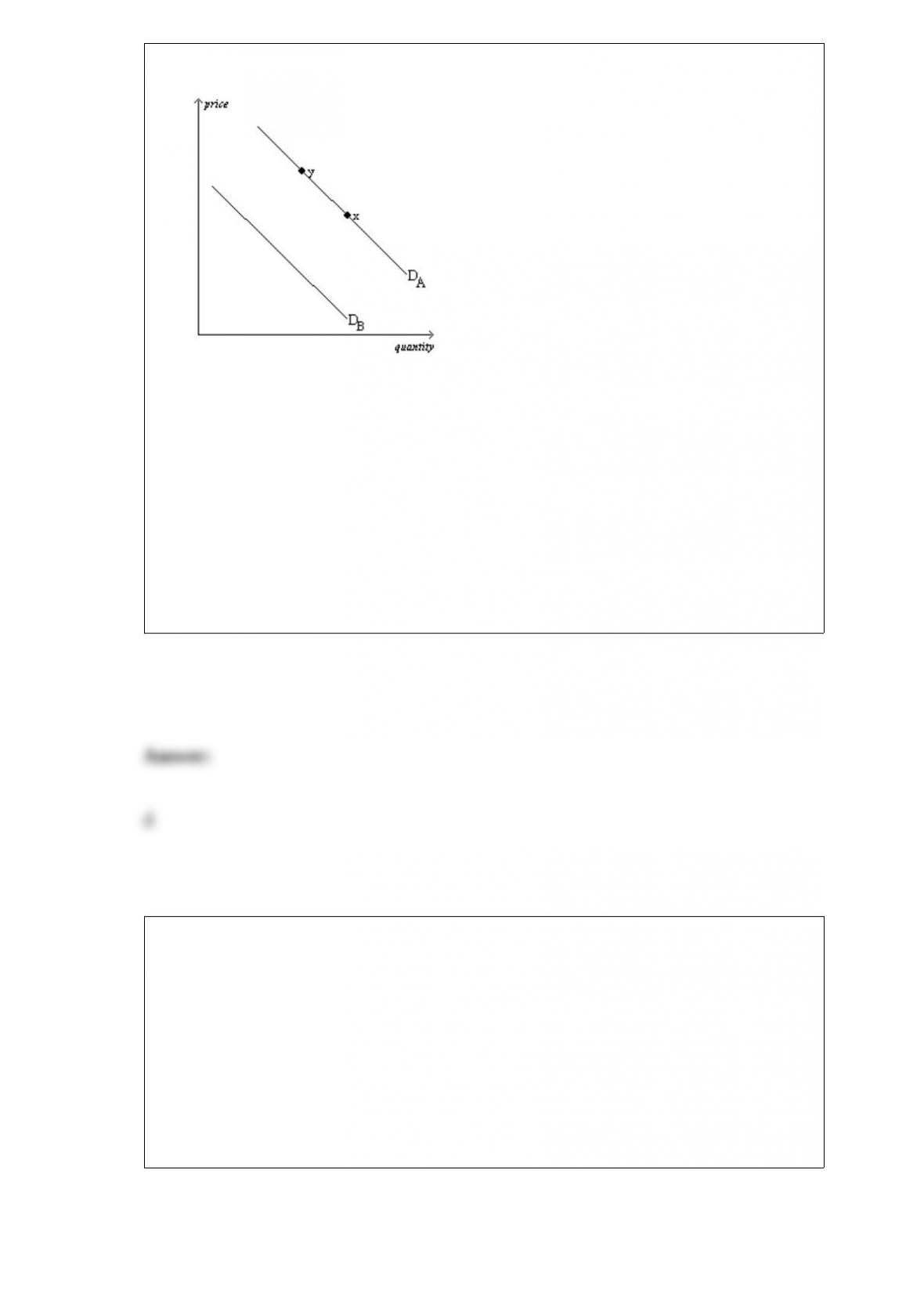
The diagram below pertains to the demand for turkey in the United States.
RefertoFigure4-24.All else equal, a decrease in the price of the grain fed to turkeys
would cause a move from
a. DAto DB.
b. DBto DA.
c. x to y.
d. y to x.
Suppose that monetary neutrality and the Fisher effect both hold. An increase in the
money supply growth rate increases
a. the inflation rate and nominal interest rates.
b. the inflation rate, but not nominal interest rates.
c. nominal interest rates, but not the inflation rate.
d. neither the inflation rate nor nominal interest rates.

Consider a small economy in which consumers buy only two goods: apples and pears.
In order to compute the consumer price index for this economy for two or more
consecutive years, we assume that
a. the number of apples bought by the typical consumer is equal to the number of pears
bought by the typical consumer in each year.
b. neither the number of apples nor the number of pears bought by the typical consumer
changes from year to year.
c. the percentage change in the price of apples is equal to the percentage change in the
price of pears from year to year.
d. neither the price of apples nor the price of pears changes from year to year.
If natural resources had become scarcer, then we would expect their
a. prices to have risen more than inflation as they have.
b. prices to have risen more than inflation, but they have not.
c. known quantities to have fallen as they have.
d. known quantities to have fallen but they have not.

Which of the following items is included in GDP?
a. the sale of stocks and bonds
b. the sale of used goods
c. the sale of services such as those performed by a doctor
d. All of the above are included in GDP.
In effect, an annuityprovides insurance
a. against the risk of dying and leaving one’s family without a regular income.
b. against the risk of living too long.
c. to people who are not risk-averse.
d. to people whose utility functions do not display the usual properties.
Normative statements describe how the world is, while positive statements prescribe

how the world should be.
a. True
b. False
Which of the following would make the equilibrium real interest rate increase and the
equilibrium quantity of funds decrease?
a. The demand for loanable funds shifts right.
b. The demand for loanable funds shifts left.
c. The supply of loanable funds shifts right.
d. The supply of loanable funds shifts left.
A company unexpectedly announces a product recall due to safety concerns about its
product. According to the efficient markets hypothesis, this news should
a. raise the price of the company’s stock.
b. not affect the price of the company’s stock.
c. reduce the price of the company’s stock.
d. More information is needed to answer the question.

If you presently have $50,000 saved and earn 15 percent interest per year, about how
many years will it take for your investment to triple?
a. 6
b. 8
c. 10
d. 12
After the terrorist attacks on September 11, 2001, governments within the United States
raised expenditures to increase security at airports. These purchases of goods and
services are
a. not included in GDP since they do not represent production.
b. not included in GDP since the government collects taxes to pay for them.
c. included in GDP since government expenditures on goods and services are included
in GDP.
d. included in GDP only to the extent that the federal government, rather than state or
local governments, paid for them.

The average income in a rich country
a. is about 5 times that in a poor country. Further, people in rich countries have longer
life expectancy.
b. is about 5 times that in a poor country. However, people in rich countries have about
the same life expectancy as those in poor countries.
c. is more than ten times that in a poor country. Further, people in rich countries have
longer life expectancy.
d. is more than ten times that in poor country. However, people in rich countries have
about the same life expectancy as those in poor countries.
Interest rates adjusted for the effects of inflation
a. and inflation are nominal variables.
b. and inflation are real variables.
c. are real variables; inflation is a nominal variable.
d. are nominal variables; inflation is a real variable.