
The value of the four-firm concentration ratio that many economists consider indicative
of the existence of an oligopoly in a particular industry is
A) anything greater than 10 percent.
B) anything greater than 20 percent.
C) anything greater than 30 percent.
D) anything greater than 40 percent.
For each bottle of wine that Italy produces, it gives up the opportunity to make 10
pounds of cheese. France can produce 1 bottle of wine for every 25 pounds of cheese it
produces. Which of the following is true about the comparative advantage between the
two countries?
A) Italy has the comparative advantage in cheese.
B) Italy has the comparative advantage in wine.
C) France has the comparative advantage in wine and cheese.
D) France has the comparative advantage in wine.
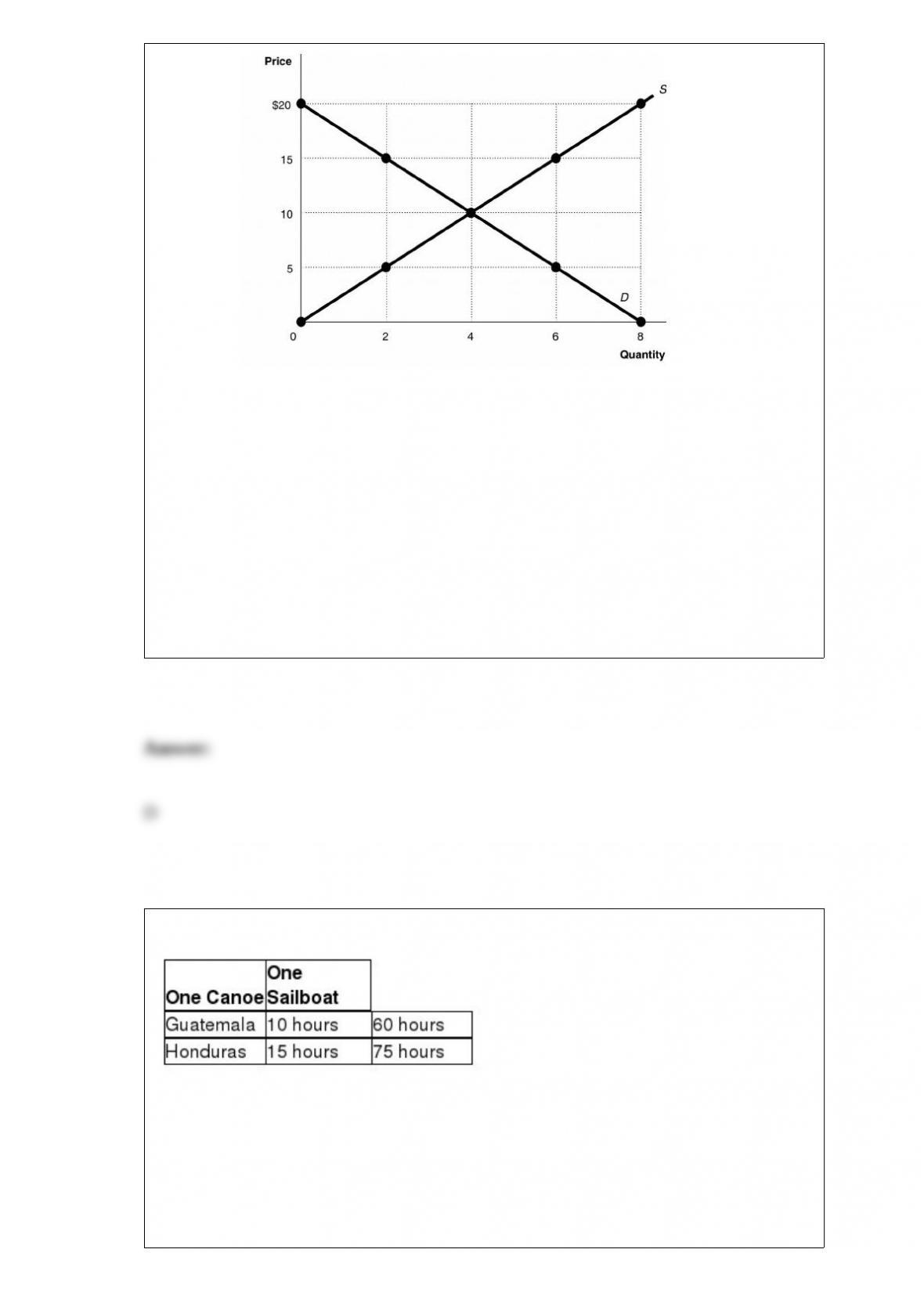
Figure 3-5
In a free market such as that depicted above, a shortage is eliminated by
A) a price increase, increasing the supply and decreasing the demand.
B) a price decrease, decreasing the supply and increasing the demand.
C) a price decrease, decreasing the quantity supplied and increasing the quantity
demanded.
D) a price increase, increasing the quantity supplied and decreasing the quantity
demanded.
Table 2-9
Table 2-9 shows the number of labor hours required to produce a canoe and a sailboat in
Guatemala and Honduras. What is Honduras’s opportunity cost of producing one
canoe?
A) 1/5 of a sailboat
B) 1.5 sailboats
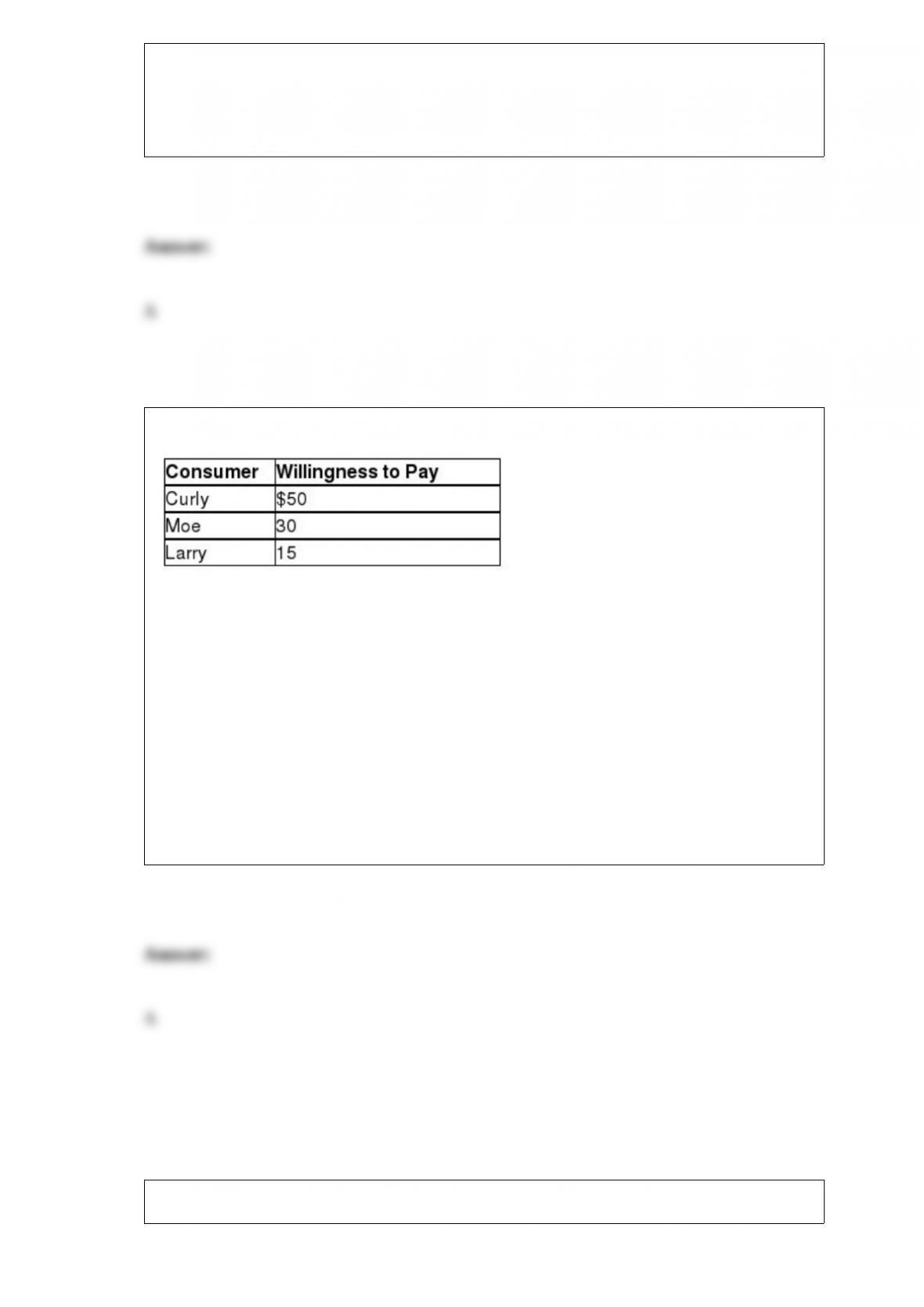
C) 5 sailboats
D) 6 sailboats
Table 4-4
The table above lists the highest prices three consumers, Curly, Moe, and Larry, are
willing to pay for a bottle of champagne. If the price of the champagne falls from $24 to
$14,
A) consumer surplus increases from $32 to $53.
B) Curly will buy four bottles; Moe will buy two bottles, and Larry will buy one bottle.
C) consumer surplus will increase from $80 to $95.
D) Larry and Moe will receive more consumer surplus than Curly.
Table 2-1 Production Choices for Dina’s Diner
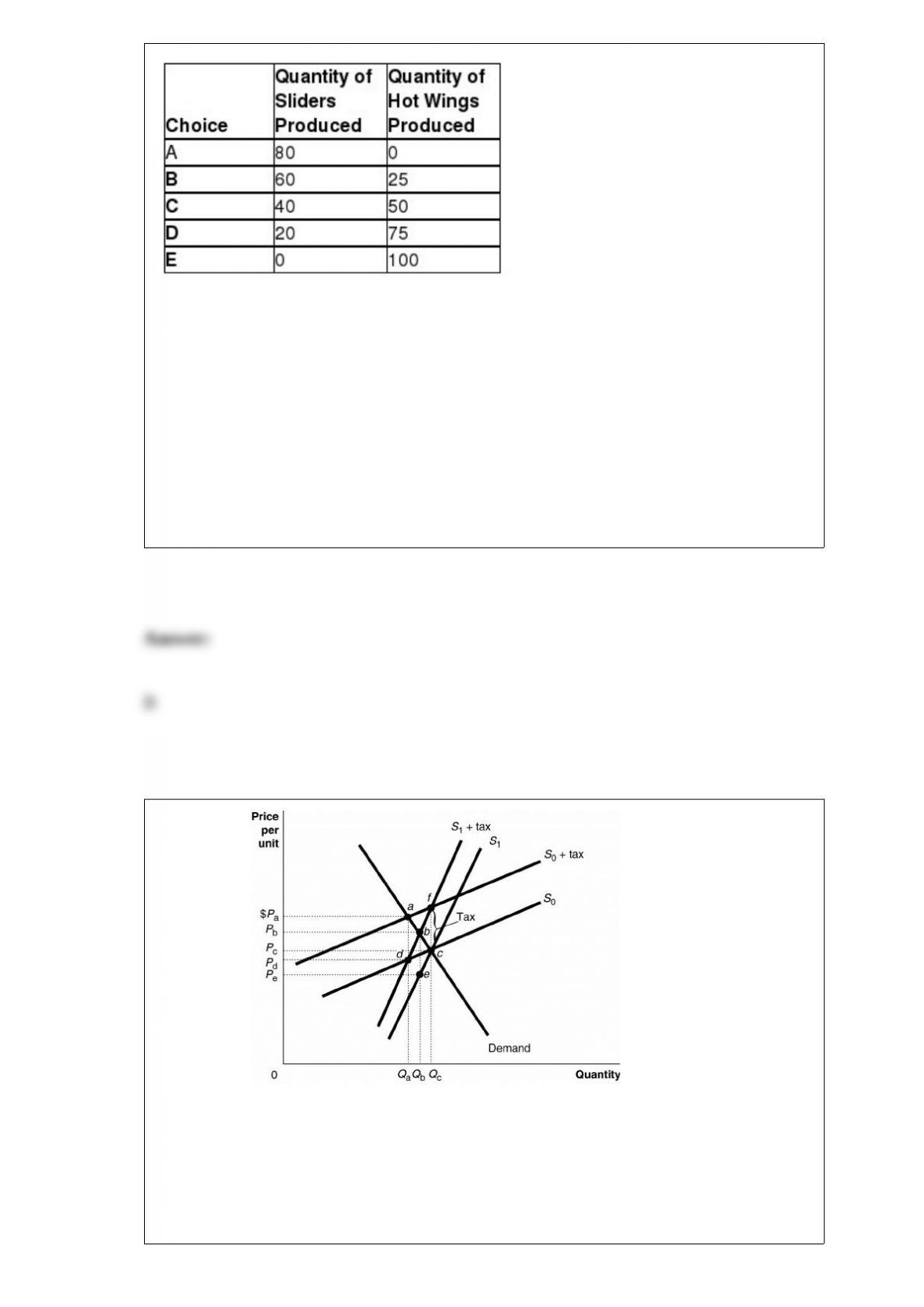
Assume Dina’s Diner only produces sliders and hot wings. A combination of 40 sliders
and 25 hot wings would appear
A) along Dina’s production possibilities frontier.
B) inside Dina’s production possibilities frontier.
C) outside Dina’s production possibilities frontier.
D) at the vertical intercept of Dina’s production possibilities frontier.
Figure 18-2 Figure 18-2 shows a
demand curve and two sets of supply curves, one set more elastic than the other.
If the government imposes an excise tax of $1.00 on every unit sold, the consumer’s
burden of the tax
A) is greater under the more elastic supply curve S0.

B) is greater under the less elastic supply curve S0.
C) is greater under the less elastic supply curve S1.
D) is the same under either supply curve because there is a single demand curve that
captures buyers’ market behavior.
If tablet computers are considered substitutes for e-readers, the decline in the price of
e-readers would, all else equal,
A) increase the demand for tablet computers.
B) decrease the demand for tablet computers.
C) increase the quantity of tablet computers demanded.
D) decrease the quantity of tablet computers demanded.
A perfectly competitive industry achieves allocative efficiency in the long run. What
does allocative efficiency mean?
A) Each firm produces up to the point where the price of the good equals the marginal
cost of producing the last unit.
B) Each firm produces up to the point where all scale economies are exhausted.
C) Production occurs at the lowest average total cost.

D) Firms use an input combination that minimizes cost and maximizes output.
Suppose a bank has $100,000 in checking account deposits with no excess reserves and
the required reserve ratio is 5 percent. If the Federal Reserve lowers the required
reserve ratio to 3 percent, then the bank will now have excess reserves of
A) $0.
B) $2,000.
C) $3,000.
D) $5,000.
Aisha and Debbie both purchase milk and bread at the same Quik Mart. They have
different tastes for milk and bread and different incomes. They both buy some milk and
some bread, but they buy considerably different quantities of the two goods. Which of
the following statements is true, given that Aisha and Debbie are utility-maximizers?
A) In equilibrium, their marginal rate of substitution between milk and bread is the
same.
B) In equilibrium, their marginal rate of substitution between milk and bread is higher
for the person with the higher income.
C) In equilibrium, the marginal rate of substitution between milk and bread is greater
for the person who prefers milk more than bread.
D) No statement can be made about their respective marginal rates of substitution
without their budget constraint/indifference curve diagrams.

Which of the following best explains why airlines often cut their ticket prices at the
last-minute in order to fill the remaining empty seats on their flights?
A) Fixed costs in the airline industry are very large, but the marginal cost of flying one
more passenger is very low.
B) Airlines receive a subsidy from the government for each flight that is fully booked
and departs on time.
C) The Federal Aviation Administration ranks each airline based on the percentage of
flights that are fully booked. These rankings affect the decisions of firms to use a
particular airline to fly their employees to business meetings.
D) Cutting prices makes the airlines more popular with their customers, who may fly
with the same airline in the future as the result of buying low-price tickets.
Suppose that households became mistrustful of the banking system and decide to
decrease their checking accounts and increase their holdings of currency. Using the
money demand and money supply model and assuming everything else is held constant,
the equilibrium interest rate should
A) increase.
B) decrease.
C) not change.
D) increase, then decrease.

The costs to firms of changing prices are called
A) redistribution costs.
B) menu costs.
C) anticipation costs.
D) money illusion costs.
Suppose that the price of a money clip increases from $0.75 to $0.90 and quantity
supplied rises from 8,000 units to 10,000 units. Use the midpoint formula to calculate
the price elasticity of supply.
A) 1.22
B) 1.0
C) 0.82
D) 0.07

Which of the following explains why mortgages weren’t considered securities prior to
1970?
A) The Federal Reserve Act of 1913 prohibited mortgages from being considered
securities. An amendment to the Act was approved in 1970 that allowed mortgages to
be considered securities.
B) Until 1970, the average annual increase in housing prices did not allow the buying
and selling of mortgages to be profitable. There has been a significant annual increase
in housing prices and mortgage values since 1970.
C) Congress passed a law in 1970 stipulating that mortgages could be classified as
securities.
D) Prior to 1970, mortgages were rarely resold in the secondary market.
The total amount of producer surplus in a market is equal to
A) the difference between quantity supplied and quantity demanded.
B) the area above the market supply curve and below the market price.
C) the area above the market supply curve.
D) the area between the demand curve and the supply curve below the market price.