
A vertical supply curve of a factor indicates that
a. the demand for the factor will vary directly with the price of the factor.
b. the supply of the factor is perfectly elastic.
c. the factor has zero opportunity cost.
d. a government restriction has been imposed on the purchase of the factor.
Which of the following lends support to the capture theory of regulation?
a. Persons who have been in the industry will be asked to help regulate the industry.
b. There will be more people from the regulated industry at a regulatory hearing than
people from the general public.
c. It is in the best interest of an industry that is being regulated to have its personnel
develop social relationships with members of the regulatory agency.
d. all of the above
Those economists who argue that the European Union is not a true optimal currency
area cite _______________ and __________________ as justifications for this
position.
a. differences in culture; decreased labor mobility
b. differences in language; culture

c. decreased labor mobility; language differences
d. none of the above
In general, there is a ______________ relationship between the number of hours spent
studying for a test and the grade earned on the test.
a. independent
b. direct
c. inverse
d. smooth
The nominal interest rate is
a. determined by the forces of supply and demand in the consumer goods market.
b. the interest rate in current dollars, unadjusted for inflation.
c. higher than the real interest rate even if the expected inflation rate is zero.
d. lower than the real interest rate even if the expected inflation rate is zero.
e. b and d
Which of the following statements is false?
a. Microeconomics is the branch of economics that deals with human behavior and
choices as they relate to relatively small units-an individual, a firm, an industry, and a
single market.
b. Macroeconomics is the branch of economics that deals with human behavior and
choices as they relate to highly aggregate markets.
c. Positive economics attempts to determine what is.
d. Normative economics addresses what should be.
e. Positive and normative economics both address what should be.
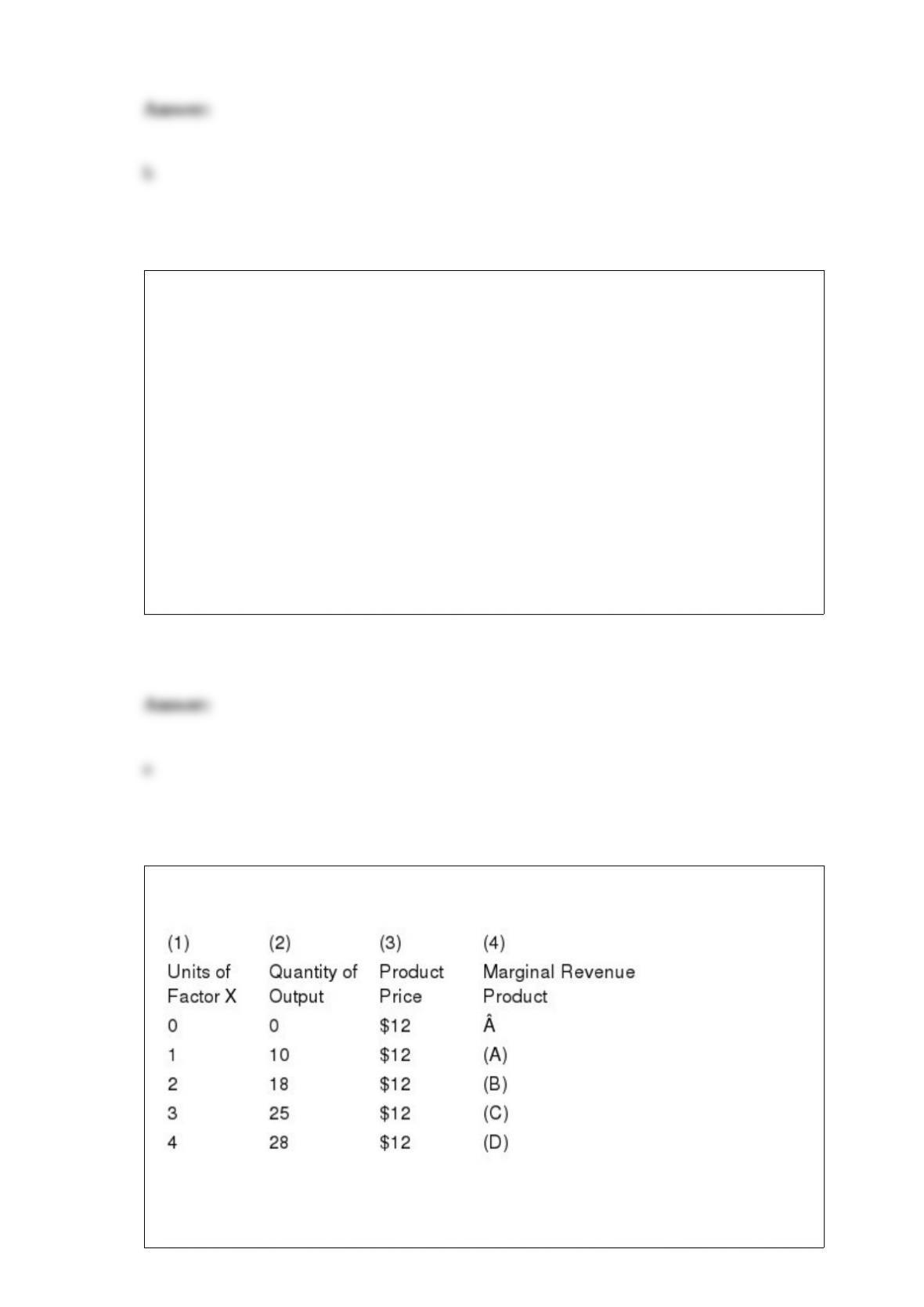
Exhibit 27-1
What dollar value goes in blank (B)?
a. $12
b. $62.50
c. $144
d. $96
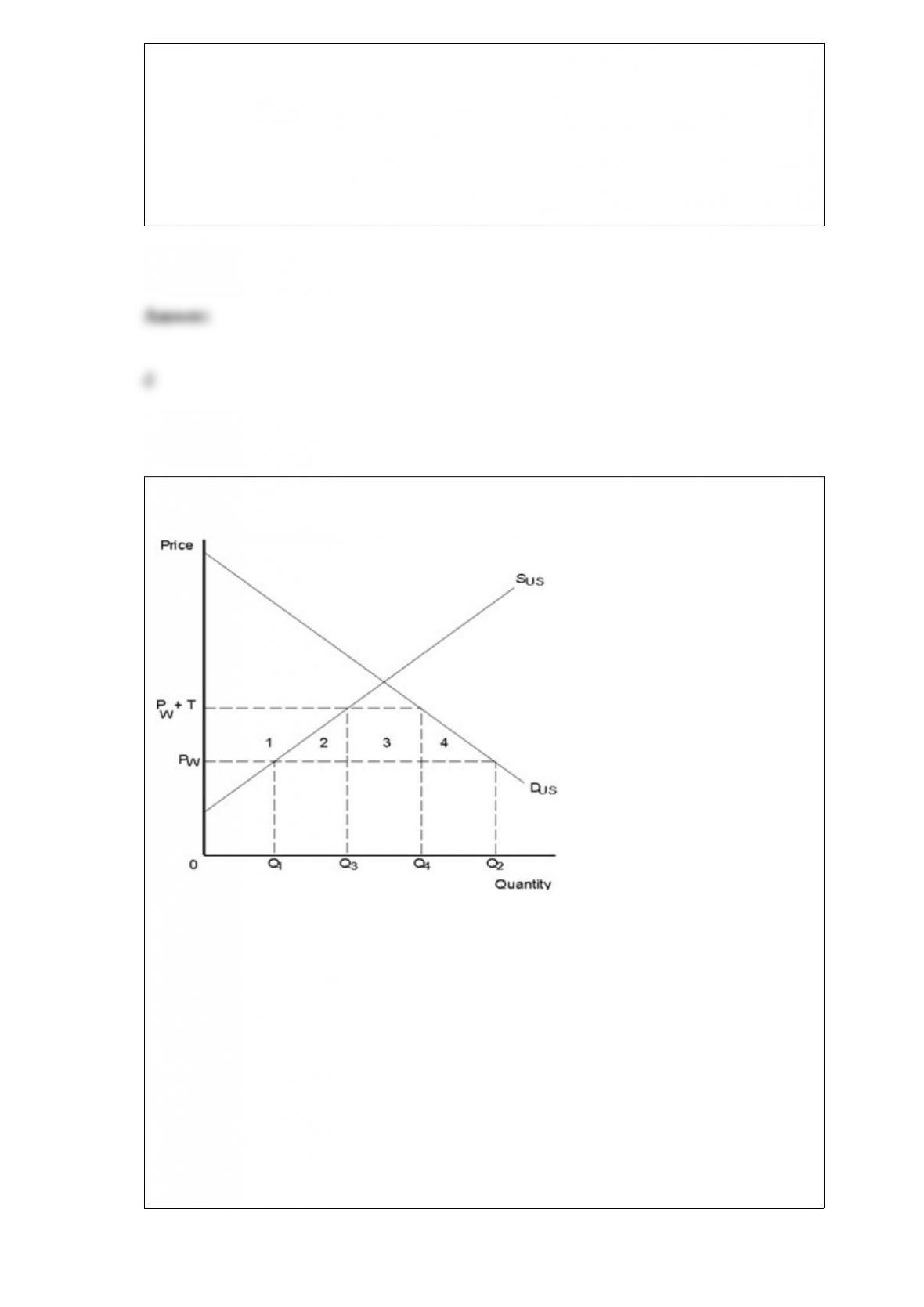
Exhibit 34-3
The world price is PW. If a tariff is imposed the price rises to PW + T. Because of the
tariff, consumers’ surplus is reduced by an amount equal to the area of
a. 1 + 2 + 3.
b. 1 + 2.
c. 1 + 2 + 3 + 4.
d. 3 + 4.
e. 2 + 3 + 4.

The Clayton Act of 1914 makes price discrimination, exclusive dealers, tying contracts,
and the acquisition of competing companies’ stock illegal when their effects
‘substantially lessen competition or tend to create a monopoly.”
a. True
b. False
The government imposes a $2.50 per-unit tax on the production of good X. As a result
the
a. supply curve forgood X shifts leftward and the price of good X rises.
b. quantity supplied of good X falls and the price of good X rises.
c. demand curve for good X shifts leftward and the price of good X falls.
d. supply curve for good X shifts rightward and the price of good X falls.
e. supply curve for good X shifts leftward and the price of good X falls.
A person buys a bond with a face value of $10,000 for $9,325. Each year until the

maturity date the bond buyer receives $750 from the issuer of the bond. The yield on
the bond is
a. 8.04 percent.
b. 7.5 percent.
c. 10.0 percent.
d. 6.75 percent.
e. There is not enough information to answer the question.
When the price of a good rises, the demand for its complements will tend to rise.
a. True
b. False