
In analyzing international trade, we often focus on a country whose economy is small
relative to the rest of the world. We do so
a. because it is impossible to analyze the gains and losses from international trade
without making this assumption.
b. because then we can assume that world prices of goods are unaffected by that
country’s participation in international trade.
c. in order to rule out the possibility of tariffs or quotas.
d. All of the above are correct.
Producer surplus is
a. measured using the demand curve for a good.
b. always a negative number for sellers in a competitive market.
c. the amount a seller is paid minus the cost of production.
d. the opportunity cost of production minus the cost of producing goods that go unsold.
“Ensuring that Social Security is financially sound for future generations is an
important use of taxpayer dollars” is an example of a
a. normative economic statement.
b. positive economic statement.
c. statement made by an economist working as a scientist.
d. judgment based on evaluation of evidence, not values.
In a competitive market, the price of a product
a. is determined by buyers, and the quantity of the product produced is determined by
sellers.
b. is determined by sellers, and the quantity of the product produced is determined by
buyers.
c. and the quantity of the product produced are both determined by sellers.
d. None of the above is correct.
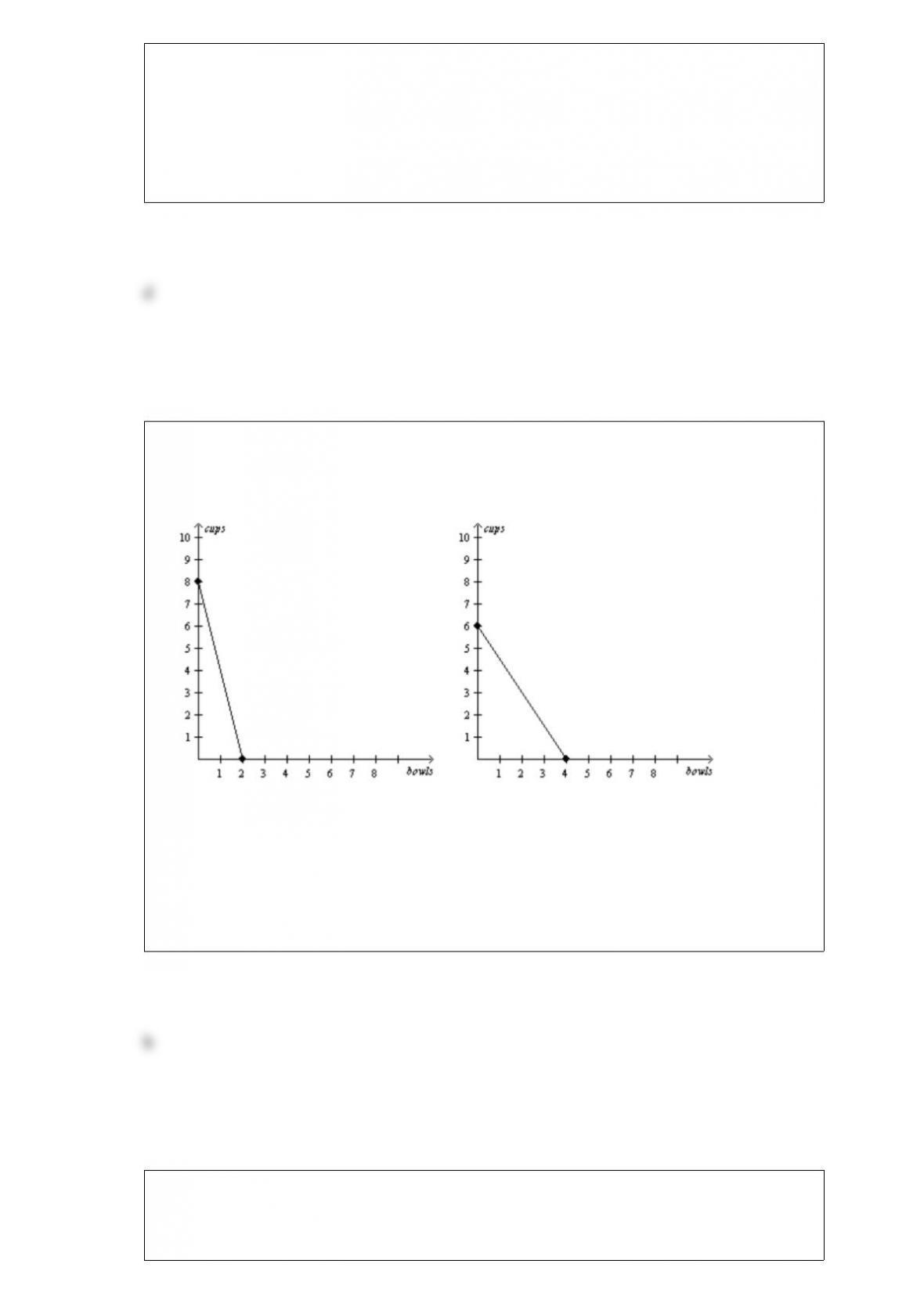
Figure 37
Bintu’s Production Possibilities FrontierJuba’s Production Possibilities Frontier
Refer to Figure 37. If the production possibilities frontier shown for Juba is for 2 hours
of work, then how long does it take Juba to make one bowl?
a. 1/8 hour
b. 1/2 hour
c. 2 hours
d. 8 hours
The less freedom young mothers have to work outside the home, the
a. more elastic the supply of labor will be.
b. less elastic the supply of labor will be.
c. more horizontal the labor supply curve will be.
d. larger is the decrease in employment that will result from a tax on labor.
A manufacturer produces 1,000 units, regardless of the market price. For this firm, the
price elasticity of supply is
a. infinity.
b. zero.
c. one.
d. negative one.
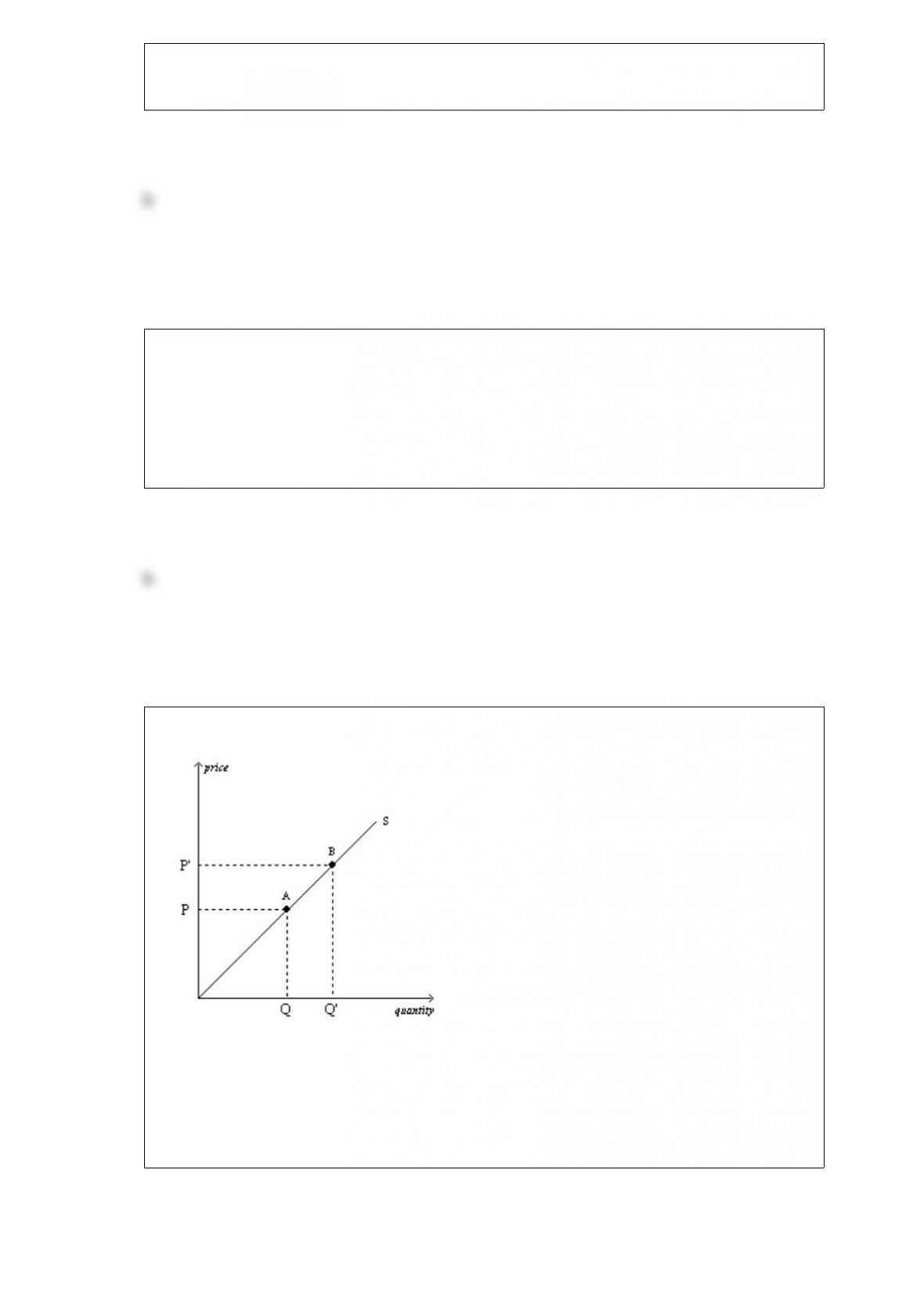
Figure 411
Refer to Figure 411. The movement from point A to point B on the graph is called
a. a decrease in supply.
b. an increase in supply.
c. an increase in the quantity supplied.
d. a decrease in the quantity supplied.

In a competitive market, the quantity of a product produced and the price of the product
are determined by
a. buyers.
b. sellers.
c. both buyers and sellers.
d. None of the above is correct.
At Nick’s Bakery, the cost to make a cheese danish is $1.50 per danish. As a result of
selling ten danishes, Nick experiences a producer surplus in the amount of $20. Nick
must be selling his danishes for
a. $2.00 each.
b. $0.50 each.
c. $3.50 each.
d. $5.00 each.
A key determinant of the price elasticity of supply is the time period under
consideration. Which of the following statements best explains this fact?
a. Supply curves are steeper over long periods of time than over short periods of time.
b. Buyers of goods tend to be more responsive to price changes over long periods of
time than over short periods of time.
c. The number of firms in a market tends to be more variable over long periods of time
than over short periods of time.
d. Firms prefer to change their prices in the short run rather than in the long run.
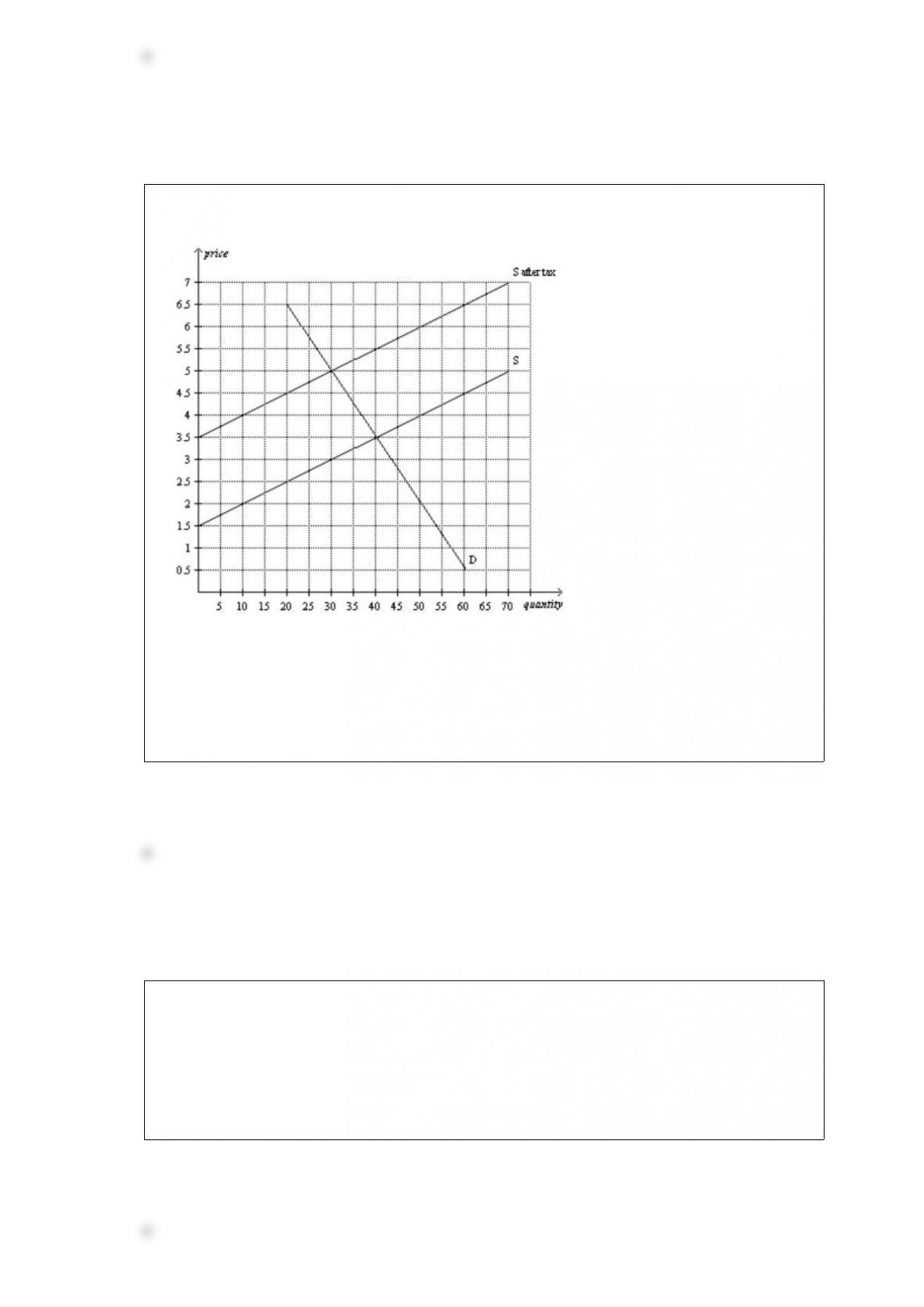
Figure 622
Refer to Figure 622. The price paid by buyers after the tax is imposed is
a. $3.00.
b. $3.50.
c. $5.00.
d. $6.00.
Assume that a 4 percent increase in income results in a 2 percent increase in the
quantity demanded of a good. The income elasticity of demand for the good is
a. negative, and the good is an inferior good.
b. negative, and the good is a normal good.
c. positive, and the good is a normal good.
d. positive, and the good is an inferior good.
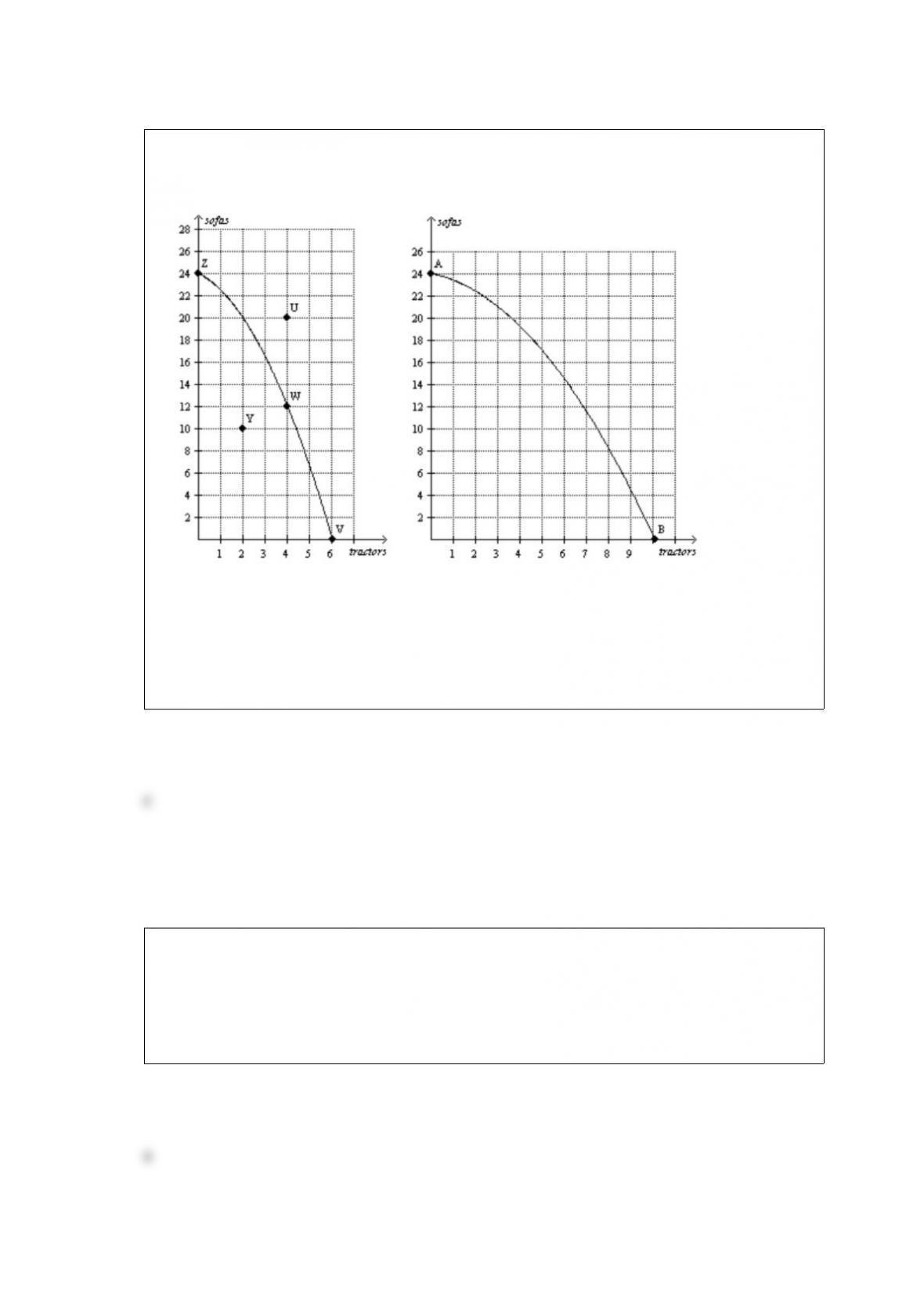
Figure 210
Panel (a) Panel (b)
Refer to Figure 210, Panel (a). Production at point Y is
a. impossible and inefficient.
b. impossible but efficient.
c. possible but inefficient.
d. possible and efficient.
Inefficiency exists in an economy when a good is
a. not being consumed by buyers who value it most highly.
b. not distributed fairly among buyers.
c. not produced because buyers do not value it very highly.
d. being produced with less than all available resources.
Almost all economists agree that local and state governments should
a. eliminate subsidies to professional sports franchises.
b. increase subsidies to professional sports franchises.
c. copy economic policy from Washington, D.C.
d. prevent companies from outsourcing work.
An import quota
a. is preferable to a tariff since an import quota does not create a deadweight loss.
b. is a tax on imported goods.
c. reduces the welfare of domestic consumers.
d. reduces the welfare of domestic producers.
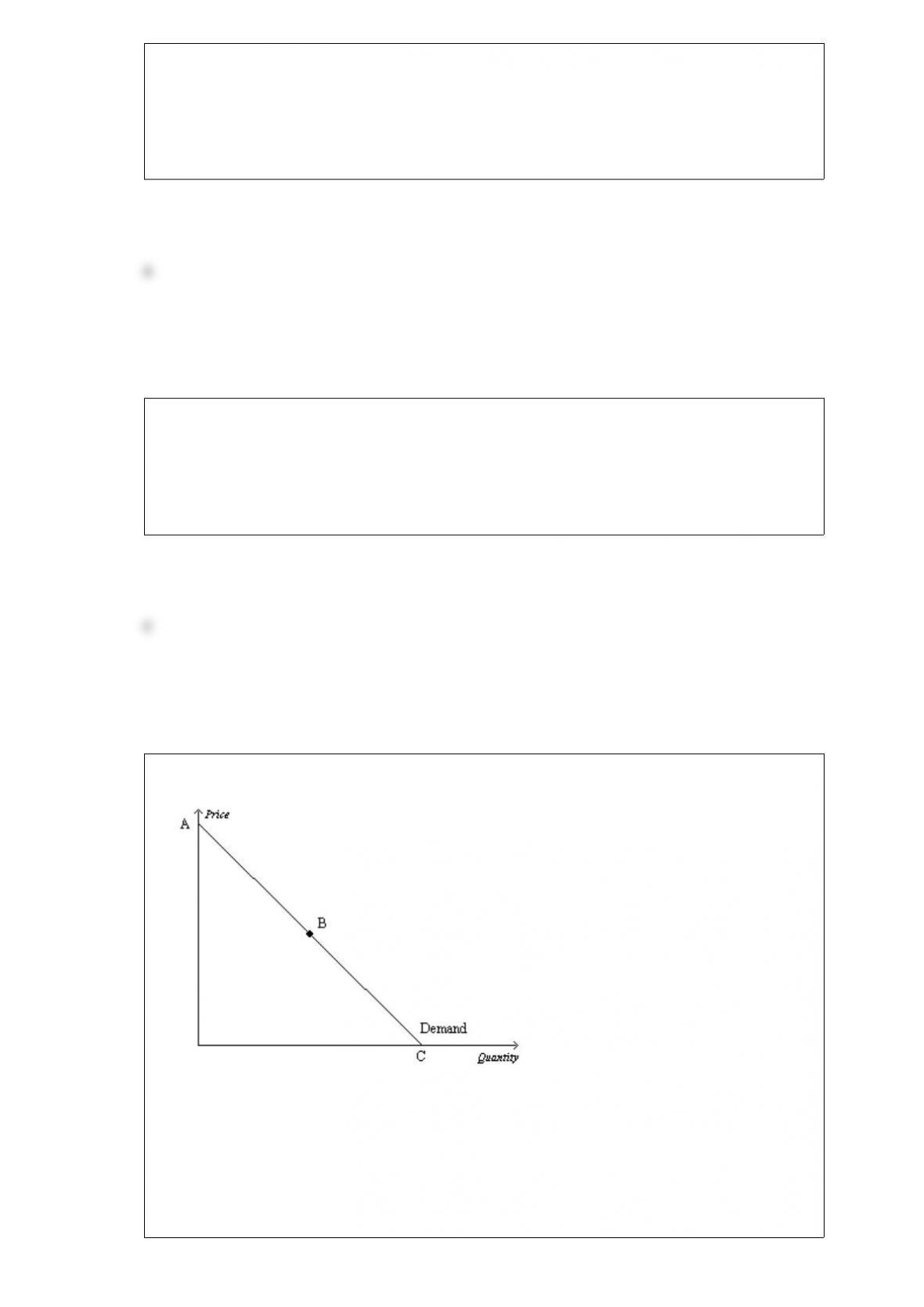
Figure 54
Refer to Figure 54. If the price increases in the region of the demand curve between
points A and B, we can expect total revenue to
a. increase.
b. stay the same.
c. decrease.
d. first increase, then decrease until total revenue is maximized.

A tax imposed on the sellers of a good will lower the
a. price paid by buyers and lower the equilibrium quantity.
b. price paid by buyers and raise the equilibrium quantity.
c. effective price received by sellers and lower the equilibrium quantity.
d. effective price received by sellers and raise the equilibrium quantity.
Ramona decides to spend two hours taking a nap rather than attending her classes. Her
opportunity cost of napping is
a. the value of the knowledge she would have received had she attended class.
b. the $24 she could have earned if she had worked at her job for those two hours.
c. the value of her nap minus the value of attending class.
d. nothing, since she valued sleep more than attendance at class.
A recent news report lamented the plight of corn farmers in Wisconsin due to a severe
drought. Which of the following best describes the effect on corn farmers in Minnesota,
where sufficient rainfall occurred?
a. Their revenue increases because price increases and demand is elastic.
b. Their revenue increases because price increases and demand is inelastic.
c. Their revenue decreases because price decreases and demand is inelastic.
d. Their revenue decreases because price increases and demand is elastic.
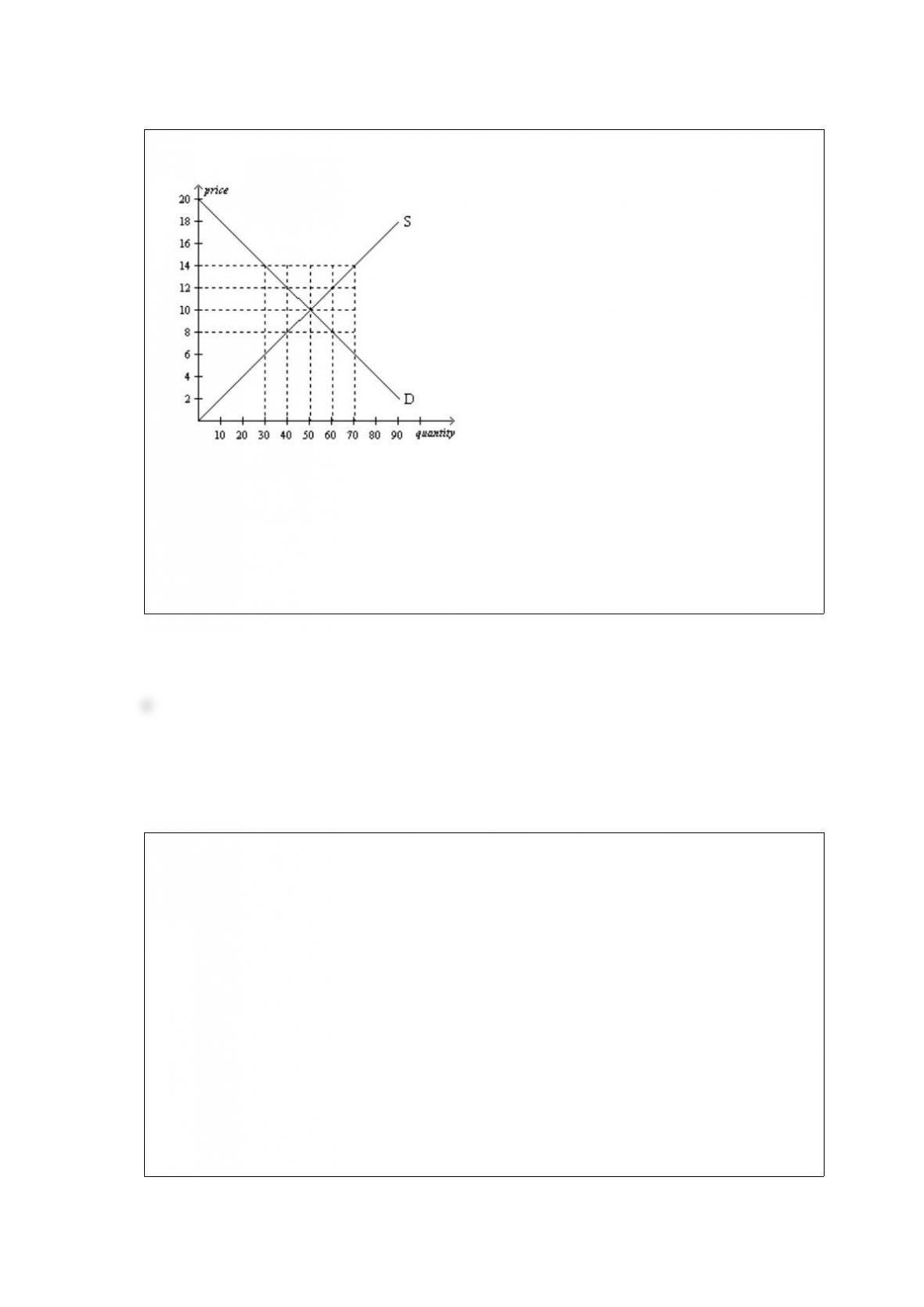
Figure 419
Refer to Figure 419. If there is currently a shortage of 20 units of the good, then the
law of
a. demand predicts that the price will rise by $2 to eliminate the shortage.
b. supply predicts that the price will rise by $2 to eliminate the shortage.
c. supply and demand predicts that the price will rise by $2 to eliminate the shortage.
d. supply and demand predicts that the price will fall by $2 to eliminate the shortage.
Table 325
Assume that Maya and Miguel can switch between producing mixers and producing
toasters at a constant rate.
Hours Needed to Make 1Amount Produced in 40 Hours
mixertoastermixerstoasters
Maya8558
Miguel201024
Refer to Table 325. The opportunity cost of 1 mixer for Maya is
a. 0.625 toasters.
b. 5 hours of labor.
c. 1.6 toasters.
d. 20 hours of labor.

The price paid by buyers in a market will increase if the government
a. decreases a binding price floor in that market.
b. increases a binding price ceiling in that market.
c. decreases a tax on the good sold in that market.
d. imposes a binding price ceiling in that market.
Refer to Figure 26. If this economy devotes all of its resources to the production of
blankets, then it will produce
a. 0 blankets and 360 pillows.
b. 200 blankets and 240 pillows.
c. 320 blankets and 120 pillows.
d. 360 blankets and 0 pillows.
Figure 917
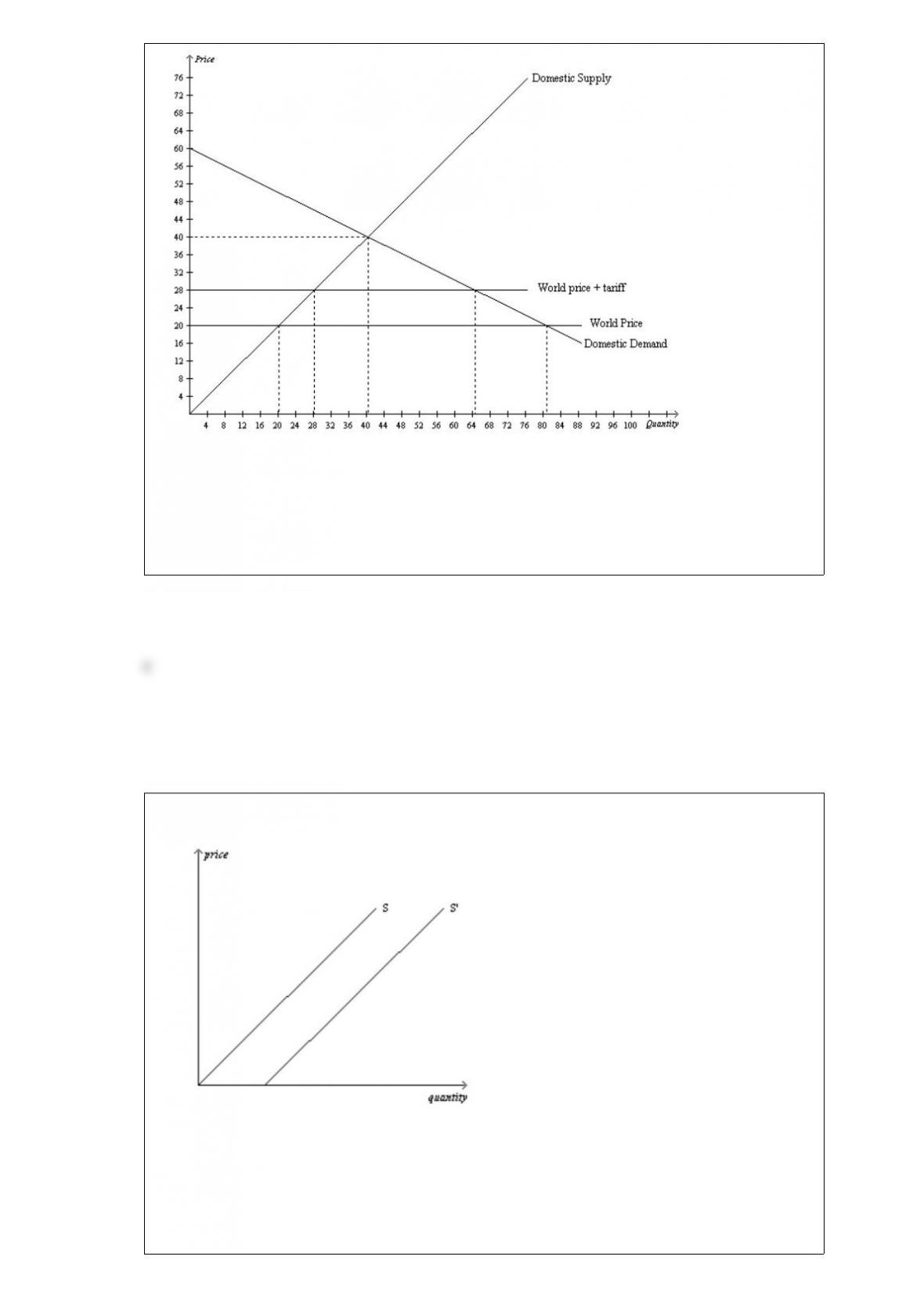
Refer to Figure 917. With free trade, total surplus is
a. $600.
b. $1,200.
c. $1,800.
d. $2,400.
Figure 416
Refer to Figure 416. If the supply curves that are drawn represent supply curves for
singlefamily residential houses, then the movement from S to S’ could be caused by
a(n)
a. increase in the price of apartments which are a substitute for singlefamily houses for
many people looking for a place to live.

b. newlyformed expectation by housebuilders that prices of houses will increase
significantly in the next six months.
c. decrease in the price of lumber.
d. All of the above are correct.
Table 710
The following table represents the costs of five possible sellers.
SellerCost
Abby$1,600
Bobby$1,300
Dianne$1,100
Evaline$900
Carlos$800
Refer to Table 710. Suppose each of the five sellers can supply at most one unit of the
good. The market quantity supplied is exactly 2 if the price is
a. $1,700.
b. $1,100.
c. $1,650.
d. $1,050.
Table 329
Juanita and Shantala run a business that programs and tests cellular phones. Assume
that Juanita and Shantala can switch between programming and testing cellular phones
at a constant rate. The following table applies.
Minutes Needed to Number of Cellular Phones Programmed or Tested in a 40Hour
Week
Program 1 Cellular PhoneTest 1 Cellular PhoneCellular Phones ProgrammedCellular
Phones Tested
Juanita ?21601200
Shantala104240600
Refer to Table 329. Juanita has an absolute advantage in

a. programming cellular phones and a comparative advantage in programming cellular
phones.
b. programming cellular phones and a comparative advantage in testing cellular phones.
c. testing cellular phones and a comparative advantage in programming cellular phones.
d. testing cellular phones and a comparative advantage in testing cellular phones.
One reason we need government, even in a market economy, is that
a. there is insufficient market power in the absence of government.
b. property rights are too strong in the absence of government.
c. the invisible hand is not perfect.
d. Both a and b are correct.
“If all economists were laid end to end, they would not reach a conclusion.” Who made
this whimsical observation?
a. Harry Truman
b. George Bernard Shaw
c. John Maynard Keynes
d. Ronald Reagan