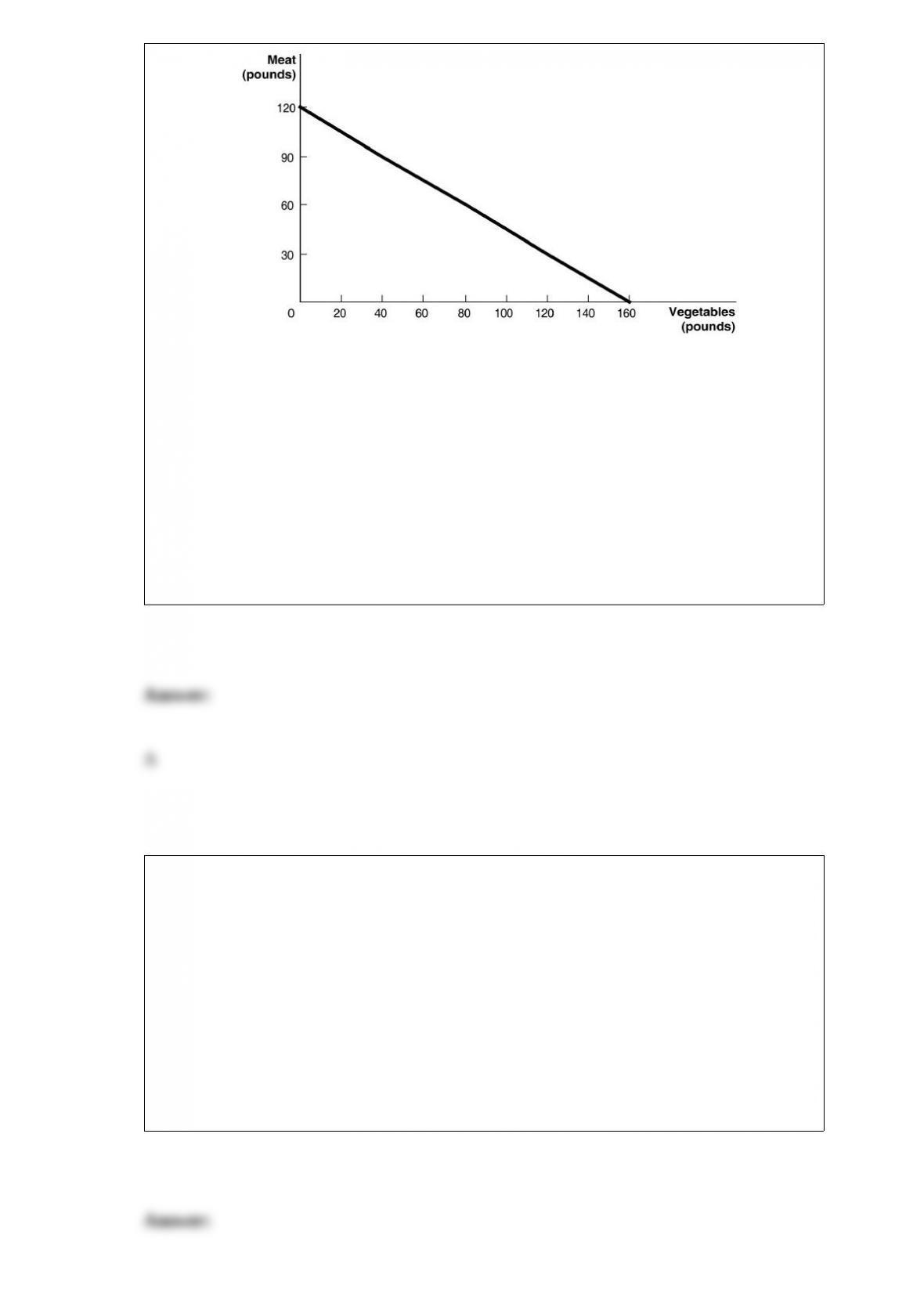
Figure 2-2 Figure
2-2 above shows the production possibilities frontier for Mendonca, an agrarian nation
that produces two goods, meat and vegetables. If Mendonca chooses to produce 120
pounds of meat, how much vegetables can it produce to maximize production?
A) 0 pounds of vegetables
B) 60 pounds of vegetables
C) 100 pounds of vegetables
D) 160 pounds of vegetables
Mandatory motorcycle helmet laws are designed to reduce the severity of injuries
resulting from motorcycle involvement in traffic accidents. In this sense, these
mandatory helmet laws are reducing ________ of risky behavior.
A) positive externalities
B) negative externalities
C) the private benefit
D) the social benefit
Under the Patient Protection and Affordable Care Act (ACA), insurance companies will
be required to participate in a high-risk pool that will cover individuals with
pre-existing medical conditions.
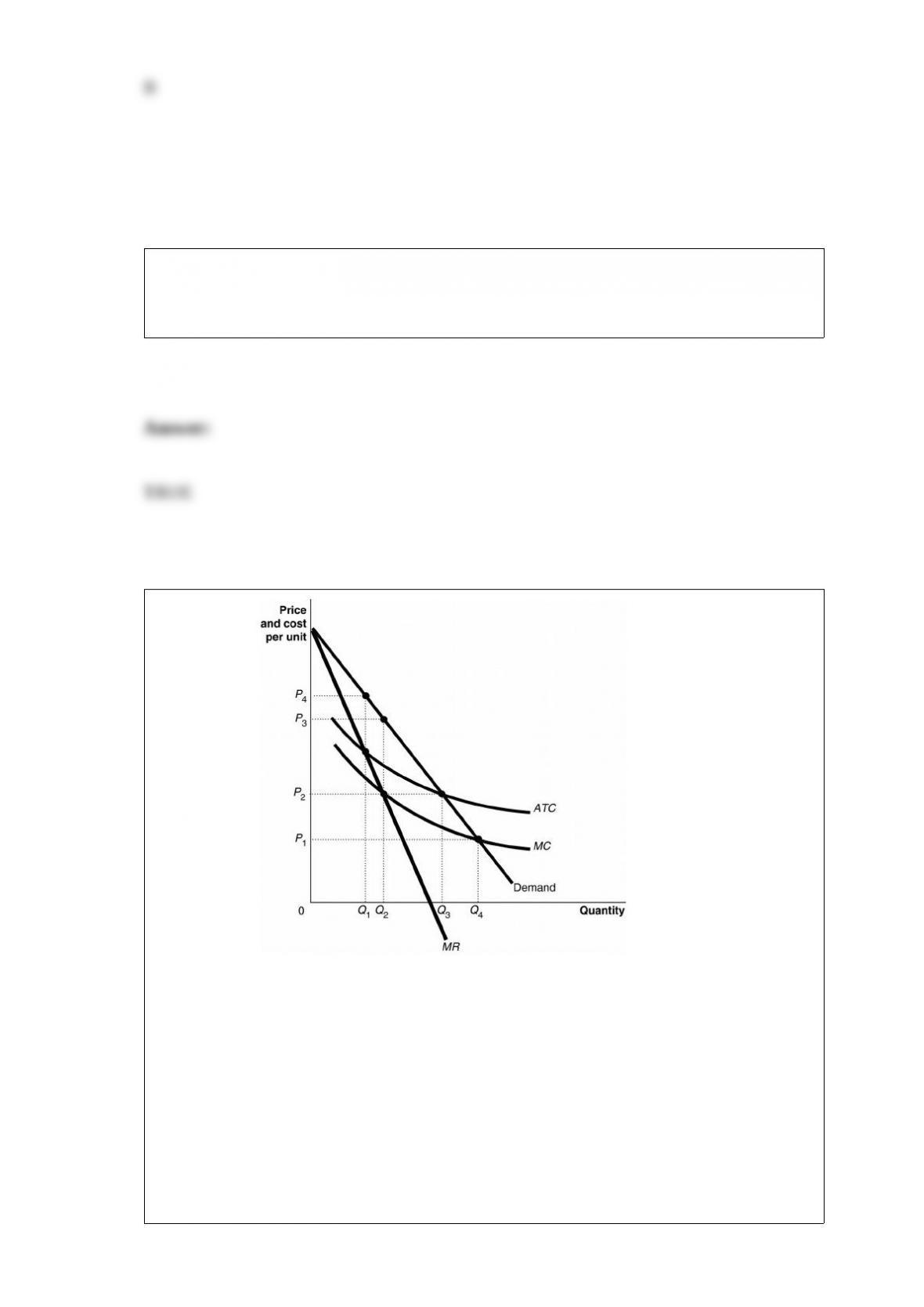
Figure 15-15 Figure 15-15 shows the
cost and demand curves for the Erickson Power Company.
Erickson Power is a natural monopoly because
A) it is a power company and all power companies are natural monopolies.
B) average total cost is still declining when it intersects demand.
C) of its continually declining marginal revenue curve as output rises.
D) its marginal cost lies entirely below its long-run average cost.

An economic ________ is a simplified version of some aspect of economic life used to
analyze an economic issue.
A) market
B) trade-off
C) variable
D) model
If full-employment GDP is equal to $4.2 trillion, what does the long-run aggregate
supply curve look like?
A) It is a horizontal line at $4.2 trillion of GDP.
B) It is a vertical line at a level of GDP below $4.2 trillion.
C) It is a vertical line at $4.2 trillion of GDP.
D) It is a vertical line at a level of GDP above $4.2 trillion.

Is a monopolistically competitive firm productively efficient?
A) No, because it does not produce at minimum average total cost.
B) Yes, because it produces where marginal cost equals marginal revenue.
C) No, because price is greater than marginal cost.
D) Yes, because price equals average total cost.
Suppose the demand curve for a product is represented by a typical downward-sloping
curve. Now suppose the demand for this product increases. Which of the following
statements accurately predicts the resulting increase in price?
A) The more elastic the supply curve, the greater the price increase.
B) The more elastic the supply curve, the smaller the price increase.
C) The increase in price is not affected by the elasticity of the supply curve.
D) There will be no increase in price if the supply curve is perfectly inelastic.
The proposition that the outcome of a majority vote is likely to represent the
preferences of the voter who is in the political middle is called
A) the mean (or average) voter theorem.
B) the voting paradox.
C) the Arrow impossibility theorem.

D) the median voter theorem.
A firm’s primary interest when it hires an additional worker is
A) the cost of hiring the additional worker.
B) how the average output of the firm will be affected by this new worker.
C) the extra revenue the firm realizes from hiring that worker.
D) whether or not the new worker gets along with the firm’s existing workers.
The average price of goods and services in the economy is also known as
A) the price level.
B) the inflation rate.
C) a market basket.
D) the cost of living.