
If the government finances an increase in government purchases with an increase in
taxes, which of the following would you not expect to see?
A) an increase in the exchange rate
B) a decrease in the interest rate
C) an increase in aggregate demand
D) a decrease in net exports
Which of the following statements best describes the concept of consumer surplus?
A) “Safeway was having a sale on Dreyer’s ice cream so I bought 3 quarts.”
B) “I was all ready to pay $300 for a new leather jacket that I had seen in Macy’s but I
ended up paying only $180 for the same jacket.”
C) “I paid $130 for a printer last week. This week the same store is selling the same
printer for $110.”
D) “I sold my Blu-ray copy of Ben-Hur for $18 at a garage sale even though I was
willing to sell it for $10.”
A decrease in the price level results in a(n) ________ in the quantity of real GDP
demanded because a lower price level ________ consumption, investment, and net
exports.
A) decrease; increases

B) increase; increases
C) decrease; decreases
D) increase; decreases
Which of the following is not among Porter’s competitive forces?
A) power of buyers
B) power of suppliers
C) threat of new entrants
D) changing consumer tastes
Gertrude Stork’s Chocolate Shoppe normally employs 4 workers. When the Chocolate
Shoppe hired a 5th worker the Shoppe’s total output decreased. Therefore
A) the marginal product of the 5th worker is negative.
B) the total output of Gertrude Stork’s Chocolate Shoppe is negative.
C) the average product of the 5th worker is negative.
D) the 5th worker should be hired only if he is willing to accept a wage lower than the
wage paid to the other 4 workers.

The quantity of goods and services that can be produced by one worker or by one hour
of work is referred to as
A) technology.
B) labor productivity.
C) real GDP.
D) human capital.
Some economists argue that Microsoft become a monopoly in the market for computer
software by developing MS-DOS, an operating system used for the first IBM personal
computers. The more people who used MS-DOS-based programs, the greater the
usefulness of a using a computer with an MS-DOS operating system. The explanation
for Microsoft’s monopoly is
A) the development of new technology that other firms could not copy.
B) control of a key resource which, in this case, is the MS-DOS operating system.
C) network externalities.
D) patents Microsoft obtained when it developed the MS-DOS operating system.
Positive technological change in the production of LCD televisions caused the price of
LCD televisions to fall. Holding everything else constant, how would this affect the
market for Blu-ray players (a complement to LCD televisions)?
A) The supply of Blu-ray players would increase and the equilibrium price of Blu-ray
players would decrease.
B) The demand for Blu-ray players would increase and the equilibrium price of Blu-ray
players would increase.
C) The demand for Blu-ray players would decrease because consumers could afford to
buy fewer LCD televisions and Blu-ray players.
D) The demand for Blu-ray players would increase and the equilibrium price of Blu-ray
players would decrease.
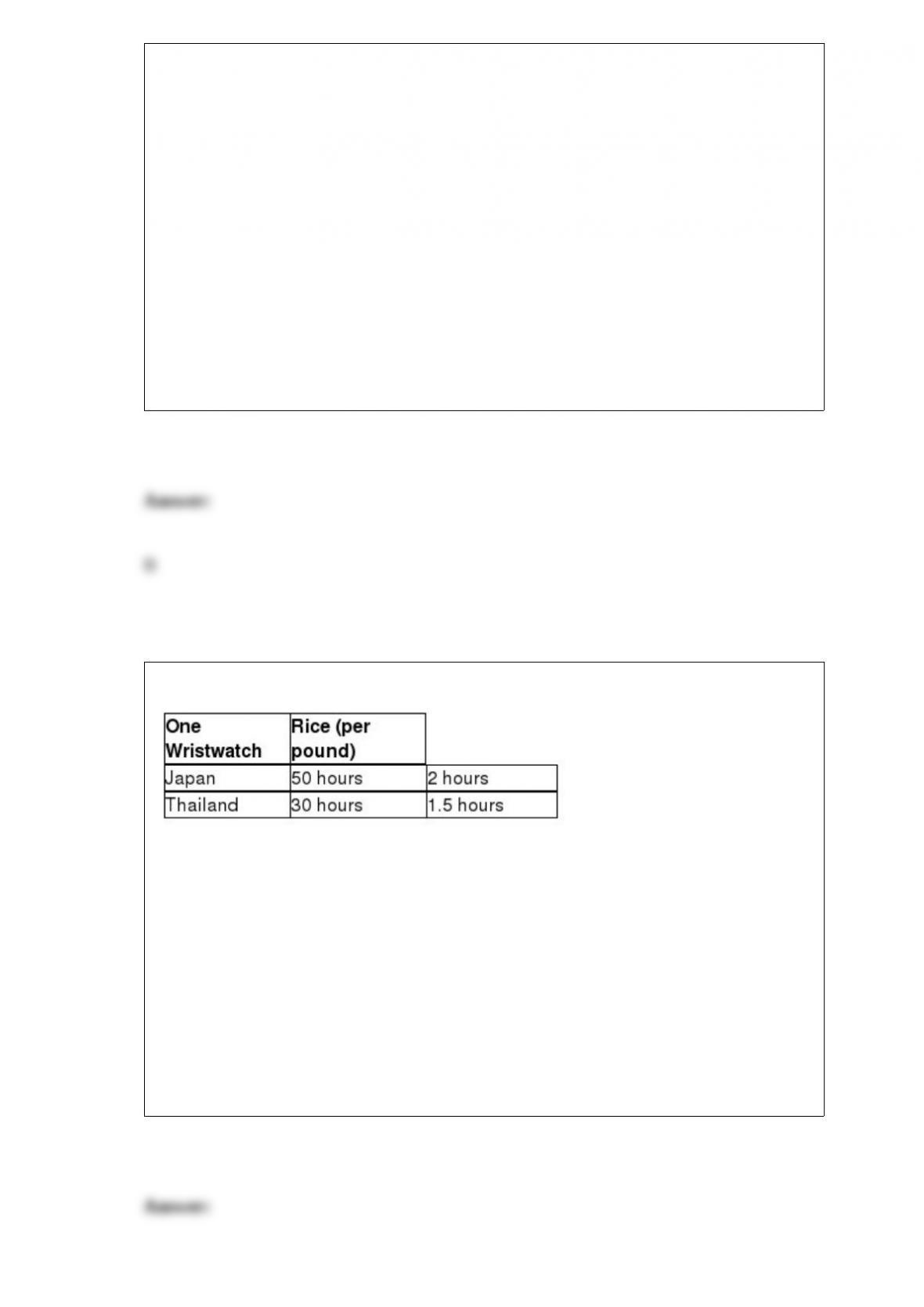
Table 2-20
Table 2-20 shows the number of labor hours required to produce a wristwatch and a
pound of rice in Japan and Thailand.
What is Japan’s opportunity cost of producing one pound of rice?
A) 0.04 units of a wristwatch
B) 4 wristwatches
C) 25 wristwatches
D) 40 wristwatches
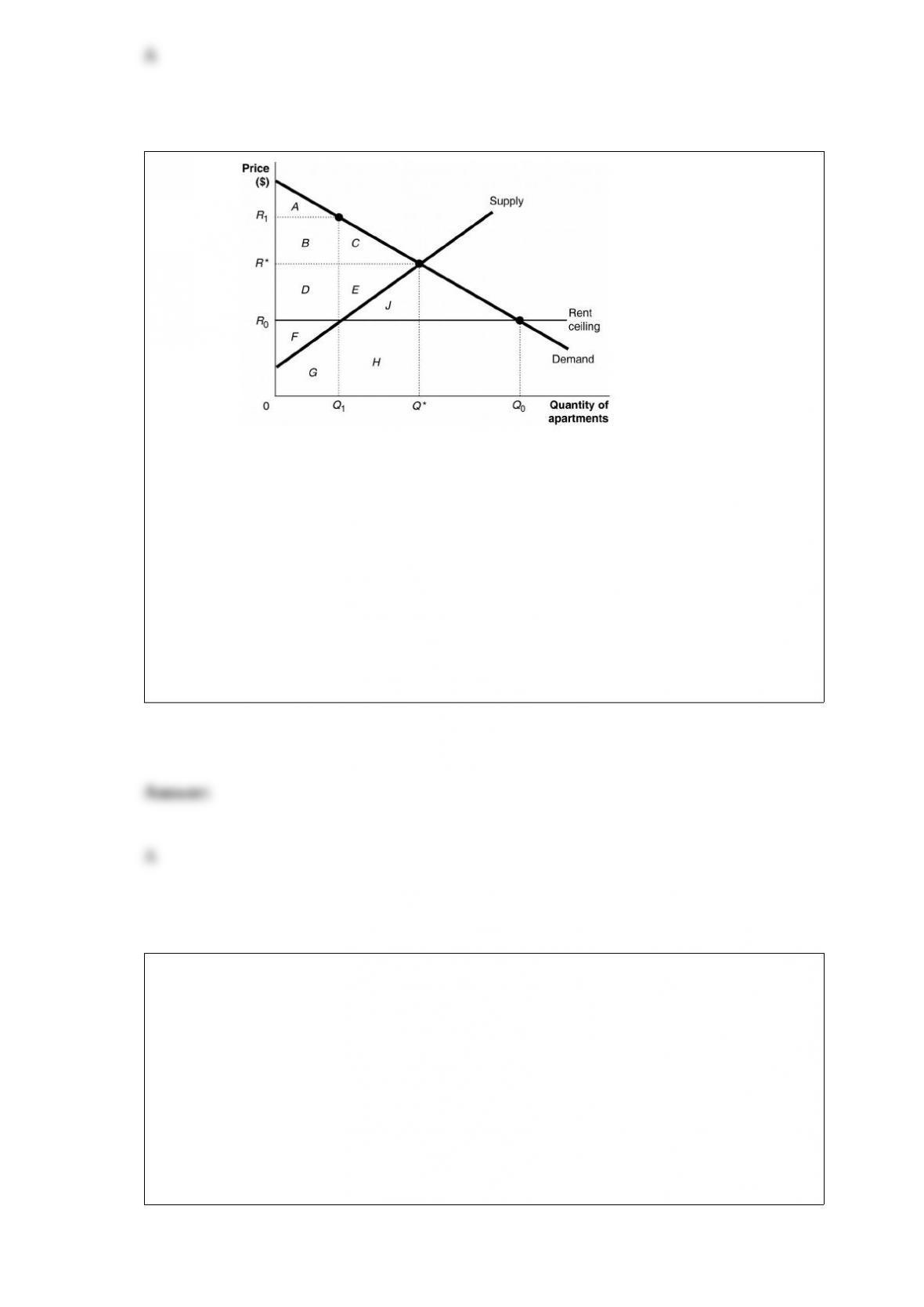
Figure 4-5 Figure 4-5 shows the
market for apartments in Bay City. Recently, the government imposed a rent ceiling at
R0. What is the area that represents consumer surplus after the imposition of the
ceiling?
A) A + B+ D
B) A + B + C
C) A + B + D + F
D) A + B + D + F + G
A monopolistically competitive firm maximizes profit in the short run by producing
where
A) price is less than marginal cost.
B) price is less than marginal revenue.
C) price is less than average revenue.
D) price is greater than marginal cost.
The long-run adjustment to a negative supply shock results in
A) the short-run aggregate supply curve shifting to the right.
B) the price level rising.
C) unemployment rising.
D) workers being willing to accept higher wages.
Which of the following is operating income?
A) explicit plus implicit costs
B) stockholders’ equity
C) revenue minus operating expenses
D) net profit
The deflation of the 1930s impacted the U.S. economy because it led some consumers
to ________ and because it ________.

A) postpone purchases while they waited for prices to fall even lower; increased the
burden on borrowers
B) demand higher wages in anticipation of prices eventually rising again; increased
manufacturing since firms could afford to hire more labor
C) borrow more money since money was now cheap; reduced the amount of money
consumers would have to pay back on their outstanding loans
D) increase purchases to take advantage of the falling prices; increased the burden on
lenders
Suppose Adam Einberg pays $100 for a ticket to a new Broadway play and $100 was
the maximum price he was willing to pay. On the day of the performance of the play
Adam refuses to sell the ticket for $150. How would behavioral economists explain
Adam’s refusal to sell his ticket?
A) Adam’s tastes had changed from the time he bought the ticket to the time of the
performance of the play.
B) When Adam bought the ticket he was being unrealistic about his future behavior.
C) The endowment effect explains Adam’s actions. People like Adam seem to value
things that they have more than the things they do not have.
D) Adam’s income probably increased between the time he bought the ticket and the
day of the play’s performance.
If banks do not loan out all their excess reserves, then the real world multiplier is
A) smaller than 1/RR.
B) larger than 1/RR.
C) equal to 1/RR.
D) not related to 1/RR.
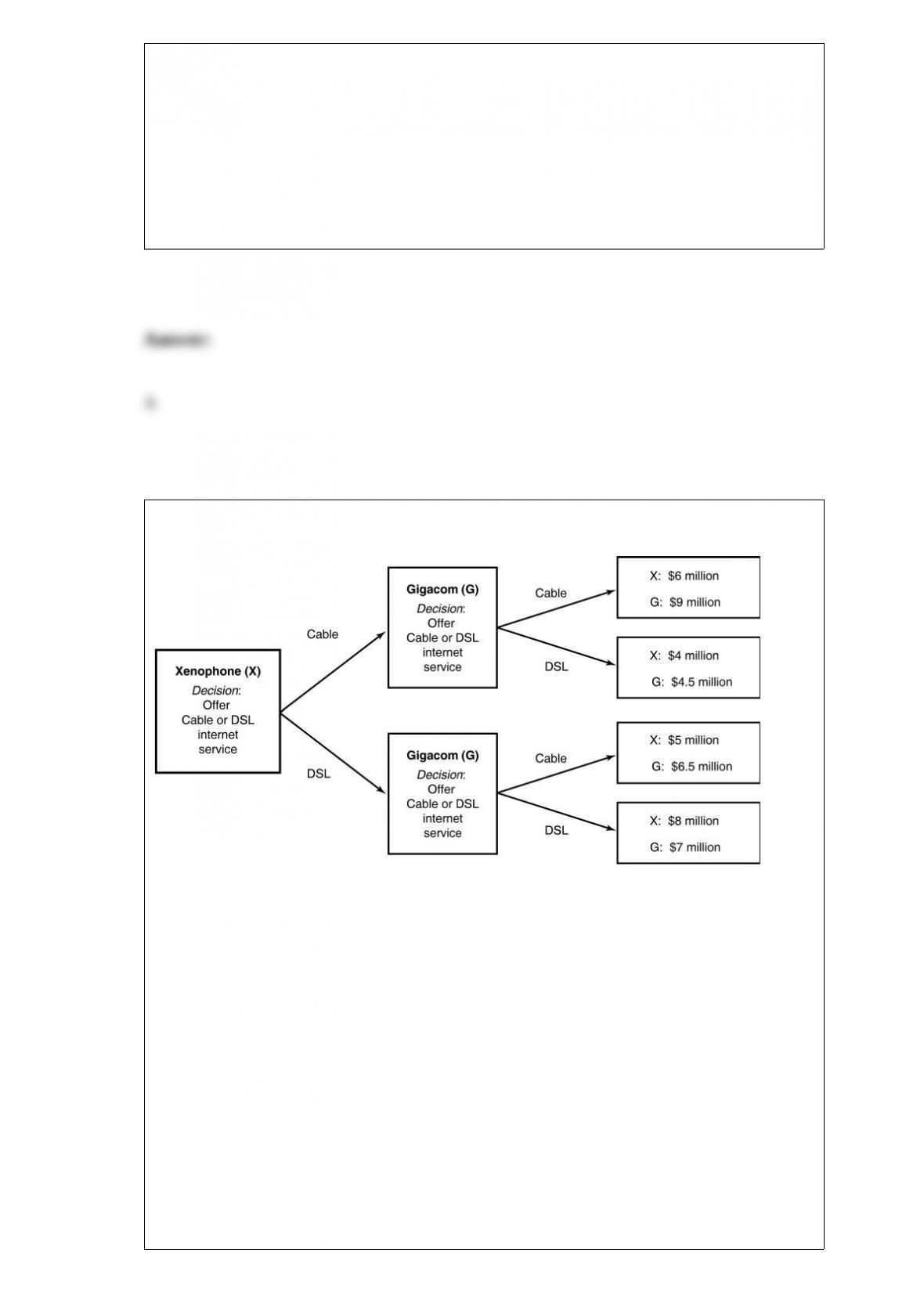
Figure 14-2
The
government of a developing country plans to award two firms, Gigacom and
Xenophone, the exclusive rights to share the market for high speed Internet service.
Gigacom and Xenophone can both provide the service either via television cable lines
or via direct subscriber line (dbl). Suppose the government is considering a proposal to
delay one firm’s entry into the market on the grounds that it wants to prevent “harmful”
competition. Figure 14-2 shows the decision tree for this game.
What is the equilibrium outcome in this game, and is this a subgame-perfect
equilibrium?
A) Odeon’s offer of $40 per copy of the software package is accepted, and this is a
subgame-perfect equilibrium.
B) In the equilibrium, Odeon offers $40 per copy of the software package and is
accepted, but this is not a subgame-perfect equilibrium.

C) In the equilibrium, Odeon offers $30 per copy of the software package and is
rejected, and this is a subgame-perfect equilibrium.
D) There is no equilibrium in this game.
Which of the following would be the source of a “real” business cycle?
A) changes in technology
B) anticipated expansionary monetary policy
C) unanticipated expansionary monetary policy
D) unanticipated contractionary monetary policy
________ are financial securities that represent promises to repay a fixed amount of
funds.
A) Stocks
B) Bonds
C) Interest rates
D) Mutual funds