Credit card balances are not considered to be money primarily because they:
A. are rarely used to make purchases.
B. are not part of people’s wealth.
C. are an asset used in making transactions.
D. do not represent an obligation to pay someone else.
Refer to the figure above. In the graph above, the ____ needed to achieve the social
optimum is ____ the resulting price change.
A. tax; equal to
B. tax; greater than
C. tax; less than
D. subsidy; equal to
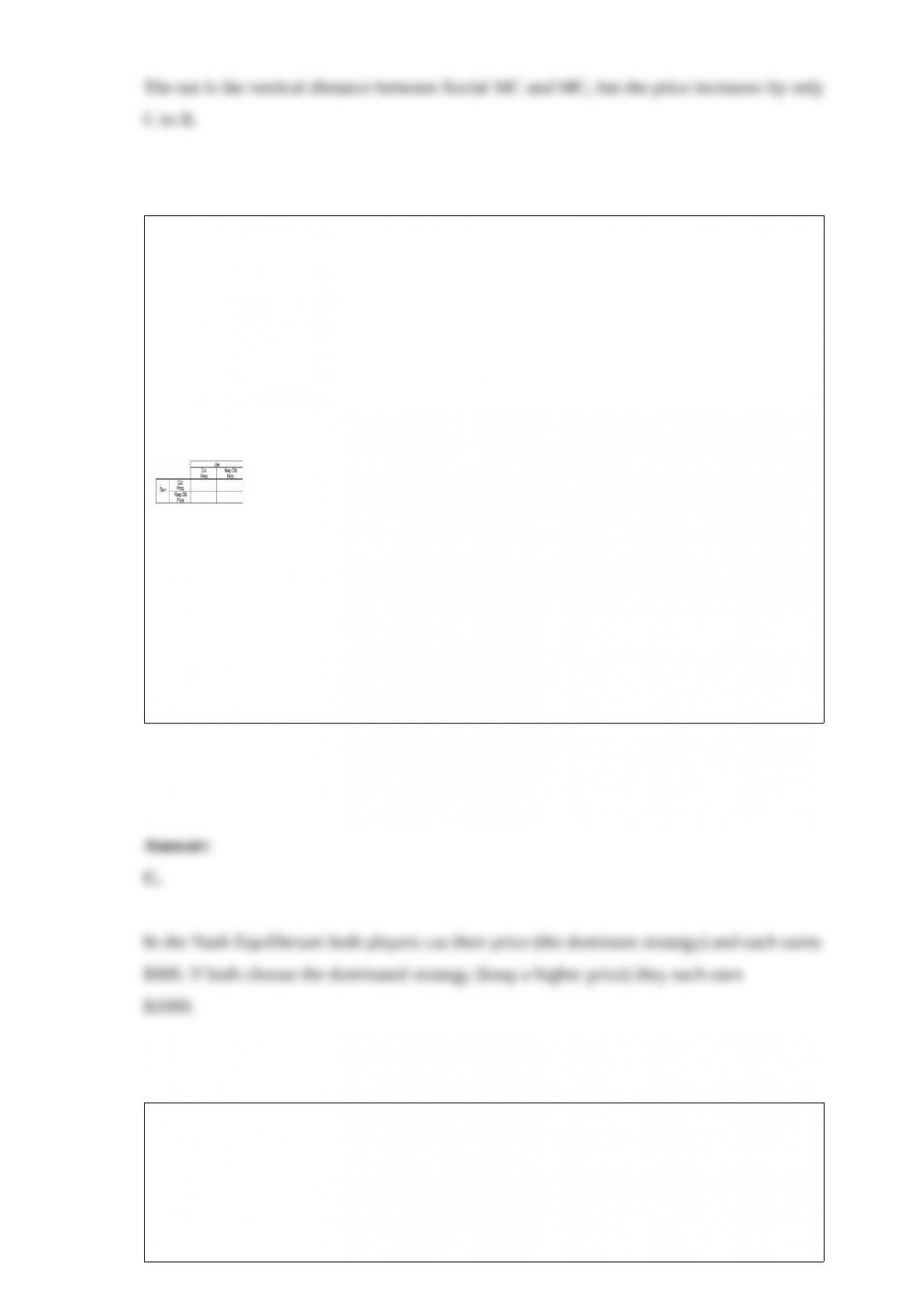
Joe is the owner of the 7-11 Mini Mart, Sam is the owner of the SuperAmerica Mini
Mart and together they are the only gas stations in town. At the current price of $3 per
gallon, both receive total revenues of $1,000. Joe is considering cutting his price to
$2.90, which would increase his total revenue to $1,350 if Sam continues to charge $3.
If Sam’s price remains $3 after Joe cuts his price, Sam will collect $500 in revenues. If
Sam cuts his price to $2.90, his total revenues would also rise to $1,350 if Joe continues
to charge $3. Joe will collect $500 in revenues if he keeps his price at $3 while Sam
lowers his to $2.90. Joe and Sam will receive $900 each in total revenue if they both
lower their price to $2.90. You may find it easier to answer the following question if
you fill in the payoff matrix below.
Refer to the information given above. In this situation the Nash Equilibrium yields a:
A. lower payoff than each would receive if each played his dominant strategy.
B. higher payoff than each would receive if each played his dominant strategy.
C. lower payoff than each would receive if each played his dominated strategy.
D. the same payoff that each would receive if each played his dominated strategy.
In Econoland in 2000, people with incomes between $20,000 and $30,000 paid 12% of
their income in taxes and people with incomes between $30,001 and $40,000 paid 15%.
In 2000, the CPI in Econoland equaled 1.20, and it increased to 1.26 in 2001. If the
government of Econoland wants to keep households with a given real income from
being pushed up into a higher tax bracket by inflation, the $20,000-to-$30,000 bracket
will be changed in 2001 to:
A. $15,873-to-$23,810
B. $21,000-to-$31,500
C. $24,000-to-$37,800
D. $25,200-to-$37,800
An example of a government policy to provide a framework within which the private
sector can operate productively is:
A. the taxation of savings.
B. the suppression of political dissent.
C. establishing well-defined property rights.
D. government ownership of capital.
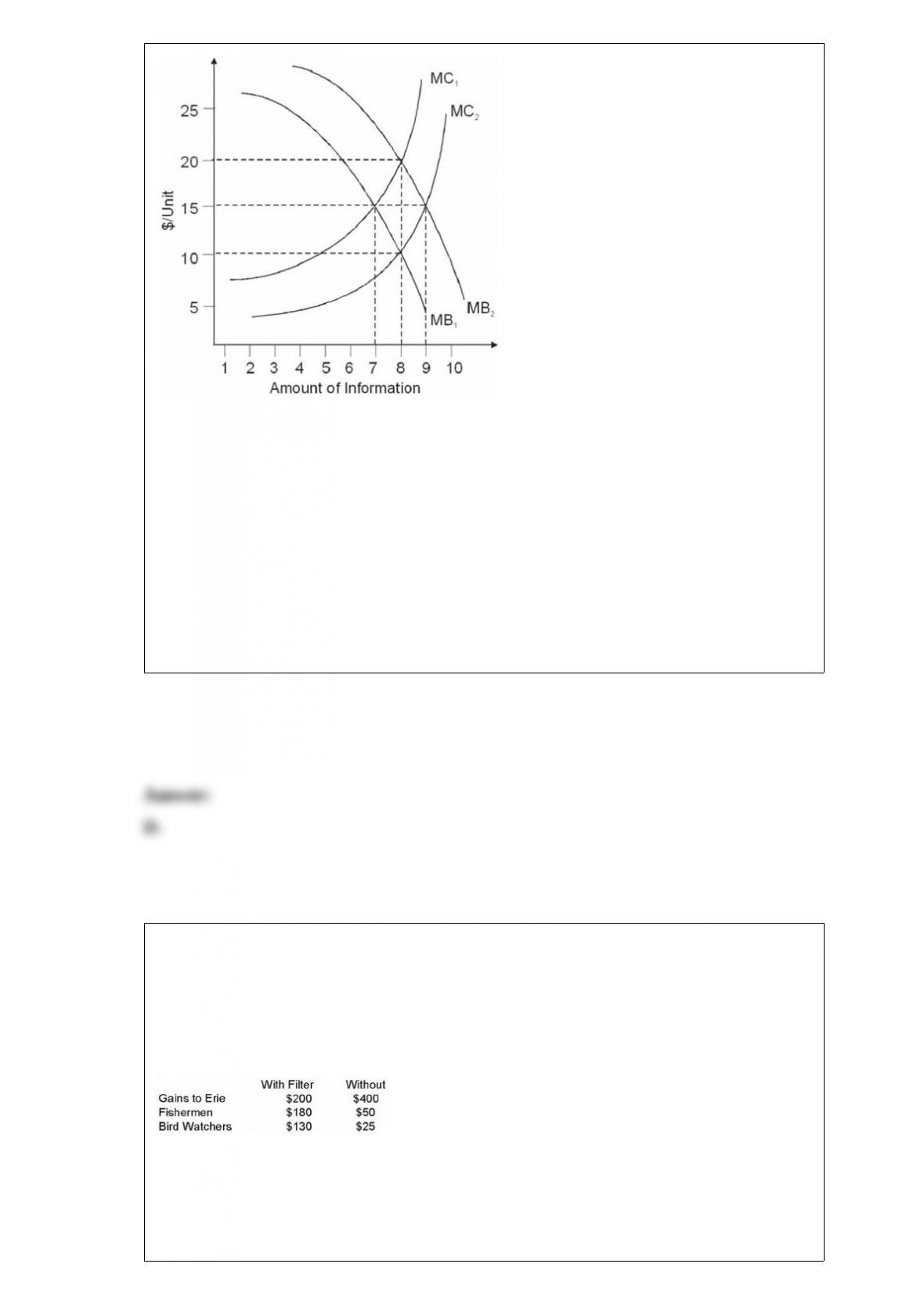
Refer to the figure above. If the relevant curves are MC1 and MB2, a rational consumer
will acquire _____ units of information, the amount for which marginal benefit for
information is _____ its marginal cost.
A. 7, equal to
B. 7, more than
C. 8, more than
D. 8, equal to
Suppose Erie Textiles can dispose of its waste “for free” by dumping it into a nearby
river. While the firm benefits from dumping waste into the river, the waste reduces the
fish and bird reproduction. This causes damage to local fishermen and bird watchers. At
a cost, Erie Textiles can filter out the toxins, in which case local fishermen and bird
watchers will not suffer any damage. The relevant gains (in thousands of dollars) and
losses for the three parties are listed below.
Refer to the information given above. Suppose that Erie Textiles can only negotiate
with one of the affected groups. Will Erie operate with a filter?
A. Yes, if they negotiate with the Bird Watchers, but not if they negotiate with the
Fishermen.
B. No, regardless of which group they negotiate with.
C. Yes, if they negotiate with the Fishermen, but not if they negotiate with the Bird
Watchers.
D. Yes, regardless of which group they negotiate with.
Savings deposits are ______ the M1 measure of money and ______ the M2 measure of
money.
A. included in; excluded from
B. included in; included in
C. excluded from; excluded from
D. excluded from; included in
To prevent inflation from becoming permanently higher following an adverse inflation
shock the Fed must ____, while to offset the effect of an increase in aggregate demand
the Fed must _____.
A. lower the inflation rate target; adjust the real interest rate target to the level at which
saving equals investment in the long run.

B. raise the inflation rate target; adjust the real interest rate target to the level at which
saving equals investment in the long run.
C. maintain the inflation rate target; maintain the real interest rate target.
D. maintain the inflation rate target; adjust the real interest rate target to the level at
which saving equals investment in the long run.
Assume that each day ten thousand children watch Sesame Street on public television
and that the educational benefits of watching Sesame Street generate private benefits of
$100 per child per year and a positive externality of $50 per child per year. No products
are advertised on Sesame Street but once a year the stations hold a pledge drive. During
pledge drives viewers are asked to make voluntary contributions to the public station in
order to keep the programming viable.
If the public television stations collect less than $100 per child during the pledge drives
it is evidence that
A. the government subsidy is too high.
B. viewers do not take externalities into account when making a donation.
C. some viewers are free riders.
D. viewers do not value Sesame Street as much as originally estimated.
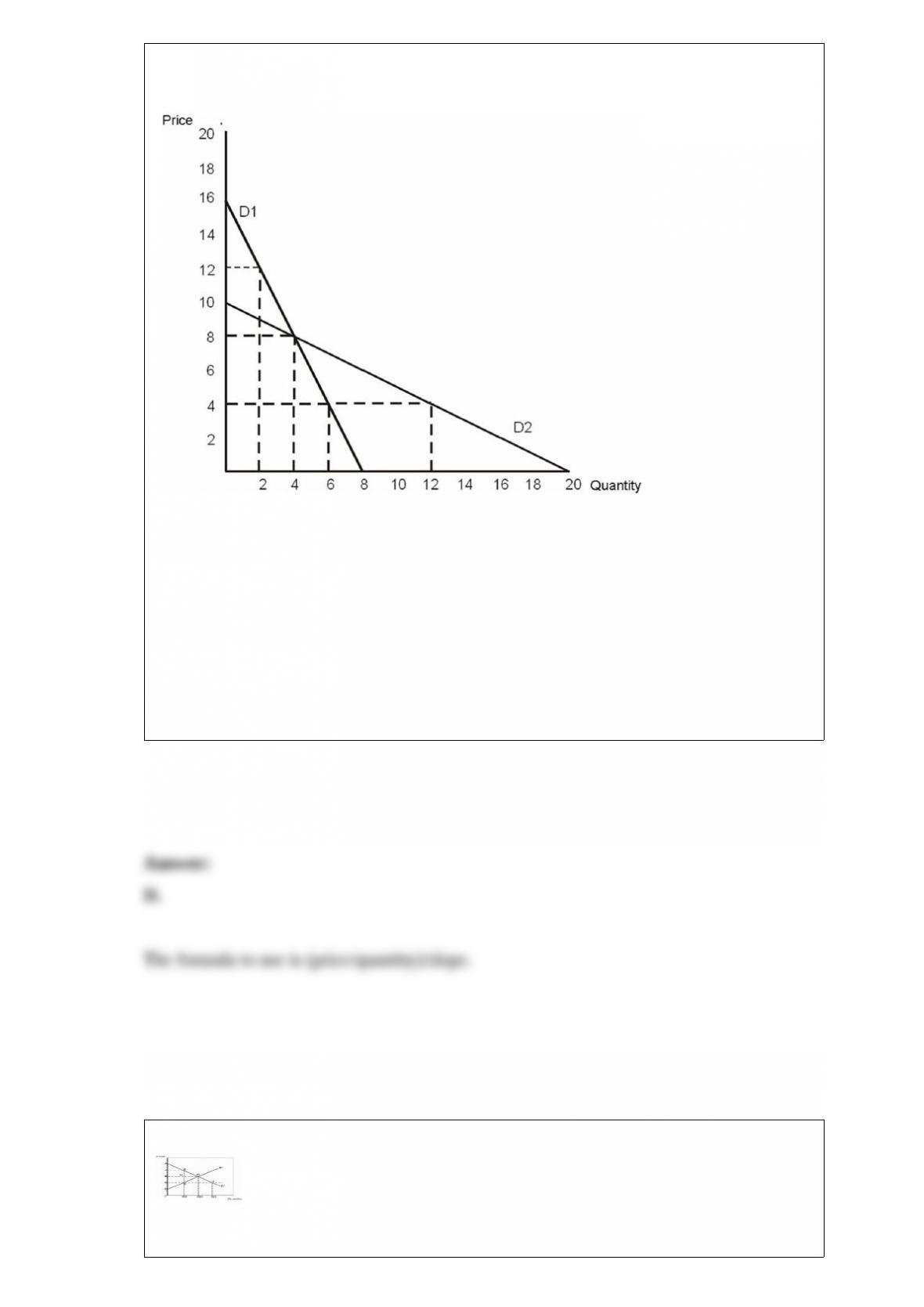
Refer to the figure above. For demand curve D1, what is the price elasticity of demand
when P = 12?
A. 12
B. 6
C. 4
D. 3
Refer to the figure above. Assume that a price ceiling is imposed at point G. The
distance ______ measures the extent of the __________.
A. Q2Q1; excess supply
B. FI; excess demand
C. FI; excess supply
D. GF; excess demand
Matt is offered a job driving the campus shuttle bus from 4 P.M. to 6 P.M. each
Monday. His reservation wage for this job is $7/hour.
Now suppose the director offers Matt $50/hour, but also announces that the earnings
from the job will be divided equally among Matt and four other students. Will Matt still
accept this job?
A. No, because the other students are free riders.
B. No, because it is not fair for Matt to do the work and then have to share the wage.
C. Yes, because $50 divided by five is greater than Matt’s reservation wage.
D. Yes, because Matt believes in the Rawlsian theory of justice.
People who say that they would like to have a job, but have not made an effort to find a

job in the past four weeks, are called ______ workers.
A. unemployed
B. involuntary part-time
C. discouraged
D. chronically unemployed
Matt has decided to purchase his textbooks for the semester. His options are to purchase
the books via the Internet with next day delivery to his home at a cost of $175, or to
drive to campus tomorrow to buy the books at the university bookstore at a cost of
$170. Last week he drove to campus to buy a concert ticket because they offered 25
percent off the regular price of $16.
According to the cost-benefit principle:
A. it would not be rational for Matt to drive to campus to purchase the books because
the $5 saving is only two percent of the cost of the books, and that is much less than the
25 percent he saved on the concert ticket.
B. it would be rational for Matt to drive to campus to purchase the books because it
costs less to buy the books there than via the Internet.
C. it would be rational for Matt to drive to campus to purchase the books because the $5
saving is more than he saved by driving there to buy the concert ticket.
D. it would not be rational for Matt to drive to campus to purchase the books because
the cost of gas and his time must certainly be more than the $5 he would save.
The No Cash on the Table Principle asserts that:
A. in equilibrium, a few unexploited opportunities exist.
B. sometimes tips aren’t picked up.
C. in disequilibrium, no opportunities exist.
D. in equilibrium, all opportunities have been exploited.
If Jane works for 6 hours she can rent 12 apartments, and if she works for 7 hours she
can rent 15 apartments. The marginal benefit of the 7th hour of Jane’s work equals:
A. 12 apartments.
B. 15 apartments.
C. 1 apartment.
D. 3 apartments.
In reference to short-term economic fluctuations, the “trough” refers to:
A. a period in which the economy is growing at a rate significantly below normal.
B. the high point of economic activity prior to a downturn.
C. the low point of economic activity prior to a recovery.
D. a particularly strong and protracted expansion.
Refer to the figure above. At the socially efficient level of output, the monopolist
would:
A. earn a profit of $100.10.
B. incur a loss of $100.10.
C. incur a loss of $61.25.
D. incur a loss of $50.05.
Economic models are intended to:
A. apply to all examples equally well.
B. eliminate differences in the way people behave.
C. generalize about patterns in decision-making.
D. distinguish economics students from everyone else.
Using real GDP to compare the level of economic well being in two countries may be
misleading because the value of ______ contributes to economic well being, but is
excluded from real GDP.
A. capital goods
B. services
C. leisure
D. formal education
The decision whether to change prices frequently or infrequently is an application of
the:
A. principle of comparative advantage.
B. scarcity principle.
C. principle of increasing opportunity cost.
D. cost-benefit principle.
In order to understand how the price of a good is determined in the free market, one
must account for the desires of:
A. purchasers exclusively.
B. sellers exclusively.
C. governmental agencies exclusively.
D. purchasers and sellers.

Joe’s Taco Hut can purchase a delivery truck for $20,000 and he estimates it will
generate a net income (after taxes, maintenance and operating costs) of $2,000 per year.
He has no other opportunities. He should:
A. purchase the truck only if the real interest rate is less than 2%.
B. not purchase the truck if the real interest rate is greater than 2%.
C. purchase the truck if the real interest rate is greater than 10%.
D. purchase the truck if the real interest rate is less than 10%.
In 1985 a desert community stopped pumping from a 1000 foot well because it had run
dry. In 2005 the price of water doubled. The community then drilled the well deeper
and started pumping again. In this community,
A. the supply of water is perfectly inelastic because it is a finite resource.
B. water production faces increasing opportunity costs.
C. markets cannot reach equilibrium because there is a persistent shortage of water.
D. higher water prices can reduce quantity demanded, but cannot increase quantity
supplied.
In the base year, real GDP ______ nominal GDP.
A. is greater than
B. is less than
C. is equal to
D. could be greater than or less than
Saving is a(n) ______ and wealth is a(n) ______.
A. stock; flow
B. flow; stock
C. asset; liability
D. liability; asset
The real costs of inflation to society include:
A. an increase in the general level of prices.
B. lost purchasing power of income.
C. higher relative prices.
D. interference with long-term planning.
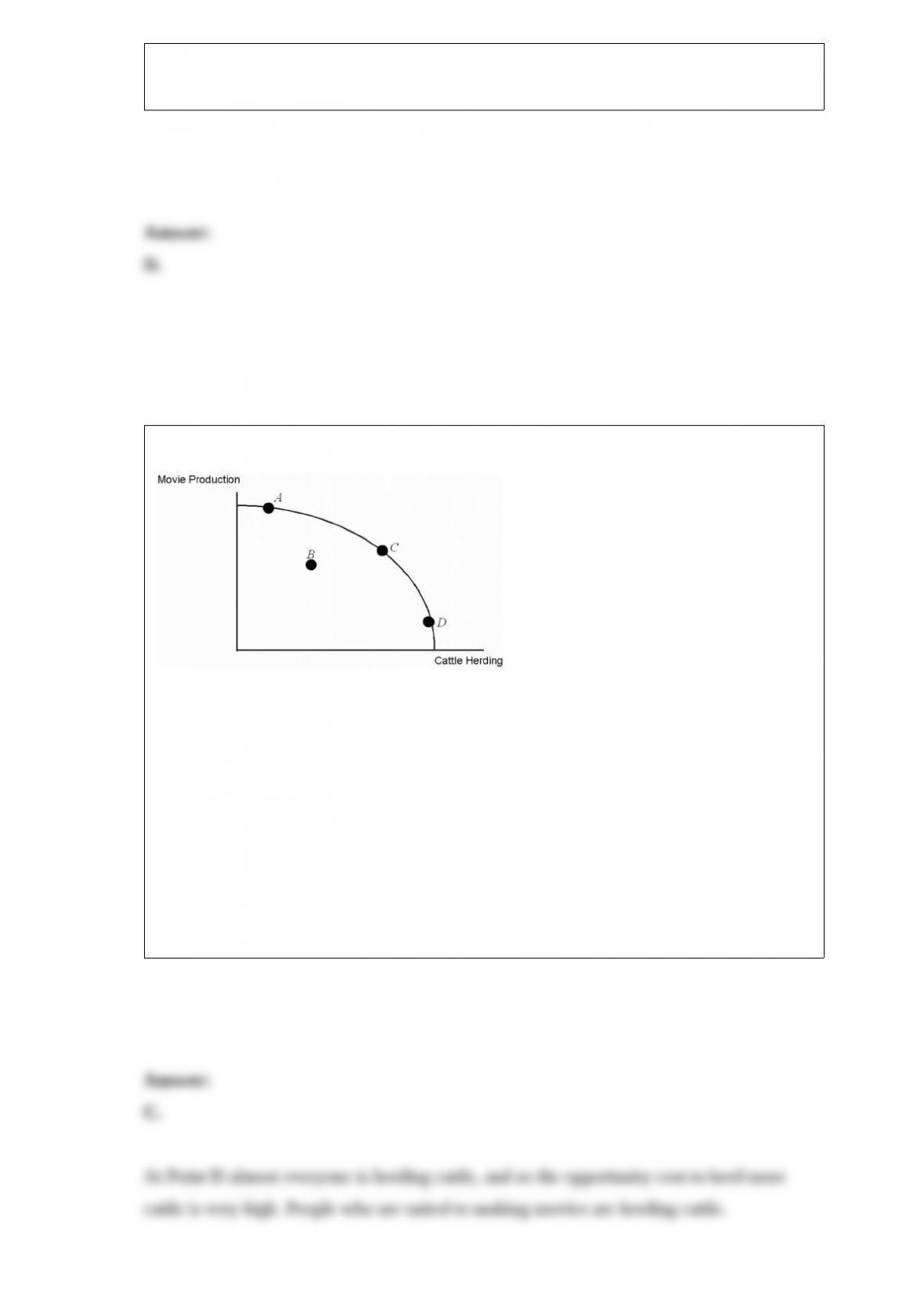
Refer to the figure above. At Point D:
A. resources that are better suited to making movies than to herding cattle are all being
used to make movies.
B. the opportunity cost of herding more cattle is low because the economy is
specializing in cattle herding.
C. the opportunity cost of herding more cattle is high because resources that are better
suited to movie production are being used to herd cattle.
D. the economy is not operating efficiently.
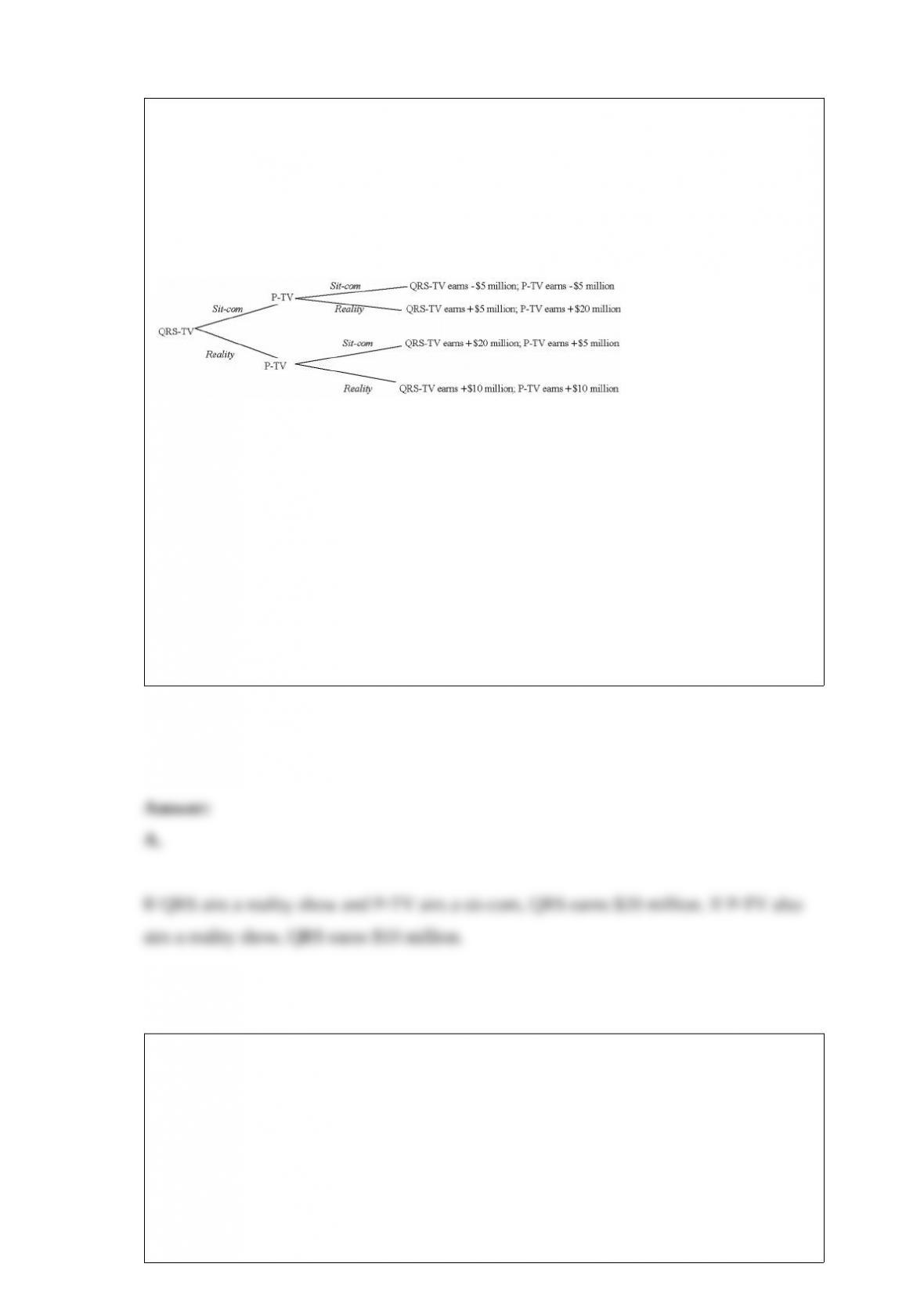
P-TV and QRS-TV are planning their fall line-up. Suppose that sit-coms are more
popular than reality shows, and so generate more advertising revenue than do reality
shows, but they are more expensive to produce since real actors must be hired. In the
following decision tree, QRS-TV announces its decision first and P-TV observes that
choice before it decides whether to air a sit-com in the same time slot or a reality show.
Both stations know all of the information shown in this diagram when they make their
decisions.
Refer to the information given above. Suppose QRS-TV enters into an agreement with
P-TV that gives QRS-TV the exclusive right to air a reality show during this time slot.
QRS-TV would be willing to pay P-TV _____ in order to persuade P-TV to enter into
this agreement.
A. no more than $10 million
B. nothing
C. more than $10 million
D. no more than $5 million
An inflation shock is:
A. the level of inflation consistent with output in a recessionary gap.
B. the level of inflation consistent with output in an expansionary gap.
C. a sudden change in the normal behavior of inflation, unrelated to the nation’s output
gap.
D. a change in the inflation rate generated by excessive aggregate spending.
The principal demanders of U.S. dollars in the foreign exchange market are:
A. foreigners wishing to purchase U.S. goods or assets.
B. the Federal Reserve.
C. U.S. households or firms wishing to purchase U.S. goods or assets.
D. U.S. households or firms wishing to purchase foreign goods or assets.