In labor economics, the term “customer discrimination” refers to a situation where
customers are charged different prices for services rendered by a firm.
If production displays constant returns to scale, then all economies of scale have been
exhausted.
A two-part tariff refers to a pricing schedule under which a buyer must pay a fixed fee
for the right to purchase the product, in addition to a per-unit price.
A monopsony restricts the quantity of a factor demanded to force down the price of the
factor and increase profits.

In the 1930s and 1940s, the Technicolor company was able to leverage its bargaining
power over the movie industry because Technicolor was the sole producer of cameras
and films needed to produce color films.
Consider a country that produces only two goods: parrots and iguanas. Suppose it is
impossible for this country to increase its production of parrots without producing
fewer iguanas. In this case, its current output combination is efficient.
Financial markets and financial intermediaries comprise the financial system.
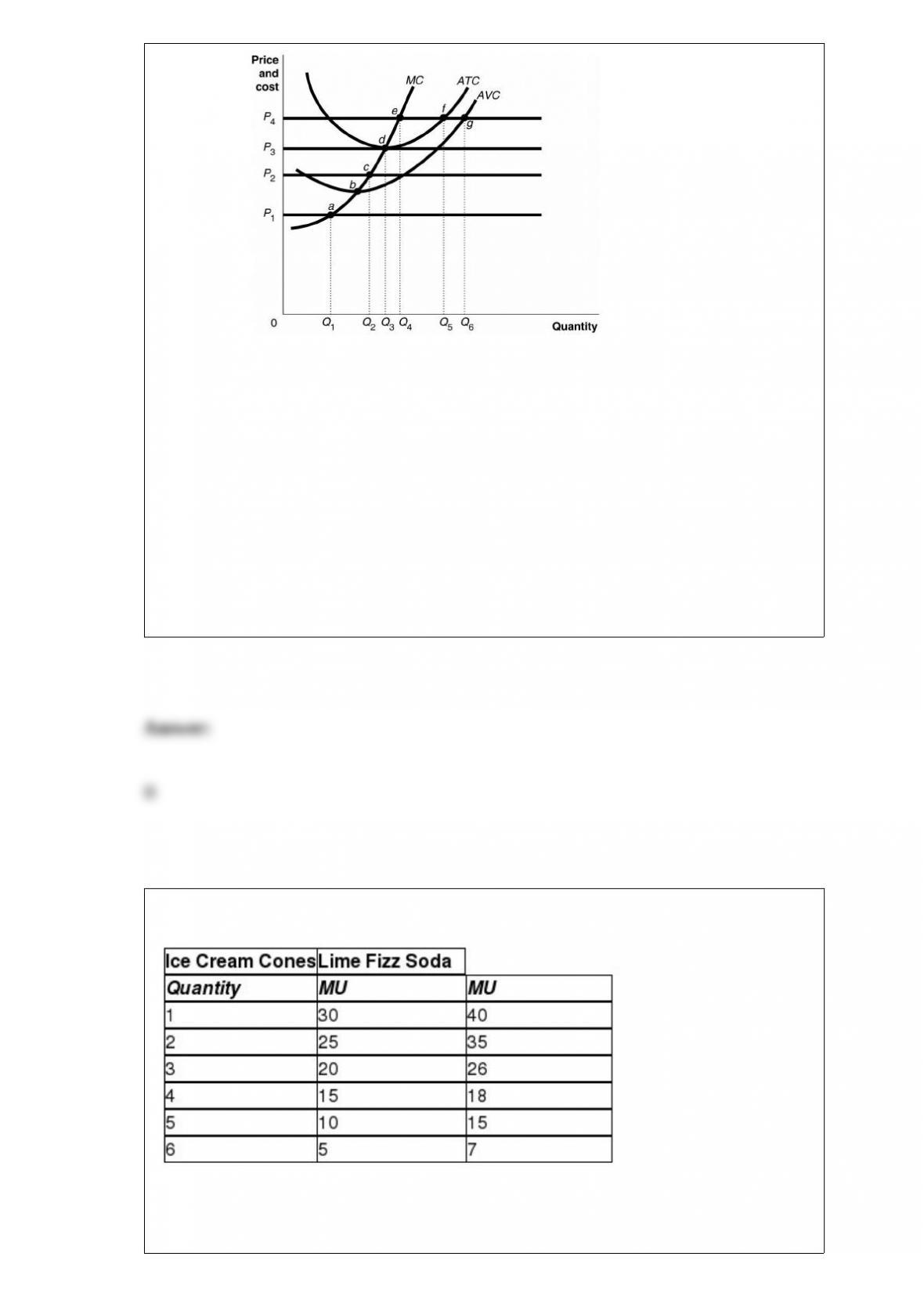
Figure 12-9 Figure 12-9 shows cost and
demand curves facing a profit-maximizing, perfectly competitive firm.
At price P3, the firm would produce
A) Q2 units
B) Q3 units.
C) Q4 units.
D) Q5 units.
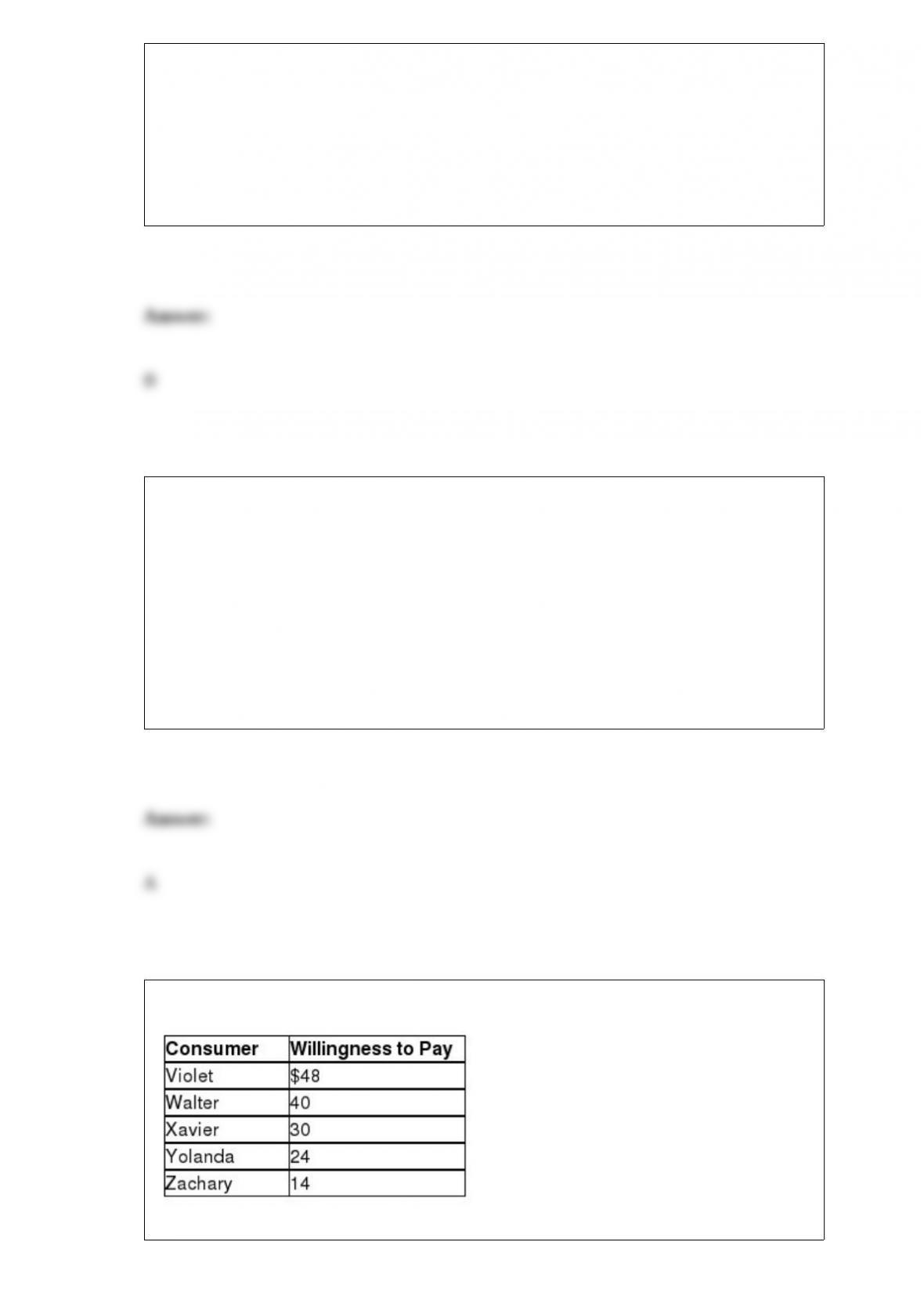
Table 10-3
The table above shows Lee’s marginal utility from consuming ice cream cones and cans
of Lime Fizz Soda. Select the phrase that completes the following statement. “We can

determine the number of ice cream cones and cans of Lime Fizz Soda Lee should
consume to maximize his utility
A) if we know what Lee’s income is.”
B) if we know what Lee’s income is and the price of an ice cream cone and the price of
a can Lime Fizz Soda.”
C) by adding up the marginal utilities for ice cream cones and Lime Fizz Soda.”
D) if we know the values of the marginal utility per dollar for ice cream cones and Lime
Fizz Soda.”
If a corporation retains all its profits and distributes none of the profit to owners, how
can owners benefit?
A) If the retained earnings are expected to create future profits, the market price of the
firm’s stock will increase and create a capital gain for stockholders if the stock is sold.
B) Shares of stock can be converted into bonds so stockholders will be able to earn
coupon payments.
C) Owners will only benefit if some profits are paid out in the form of dividends.
D) Owners will benefit by changing the board of directors.
You are an economic advisor to the president. You are asked to recommend a policy to
promote long-term economic growth in the economy. Which of the following policies
would you choose?
A) a reduction in sales taxes
B) an investment tax credit
C) a reduction in taxes on luxury yachts
D) all of the above
Economists refer a to a market where buying and selling take place at prices that violate
government price regulations as
A) a black market.
B) an outlaw market.
C) a noncompetitive market.
D) a restricted market.
Table 4-2
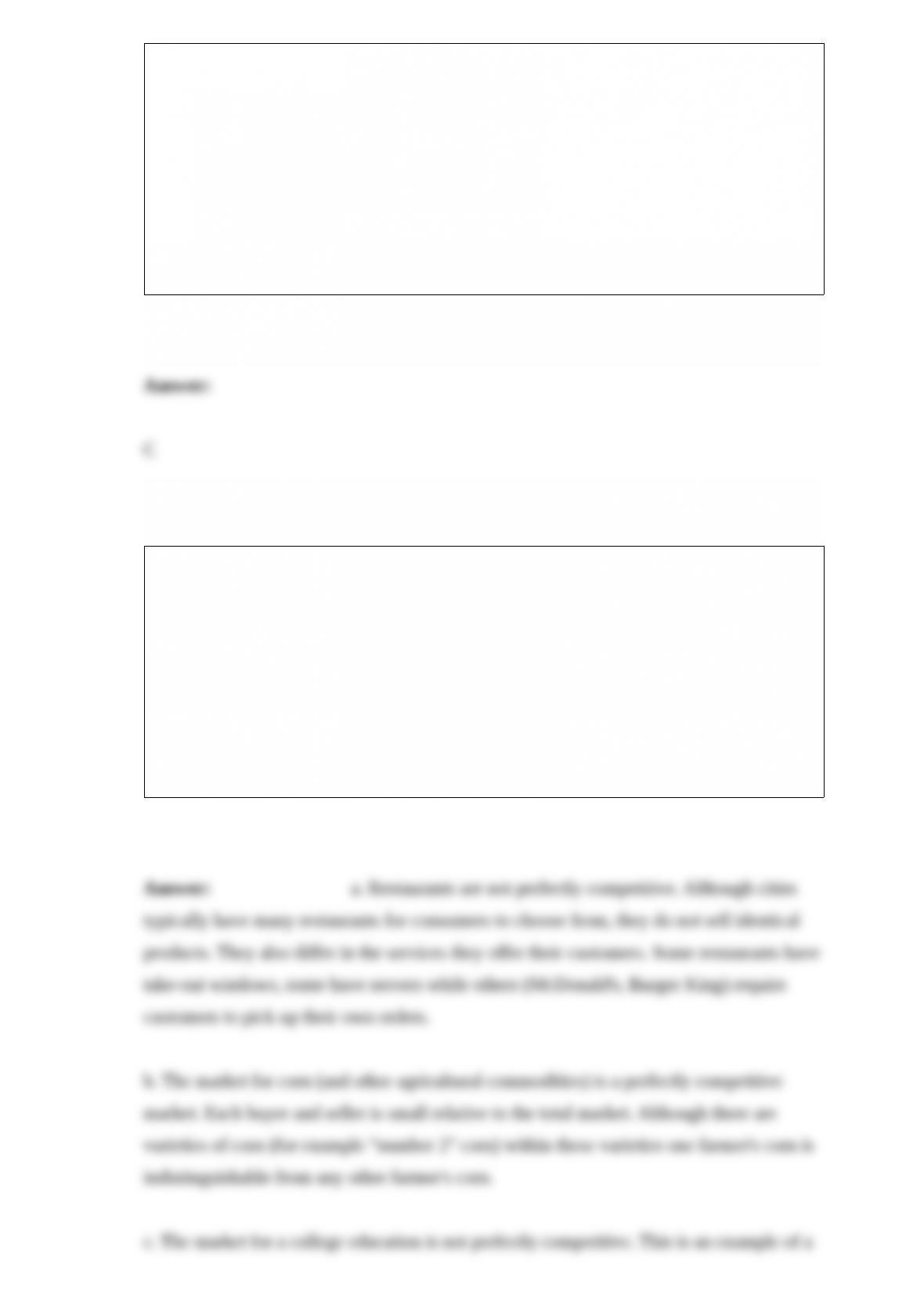
The table above lists the highest prices five consumers are willing to pay for a concert
ticket. If the price of one ticket falls from $50 to $20
A) only three tickets will be sold.
B) consumer surplus decreases from $48 to $24.
C) consumer surplus increases from $0 to $62.
D) everyone will buy a ticket.
Of the following industries, which are perfectly competitive? For those that are not
perfectly competitive, explain why.
a. Restaurants
b. Corn
c. College education
d. Local radio and television
In economics, an organization that produces a good or service is called a
A) firm.
B) company.
C) business.
D) All of the above are correct.
The current exchange rate system in the United States is best described as a
A) silver standard.
B) managed float exchange rate system.
C) fixed exchange rate system.
D) gold standard.

Persistent current account deficits for the United States have
A) decreased investment in new plant and equipment.
B) slowed economic growth.
C) increased government budget deficits.
D) None of the above are correct.
If workers and firms expect that inflation will be 5 percent next year, and real wages are
not changing over time, by how much will nominal wages increase?
A) 5 percent
B) more than 5 percent
C) less than 5 percent
D) depends on actual inflation for next year
Which of the following describes the difference between the market demand curve for a
perfectly competitive industry and the demand curve for a firm in this industry?
A) The market demand curve is a horizontal line; the firm’s demand curve is downward
sloping.
B) The market demand curve is downward sloping; the firm’s demand curve is a
vertical line.
C) The market demand curve cannot have a constant slope; the firm’s demand curve has
a slope equal to zero.
D) The market demand curve is downward sloping; the firm’s demand curve is a
horizontal line.
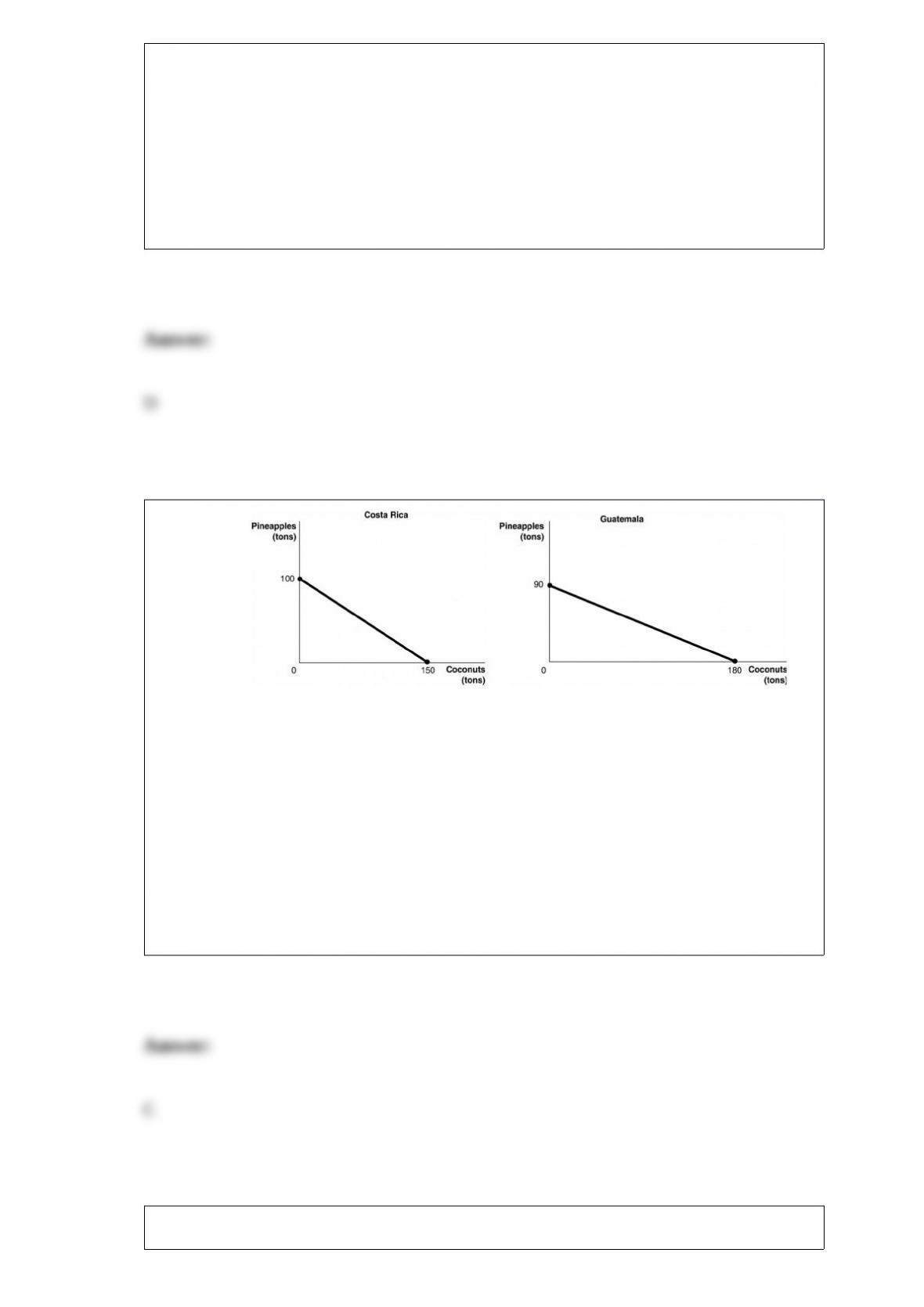
Figure 2-14
Figure 2-14 shows the production possibilities frontiers for Costa Rica and Guatemala.
Each country produces two goods, pineapples and coconuts. What is the opportunity
cost of producing 1 ton of pineapples in Costa Rica?
A) 3/8 of a ton of coconuts
B) 2/3 of a ton of coconuts
C) 1 1/2 tons of coconuts
D) 100 tons of coconuts
The simple trade model demonstrates that countries can expand consumption by
specializing in the production of goods and services in which they have a comparative
advantage. In reality we do not see complete specialization in production. State three
reasons why this is case.
What is meant by the statement that “optimal decisions are made at the margin”?
What is corporate governance?
A construction project in Congressman Foghorn’s district is unfinished. Foghorn has
asked that a new appropriations bill include funds to complete the project, despite a
report by an independent agency that the project is a waste of taxpayer money.
Foghorn’s project is a bridge that crosses a river between two cities in his district. The
press has criticized Foghorn and dubbed the project “a bridge too far” since another
bridge, located closer to the same two cities Foghorn’s bridge will connect, already
exists and can accommodate all traffic between the two cities. Foghorn argues that if the
bridge project is not completed, the $50 million already spent will have been wasted. Is
Foghorn’s argument economically rational? Explain your answer.
What happens to national saving when the government runs a budget surplus? What
happens to national saving when the government runs a budget deficit?
What three real-world complications keep purchasing power parity from being a
complete explanation of exchange rate fluctuations in the long run? Explain.
What does it mean for a country to have an absolute advantage in producing a product?
If the labor supply curve shifts to the left and the labor demand curve remains
unchanged, what will happen to the equilibrium wage and the equilibrium level of
employment? Illustrate your answer with a graph.