
The ongoing search by savers for high returns leads the bond and stock markets to
direct funds to the uses that appear:
A. most likely to be productive.
B. least likely to be productive.
C. to have the least risk.
D. to have no risk.
Mel is thinking of going on a cruise. Mel values a cruise in nice weather at $2,000 and
values a cruise in bad weather at $50. According to a very reliable source, the
probability of nice weather is 60% and the probability of bad weather is 40%. Trip
insurance is sometimes available. If purchased, it allows travelers to delay the cruise
until the weather is nice.
Mels’ friend Flo is risk-averse. Flo’s reservation prices for cruises under the different
weather conditions are the same as Mel’s. Flo will
A. always buy trip insurance.
B. never be willing to pay more than $500 for a cruise.
C. be willing to pay more for trip insurance than Mel.
D. be willing to pay the same amount for trip insurance than Mel.
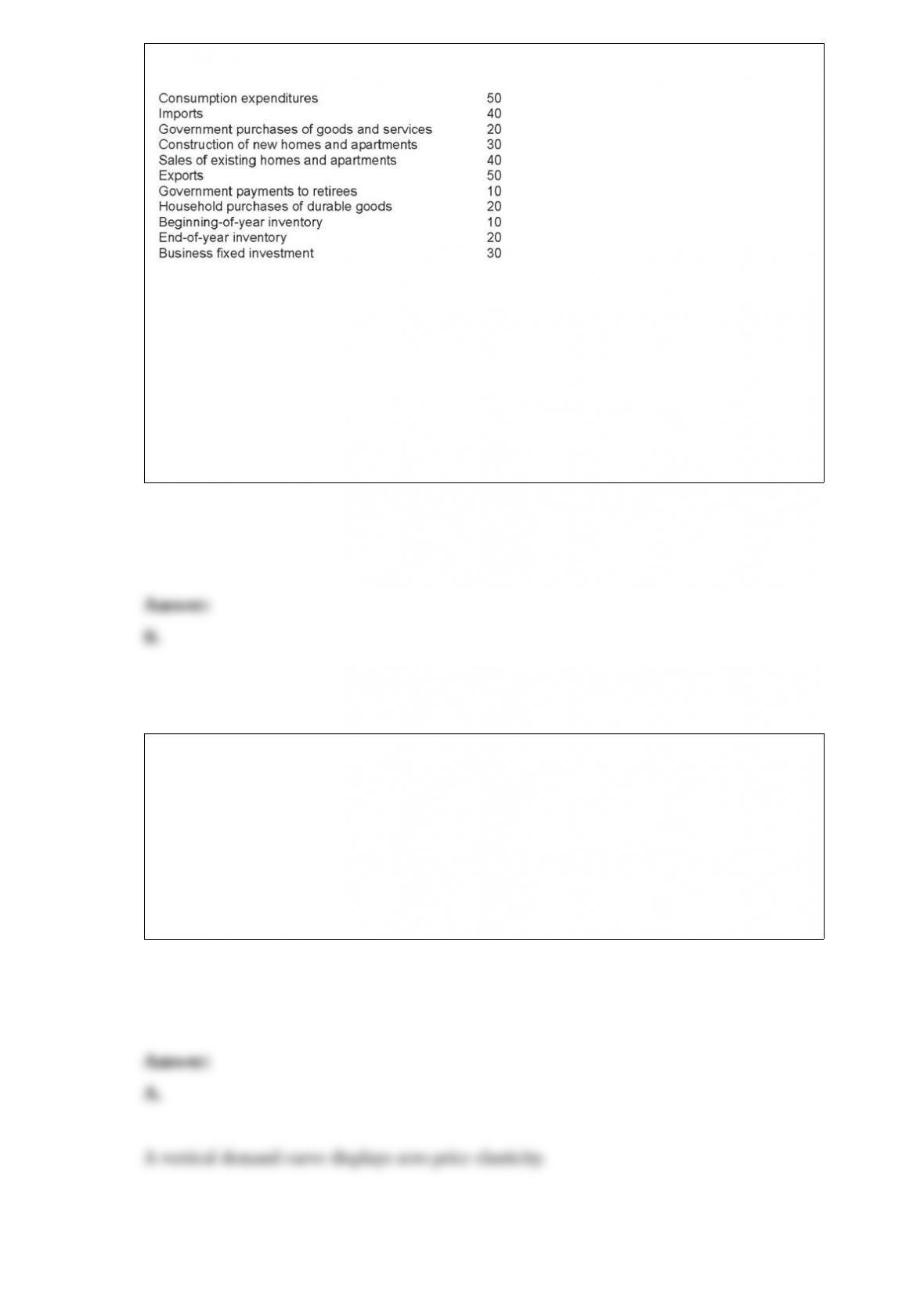
The following table provides data for an economy in a certain year.
Given the data in the table, compute the government purchases component of GDP.
A. 10
B. 20
C. 30
D. 40
A demand curve that is drawn as a vertical line illustrates price elasticity equal to:
A. 0.
B. 1.
C. infinity.
D. the quantity.
Short-run equilibrium output is the level of output at which actual output:
A. equals potential output.
B. maximizes firm profits.
C. equals real GDP per capita.
D. equals planned aggregate expenditure.
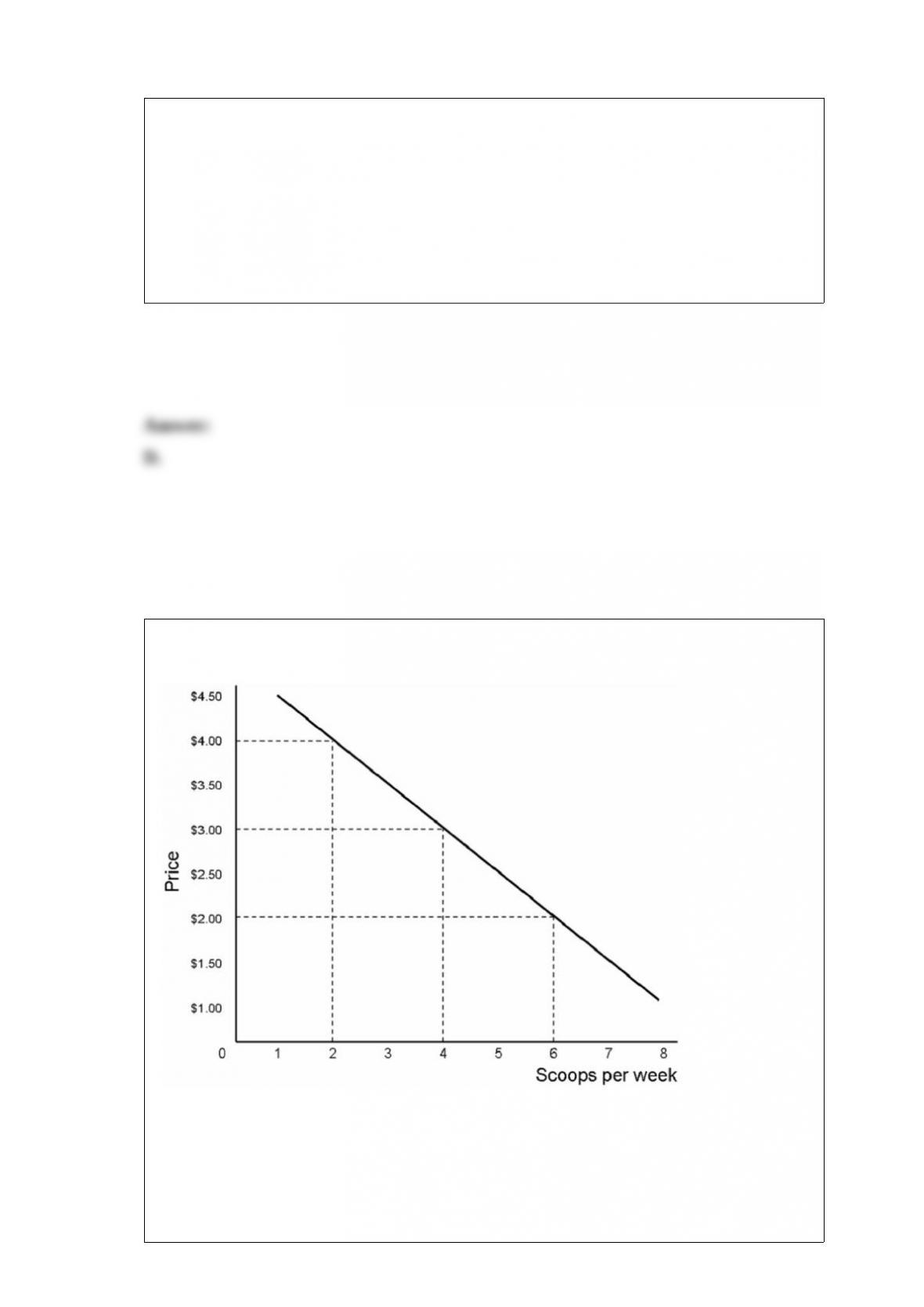
This graph shows one consumer’s demand for ice cream at the student union:
Fran is one of the students whose demand is shown. When price is $4.00, Fran buys
____ scoops, but when price is $2.00, Fran buys _______ scoops.
A. 1; 3
B. 2; 5

C. 2; 4
D. 2; 6
There is ______ connection between the strength of a country’s currency and the
strength of its ______.
A. no simple; economy
B. a direct; economy
C. an inverse; central bank independence
D. a solid; real wage growth
In the long-run, if the production of all goods increases for a society (there is economic
growth), it will cause the production possibility curve to:
A. shift inward.
B. shift outward.
C. first shift inward and then shift outward.
D. stay the same.
The price elasticity of demand for a good is the response of:
A. demand to a one percent change in price of that good.
B. demand to a one percent change in price of the related good.
C. quantity demanded to a one percent change in price of that good.
D. quantity demanded to a one percent change in price of the related good.
To ensure that a nominal payment represents a constant level of purchasing power over
time, one should:
A. add a price index to it.
B. subtract a price index from it.
C. divide it by a price index.
D. increase it by a percentage equal to the rate of inflation for that year.

Which of the following policies would be expected to increase private saving?
A. Increasing the income tax.
B. Reducing the tax rate on capital gains and dividends.
C. Providing more generous Social Security retirement benefits.
D. Increasing job security.
The costs of unemployment are lowest (and perhaps even negative) for ______
unemployment.
A. frictional
B. cyclical
C. structural
D. cyclical and structural
The tit-for-tat strategy only works for prisoner’s dilemma games that:
A. have only one Nash equilibrium.
B. are played only one time.
C. have no Nash equilibrium.
D. are repeated.
The dollar price of a good relative to the average dollar price of all other goods is the
A. market price
B. equilibrium price
C. nominal price
D. real price
A fixed exchange rate is an exchange rate whose value:
A. is established annually by the International Monetary Fund.

B. varies according to the supply and demand for the currency in the foreign exchange
market.
C. is set by official government policy.
D. reflects the comparative advantage of the home country versus other foreign
countries.
Defenders of limits on economic growth are concerned that continued economic growth
will eventually:
A. raise interest rates.
B. reduce the rate of technological progress.
C. exhaust natural resources.
D. make plant and equipment obsolete.
The hurdle method of price discrimination usually _____ consumer surplus and _____
producer surplus.
A. decreases; increases
B. increases; decreases
C. decreases; decreases

D. increases; increases
The speed at which money circulates is called:
A. the multiplier.
B. acceleration.
C. velocity.
D. the pace of money.
The population of Omega totals one million people, 30 percent of whom are employed.
Average output per worker in Alpha is $30,000. Real GDP per person in Alpha totals:
A. $9,000.
B. $21,000.
C. $30,000.
D. $100,000.
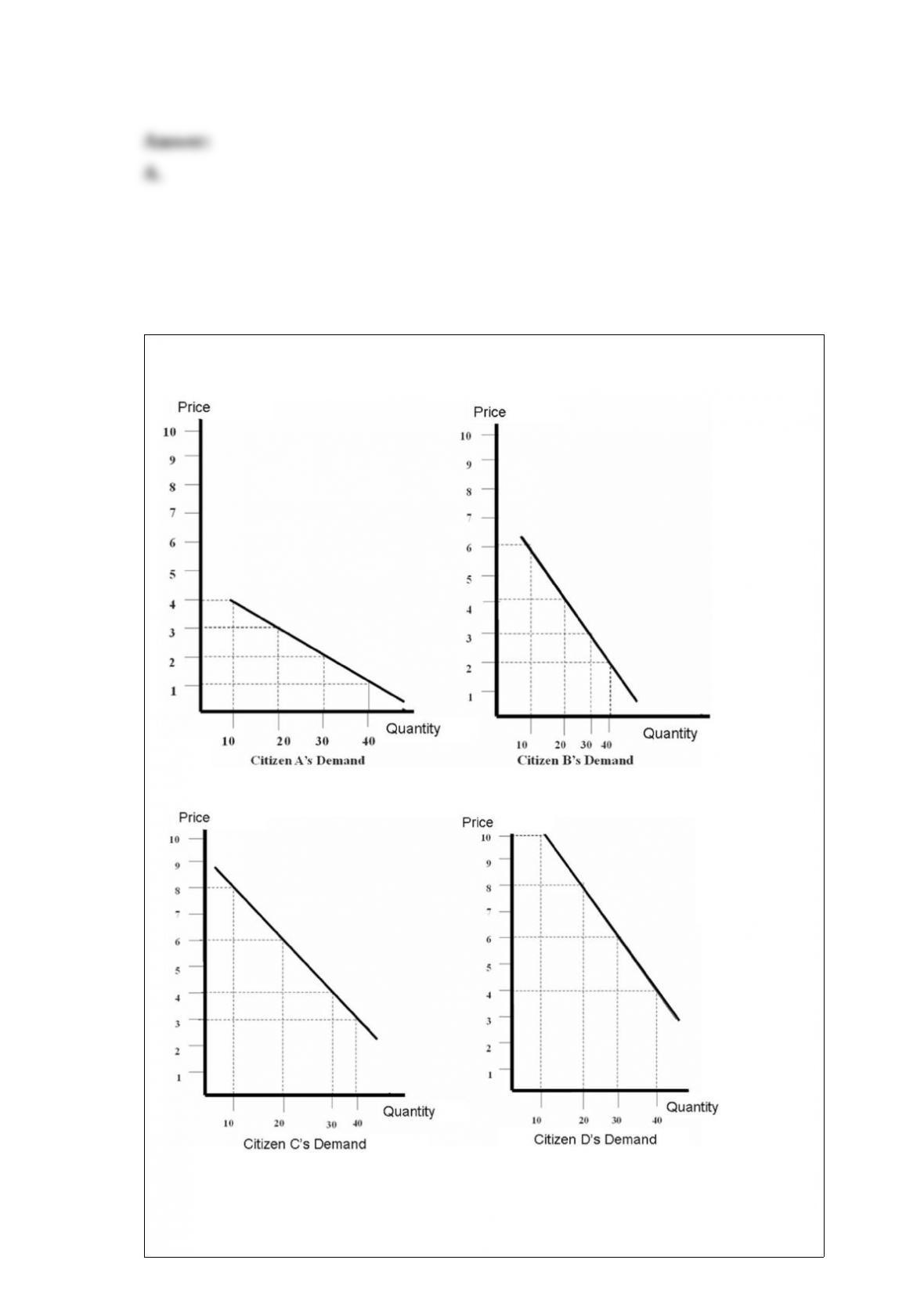
Refer to the figure above. Assume that the good shown on the graphs is a public good.
If 40 units are provided, total benefit equals _______.
A. $7

B. $10
C. $20
D. $30
A leftward shift of the AS curve indicates:
A. a decrease in aggregate supply.
B. an increase in aggregate supply.
C. a decrease in potential GDP.
D. an increase in potential GDP.
Suppose that there is only one small clothing store in the remote village of Green Acres,
and until recently all of the townspeople bought most of their shirts there. As more
people in Green Acres become connected to the Internet, the price elasticity of demand
for shirts at the Green Acres store will:
A. increase because the Internet offers more substitutes.
B. decrease because the Internet offers more substitutes.
C. remain the same, but the quantity demanded will decrease as more people shop
online.
D. remain the same, but the quantity will decrease as more people shop online.
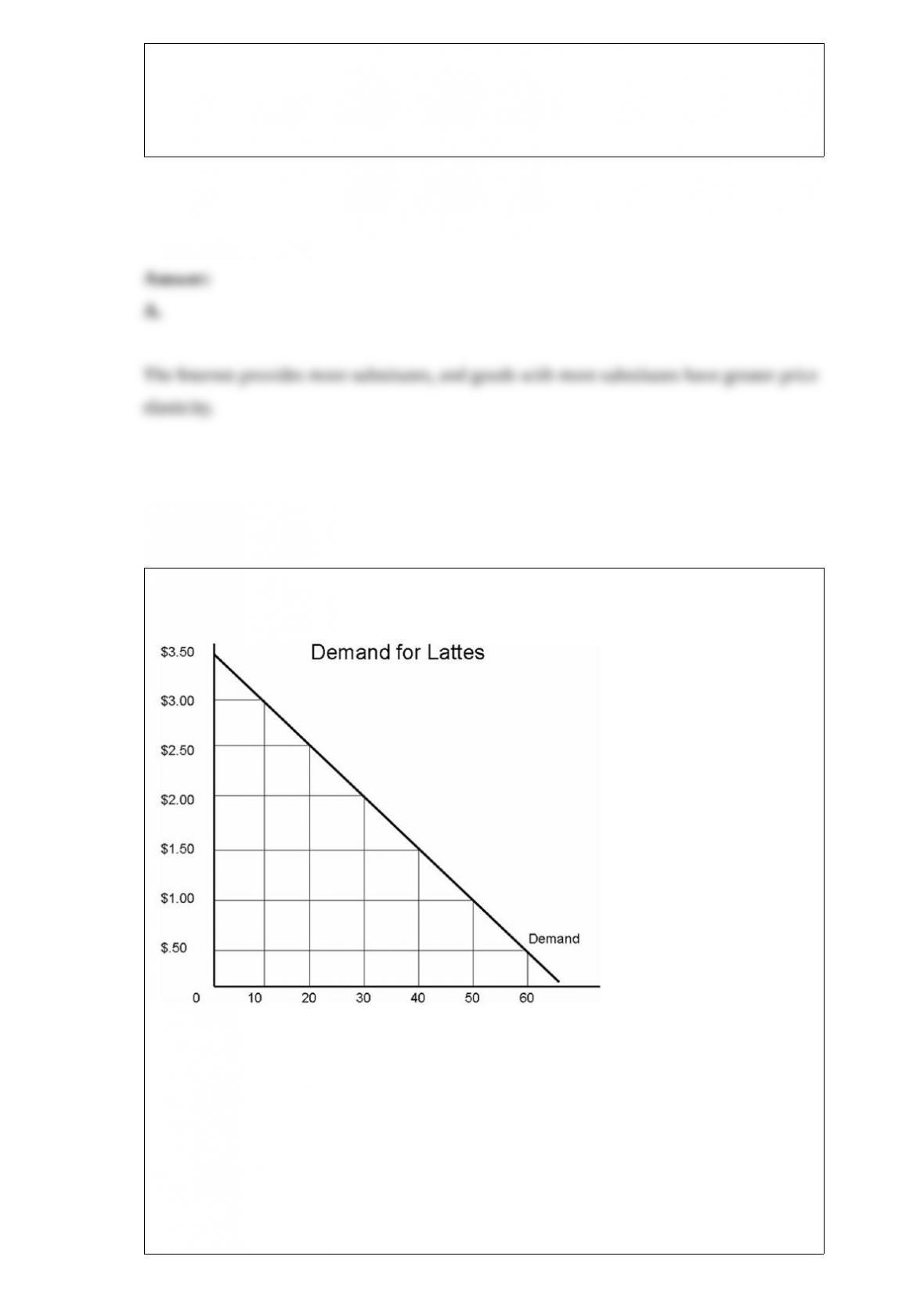
Refer to the figure above. To increase total revenues, firms with ______ demand should
lower price, and firms with ______ demand should increase price.
A. elastic; unitary
B. elastic; inelastic
C. inelastic; elastic
D. unitary; inelastic

Refer to the figure above. With the subsidy, the equilibrium price of sugar is _____ and
the equilibrium quantity is ______ tons per day.
A. $1000; 14
B. $1000; 10
C. $1500; 14
D. $1500; 10
A fiscal policy action to close a recessionary gap is to:
A. increase taxes.
B. decrease transfer payments.

C. increase government purchases.
D. increase the marginal propensity to consume.
The coupon rate on newly issued bonds is usually ______ for bonds with favorable tax
treatment, such as municipal bonds, and ______ for bonds that are very risky, such as
junk bonds.
A. higher; lower
B. higher; higher
C. lower; lower
D. lower; higher
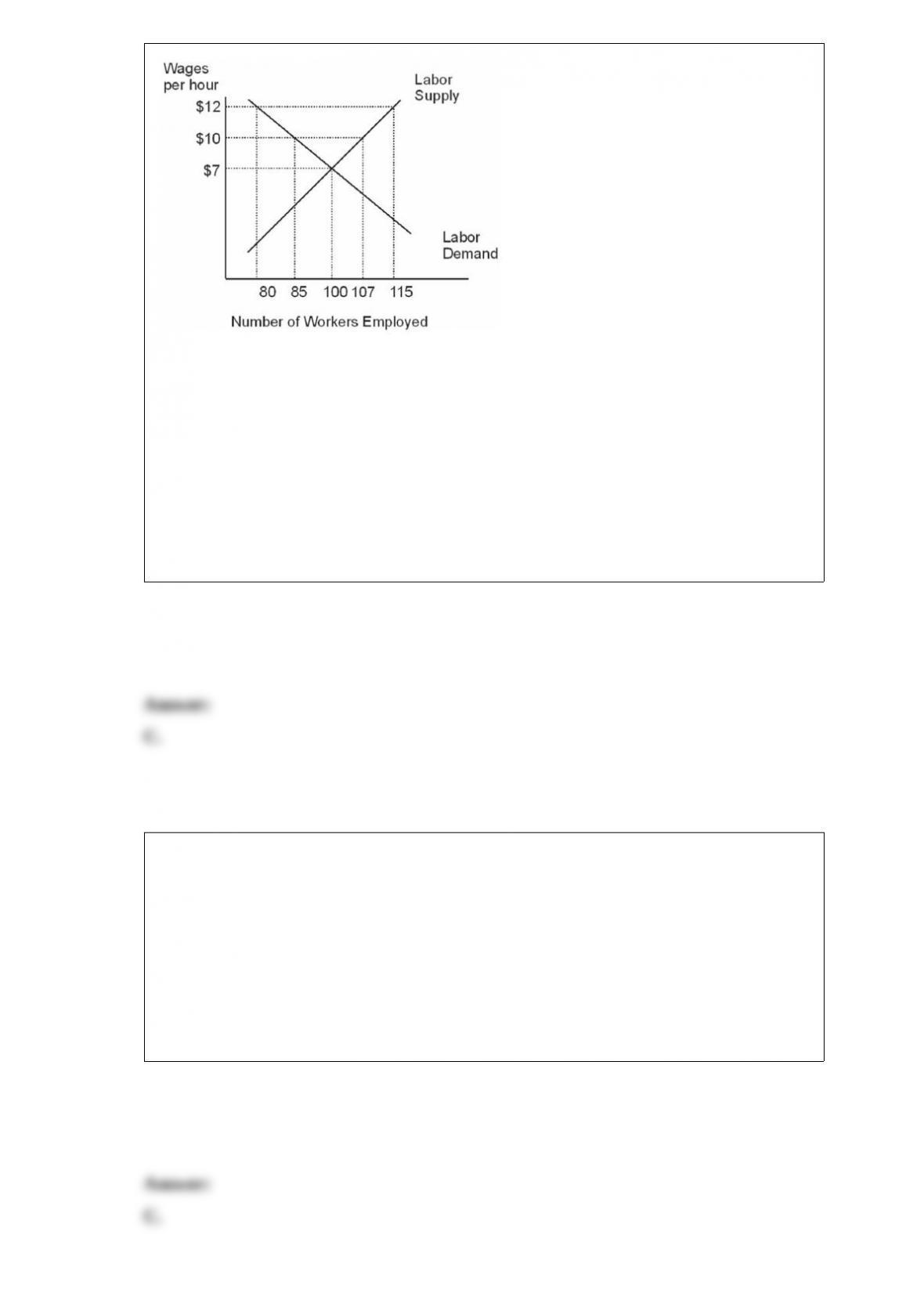
Based on the labor market diagram above, if the minimum wage is set at $10 per hour,
there will be ______ unemployed workers.
A. 7
B. 15
C. 22
D. 27
Most economists believe that the reduced variability of inflation in the U.S. is the result
of:
A. globalization.
B. better management of inventories.
C. improved monetary policymaking by the Fed.
D. deregulation.

Airlines used to allow infant children to ride on a parent’s lap for free. Suppose that they
start requiring that parents purchase an extra ticket for their infants and use a safety
seat. It is likely this policy would result in
A. no change in the number of families selecting air travel.
B. a significant reduction in the number of air traffic accidents.
C. an increase in the number of infant deaths during auto travel.
D. a reduction in the number of infant deaths as parents leave their infants at home
when they travel.
If all firms were to pay the same premium per worker into the workers’ compensation
system, then
A. all firms would experience the same burden.
B. firms with low injury rates would benefit.
C. firms with high injury rates would benefit.
D. the socially optimal injury rate would result.

More economic growth is not necessarily better unless the benefits of growth:
A. exceed the costs of growth.
B. increase average labor productivity.
C. increase real GDP per capita.
D. increase human capital.
Most cartels end or cease to be effective because:
A. of enforcement of antitrust legislation.
B. of the incentive to cheat on the cartel agreement.
C. the dominant member firm buys out the other firms.
D. consumers discover the cartel agreement and buy instead from other firms.
Differences in wage rates associated with differences in working conditions are called
A. compensating income differentials.
B. equalizing wage ratios.
C. conditional differentials.
D. compensating wage differentials.
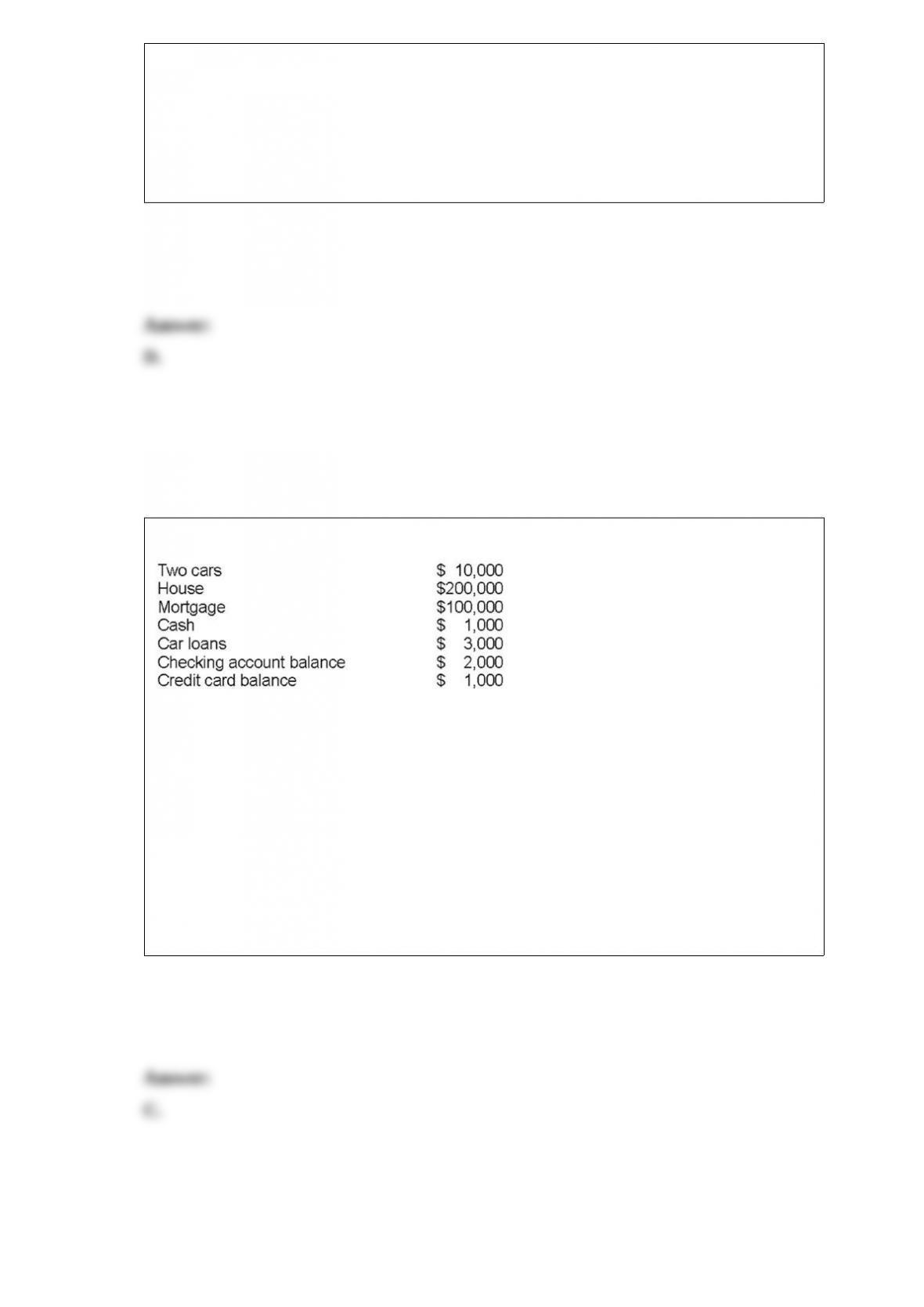
Jordan has the following assets and liabilities:
Suppose that Jordan wins $100,000 in the lottery. If he uses that money to pay off his
mortgage, his wealth would ______; if he puts that money in his checking account, his
wealth would ______.
A. increase to $209,000; not change
B. not change; increase to $207,000
C. increase to $209,000; increase to $209,000
D. increase to $207,000; not change