If inflationary expectations on the part of the public increase, the trade-off between
inflation and unemployment becomes worse.
The purchase of foreign stocks and bonds by a U.S. brokerage firm is an example of
capital inflows to the United States.
Maximizing average profit is equivalent to maximizing total profit.
As spending on government purchases increases, income rises and money demand falls.
It is not possible to have an absolute advantage in producing a good or service without
having a comparative advantage.
To increase gas mileage, automobile manufacturers make cars small and light. Large
cars absorb more of the impact of an accident than small cars but yield lower gas
mileage. These facts suggest that a positive relationship exists between safety and gas
mileage.
A modern example of the tragedy of the commons is the forests in many poor countries.
A shortage occurs when the market price is lower than the equilibrium price.

Examining the conditions that could lead to unemployment in an economy is an
example of microeconomics topic.
An economic growth model
A) explains changes in nominal GDP per capita in the long run.
B) explains changes in real GDP per capita in the long run.
C) explains changes in nominal GDP per capita in the short run.
D) explains changes in real GDP per capita in the short run.
The Patient Protection and Affordable Care Act (ACA) is scheduled to be fully
implemented by 2019, at which point
A) current budget cuts are expected to have completely offset the cost of the program.
B) more than 30 million additional individuals are expected to have health care
coverage.
C) all hospitals in the United States will be taken over by the federal government.
D) private health insurance companies will no longer exist in the United States.
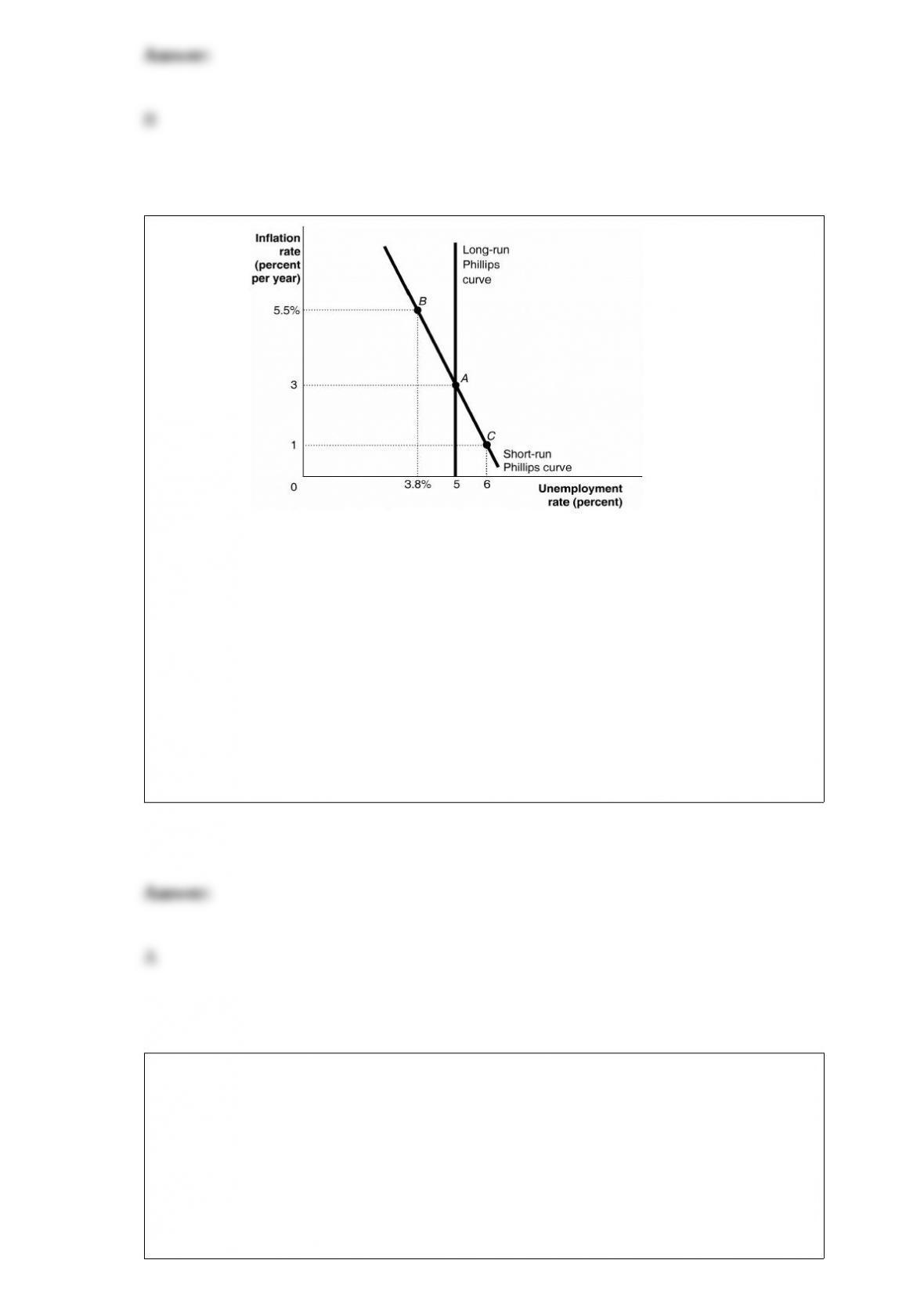
Figure 28-2
Suppose the economy is at point B. If the Fed increases the money supply so that
inflation increases, the economy will ________ in the short run, holding all else
constant.
A) eventually move to point A
B) stay at point B
C) eventually move to point C
D) move to point A and then back to point B
Who controls a sole proprietorship?
A) owner
B) stockholders
C) bondholders

D) employees
Which of the following is not an argument against inflation targeting?
A) Inflation targeting reduces the flexibility of the Fed to pursue other policy goals.
B) Inflation targeting assumes that the Fed can accurately forecast future inflation rates.
C) Inflation targeting makes monetary policy ineffective because the targets are
publicly announced.
D) Inflation targeting holds the Fed accountable for an inflation goal, but may make it
less likely the Fed will achieve other goals.
The three main monetary policy tools used by the Federal Reserve to manage the
money supply are
A) interest rates, tax rates, and government spending.
B) tax rates, government purchases, and government transfer payments.
C) open market operations, discount policy, and reserve requirements.
D) open market operations, the exchange rate of the dollar against foreign currencies,
and government purchases.

Which of the following would reduce the labor force participation rate, all else equal?
A) an increase in the number of people in the labor force
B) an increase in the unemployment rate
C) a decrease in the unemployment rate
D) an increase in the working-age population
A demand curve shows the relationship between
A) the price of a product and the quantity of the product demanded.
B) the amount of a product sellers are willing to sell at a particular price and the amount
consumers are willing to buy at that price.
C) the quantity that consumers are willing and able to buy and the quantity that sellers
are willing and able to offer.
D) the price of a produce and the demand for the product.
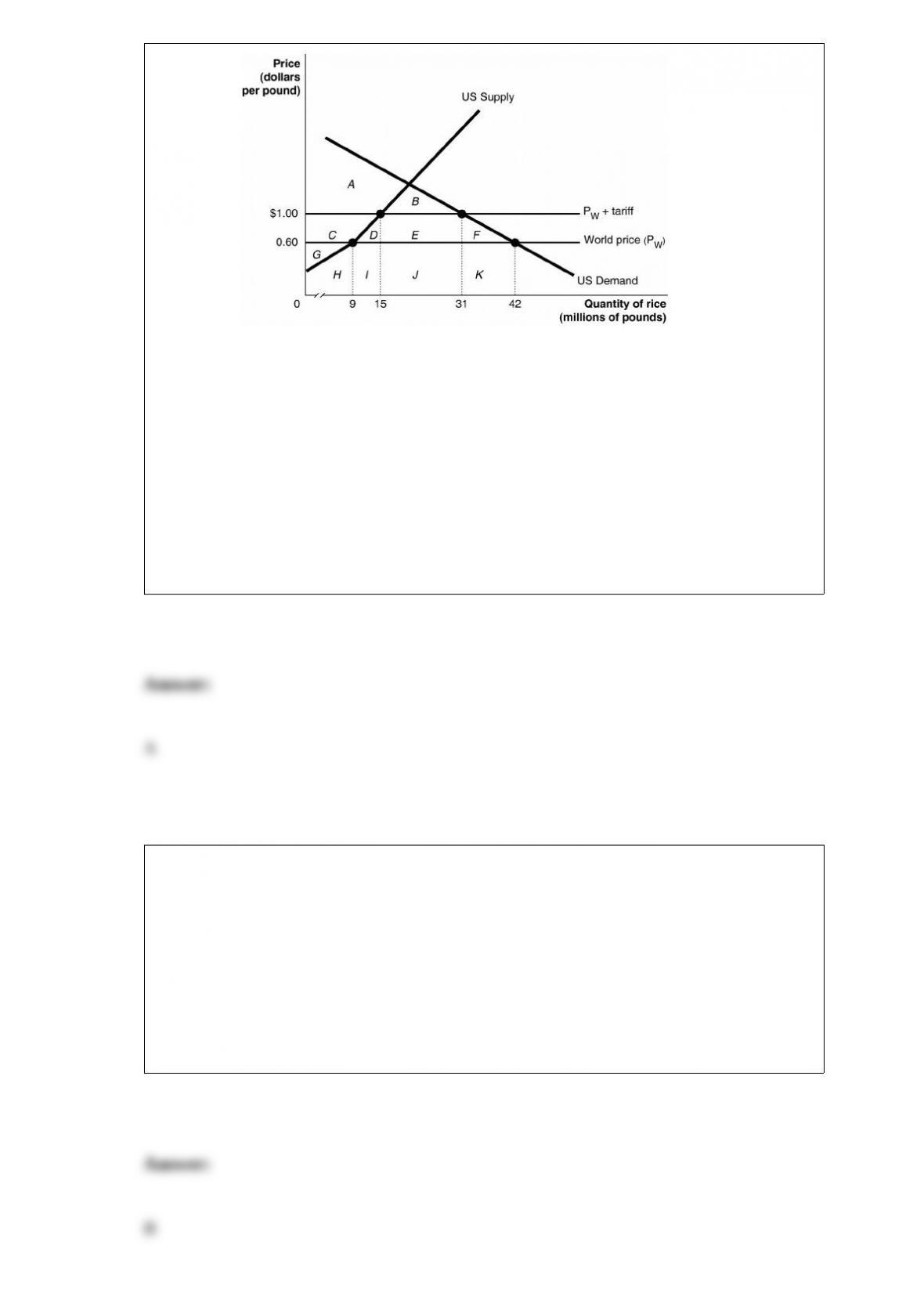
Figure 9-2 Suppose the U.S.
government imposes a $0.40 per pound tariff on rice imports. Figure 9-2 shows the
impact of this tariff. The increase in domestic producer surplus as a result of the tariff is
equal to the area
A) C.
B) C + G.
C) A + C + G.
D) C + D + G + H + I.
An increase in the price level causes
A) the money demand curve to shift to the left.
B) the money demand curve to shift to the right.
C) a movement up along the money demand curve.
D) a movement down along the money demand curve.

Consider the following types of demand curves:
a. a vertical demand curve
b. a horizontal demand curve
c. a linear downward-sloping demand curve Which of the demand curves listed exhibits
a price elasticity of demand coefficient that remains constant along the demand curve?
A) a only
B) b only
C) a and b only
D) a, b, and c
Which of the following will lead to a decrease in the equilibrium interest rate in the
economy?
A) an increase in the price level
B) a sale of government securities by the Fed
C) a decrease in GDP
D) an increase in the discount rate
E) an increase in the reserve requirement

If a restaurant was a natural monopoly, dividing the restaurant equally into two separate
restaurants would
A) decrease marginal cost.
B) raise average total cost.
C) increase total revenue.
D) make marginal revenue less elastic.
According to the “Rule of 70,” it will take 4 years for real GDP per capita to double
when the growth rate of real GDP per capita is
A) 4 percent.
B) 12.25 percent.
C) 17.5 percent.
D) 28 percent.
If the opportunity cost of production for two goods is different between two countries,
then
A) trade cannot benefit either country.
B) only one country can be made better off by trade.
C) mutually beneficial trade is possible.
D) trade will only benefit both countries if one can lower its opportunity costs.
Most economists agree that some of the burden of the corporate income tax
A) is reduced because the tax is progressive.
B) is shared by the federal government.
C) is reduced because the tax is used to attain a social objective.
D) is passed on to consumers in the form of higher prices.
What is the difference between economic efficiency and equity?
Would you expect to see higher or lower growth rates for countries that start out with a
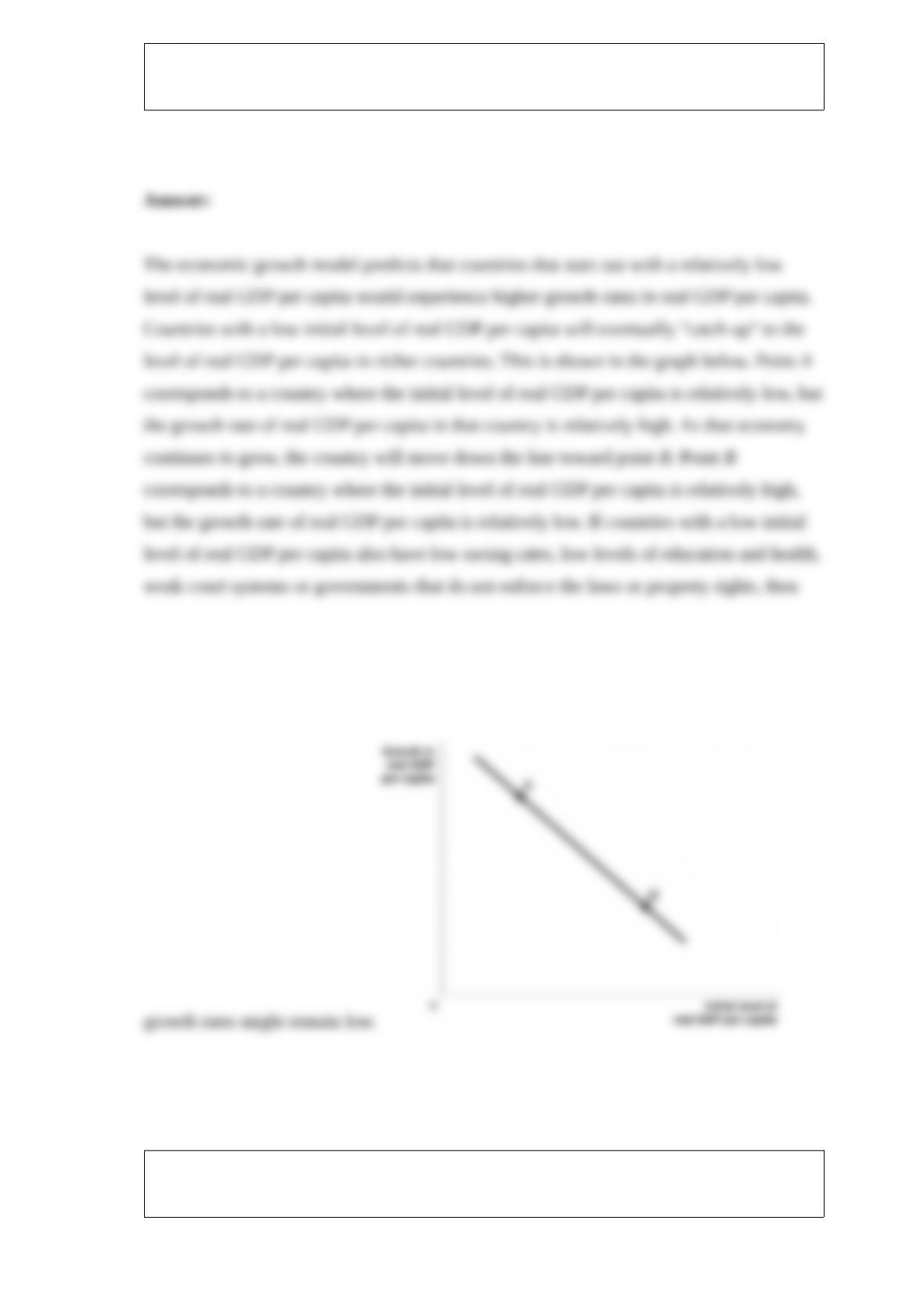
relatively low level of real GDP per capita? Explain using the concept of “catch-up” and
support your answer with a graph.
What is a mortgage? What were the important developments in the mortgage market
during the years after 1970?
Suppose a 4 percent increase in income results in a 2 percent decrease in the quantity
demanded of a good. Calculate the income elasticity of demand for the good and
determine what type of good it is.
What is the difference between federal purchases and federal expenditures?
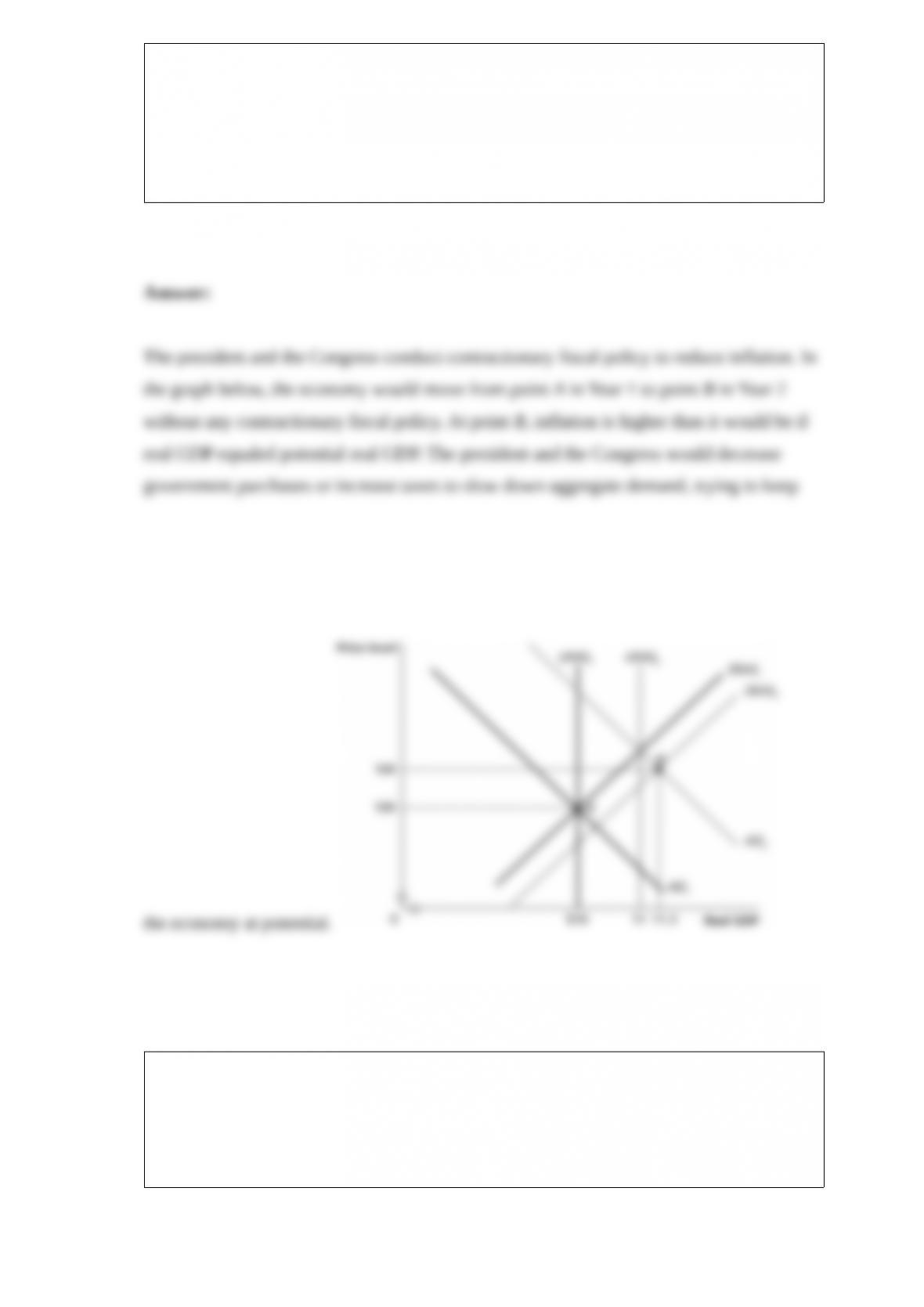
Use the dynamic aggregate demand and aggregate supply model and start with Year 1 in
a long-run macroeconomic equilibrium. For Year 2, graph aggregate demand, long-run
aggregate supply, and short-run aggregate supply such that the condition of the
economy will induce the president and the Congress to conduct contractionary fiscal
policy. Briefly explain the condition of the economy and what the president and the
Congress are attempting to do.
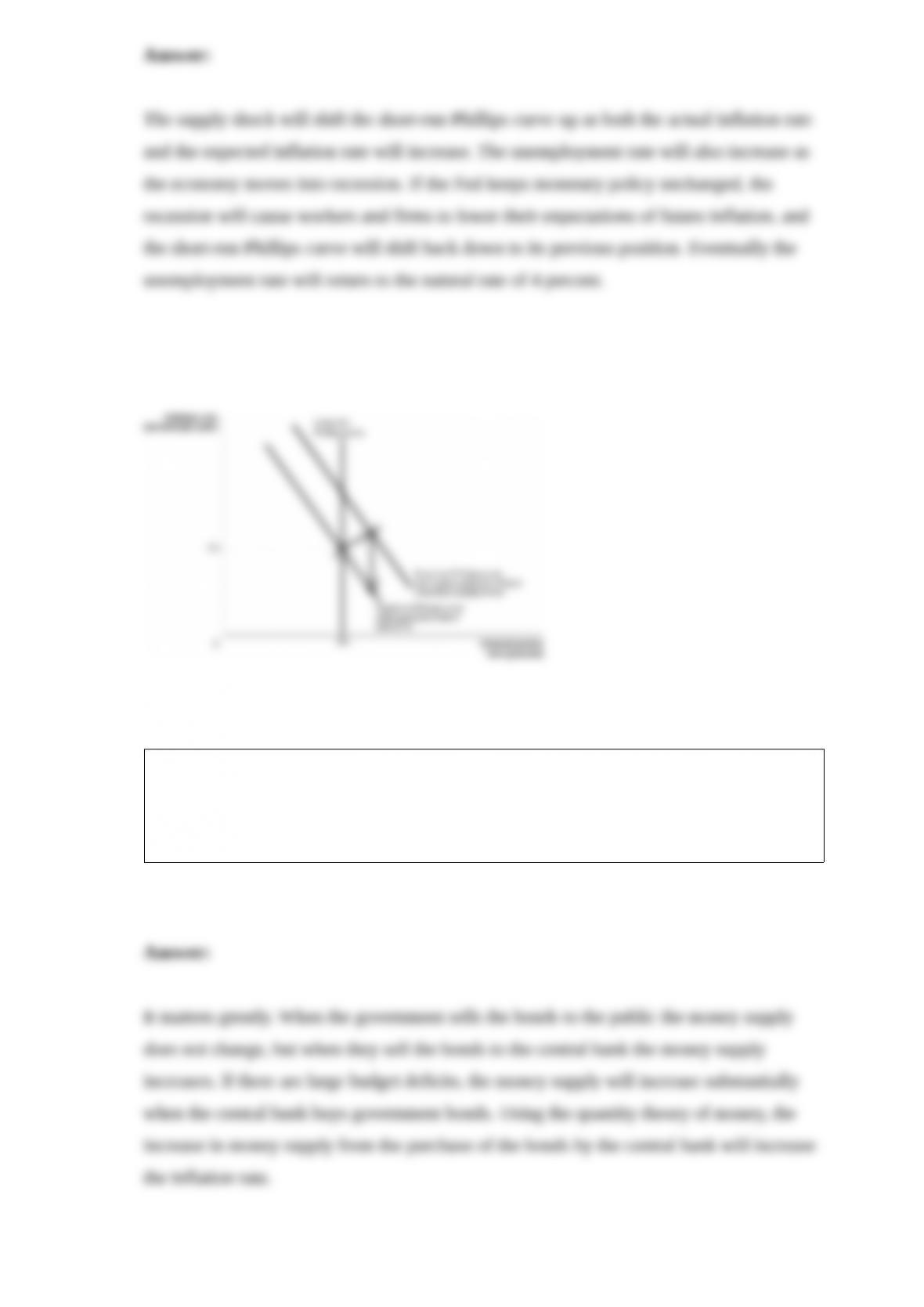
Suppose the current inflation rate and the expected inflation rate are both 3 percent. The
current unemployment rate and the natural rate of unemployment are both 4 percent.
Use a Phillips curve graph to show the effect on the economy of a severe supply shock.
If the Federal Reserve keeps monetary policy unchanged, what will eventually happen
to the unemployment rate? Show this on your Phillips curve graph.
When a government has a budget deficit, it must issue (sell) government bonds to
finance the deficit. Does it matter for the rate of inflation if the government sells the
government bonds to the public or sells the government bonds to the central bank?
Explain why it does or does not matter.