
The three most important international financial centers today are
A) New York, Los Angeles, and London.
B) London, Tokyo, and Beijing.
C) San Francisco, Paris, and Mexico City.
D) Tokyo, London, and New York.
The consumer price index (CPI), the personal consumption expenditures price index
(PCE), and the core PCE have over the last 10 years
A) moved roughly together with the CPI being the most stable.
B) moved roughly together with the PCE being the most stable.
C) moved roughly together with the core PCE being the most stable.
D) not moved together, with the CPI being the most stable.
Figure 2-1

Refer to Figure 2-1. ________ is (are) unattainable with current resources.
A) Point A
B) Point B
C) Point C
D) Points A and C
The best measure of the standard of living is
A) nominal GDP.
B) real GDP.
C) nominal GDP per capita.
D) real GDP per capita.

If Congress passed a one-time tax cut in order to stimulate the economy in 2014, and
tax rate levels returned to their pre-2014 level in 2015, how should this tax cut affect
the economy?
A) The tax cut would increase consumption spending less than would a permanent tax
cut.
B) The tax cut would increase consumption spending more than would a permanent tax
cut.
C) The tax cut would increase consumption spending by the same amount as would a
permanent tax cut.
D) The tax cut would raise the price level in 2014.
Economists John Cogan, Glenn Hubbard, and Daniel Kessler have estimated that
________ the tax preference for employer-provided health insurance would reduce
spending by people enrolled in these programs by 33 percent.
A) enacting
B) doubling
C) cutting in half
D) repealing
A decrease in ________ can put your job at risk if aggregate expenditures fall.
A) consumer confidence

B) the natural rate of unemployment
C) the inflation rate
D) the length of a business cycle
During the Chinese experience with pegging the yuan to the dollar, the yuan was
undervalued. As a result,
A) there was a surplus of yuan on the market that the Chinese government had to
purchase to maintain the peg, depleting China’s reserves of dollars.
B) there was a surplus of dollars on the market that the Chinese government had to
purchase to maintain the peg.
C) the prices of Chinese exports were higher than they would have been without the
peg.
D) the equilibrium value of the yuan was below the pegged value of the yuan.
Figure 7-3
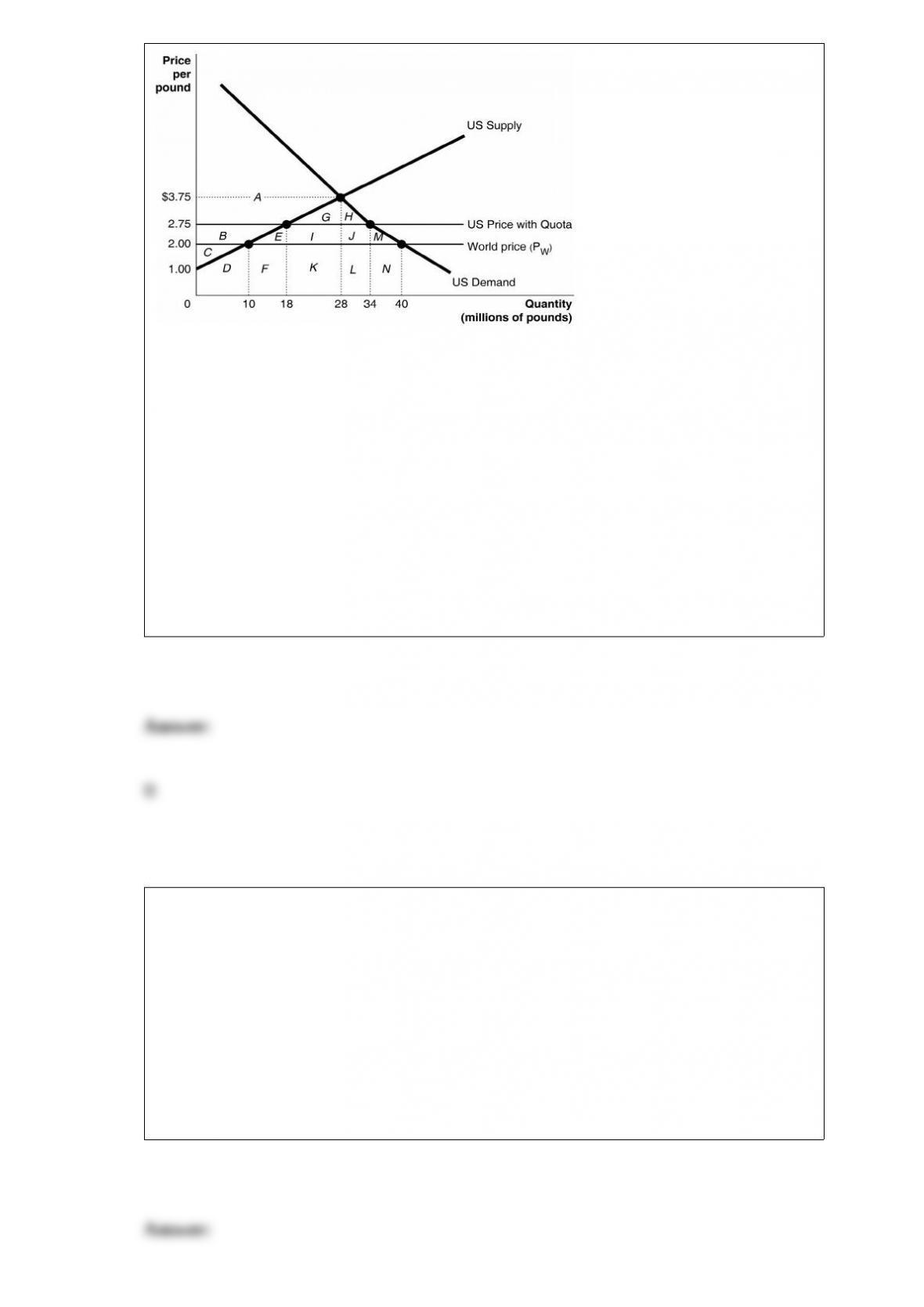
Since 1953 the United States has imposed a quota to limit the imports of peanuts.
Figure 7-3 illustrates the impact of the quota.
Refer to Figure 7-3. With a quota in place, what is the quantity supplied by domestic
producers?
A) 16 million pounds
B) 18 million pounds
C) 28 million pounds
D) 34 million pounds
The process of bundling loans together and buying and selling these bundles in a
secondary financial market is called
A) open market operations.
B) securitization.
C) fractional reserve lending.
D) seigniorage.
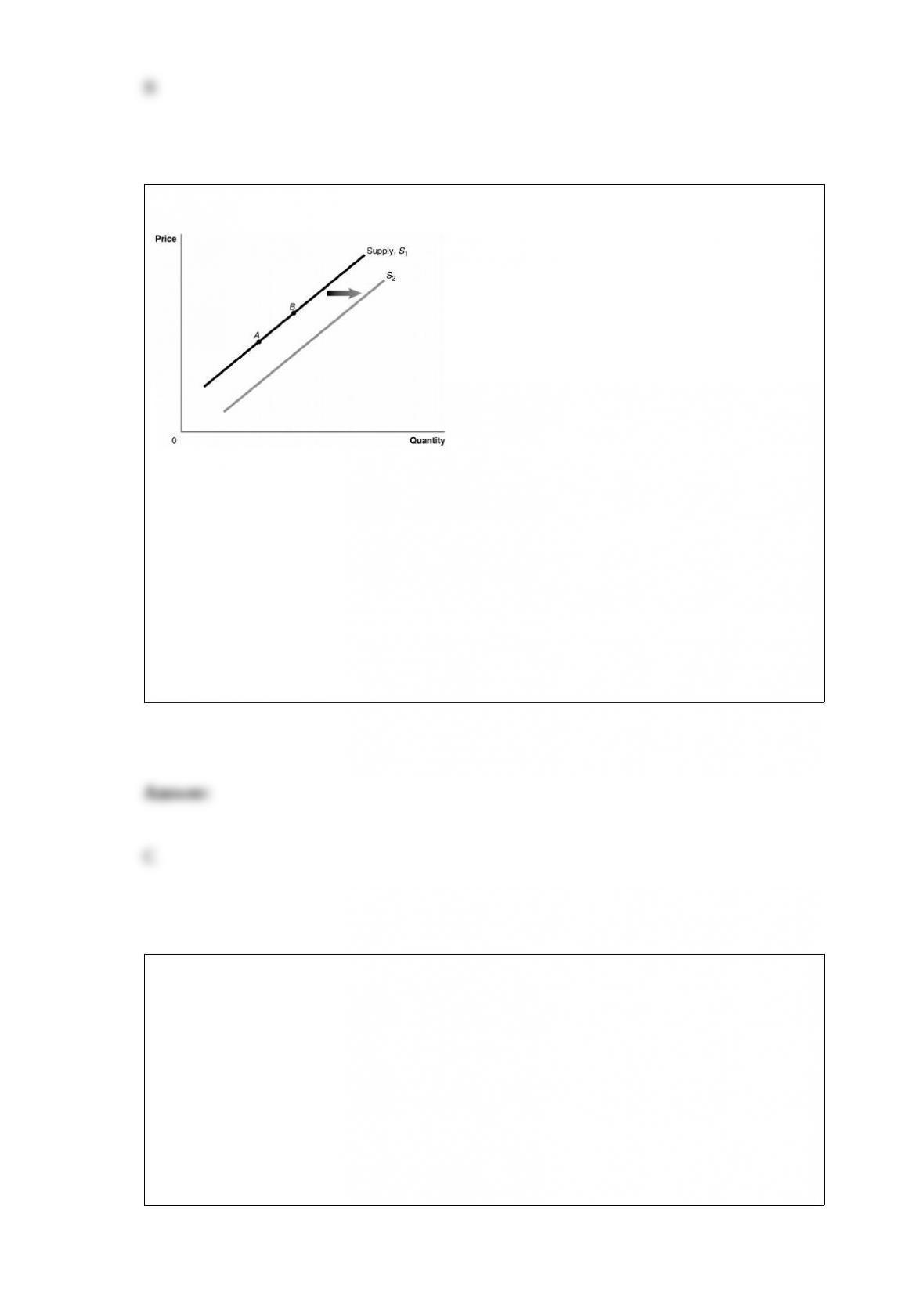
Figure 3-2
Refer to Figure 3-2. A decrease in the price of substitutes in production would be
represented by a movement from
A) A to B.
B) B to A.
C) S1 to S2.
D) S2 to S1.
All of the following are considered among the four most important determinants in
explaining exchange rate fluctuations in the long run except
A) tariffs and quotas.
B) preferences for domestic and foreign goods.
C) interest rates.
D) relative rates of productivity growth across countries.

Buyers will bear the entire burden of a unit tax if the demand curve for a product is
A) horizontal.
B) vertical.
C) downward sloping.
D) upward sloping.
In calculating gross domestic product, the Bureau of Economic Analysis uses the sum
of the market value of final goods and services produced. This means that the BEA
A) simply counts the total number of goods produced in the market place and then adds
them up.
B) values goods at their market prices, multiplies them by the quantity produced, and
then adds them up.
C) simply counts the total number of goods and services produced in the marketplace
and then adds them up.
D) values goods and services at their market prices, multiplies them by the quantity
produced, and then adds them up.

Article Summary
According to the International Energy Agency (IEA), increased oil production resulting
from U.S. shale oil has invigorated the North American oil industry and has created a
global supply shock. The shale oil and gas industry has generated tens of billions of
dollars in revenues and hundreds of thousands of new jobs, and could result in the
United States changing from being the world’s largest oil importer to a net exporter
within a few years. An IEA forecast predicts that because of shale oil, the United States
will become the world’s largest oil producer by 2017, with supply growing by 3.9
million barrels per day from 2012-2018.
Source: Denise Roland, and AFP, “US shale energy creates global oil ‘supply shock’,”
Telegraph, May 14, 2013.
Refer to the Article Summary. The supply shock mentioned in the article summary may
well result in a decrease in the price of oil. When the price of oil falls unexpectedly, the
equilibrium price level ________ and the unemployment rate ________ in the short
run.
A) rises; falls
B) rises; rises
C) falls; falls
D) falls; rises
How will contractionary monetary policy in Japan affect the demand for the yen and the
supply of the yen in the foreign exchange market?
A) The demand for the yen will fall, and the supply of the yen will increase.
B) The demand for the yen will increase, and the supply of the yen will fall.
C) The demand for the yen will fall, and the supply of the yen will fall.
D) The demand for the yen will increase, and the supply of the yen will increase.

The short-term unemployment arising from the process of matching workers with jobs
is called
A) frictional unemployment.
B) structural unemployment.
C) cyclical unemployment.
D) seasonal unemployment.
E) unnatural unemployment.