
1) Assume that a college student spends her income on books and pizza. The price of a
pizza is $8, and the price of a book is $15. If she has $120 in income, she could choose
to consume
a.8 pizzas and 4 books.
b.4 pizzas and 6 books.
c.5 pizzas and 5 books.
d.2 pizzas and 7 books.
2) Scenario 17-4.
Consider two cigarette companies, PM Inc. and Brown Inc. If neither company
advertises, the two companies split the market and earn $50 million each. If they both
advertise, they again split the market, but profits are lower by $10 million since each
company must bear the cost of advertising. Yet if one company advertises while the
other does not, the one that advertises attracts customers from the other. In this case, the
company that advertises earns $60 million while the company that does not advertise
earns only $30 million.
Refer to Scenario 17-4. PM Inc.’s dominant strategy is to
a.refrain from advertising regardless of whether Brown Inc. advertises.
b.advertise only if Brown Inc. advertises.
c.advertise only if Brown Inc. does not advertise.
d.advertise regardless of whether Brown Inc. advertises.
3) Suppose an economy only produces two goods, robots and ice cream. Last month,
the economy produced 10 robots and 200 gallons of ice cream. This month, the same
economy produced 15 robots and 240 gallons of ice cream. Which of the following
statements could explain this change?
a.This month, the economy reduced the unemployment of its resources.
b.This month, the economy experienced an improvement in technology.
c.This month, the economy experienced an increase in resources
d.All of the above are correct.
4) Table 14-1

Over what range of output is marginal revenue declining?
a.1 to 6 units
b.3 to 7 units
c.7 to 9 units
d.Marginal revenue is constant over the entire range of output.
5) Kate is a professional opera singer who gives voice lessons. The vocal-music
industry is competitive. Kate hires a business consultant to analyze her financial
records. The consultant recommends that Kate give fewer voice lessons. The consultant
must have concluded that Kate‘s
a.total revenues exceed her total accounting costs.
b.marginal revenue exceeds her total cost.
c.marginal revenue exceeds her marginal cost.
d.marginal cost exceeds her marginal revenue.
6) The famous observation that households and firms interacting in markets act as if
they are guided by an invisible hand that leads them to desirable market outcomes
comes from whose 1776 book?
a.David Ricardo
b.Thorstein Veblen
c.John Maynard Keynes
d.Adam Smith
7) Which of the following was not a reason OPEC failed to keep the price of oil high?

a.Over the long run, producers of oil outside of OPEC responded to higher prices by
increasing oil exploration and by building new extraction capacity.
b.Consumers responded to higher prices with greater conservation.
c.Consumers replaced old inefficient cars with newer efficient ones.
d.The agreement OPEC members signed allowed each country to produce as much oil
as each wanted.
8) According to libertarians, the government should redistribute income from rich
individuals to poor individuals to achieve a more equal distribution of income.
a.True
b.False
9) Diminishing marginal productivity implies decreasing total product.
a.True
b.False
10) If demand is perfectly elastic, the demand curve is horizontal, and the equals 1
a.True
b.False
11) Which of the following events would cause a movement upward and to the right
along the supply curve for mangos?
a.The number of sellers of mangos increases.
b.There is an advance in technology that reduces the cost of producing mangos.
c.The price of fertilizer decreases, and fertilizer is an input in the production of mangos.
d.The price of mangos rises.
12) Figure 8-6
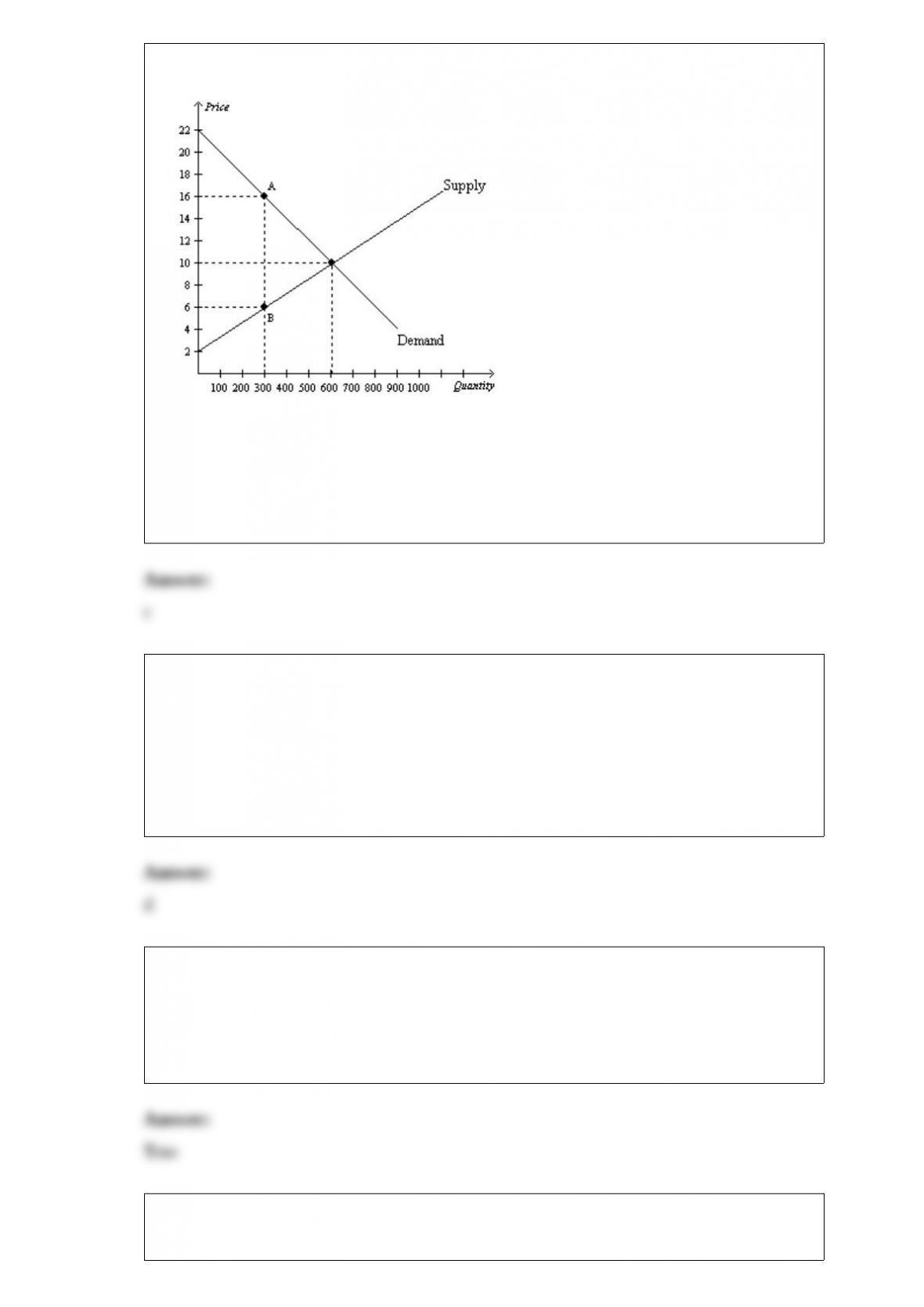
The vertical distance between points A and B represents a tax in the market.
Total surplus with the tax in place is
a. $1,500.
b. $3,600.
c. $4,500.
d. $6,000.
13) The principle of comparative advantage asserts that
a.not all countries can benefit from trade with other countries.
b.the world price of a good will prevail in all countries, regardless of whether those
countries allow international trade in that good.
c.countries can become better off by exporting goods, but they cannot become better off
by importing goods.
d.countries can become better off by specializing in what they do best.
14) One example of labor-market discrimination is that firms may be less likely to
interview job-market candidates whose names suggest that they are members of a racial
minority.
a.True
b.False
15) Scenario 20-2
The government is proposing switching from a progressive tax system, in which

families pay 15% of the first $40,000 earned, 30% of the next $40,000 earned, and 45%
of any income over $80,000 to a tax system in which every family pays 1/4 of its
income regardless of how much they earn and all income redistribution is eliminated.
That is, the tax revenue generated is used only for infrastructure, public administration,
and national defense.
Refer to Scenario 20-2. Which group would be most in favor of the proposed change
in tax policy?
a.Liberals, because they believe in the maximin criterion.
b.Libertarians, because they do not believe in redistributing income.
c.Utilitarians, because they believe in diminishing marginal utility.
d.None of the above would be in favor of the proposed change.
16) The law of demand states that, other things equal, when the price of a good rises,
the quantity demanded of the good falls, and when the price falls, the quantity
demanded rises.
a.True
b.False
17) At any quantity, the price given by the supply curve shows the cost of the
lowest-cost seller.
a.True
b.False
18) Profit maximizing firms in competitive industries with free entry and exit face a
price equal to the lowest possible
a.marginal cost of production.
b.fixed cost of production.
c.total cost of production.
d.average total cost of production.
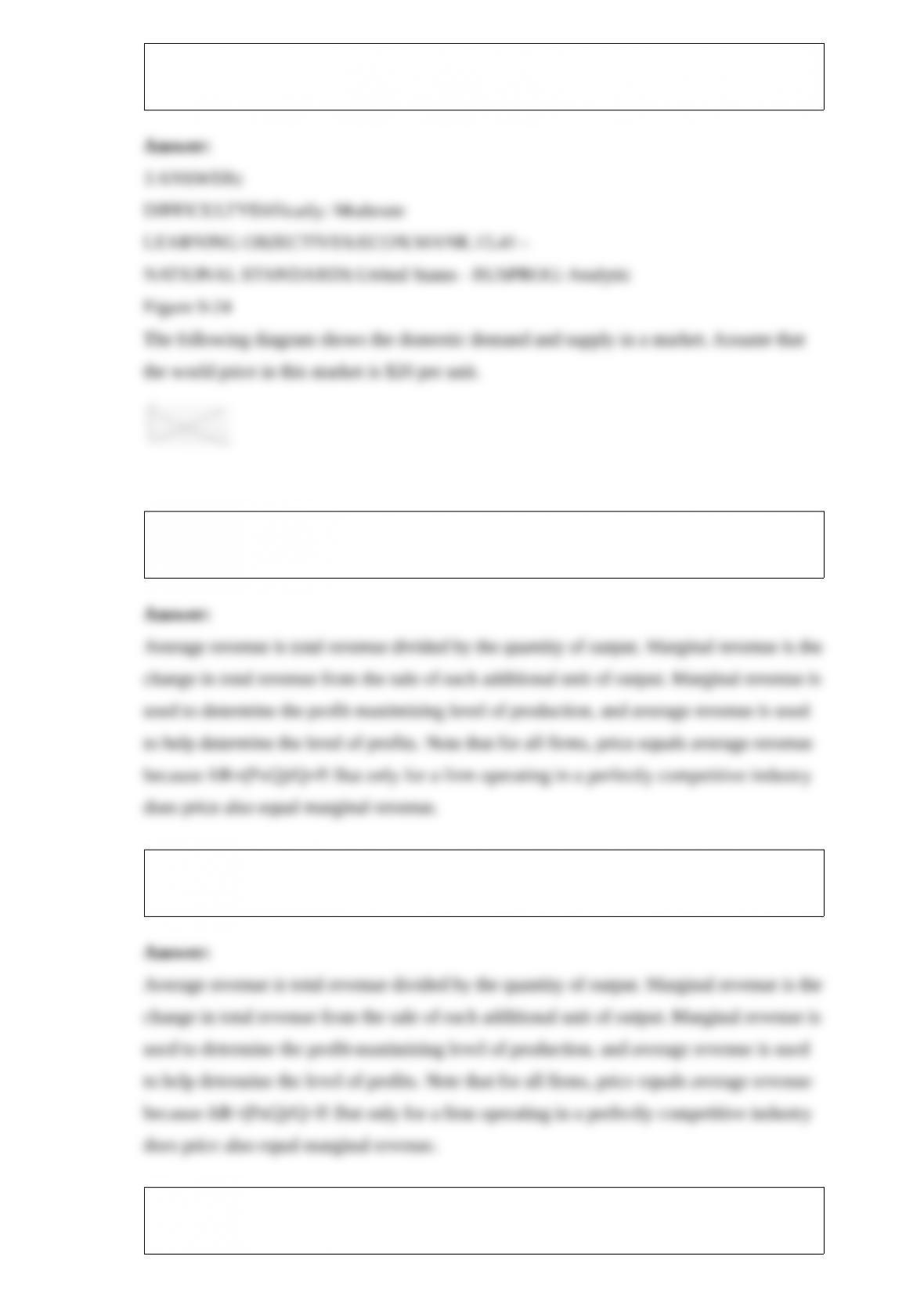
19) Refer to Figure 9-23. Producer surplus with free trade is
a. $200.
b. $450.
c. $630.
d. $1,080
20) Describe the difference between average revenue and marginal revenue. Why are
both of these revenue measures important to a profit-maximizing firm?
21) Describe the difference between average revenue and marginal revenue. Why are
both of these revenue measures important to a profit-maximizing firm?
22) In 2011, what were the two largest sources of federal tax revenues, and what were
the two largest expenses of the federal government?
23) Suppose the government taxes 10 percent of the first $20,000 in income, 20 percent
of the next $20,000 in income, and 30 percent of all income over $40,000. Calculate the
marginal tax rate and the average tax rate for a person who earns $100,000.
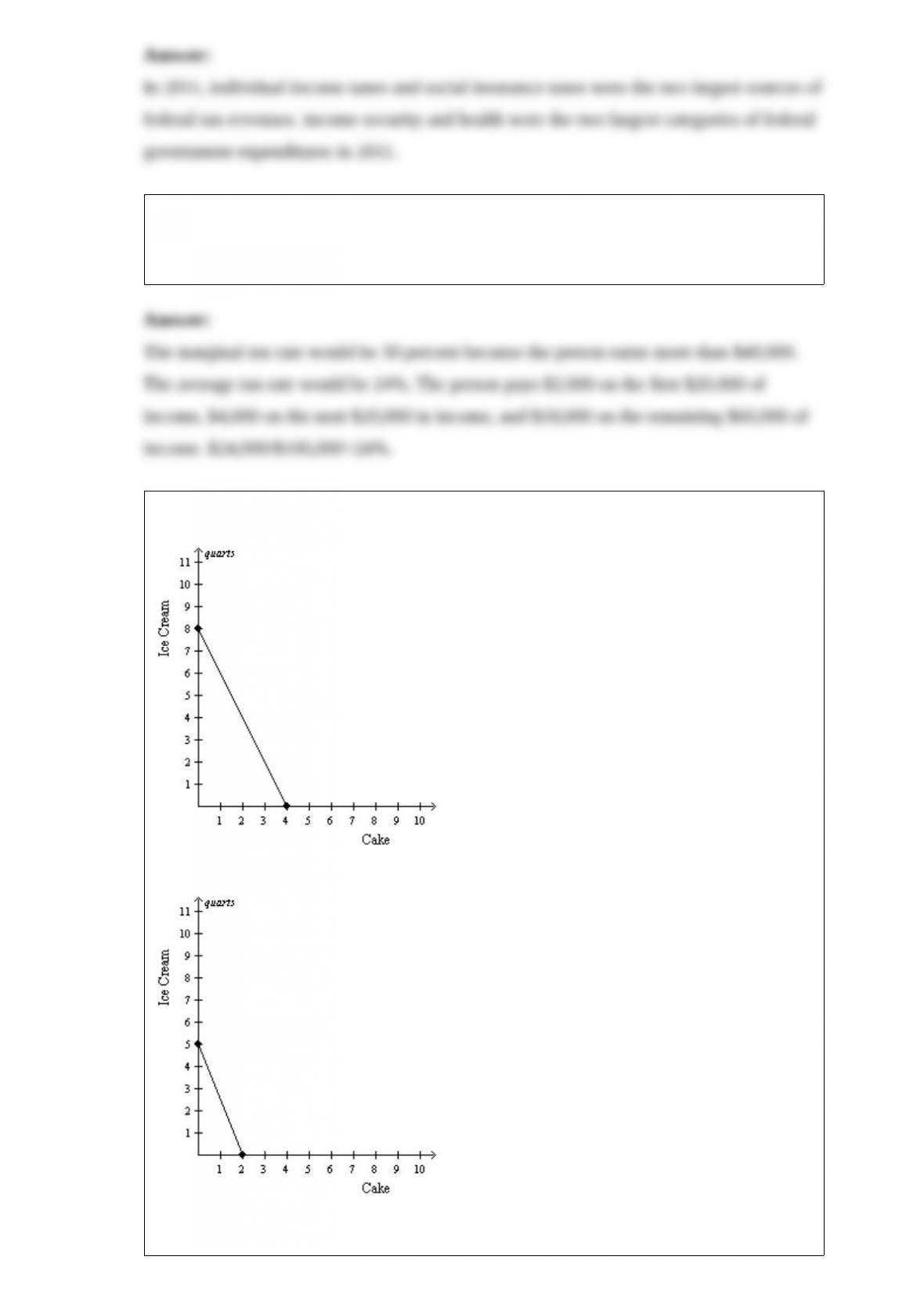
24) Greg’s Production Possibilities
Catherine’s Production Possibilities
What is Catherine’s opportunity cost of producing cake? Explain how you derived your
answer.
25) If tax revenues from a tax on wine, beer, and hard liquor are used to pay for
healthcare expenses related to liver damage, the alcohol tax could be justified using the.
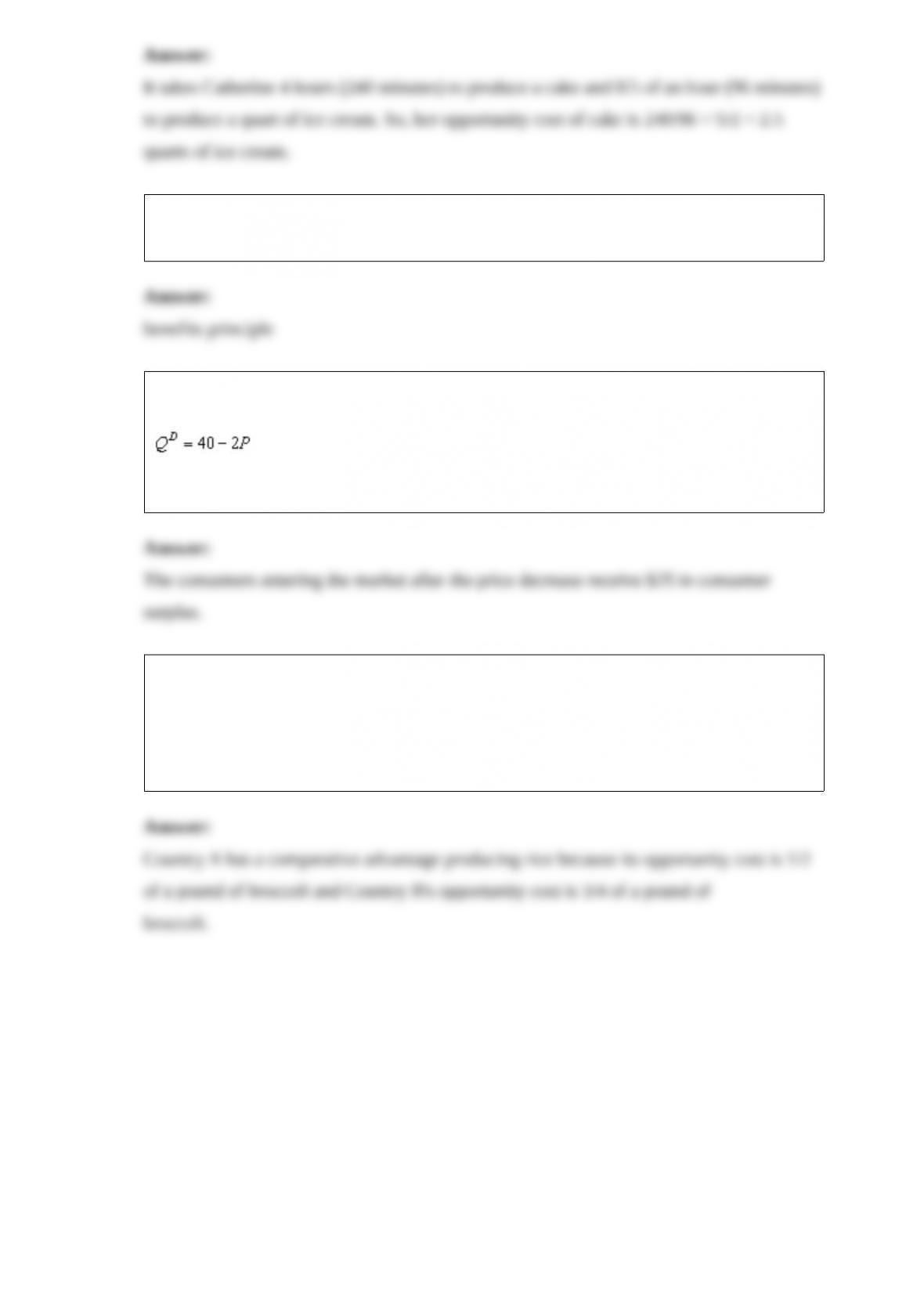
26) Scenario 7-1
Suppose market demand is given by the equation
Refer to Scenario 7-1. If the market equilibrium price falls from $10 to $5, how much
consumer surplus do consumers entering the market after the price drop receive?
27) In country A a worker who works 40 hours can produce 200 pounds of rice or 100
pounds of broccoli. In country B a worker who works 40 hours can produce 160 pounds
of rice or 120 pounds of broccoli.
Which country, if either, has a comparative advantage producing rice? Defend your
answer using the numbers given.