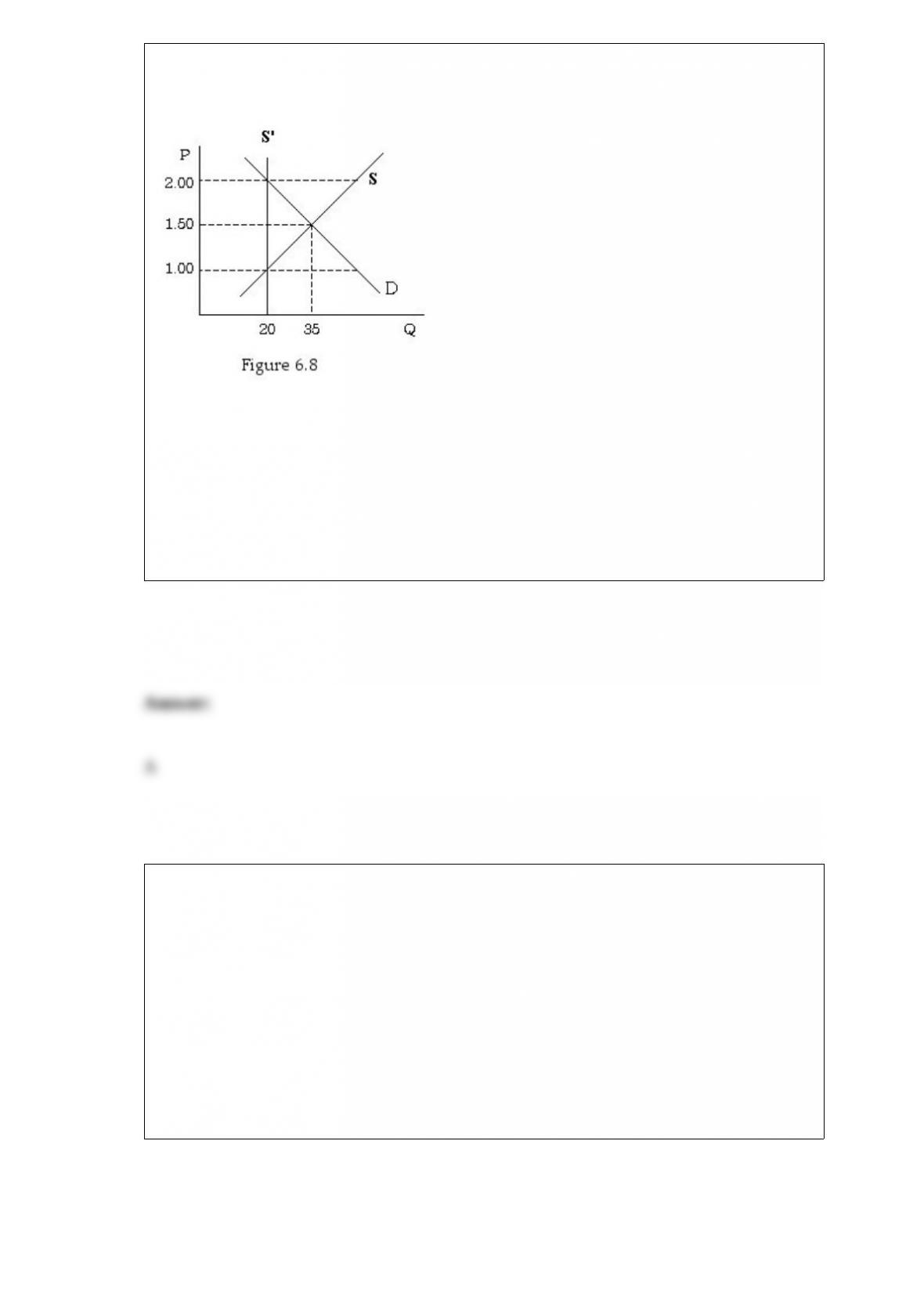
Figure 6.8 shows the market for taxicab services in a small town. If the government
limits taxicab services to 20 per day, then producer surplus will:
A) increase by $10.
B) increase by $6.25.
C) decrease by $3.75.
D) increase by $20.
In equilibrium in a mixed market:
A) the percent of low quality goods on the market equals the buyers’ estimate of the
percent of low quality goods on the market.
B) the percent of low quality goods on the market equals the sellers’ estimate of the
percent of low quality goods on the market.
C) 50% of the goods on the market are low quality and 50% are high quality.
D) all low quality goods have been driven out of the market.
In order to identify their used cars as plums (high-quality), many used car dealers:
A) raise the minimum price of plums (high-quality).
B) advertise their prices.
C) offer money-back guarantees.
D) raise the minimum price of lemons (low-quality).
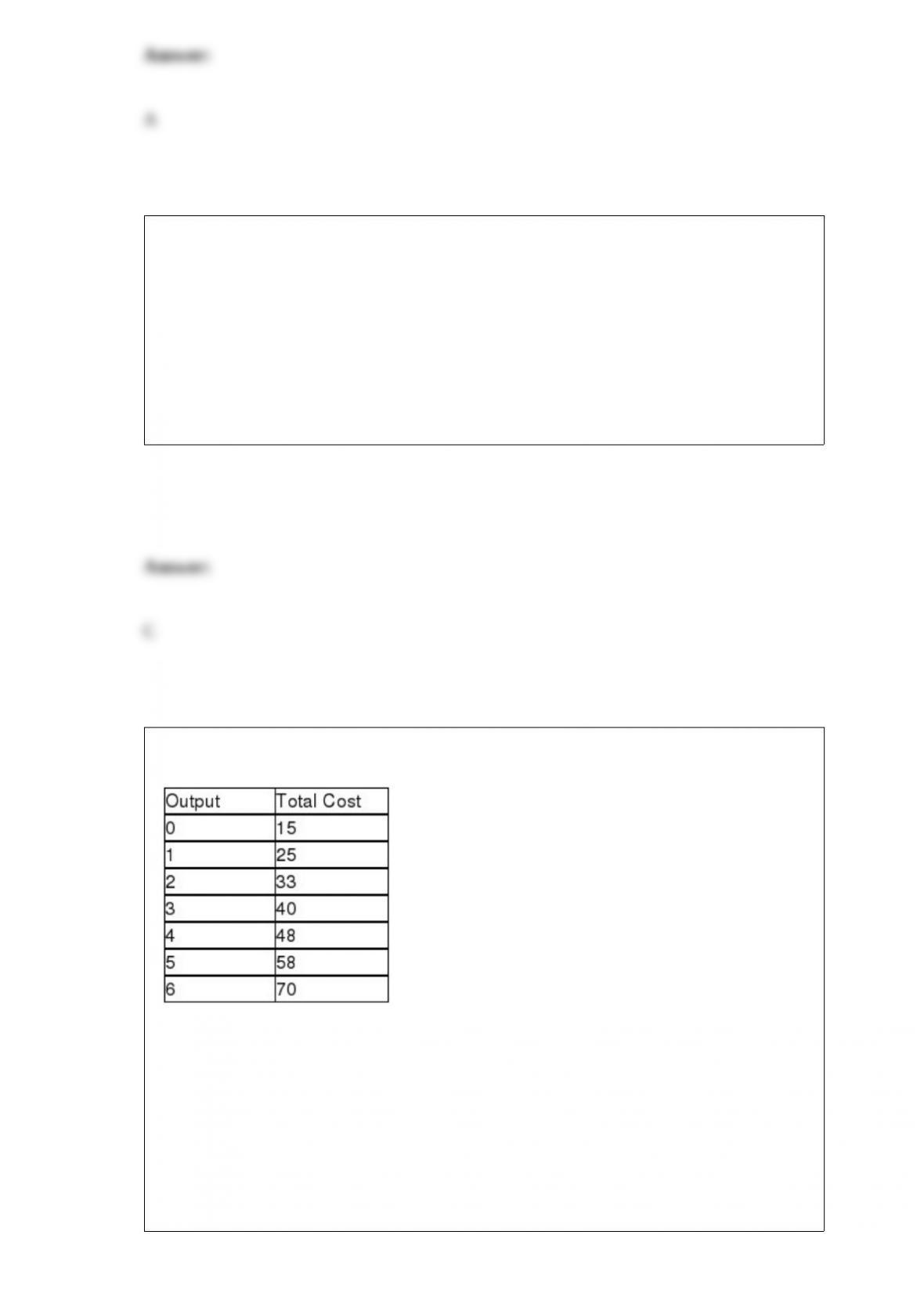
Refer to Table 8.5. The total variable cost of producing five units of output is:
Table 8.5
A) $8.60.
B) $43.
C) $48.
D) $58.
The principle of diminishing returns occurs:
A) when there is only one input.
B) when there are two or more inputs and at least one input is held fixed.
C) when there are two or more inputs and all inputs are held fixed.
D) when there are two or more inputs and all inputs are allowed to vary.
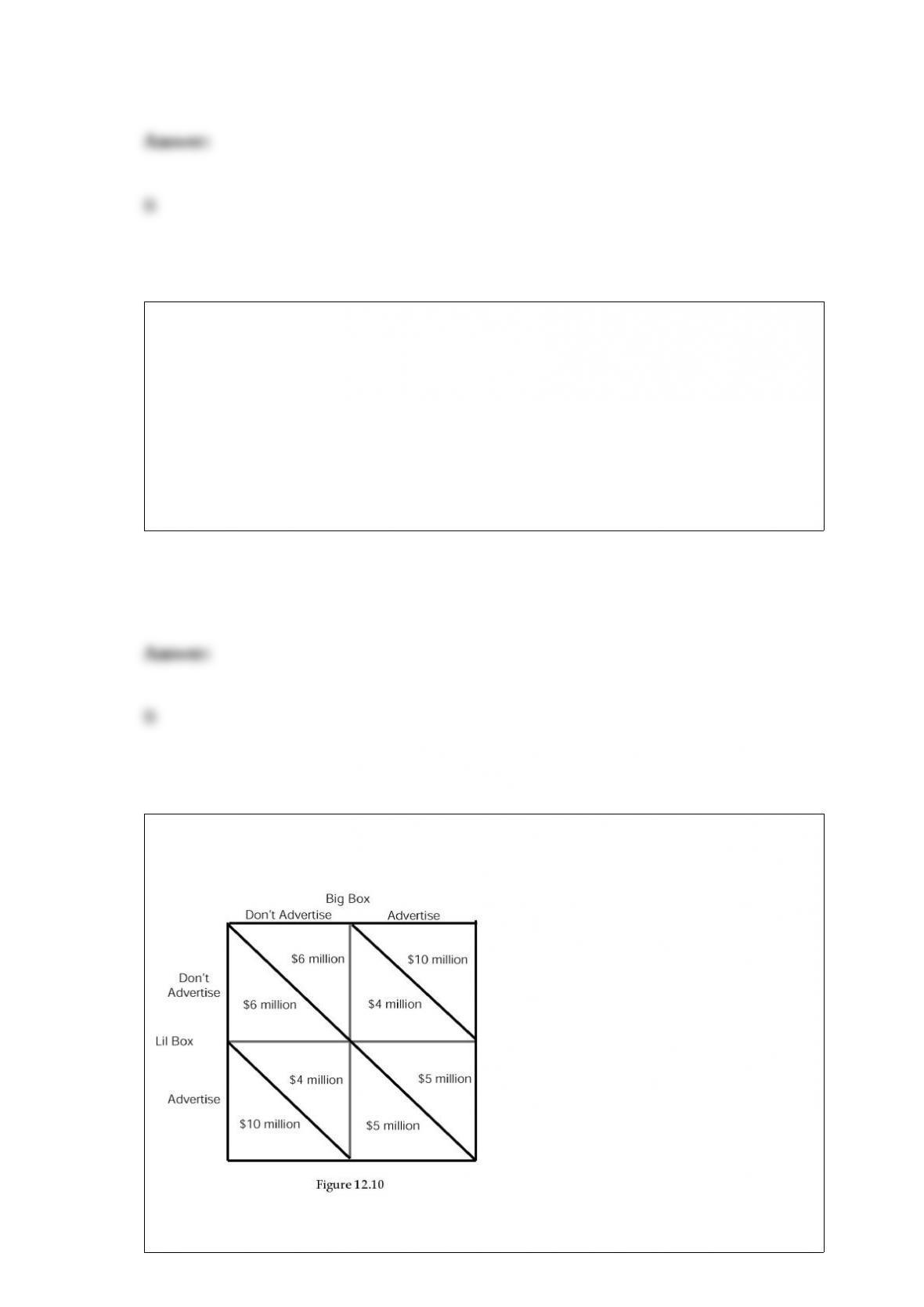
Refer to Figure 12.10. The data in the boxes are the annual profits for each company
whether they choose to advertise or not. If Lil Box decides not to advertise:
A) Big Box should not advertise.

B) Big Box should advertise.
C) Lil Box will make $6 million.
D) Lil Box will make $10 million.
You own a building that has four possible uses: an Internet cafe, a coffee store, an ice
cream store, and a bookstore. The value of the building in each use is $2,000; $3,000;
$4,000; and $5,000, respectively. You decide to open an ice cream store. The
opportunity cost of using this building for an ice cream store is:
A) $2,000, the value if the building is used as an Internet cafe.
B) $3,000, the value if the building is used as a coffee store.
C) $3,333, the average of the values if the building is used for either an Internet cafe, a
coffee store, or a bookstore.
D) $5,000, the value if the building is used for a bookstore.
The long-run average cost of production is defined as:
A) total cost divided by the quantity of output the firm chooses when at least one factor
is fixed.
B) total cost divided by the quantity of output the firm chooses when it can choose a
production facility of any size.
C) the quantity produced by a firm that can choose any size production facility.
D) the quantity produced by a firm when at least one factor is fixed.
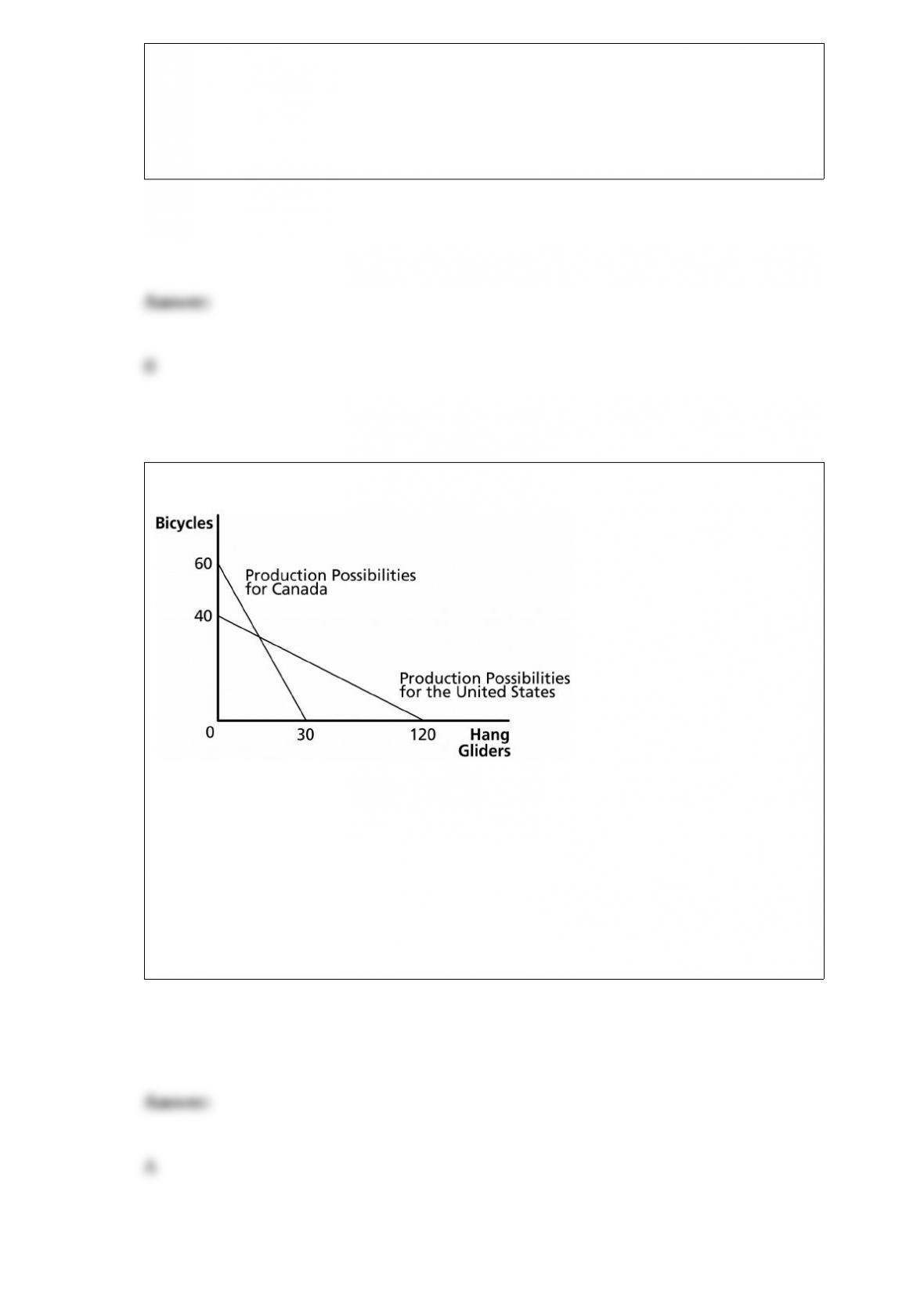
Refer to Figure 18.1. Canada has a comparative advantage in the production of:
Figure 18.1
A) bicycles.
B) hang gliders.
C) both bicycles and hang gliders.
D) neither bicycles nor hang gliders.

If the U.S.government imposes an import ban on German made cars, then:
A) no German made cars can enter the U.S.
B) any German made car after a certain predetermined number is not allowed.
C) no German made can can enter the U.S. without being taxed.
D) any German made car after a certain predetermined number is taxed.
A perfectly competitive market is one where:
A) each firm controls the price charged for its product by changing the quantity they
produce.
B) each firm sells at the government mandated price.
C) each firm within the market must sell its good at the market price.
D) a firm can affect market price by increasing output.
By using celebrities to promote a product, a firm is attempting to:
A) send a signal to consumers.
B) increases repeat customers.
C) increase sales.
D) all of these
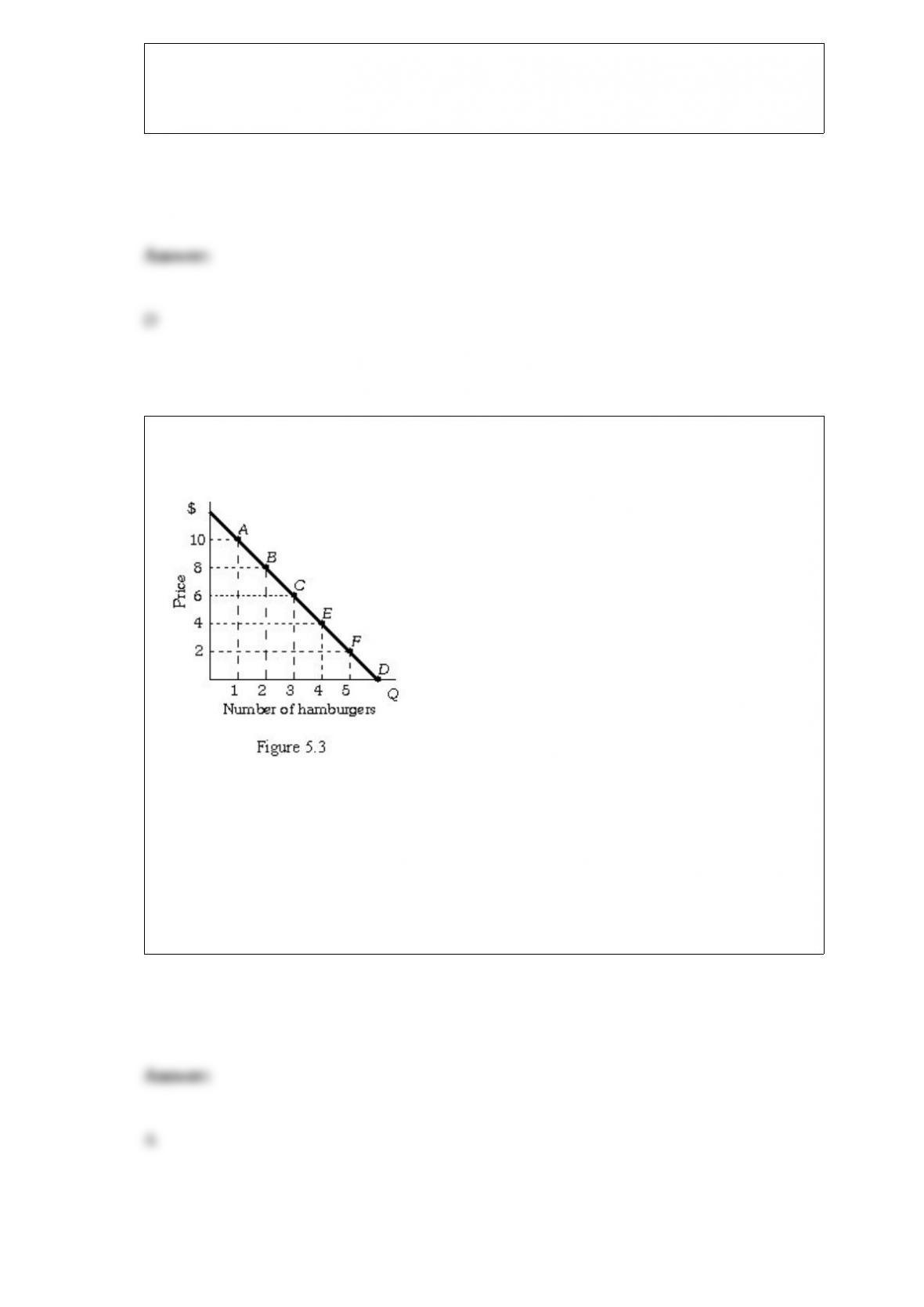
Refer to Figure 5.3. At point C the price elasticity of demand is 1. Along line segment
BC of the demand curve, the demand is:
A) elastic.
B) unitarily elastic.
C) inelastic.
D) either elastic or inelastic, depending on whether price increases or decreases.

Suppose that the income elasticity of demand for good X is positive but less than 1.
Other things being equal, which of the following statements is INCORRECT?
A) Good X is a normal good.
B) The quantity demanded of good X decreases as a consumer’s income declines.
C) A consumer buys more X as income rises, but the share of income spent on good X
falls.
D) A consumer buys more X as income rises and the share of income spent on good X
also rises.
If the weekly income from 1974 to 2011 increased from $80 to $290, but the number of
standard baskets of goods that the weekly income decreased from 1.70 to 1.29 in 2011,
then we can conclude that:
A) prices decreased faster than the wage increase between 1974 and 2011.
B) prices increased faster than the wage increase between 1974 and 2011.
C) prices increased slower than the wage increase between 1974 and 2011.
D) prices decreased slower than the wage increase between 1974 and 2011.
In which system are decisions made by thousands of people who have information
about resources, production technology and consumer desires?

A) market system
B) centrally planned system
C) command system
D) socialist system
Suppose buyers in the used car market are willing to pay $8,000 for a plum
(high-quality) used car and $3,000 for a lemon (low-quality) used car. If buyers believe
that 20% of the used cars on the market are lemons (low quality), what would they be
willing to pay for a used car?
A) $7,000
B) $6,000
C) $5,000
D) $4,000
When a second firm enters a monopolist’s market:
A) the former monopolist’s average cost decreases as its output level decreases.
B) the demand curve facing the former monopolist shifts to the right.

C) the market price falls.
D) none of the above
In modern economies, individuals in markets make most of the decisions about:
A) what to produce.
B) how to produce.
C) for whom to produce.
D) all of the above.
The tradeoffs faced by a monopolist in cutting price to sell a larger quantity leads to
marginal revenue being:
A) less than price.
B) greater than price.
C) equal to price.
D) none of the above.

Figure 4.5 illustrates a set of supply and demand curves for hamburgers. A decrease in
supply and a decrease in demand are represented by a movement from:
A) point c to point a.
B) point b to point d.
C) point d to point a.
D) point a to point b.
The government sometimes creates an excess demand for a product by setting a
maximum price at which the product may be sold to consumers. This is sometimes
called a:
A) price ceiling.
B) price floor.
C) tax.
D) subsidy.

Consumers benefit from monopolistically competitive markets because:
A) they only have one good from which to choose.
B) in this type of market, producers supply goods in a variety of locations or with a
variety of characteristics.
C) in this type of market, goods are sold at a price equal to the marginal cost of
production.
D) goods are sold at a price equal to marginal revenue.
A duopolists’ dilemma occurs when two firms in a market would be better off if:
A) both choose the high price but instead each chooses the low price.
B) both firms act jointly as a cartel and chooses the best price.
C) one firm refuses to participate in the cartel.
D) both firms adopt price matching.
The marginal principle states that “we should increase the level of an activity as long as:
A) its marginal benefit exceeds it marginal cost.”

B) its marginal cost exceeds its marginal benefit.”
C) its total benefit exceeds its total cost.”
D) its total cost exceeds its total benefit.”
According to the marginal principle, a rational firm will introduce a movie sequel as
long as:
A) marginal benefit exceeds marginal cost.
B) marginal benefit is less than marginal cost.
C) marginal benefit equals marginal cost.
D) total benefit equals total cost.
Taxi fares in Cleveland are set by the city government. Suppose that the local taxi
companies petition the city council to raise taxi fares. Despite the fact that higher fares
will ________ the quantity demanded for taxi cab rides, the taxi companies must
believe that demand for taxis is ________ and therefore that revenue will ________.
A) decrease; inelastic; increase
B) decrease; elastic; increase
C) decrease; inelastic; decrease
D) increase; inelastic; increase
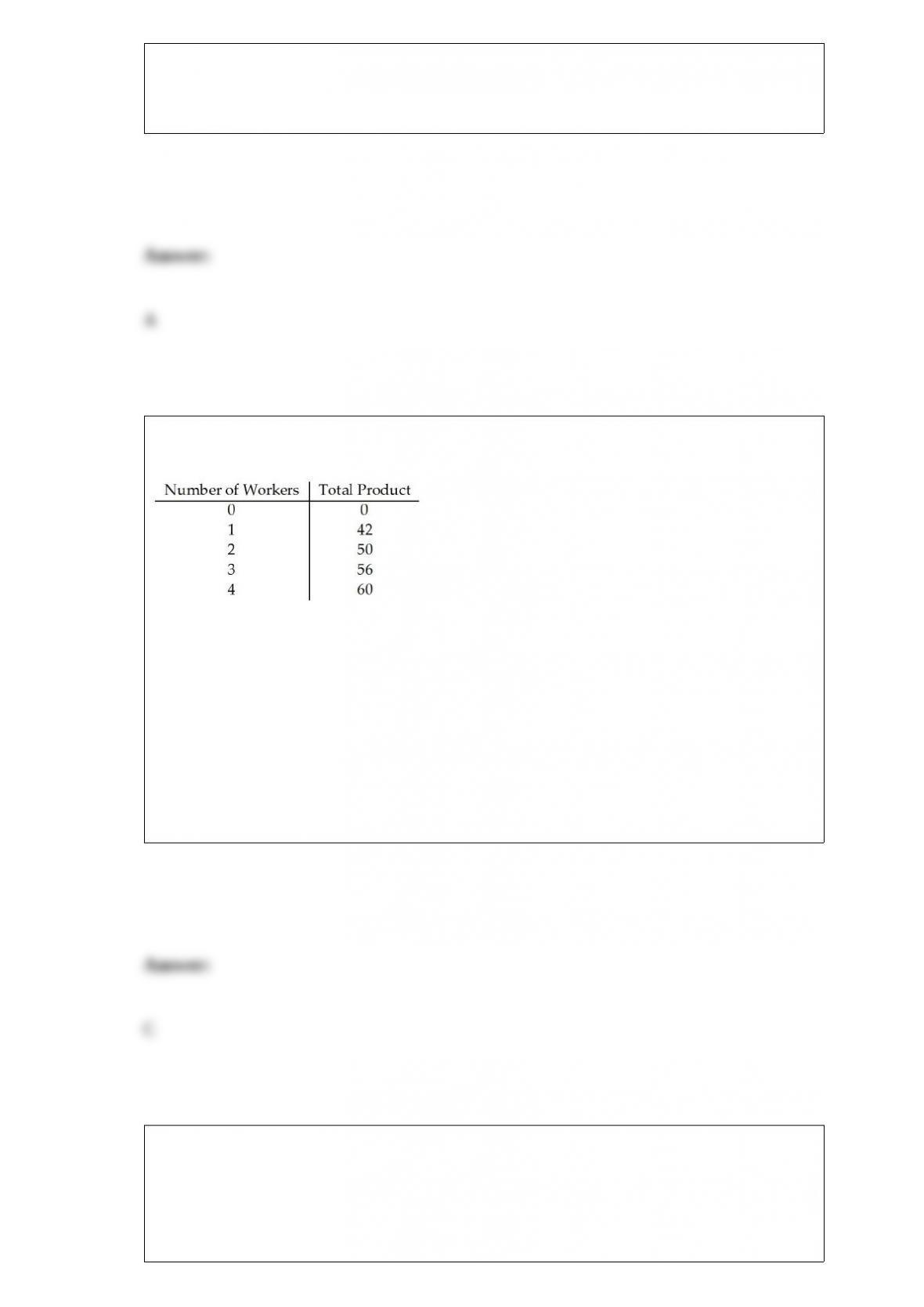
Refer to Table 17.4. Suppose the firm is hiring only one worker when the wage rate is
$12 and the output price is $2. Which of the following is true?
Table 17.4
A) The firm is maximizing profit.
B) The firm is incurring a loss and should hire less labor.
C) The firm could increase its profit by hiring more labor.
D) The wage rate will fall.
Minimum wage laws are examples of:
A) price ceilings.
B) equilibrium prices.

C) price floors.
D) minimum supply prices.
The term “rent seeking” best describes a situation in which:
A) individuals expend effort searching for a good price on an apartment.
B) consumers compete for a limited quantity of the good.
C) firms use resources to secure or preserve a monopoly in providing a good or service.
D) None of the above are good descriptions of rent-seeking behavior.