
For years economists believed that market structure explained the ability of some firms
to earn economic profits. For example, firms in industries with little competition and
high barriers to entry would earn higher profits than firms in competitive industries with
low entry barriers. Which of the following has caused economists to question this
explanation and seek other explanations for why firms are profitable?
A) Studies have shown that, on average, firms in competitive industries earn higher
profit rates than firms in industries with little competition.
B) In recent years new technologies have increased the potential entry of new firms in
industries with high entry barriers.
C) Studies have shown that firms in industries that have little competition and high
entry barriers are not very profitable. Economists conclude from this that some
competition is necessary in order to force firms to lower their costs and develop
products that satisfy new consumer demands.
D) The market structure explanation fails to explain how firms in the same industry can
have very different levels of profit.
Which of the following is nota reason why government officials are willing to impose
entry barriers?
A) to raise revenue
B) to encourage innovation which may improve the standard of living in the long run
C) to increase economic efficiency
D) to promote an equitable distribution of income

Among potential stores of value, money
A) offers the highest rate of return.
B) increases in value during periods of inflation.
C) has the advantage of being the most liquid asset.
D) provides more services than the other assets.
The law of demand implies, holding everything else constant, that as the price of yogurt
A) increases, the demand for yogurt will increase.
B) increases, the quantity of yogurt demanded will decrease.
C) decreases, the quantity of yogurt demanded will decrease.
D) decreases, the demand for yogurt will increase.
You earn $500 a month, currently have $200 in currency, $100 in your checking
account, $2,000 in your savings accounts, $3,000 worth of illiquid assets and $1,000 of
debt. You have
A) money = $2,300, annual income = $6,000, and wealth = $5,000.
B) money = $300, annual income = $6,000, and wealth = $4,300.
C) money = $200, annual income = $500, and wealth = $4,300.

D) money = $300, annual income = $6,000, and wealth = $5,000.
The Federal Reserve’s narrowest definition of the money supply is
A) M0.
B) M1.
C) M2.
D) M3.
The difference between the value of the goods a country exports and the value of the
goods a country imports is the country’s
A) financial account balance.
B) current account balance.
C) balance of trade.
D) capital account balance.

If a monopolist’s marginal revenue is $25 a unit and its marginal cost is $25, then
A) to maximize profit the firm should increase output.
B) to maximize profit the firm should decrease output.
C) to maximize profit the firm should continue to produce the output it is producing.
D) Not enough information is given to say what the firm should do to maximize profit.
The points outside the production possibilities frontier are
A) efficient.
B) attainable.
C) inefficient.
D) unattainable.
Figure 11-4
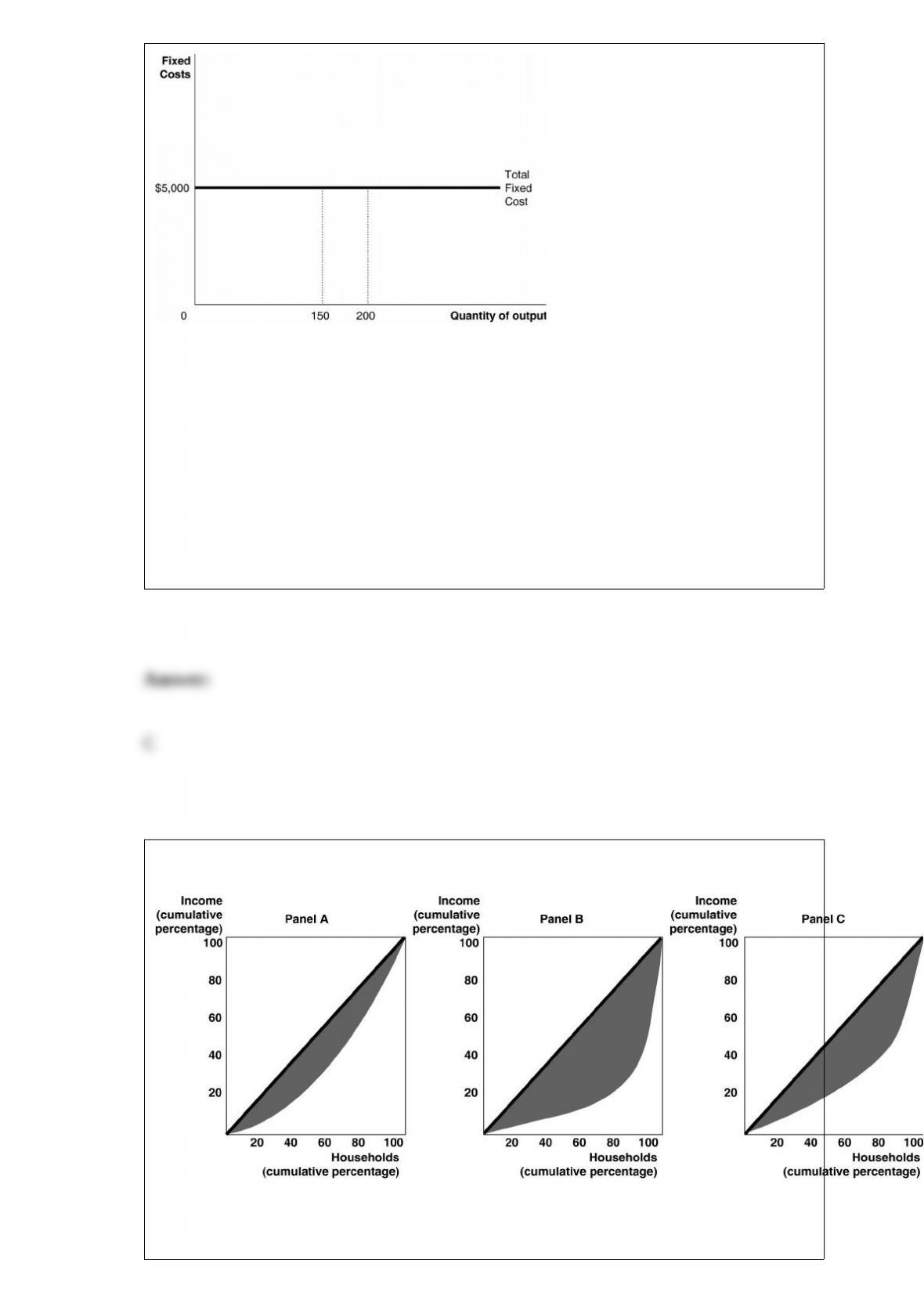
What happens to the average fixed cost of production when the firm increases output
from 150 to 200?
A) It remains constant.
B) It rises.
C) It falls.
D) It could rise or fall depending on what happens to total cost.
Figure 18-4
Rank the above panels in terms of most unequal income distribution to least unequal
income distribution.

A) Panel A, Panel B, Panel C
B) Panel B, Panel C, Panel A
C) Panel A, Panel C, Panel B
D) Panel C, Panel B, Panel A
A decrease in investment causes the price level to ________ in the short run and
________ in the long run.
A) increase; increase further
B) increase; decrease
C) decrease; decrease further
D) decrease; increase
According to the ability-to-pay principle of taxation
A) individuals who receive the benefit of a good or service should bear a greater share
of the tax burden.
B) it is fair to expect a greater share of the tax burden to be borne by people who have a
greater ability to pay.
C) people in the same economic situation should bear an equal share of the tax burden.
D) individuals who are willing to bear a greater share of the tax burden should be

compensated with non-monetary benefits.