
A decrease in the price level will
A) shift the aggregate demand curve to the left.
B) shift the aggregate demand curve to the right.
C) move the economy up along a stationary aggregate demand curve.
D) move the economy down along a stationary aggregate demand curve.
The discount rate is
A) the interest rate banks charge each other for overnight loans.
B) the interest rate banks charge their best customers.
C) the interest rate the Fed charges to banks for loans from the Fed.
D) the interest rate the U.S. Treasury pays on Treasury Bills.
A tax rebate, which is expected to be offered in this and all future years, will
A) have a small positive effect on consumption and aggregate demand.
B) have no effect on consumption and aggregate demand.
C) have a significant positive effect on consumption and aggregate demand, with
aggregate demand growing by a multiple of the tax rebate.
D) increase aggregate supply and aggregate demand.

If a bank receives a $1 million discount loan from the Federal Reserve, then the bank’s
reserves will
A) not change.
B) increase by $1 million.
C) increase by less than $1 million.
D) increase by more than $1 million.
The cost incurred from the production of an additional unit of a product
A) is a marginal cost to the firm.
B) is called a loss.
C) is called opportunity cost.
D) must be zero for a firm to be efficient.
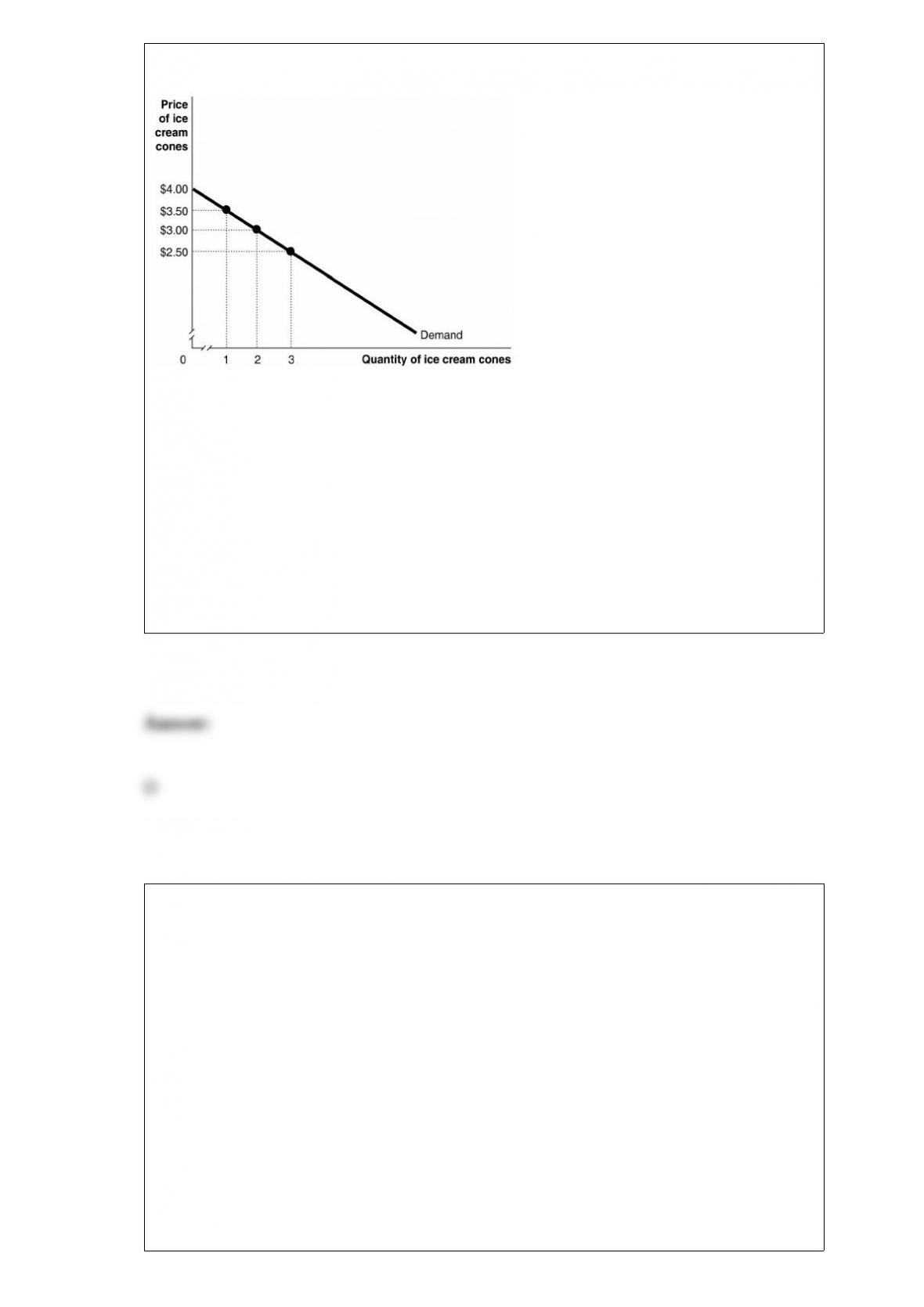
Figure 4-1
Figure 4-1 shows Kendra’s demand curve for ice-cream cones.
Refer to Figure 4-1. If the market price is $3.50, what is Kendra’s consumer surplus?
A) $9.00
B) $7.50
C) $3.50
D) $0
In preparing their estimates of the stimulus package’s effect on GDP, Obama
administration economists estimated a government purchases multiplier of 1.57.
Economist Robert Barro argues that ________, the government purchases multiplier
would be lower than the administration’s estimate, and economists Lawrence
Christiano, Martin Eichenbaum, and Sergio Rebelo argued that ________, the
multiplier would be higher than the administration’s estimate.
A) during a recession; when the inflation rate is relatively low
B) when the unemployment rate is high; when the value of the dollar is depreciating
against foreign currencies
C) when the federal budget is in surplus; when government transfer payments are
declining

D) during wartime; when short-term interest rates are near zero
Long-run macroeconomic equilibrium occurs when
A) aggregate demand equals short-run aggregate supply.
B) aggregate demand equals short-run aggregate supply and they intersect at a point on
the long-run supply curve.
C) structural and frictional unemployment equals zero.
D) output is above potential GDP.
The Bureau of Labor Statistics has taken several steps to reduce the bias in the
consumer price index. Which of the following is not one of the steps taken to reduce the
bias?
A) using statistical methods to reduce the size of the quality bias
B) updating the market basket every two years, rather than every 10 years
C) incorporating substitutions by consumers when prices of specific products rise
rapidly
D) conducting a point-of-purchase survey to track where consumers actually make their
purchases

Which of the following explains the cause of the change in the unemployment rate at
the end of a recession?
A) Firms are hesitant to rehire laid off workers, as they continue to operate below
capacity.
B) Firms rapidly hire new workers at the first sign of an increase in demand for their
goods.
C) Discouraged workers return to the labor force, and this makes the unemployment
rate fall.
D) Discouraged workers leave the labor force, and this makes the unemployment rate
rise.
Suppose the demand curve for a product is downward sloping and the supply curve is
upward sloping. If a unit tax is imposed in the market for this product,
A) sellers bear the entire burden of the tax.
B) the tax burden will be shared among the government, buyers and sellers.
C) buyers bear the entire burden of the tax.
D) the tax burden will be shared by buyers and sellers.

The Federal Reserve plays a larger role than Congress and the president in stabilizing
the economy because
A) the Federal Reserve can more quickly change monetary policy than the president
and the Congress can change fiscal policy.
B) the Federal Reserve can immediately recognize when real GDP is below or above
potential GDP.
C) changes in interest rates have a considerably larger effect on the economy than
changes in government purchases or taxes.
D) changes in interest rates have their full effect on the economy in a short period of
time, whereas changes in government spending and taxes have their full effect over a
long period of time.
If inflation in the United States is lower than inflation in other countries, what will be
the effect on net exports for the United States?
A) Net exports will rise as U.S. exports increase.
B) Net exports will rise as U.S. imports increase.
C) Net exports will decrease as U.S. exports decrease.
D) Net exports will decrease as U.S. imports decrease.
In 2013, the U.S. auto industry experienced rising sales. The automobile industry was
experiencing the effects of

A) inflation.
B) the underground economy.
C) the business cycle.
D) depreciation.
In a graph of unemployment rates (on the horizontal axis) versus inflation rates (on the
vertical axis), the short-run Phillips Curve is
A) downward sloping.
B) horizontal.
C) vertical.
D) upward sloping.
The Congressional Budget Office estimates that the Patient Protection and Affordable
Care Act (ACA) will increase government spending
A) by just under $1 trillion over 10 years.
B) by more than the additional taxes and fees enacted under the law will bring in.
C) by less than $50 billion over the next decade.
D) by more than $20 trillion dollars over the next 5 years.
Technological advancements have led to lower prices and an increase in the sale of
color laser printers. How does this affect the market for traditional inkjet printers?
A) The demand curve for inkjet printers shifts to the right.
B) The demand curve for inkjet printers shifts to the left.
C) The quantity of inkjet printers demanded increases.
D) The quantity of inkjet printers demanded decreases.
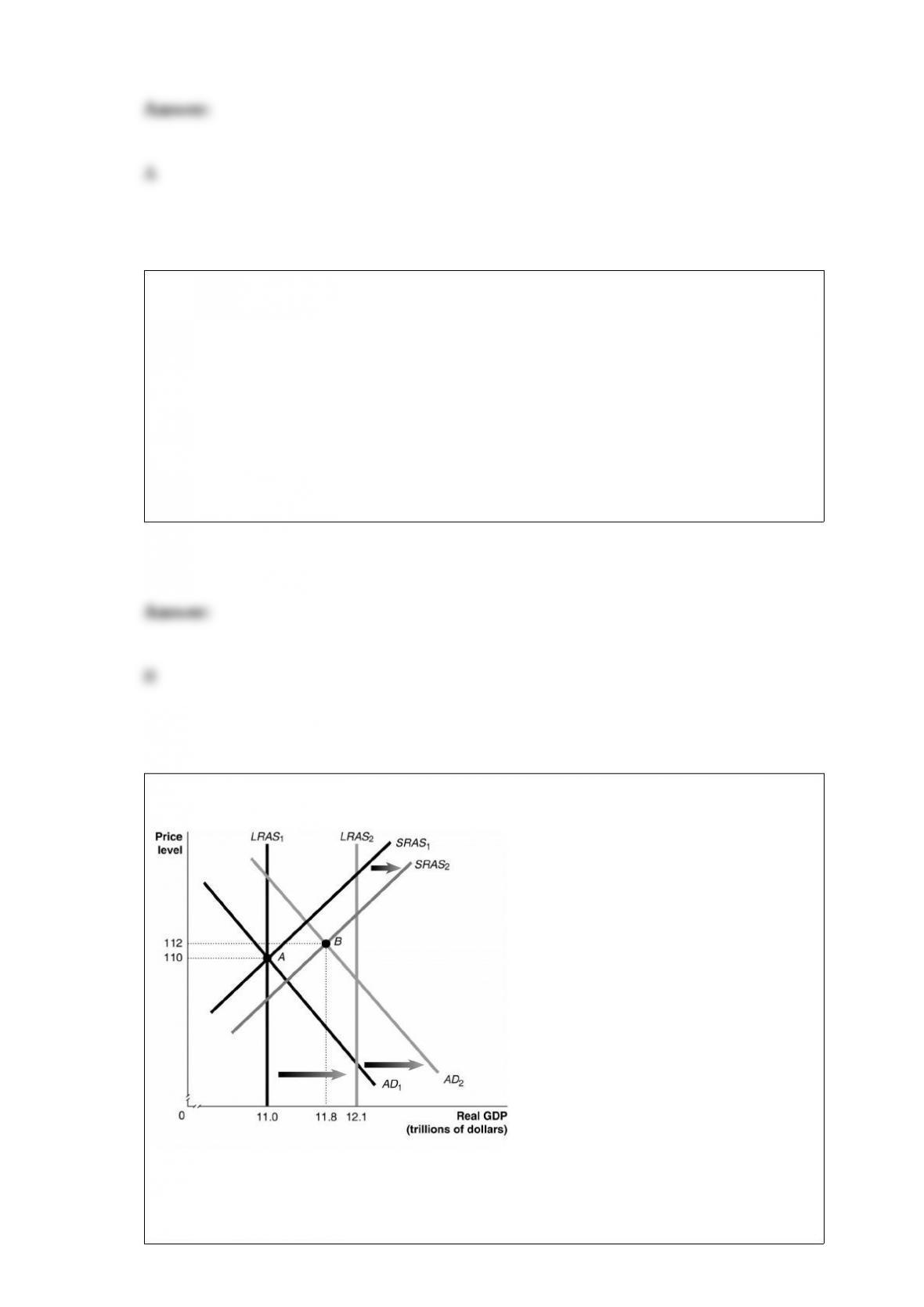
Figure 13-4
Refer to Figure 13-4. In the figure above, AD1, LRAS1 and SRAS1 denote AD, LRAS
and SRAS in year 1, while AD2, LRAS2 and SRAS2 denote AD, LRAS and SRAS in year
2. Given the economy is at point A in year 1, what is the actual growth rate in GDP in

year 2?
A) 2.5%
B) 7.3%
C) 8.0%
D) 10.0%
Prior to 1970, mortgages were ________ resold in the secondary market.
A) never
B) rarely
C) often
D) always