
Assume that the price for swimming pool maintenance services has risen and sales of
these services have fallen. One can conclude that
A) the law of supply has been violated.
B) the demand for swimming pool maintenance services has increased.
C) the supply of swimming pool maintenance services has decreased.
D) swimming pool maintenance services are becoming more technologically advanced.
The Philippines and Vietnam have roughly the same size population. Suppose the GDP
of the Philippines is $1,000 billion and the GDP of Vietnam is $10,000 billion. You
should conclude
A) a typical person in Vietnam is 10 times as well off as the typical person in the
Philippines.
B) a typical person in Vietnam is more than 10 times as well off as the typical person in
the Philippines.
C) a typical person in Vietnam is less than 10 times as well off as the typical person in
the Philippines.
D) it is not possible to make a good comparison of the economic well being of a typical
individual in the 2 countries without additional information.

Figure 4-16
Suppose the market is initially in equilibrium at price P1 and now the government
imposes a tax on every unit sold. Which of the following statements best describes the
impact of the tax? For demand curve D1
A) the producer bears a greater share of the tax burden if the supply curve is S2.
B) the producer bears a greater share of the tax burden if the supply curve is S1.
C) the producer’s share of the tax burden is the same whether the supply curve is S1or
S2.
D) the producer bears the entire burden of the tax if the supply curve is S1 and the
consumer bears the entire burden of the tax if the supply curve is S2.
Donnie’s Donuts incurs $450,000 per year in explicit costs and $200,000 in implicit
costs. The bakery earns $800,000 in revenues and has $2 million in net worth. Based on
this information, what is the accounting profit for Donnie’s Donuts?
A) $150,000
B) $350,000
C) $600,000
D) $1.2 million

A firm’s net worth is calculated as
A) the Difference between a firm’s revenues and explicit costs.
B) the Difference between a firm’s revenues and implicit costs.
C) the Difference between a firm’s assets and liabilities.
D) the Difference between a firm’s liabilities and outstanding equities.
How are the fundamental economic questions answered in a market economy?
A) The government alone decides the answers.
B) Individuals, firms, and the government interact in markets to decide the answers to
these questions.
C) Households and firms interact in markets to decide the answers to these questions.
D) Large corporations alone decide the answers.
The expansionary monetary and fiscal policies of the 1960s resulted in ________
inflation rates and ________ rates of unemployment.
A) high; high
B) low; low
C) low; high
D) high; low
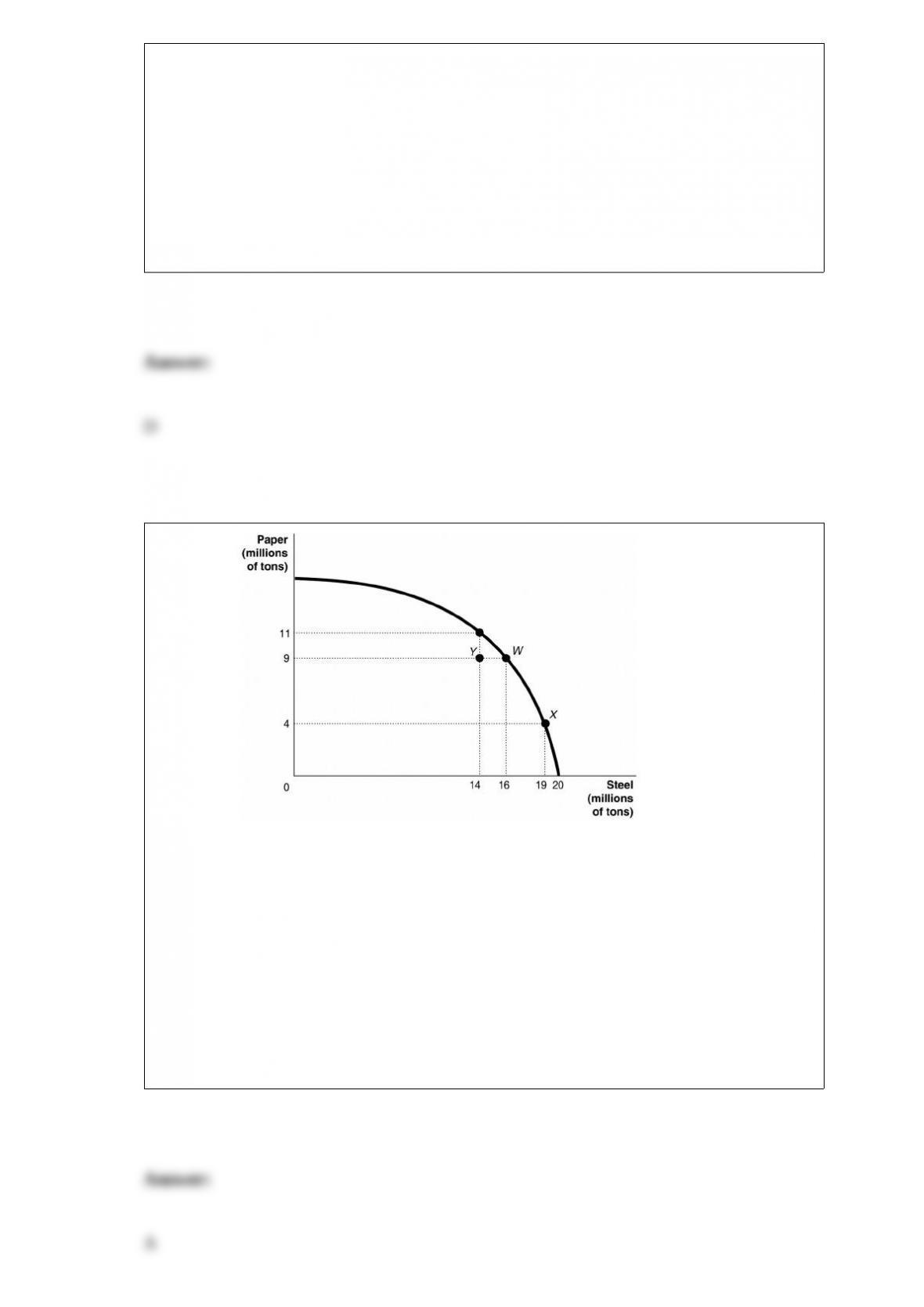
Figure 2-5
If the economy is currently producing at point X, what is the opportunity cost of moving
to point Y?
A) 5 million tons of steel
B) 9 million tons of paper
C) 5 million tons of paper
D) 14 million tons of steel

Letters are used to represent the terms used to answer this question: price (P), quantity
of output (Q), total cost (TC) and average total cost (ATC). Which of the following
equations is equal to a firm’s average profit?
A) P – ATC
B) (P – ATC) Q
C) (P Q) – TC
D) P – TC
If net exports are negative,
A) net foreign investment is also negative.
B) capital inflows must be less than capital outflows.
C) net foreign investment is positive.
D) Both A and B are correct.
Why is the study of asymmetric information associated with the market for “lemons”?
A) Sellers of citrus fruit€lemons, oranges, grapefruit€know the Difference between bad
fruit and good fruit; buyers do not have this information.

B) Because there is little advertising in the market for lemons, buyers have Difficulty
determining the quality of lemons before they are purchased.
C) Potential buyers of used cars have Difficulty separating good used cars from bad
used cars; bad used cars are often referred to as “lemons.”
D) Most sellers of used cars have less information about their cars than the dealers who
buy them; used cars are often referred to as “lemons.”