1) Overall, economists believe that deregulation of industries formerly subjected to
industrial regulation:
A.has been a clear failure.
B.is neutral in its impact to society’s well-being, creating minimal net benefits at best.
C.has produced large net benefits for consumers and society.
D.has produced sizable efficiency gains in the communications industry, but not in the
transportation industry (railways, trucking, airlines).
2)
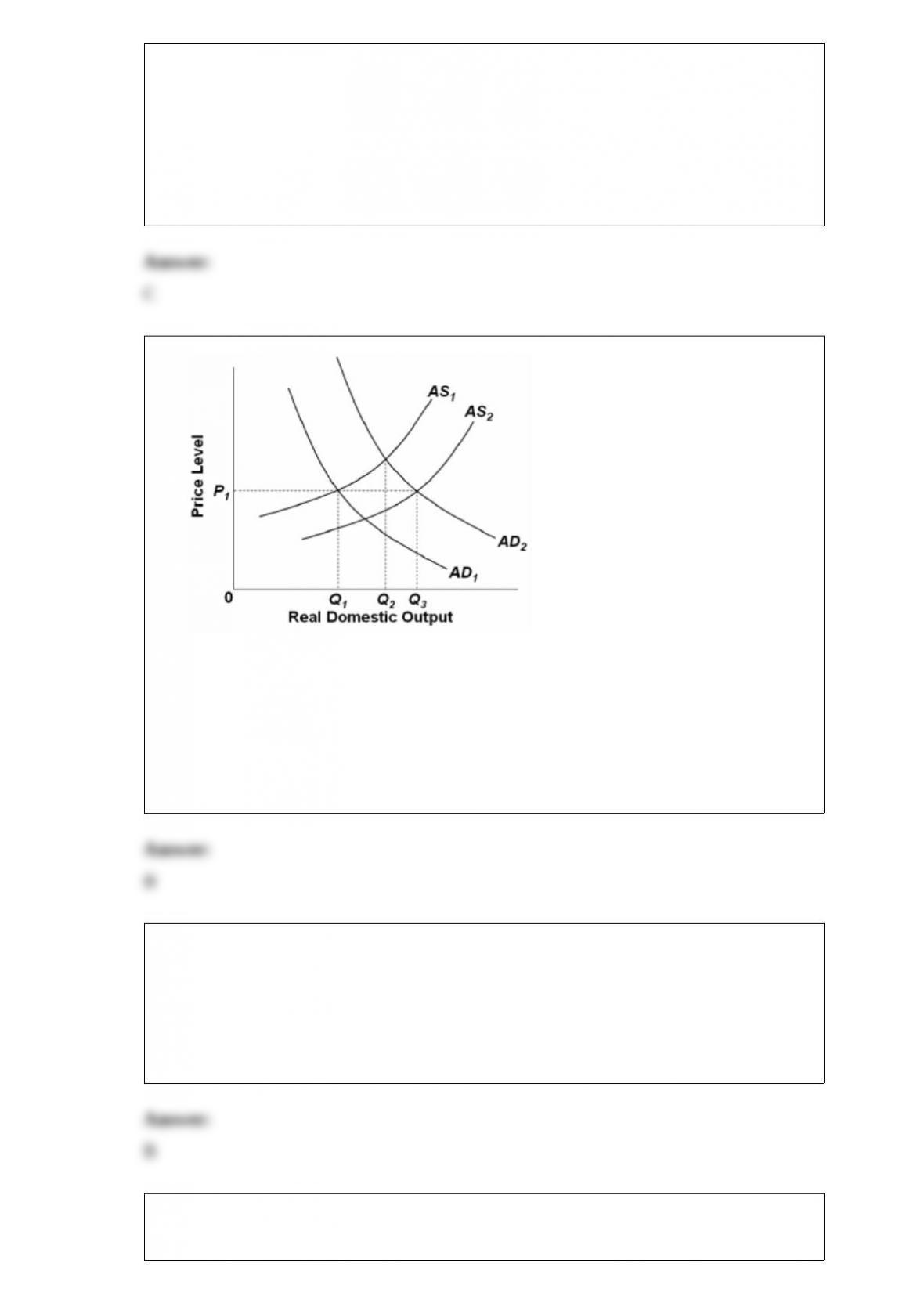
In the above figure AD1 and AS1 represent the original aggregate supply and demand
curves and AD2 and AS2 show the new aggregate demand and supply curves. The
change in aggregate supply from AS1 to AS2 could be caused by:
A.a reduction in the price level.
B.the increased availability of entrepreneurial talent.
C.an increase in business taxes.
D.the real-balances, interest-rate, and foreign purchases effects.
3) (Consider This) According to the Consider This box “Superstars,” the high pay of
superstars reflects:
A.elastic product demand.
B.high marginal revenue productivity.
C.blocked occupational entry.
D.warped societal values.
4) In the inverted-U theory of R&D:
A.process innovation and product innovation are inversely related.

B.technological change is inversely related to scientific discovery.
C.R&D expenditures rise continuously as a percentage of firms’ sales as industry
concentration rises.
D.R&D expenditures first rise as a percentage of firms’ sales as industry concentration
increases, but then fall as higher industry concentration occurs.
5) cost-push inflation may be caused by:
a.a decline in per unit production costs.
b.a decrease in wage rates.
c.a negative supply shock.
d.an increase in resource availability.
6) an increase in money income shifts the consumer’s:
a.budget line to the right.
b.budget line to the left.
c.indifference curves to the left.
d.indifference curves to the right.
7) Mainstream economists contend that, as stabilization tools:
A.discretionary fiscal policy is effective, but discretionary monetary policy is not.
B.discretionary monetary policy is effective, but discretionary fiscal policy is not.
C.both discretionary fiscal policy and monetary policy can be effective if appropriately
used.
D.discretionary fiscal policy and discretionary monetary policy cause more instability
than they cure.
8) As it applies to insurance, the adverse selection problem is the tendency for:
A.those most likely to collect on insurance to buy it.
B.those who buy insurance to take less precaution in avoiding the insured risk.
C.sellers to price discriminate.
D.sellers to restrict output and charge high prices.
9) Standard Census data on the distribution of income:
A.take all taxes and transfer payments into account.
B.are before taxes in that they do not account for personal income and payroll taxes.
C.include noncash transfers.
D.exclude cash transfers.
10) gross investment refers to:
a.private investment minus public investment.
b.net investment plus investment in replacement capital.
c.net investment after it has been “inflated” for changes in the price level.
d.net investment plus net exports.
11)
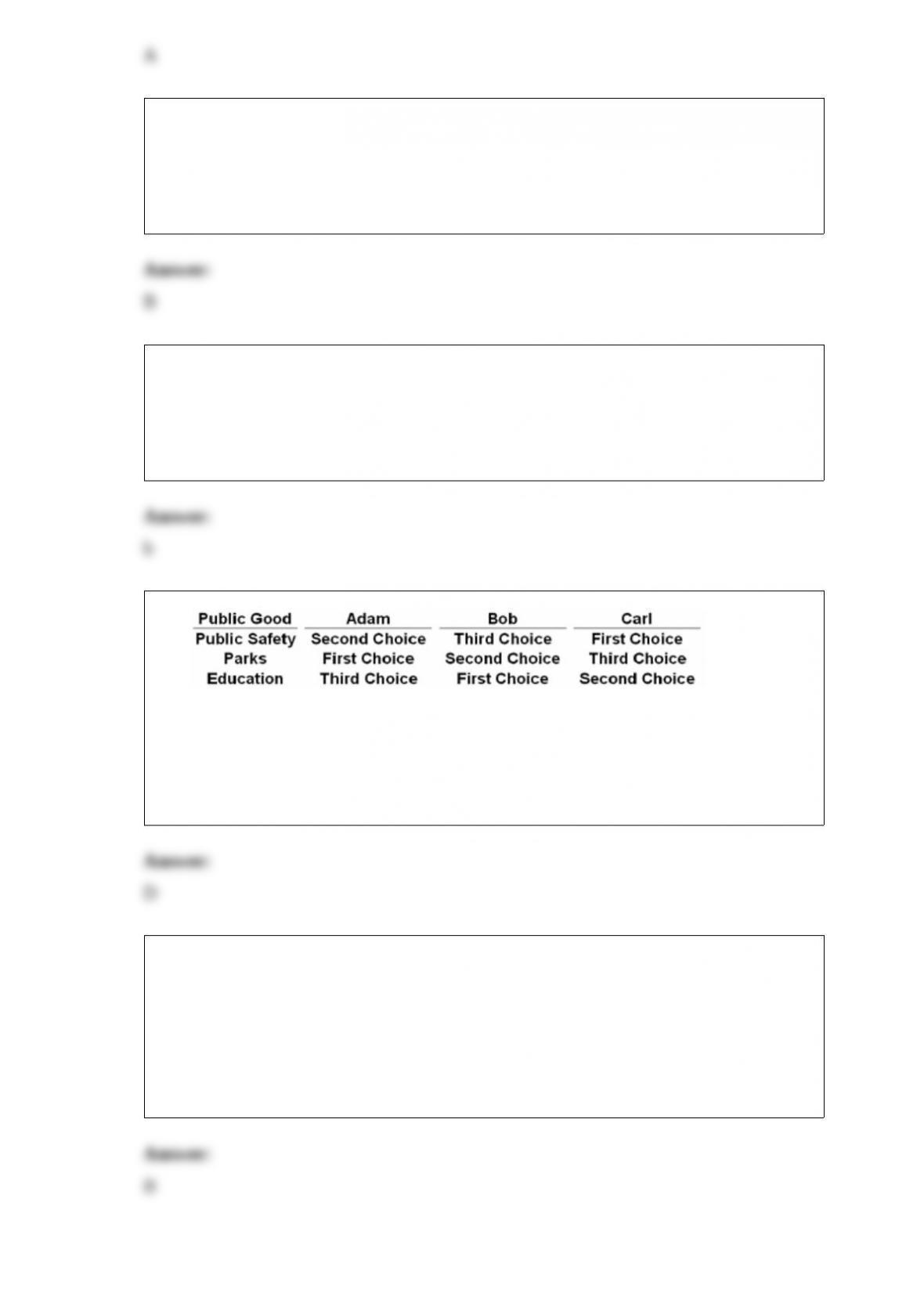
Refer to the above table. In a choice between public safety and parks:
A.the outcome would depend on which item was listed first on the ballot.
B.a majority of voters would favor public safety.
C.no voter decision is possible.
D.a majority of voters would favor parks.
12) (Consider This) According to The Economist magazine, growing income inequality
is less of a concern because:
A.it is increasing at a decreasing rate.
B.the poor have increasingly better access to goods and services once only available to
the rich.
C.poverty rates have fallen below 10 percent.
D.government transfers eliminate virtually all consumption inequality.
13) The multiple by which the commercial banking system can expand the supply of
money is equal to the reciprocal of:
A.the MPS.
B.its actual reserves.
C.its excess reserves.
D.the reserve ratio.
14)
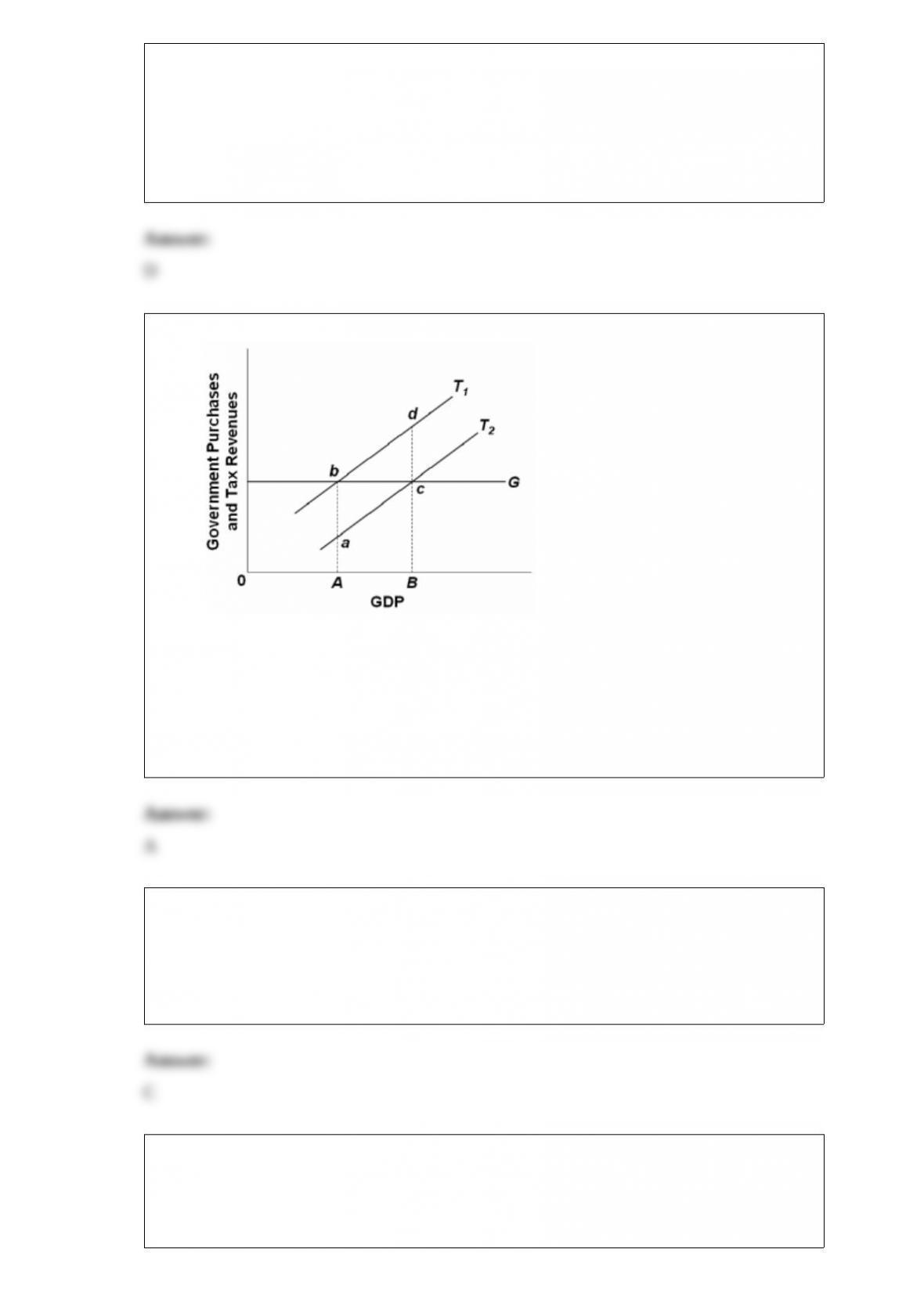
Refer to the above diagram. Discretionary fiscal policy designed to expand GDP is
illustrated by:
A.the shift of curve T1 to T2.
B.the shift of curve T2 to T1.
C.a movement from a to c along curve T2.
D.a movement from d to b along curve T1.
15) The opportunity cost of holding money:
A.is zero because money is not an economic resource.
B.varies inversely with the interest rate.
C.varies directly with the interest rate.
D.varies inversely with the level of economic activity.
16) The Fed can change the money supply by:
A.changing bank reserves through the sale or purchase of government securities.
B.changing the quantities of required and excess reserves by altering the legal reserve
ratio.
C.changing the discount rate so as to encourage or discourage commercial banks in
borrowing from the central banks.
D.doing all of these.
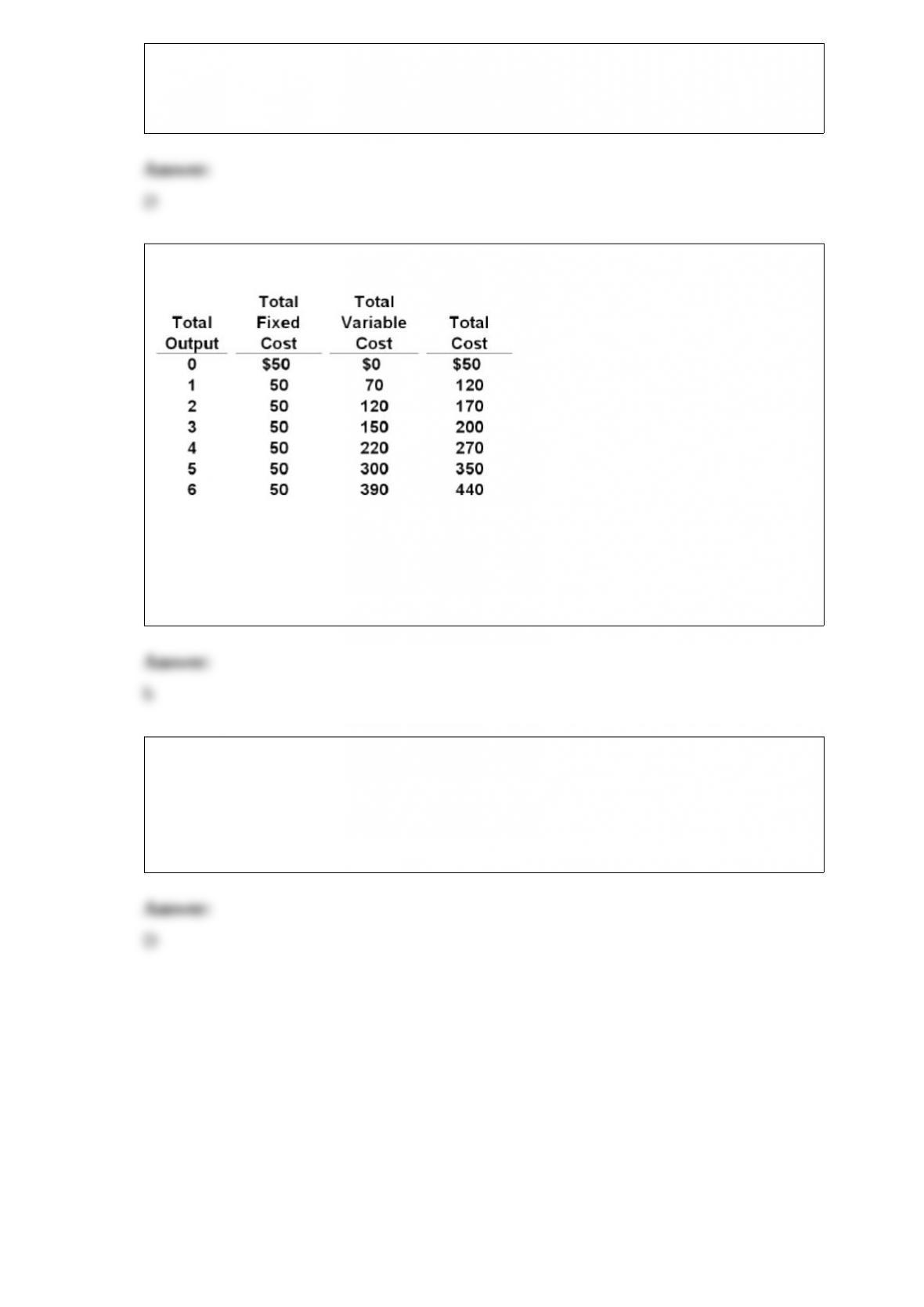
17) the following cost data for a purely competitive seller:
refer to the above data. if product price is $75, the firm will produce:
a.3 units of output.
b.4 units of output.
c.5 units of output.
d.6 units of output.
18) Cost-benefit analysis attempts to:
A.compare the real worth, rather than the market values, of various goods and services.
B.compare the relative desirability of alternative distributions of income.
C.determine whether it is better to cut government expenditures or reduce taxes.
D.compare the benefits and costs associated with any economic project or activity.