1) which of the following is a characteristic of pure monopoly?
a.close substitute products
b.barriers to entry
c.the absence of market power
d.”price taking”
2) households in the aggregate use the largest share of their total income to:
a.pay taxes.
b.consume.
c.save.
d.buy capital goods.
3) Which of the following best describes the typical growth pattern of trees for logging?
A.Trees grow slowly at first, then grow exponentially until cut down.
B.Trees grow quickly at first, then continue to grow at a declining rate.
C.Trees grow quickly at first, then plateau for a time before resuming an exponential
growth pattern.
D.Trees grow slowly at first, quickly in the middle years, and then at a diminishing rate
into old age.
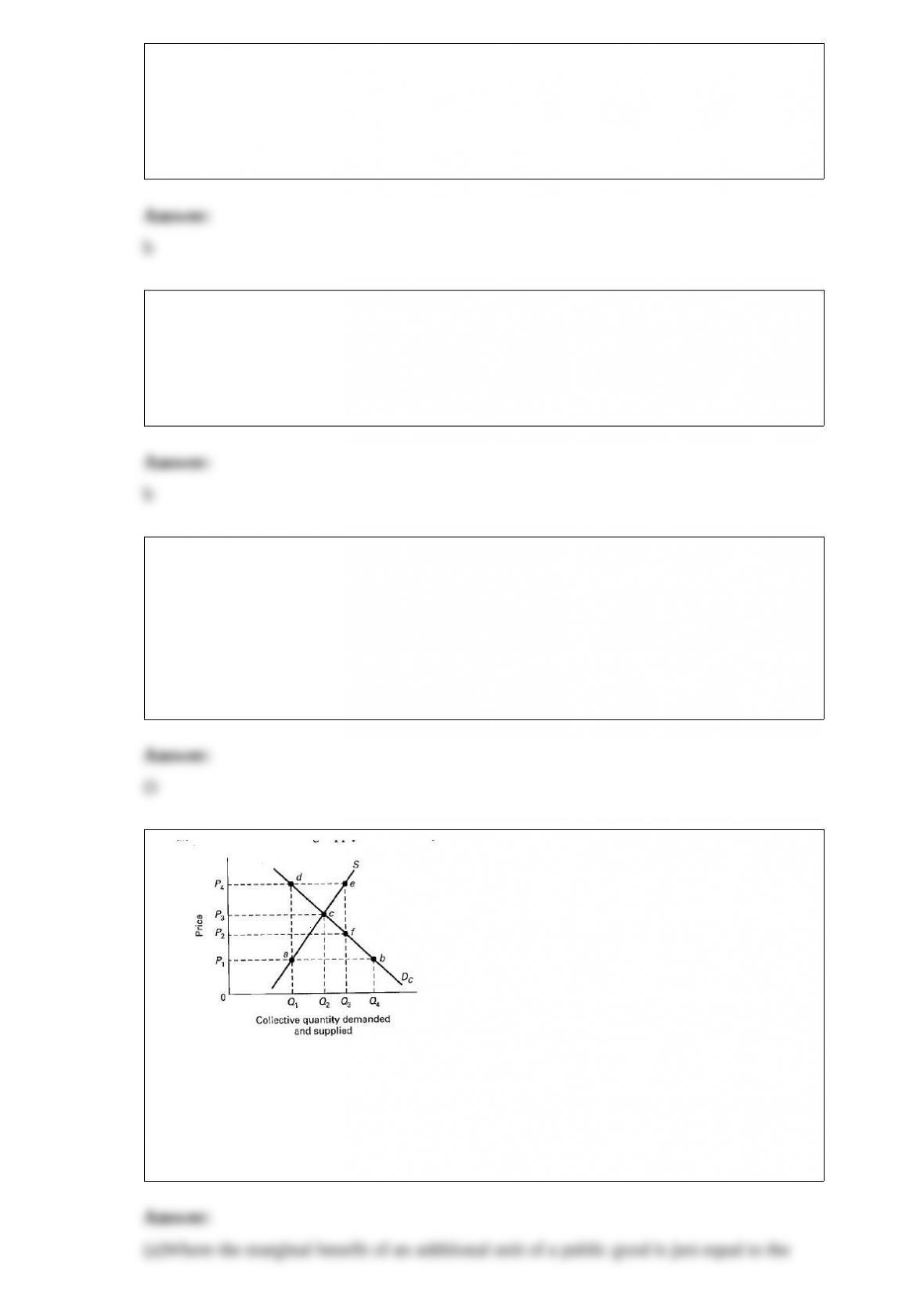
4) The next three questions refer to the below
supply and demand graph for a public good.
(a)What does point c represent?
(b)What does the line segment ef at output Q3 represent?
(c)At what output level is there an underallocation of resources to the production of this
public good?
5) determine, other things equal, the effects of a given change in a determinant of
demand or supply for product x upon (1) the demand (d) for, or supply (s) of, x, (2) the
equilibrium price (p) of x and (3) the equilibrium quantity (q) of x.
refer to the above. an improvement in the technology used to produce x will:
a.decrease s, increase p, and decrease q.
b.decrease s, increase p, and increase q.
c.increase s, decrease p, and increase q.
d.decrease d, decrease p, and decrease q.
6)
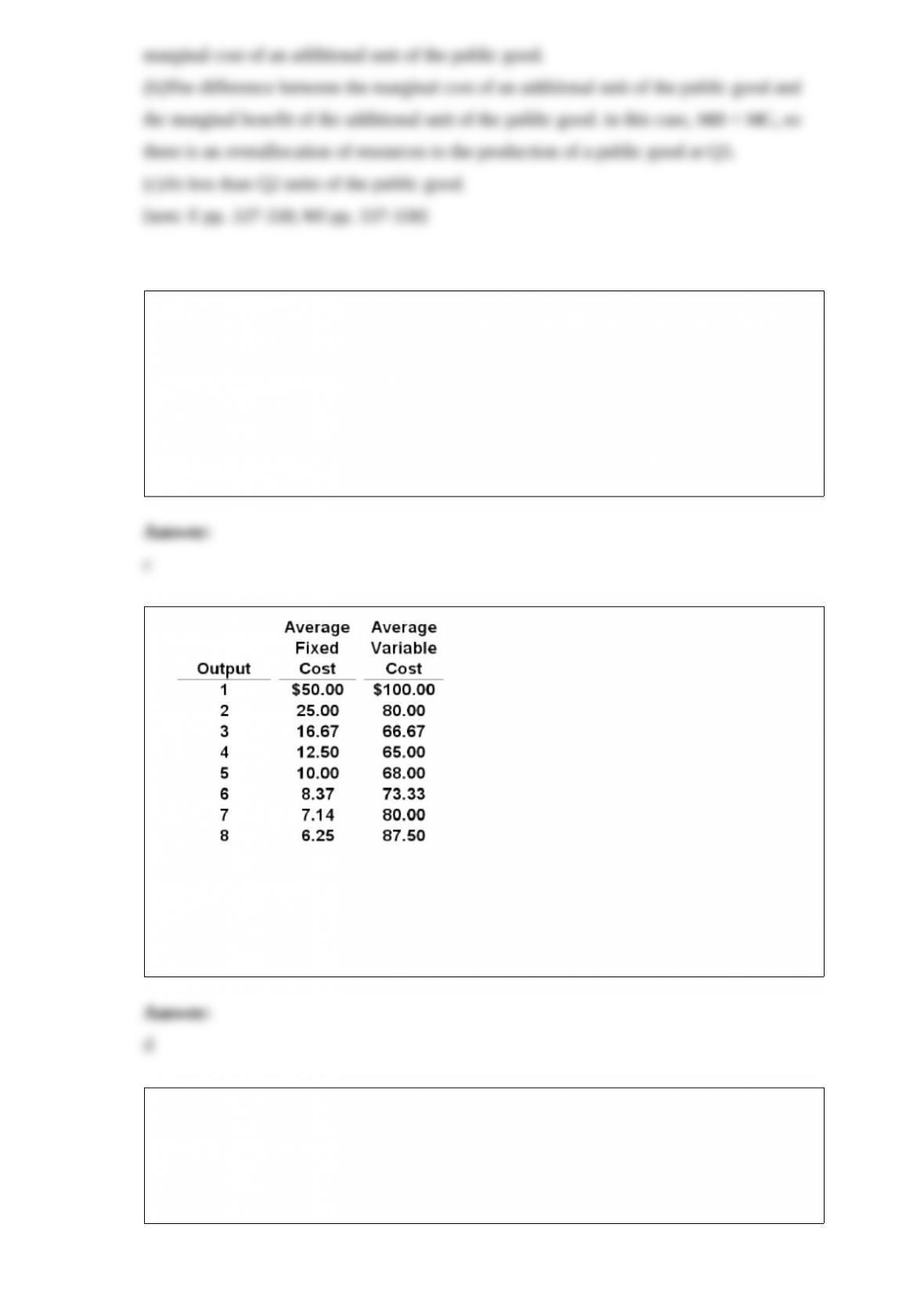
refer to the above data. total fixed cost is:
a.$6.25.
b.$100.00.
c.$150.00.
d.$50.00.
7) a purely competitive seller’s average revenue curve coincides with:
a.its marginal revenue curve only.
b.its demand curve only.
c.both its demand and marginal revenue curves.
d.neither its demand nor its marginal revenue curve.
8) which of the following most closely relates to the idea of opportunity costs?
a.tradeoffs.
b.economic growth.
c.technological change.
d.capitalism.
9) Responsibility for enforcing the antitrust laws rests:
A.with the Interstate Commerce Commission.
B.with both the Department of Justice and the Federal Trade Commission.
C.solely with the Federal Trade Commission.
D.solely with the Department of Justice.
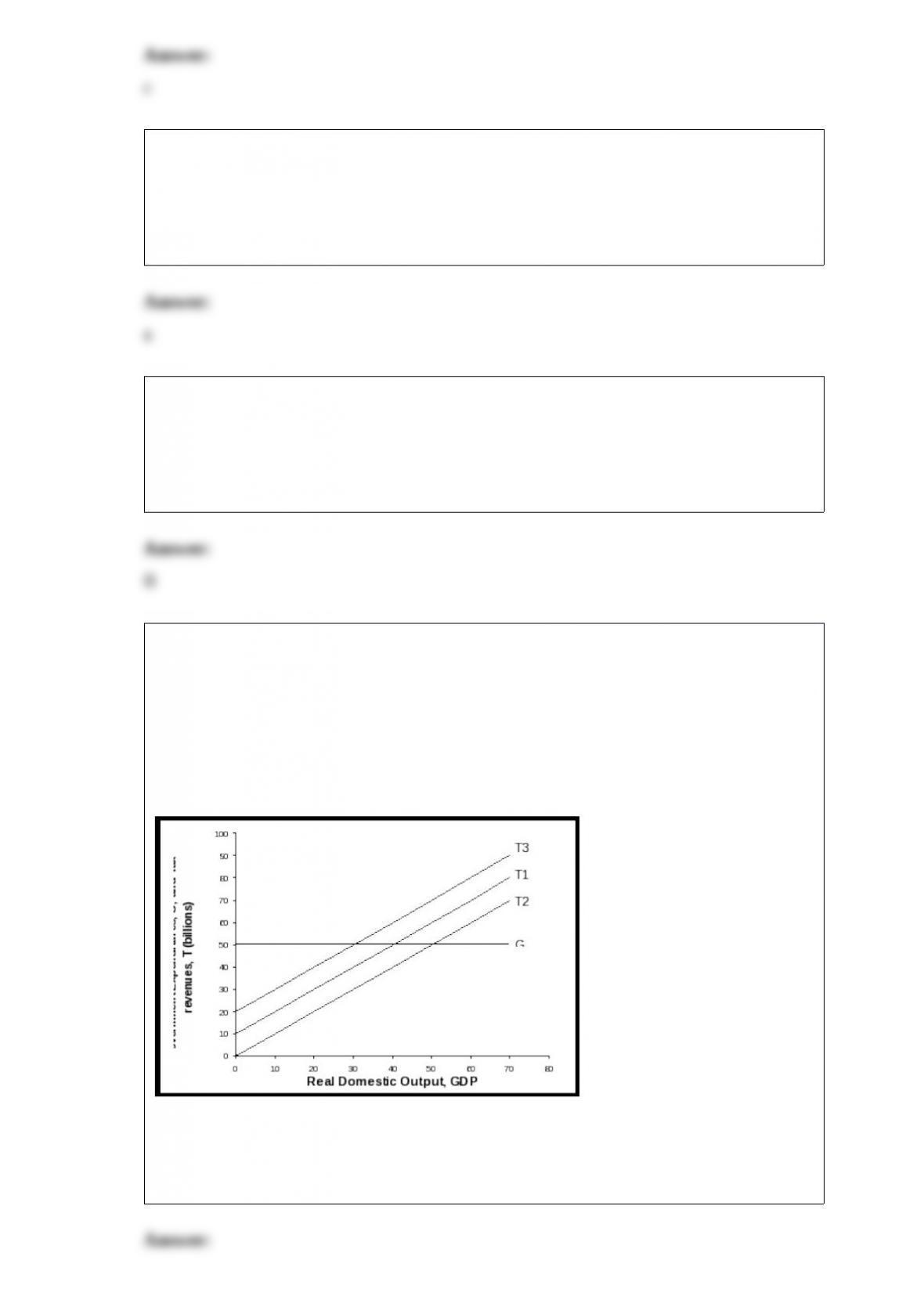
10) Use the graph below to analyze the following questions. Assume the economy starts
at full-employment GDP at $40 billion.
(a)Suppose the economy suddenly faces an expansion in output and GDP grows to $60
billion. What is the standardized budget surplus at this output?
(b)Suppose the government is afraid of rampant demand-pull inflation and decides to
increase taxes to control the expansion. Which tax line (T2 or T3) would represent this
increase in taxes and how much would the budget surplus grow by?
(c)Suppose the economy
comes into a recession and GDP falls to $20 billion. To promote growth the government
reduces taxes. Which tax line (T2 or T3) would reflect the proper tax shift? What is the
built-in standardized budget deficit and what is the deficit as a result of the government
action?
11) as output increases, total variable cost:
a.increases more rapidly than does total cost.
b.increases continuously at a decreasing rate.
c.increases at a decreasing rate and then at an increasing rate.
d.increases at a constant rate.