1) Which of the following transactions takes place in the markets for the factors of
production in the circular-flow diagram?
a.Dylan receives a salary for his work as a financial analyst for an investment firm.
b.Kristin buys two business suits to wear to her job as a Chief Information Officer.
c.Jim receives clean water in his home in exchange for paying his water bill.
d.Caroline owns a nail salon and receives payments from her clients for her services.
2) Name brand drugs are able to continue capitalizing on their market power even after
generic drugs enter the market because
(i)almost all people fear the generic drug companies are devoting too few resources to
research and development.
(ii)some people fear that generic drugs are inferior.
(iii)some people are loyal to the name brand.
a.(i) and (ii) only
b.(ii) and (iii) only
c.(i) and (iii) only
d.(i), (ii), and (iii)
3) Monopolistic competition is a type of
a.oligopoly.
b.market structure.
c.price discrimination.
d.advertising strategy.
4) Which of the following events would shift a labor supply curve?
(i)immigration of high-skilled workers
(ii)immigration of low-skilled workers
(iii)changes in the number of women willing to work full time
a.(i) and (iii) only
b.(ii) and (iii) only
c.(iii) only
d.(i), (ii), and (iii)
5) Refer to Scenario 9-2. Suppose the world price of cardboard is $60. Then, relative
to the no-trade situation, international trade in cardboard
a.benefits Boxlandian consumers by $750 and harms Boxlandian producers by $660.
b.harms Boxlandian consumers by $736 and harms Boxlandian producers by $598.
c.harms Boxlandian consumers by $704 and benefits Boxlandian producers by $864.
d.harms Boxlandian consumers by $804 and benefits Boxlandian producers by $984.
6) An insurance company that writes automobile policies tries to separate safe drivers
from risky drivers by offering policies that feature different deductibles and different
premiums. This practice is best described as an example of
a.screening.
b.behavioral economics.
c.monitoring.
d.signaling.
7) Medicare is the
a.government’s health plan for the elderly.
b.government’s health plan for the poor.
c.another name for Social Security.
d.Both a and c are correct.
8) Which of the following statements best reflects a price-taking firm?
a.If the firm were to charge more than the going price, it would sell none of its goods.
b.The firm has an incentive to charge less than the market price to earn higher revenue.
c.The firm can sell only a limited amount of output at the market price before the
market price will fall.
d.Price-taking firms maximize profits by charging a price above marginal cost.

9) Scenario 15-3
A monopoly firm maximizes its profit by producing Q = 500 units of output. At that
level of output, its marginal revenue is $30, its average revenue is $60, and its average
total cost is $34.
At Q = 500, the firm’s profit is
a. $13,000.
b. $15,000.
c. $17,000.
d. $30,000.
10) Price discrimination is a rational strategy for a profit-maximizing monopolist when
a.the monopolist finds itself able to produce only limited quantities of output.
b.consumers are unable to be segmented into identifiable markets.
c.the monopolist wishes to increase the deadweight loss that results from
profit-maximizing behavior.
d.there is no opportunity for arbitrage across market segments.
11) The Condorcet paradox
a.proved that the Arrow impossibility theorem is wrong.
b.was proved wrong by the Arrow impossibility theorem.
c.serves as an example of the Arrow impossibility theorem.
d.pertains to voting systems, whereas Arrow’s Impossibility Theorem does not.
12) For a monopoly firm, the shape and position of the demand curve play a role in
determining the
(i)profit-maximizing price.
(ii)shape and position of the marginal-cost curve.
(iii)shape and position of the marginal-revenue curve.
a.(i) and (ii) only
b.(ii) and (iii) only
c.(i) and (iii) only
d.(i), (ii), and (iii)
13) Pizza is a normal good if the demand
a.for pizza rises when income rises.
b.for pizza rises when the price of pizza falls.
c.curve for pizza slopes upward.
d.curve for pizza shifts to the right when the price of burritos rises, assuming pizza and
burritos are substitutes.
14) When calculating the cost of college, which of the following should you probably
include?
a.The cost of your meal plan for the cafeteria.
b.The cost of books required for college classes
c.The income you earn at your part-time job.
d.The cost of living in the dormitory.
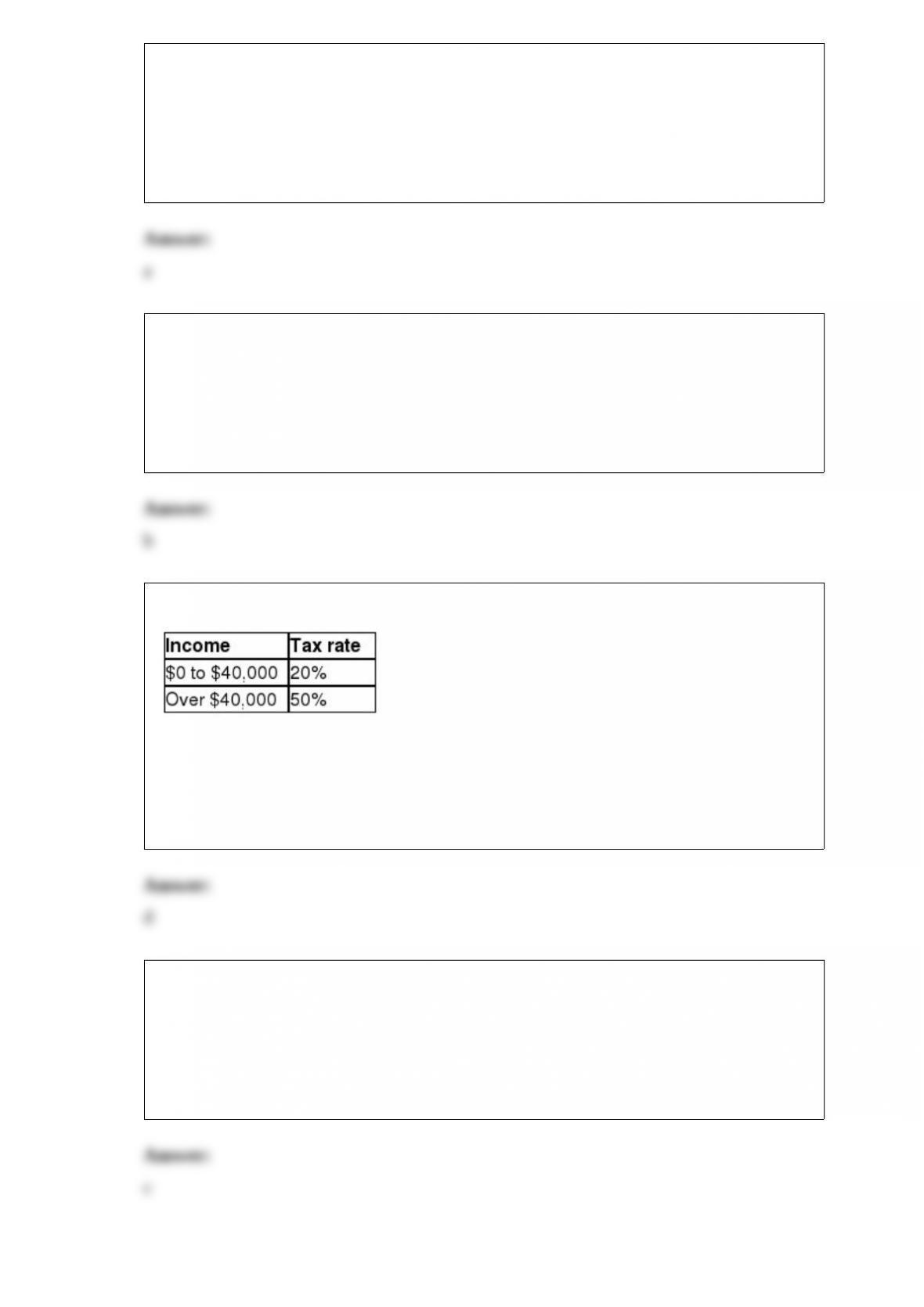
15) Table 12-3
What is the marginal tax rate for a person who makes $60,000?
a. 20%
b.30%
c.40%
d.50%
16) Financial aid to college students, quantity discounts, and senior citizen discounts
are all examples of
a.consumer surplus.
b.deadweight loss.
c.price discrimination.
d.nonprofit pricing strategies.
17) Describe how a study group of economics students could experience economies of
scale as they study for an economics exam.
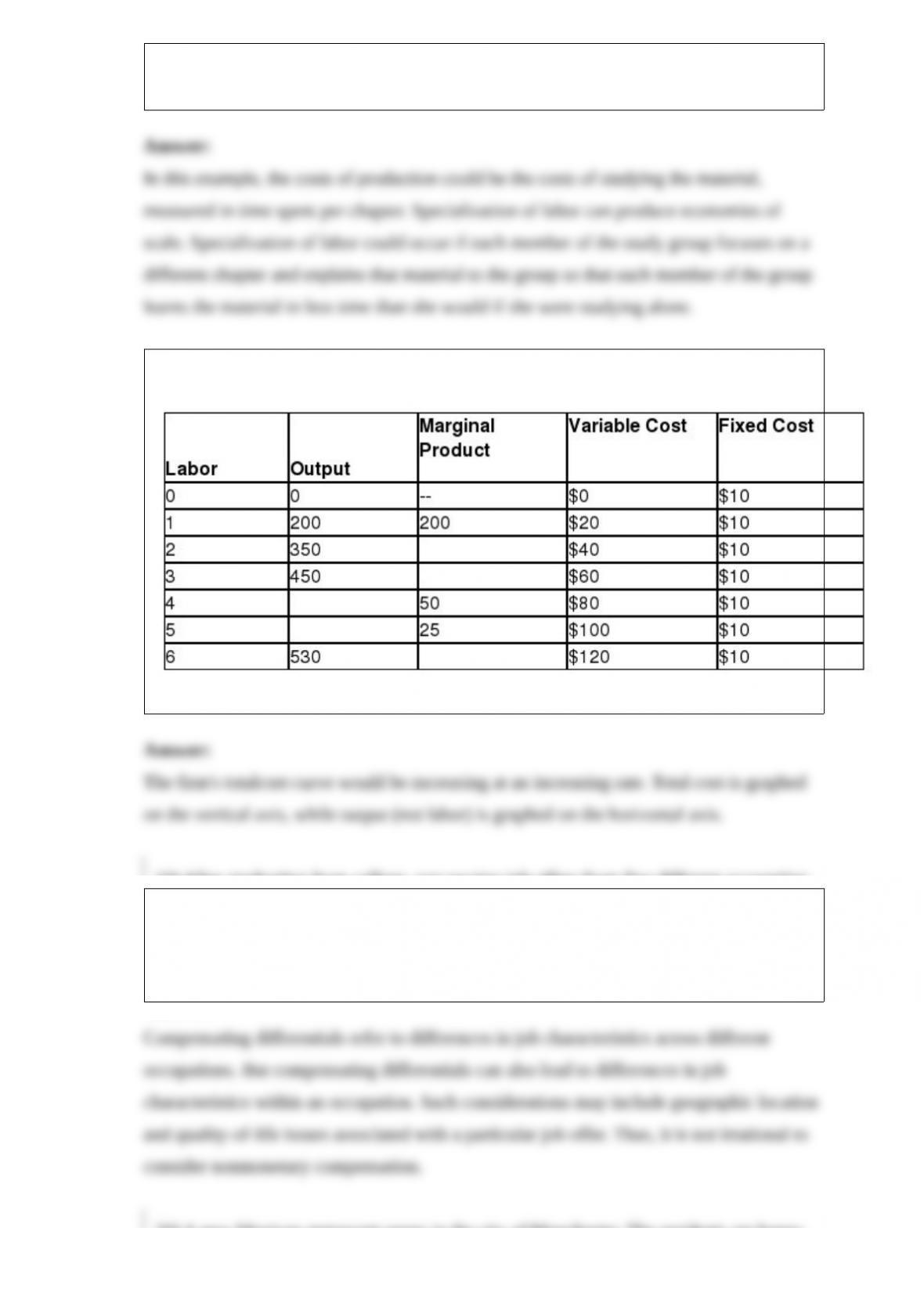
18) Table 13-18
What is the shape of the firm’s totalcost curve?
19) After graduating from college, you receive job offers from five different accounting
firms. All job offers have a different compensation package. Is it irrational for you to
accept an offer that doesn’t provide the highest level of monetary compensation? Use
the concept of compensating differentials to explain your answer.

20) A new Mexican restaurant opens in the city of Manchester. The residents are happy
about this new restaurant because they are experiencing what externality?
21) What do economists call the highest amount a consumer will pay to purchase a
good?
22) Since 1970, has the distribution of income in the US become more equal, less equal,
or remained unchanged?