
In the Battle of the Sexes game,
a. Fred and Ethel are best off choosing the activity they prefer.
b. Fred is better off attending the opera with Ethel than having Ethel attend the boxing
match with him.
c. Ethel is better off attending the boxing match with Fred than having Fred attend the
opera with her.
d. Fred and Ethel would both be better off choosing to attend either activity together
than going alone to the activity they prefer.
The productive skills resulting from previous investments in education and training are
called
a. human capital.
b. signals.
c. compensating differentials.
d. nonlabor income.
Labor Demand and Labor Supply
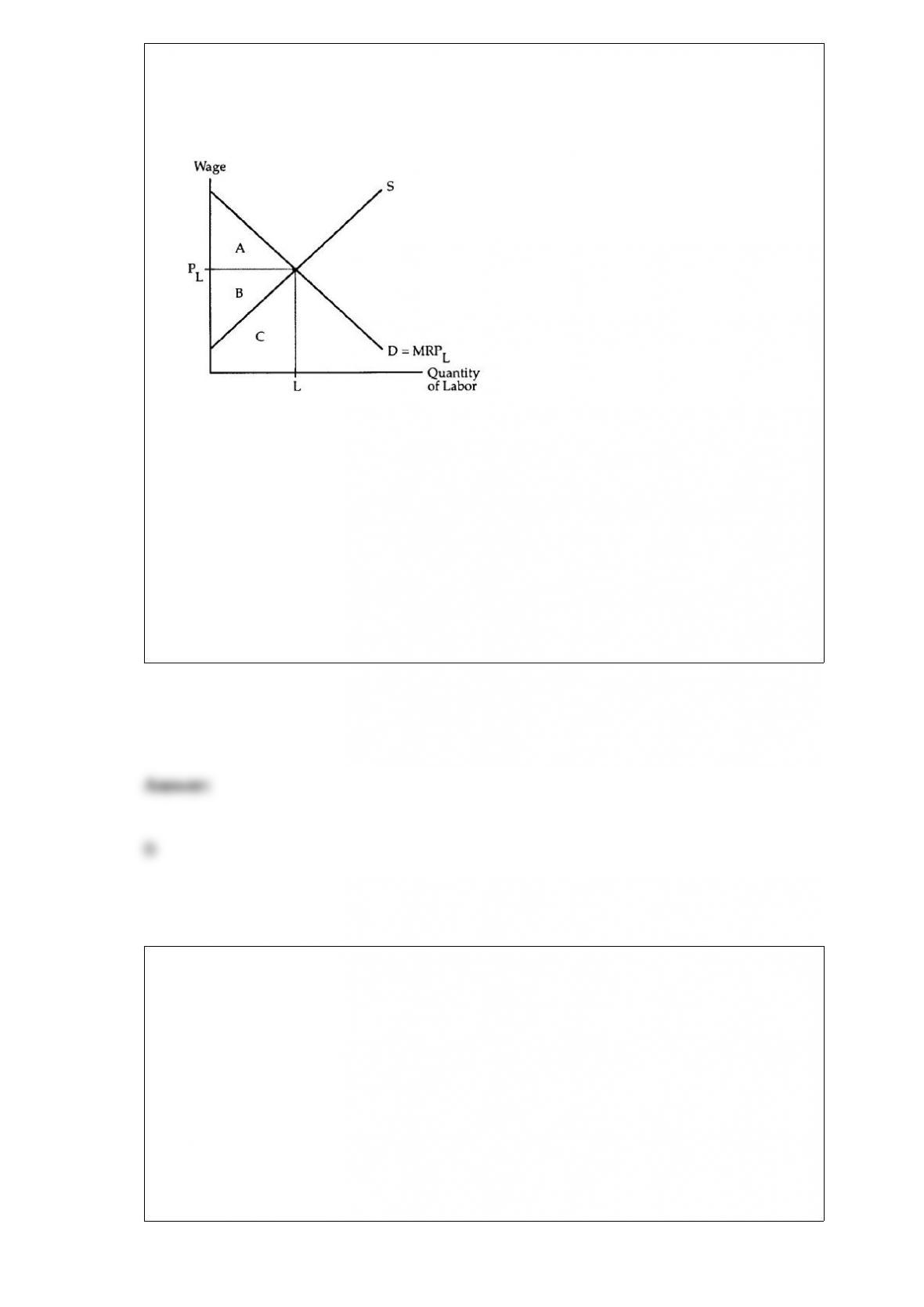
The following questions refer to the accompanying diagram, which shows an industry’s
labor demand and labor supply. Labor and capital are the only factors used by the
industry. The industry hires L units of labor at a wage of PL.
What does area B represent?
a. The industry’s total revenue.
b. The rent earned by the industry’s laborers.
c. The total wages paid to the industry’s laborers.
d. The rent earned by the industry’s capital.
Entry into the information technology industry becomes more attractive the more firms
there are because of the increased availability of already trained workers. Given this
trend, it appears that information technology is
a. an increasing-cost industry.
b. a constant-cost industry.
c. a decreasing-cost industry.
d. a government subsidized industry.

An outward, parallel shift in the budget line indicates that
a. the consumer’s income has risen.
b. the consumer’s demand for the good on the horizontal axis has risen.
c. the price of the good on the horizontal axis has fallen.
d. all commodity prices have simultaneously risen.
Market Diagram
The following questions refer to the accompanying market diagram. PC and QC are the
equilibrium price and quantity if the firm behaves competitively, and PM and QM are
the equilibrium price and quantity if the firm is a simple monopoly.

. Suppose this firm initially acted competitively. If the firm switched to the monopoly
equilibrium, how much deadweight loss would be created?
a. Area E + H.
b. Area G + H.
c. Area B + D + E + G + H.
d. Area D + E + G + H.
In third-degree price discrimination, the monopolist will choose quantities so that each
market has the same
a. price.
b. total revenue.
c. marginal revenue.
d. elasticity.

When the price of a barrel of crude oil rises, what will be the immediate effect on the
market for home heating fuel produced from crude oil?
a. The demand for the fuel will fall.
b. The quantity demanded of fuel will rise.
c. The supply of fuel will fall.
d. The quantity supplied of fuel will fall.
A Negative Externality Problem
Demand for a good is given by Q = 100 – P. The private marginal cost of production is
MCP = 10 + Q. There is a $10 per unit negative production externality in this situation.
According to Pigou, the socially optimal level of production is
a. 0 units.
b. 30 units.
c. 40 units.
d. 45 units.

Goods X and Y
For the following questions, assume that good X is on the horizontal axis and good Y is
on the vertical axis in the consumer-choice diagram. PX denotes the price of good X, PY
is the price of good Y, and I is the consumer’s income. Unless otherwise stated, the
consumer’s preferences are assumed to satisfy the standard assumptions.
Suppose the consumer is at an optimum, spending all his income on good X. How are
the marginal value of X and the relative price of X related at this corner solution?
a. The marginal value of X and the relative price of X must be equal.
b. The marginal value of X must be less than or equal to the relative price of X.
c. The marginal value of X must be greater than or equal to the relative price of X.
d. There is no definite relationship between the marginal value and the relative price of
X.
If people stand to produce at lower cost when specializing and producing in larger
quantities
a. they cannot gain from trade because each one is just as potentially productive as
another.
b. they cannot gain from trade because most people’s wants can be easily satisfied with
what they can produce themselves.
c. they cannot gain from trade if they have similar tastes.
d. they can gain from trade by specializing and increasing productivity.

An increase in the price of labor will, in the short-run, cause a competitive firm’s
a. marginal cost to increase, the quantity it sells to decrease and therefore reduce the
quantity demand of labor.
b. price of its output to increase, leaving demand for labor unchanged.
c. marginal revenue product of labor to decrease and therefore reduce demand for labor.
d. marginal revenue product of labor to increase and therefore increase demand for
labor.
A Negative Externality Problem
Demand for a good is given by Q = 100 – P. The private marginal cost of production is
MCP = 10 + Q. There is a $10 per unit negative production externality in this situation.
Suppose there are no transactions costs. Also suppose the externality is internalized
when the damaged parties offer producers a bribe of $10 per unit to reduce their
production. Coasian analysis indicates that social gain in this situation will equal
a. $0
b. $800
c. $1600

d. $3200
In order to isolate the substitution effect of a price increase, a consumer
a. must be given a lower price on the other good so that he can achieve his original
indifference curve.
b. must be given enough of the other good so that his consumption of that good is not
influenced.
c. must be given enough additional income to allow him to achieve his original
indifference curve.
d. must be given enough additional income to allow him to purchase the original
quantity of the good.
When both players in a game play a dominant strategy, the outcome will be
a. Pareto optimal.
b. a Prisoners’ Dilemma.
c. a Stackelberg equilibrium.
d. the game’s only Nash equilibrium.

If the value that people, on average, receive from a common property exceeds the
marginal cost of its use, then
a. more people will use the common property.
b. social gain is as large as possible.
c. the common property creates zero economic rent.
d. demand for the common property will fall.
Economists generally assume that the firm’s goal is to
a. minimize its costs.
b. maximize its profit.
c. make its market share as large as possible.
d. maximize its production.

The marginal value that a consumer places on the last unit can be read off of the
a. demand curve.
b. supply curve.
c. contract curve.
d. production possibility curve.
When the price of a good rises, the resulting change in quantity demanded due solely to
the decline in your income’s purchasing power is called the
a. Giffen-good phenomenon.
b. law of demand.
c. substitution effect.
d. income effect.
Which of the following are attempts to ease the principal-agent problem?
a. Stock Options.
b. Golden Parachutes.

c. Efficiency Wages.
d. All of the above.
If inflation causes the absolute prices of all commodities to double, then the relative
prices
a. will also double.
b. will be halved.
c. will be unchanged.
d. may rise, fall, or remain unchanged.
To make child daycare more affordable, government advisors are debating two possible
options. Plan A is to give daycare centers a $100 subsidy per month per child. Plan B is
to give the parents $100 reduction in taxes per month per child in daycare. Which plan
benefits parents more?
a. Plan A because it will increase the supply of childcare and decrease the price.
b. Plan B because the $100 goes directly to the parents.
c. The plans are equivalent in terms of their impact on the price minus subsidy paid by
parents.

d. Plan A because the price will fall, while under Plan B the price will rise.
When would a rise in labor’s marginal productivity lead to a leftward shift in workers’
labor supply curve?
a. When workers are employed by a monopsony.
b. When workers earn more nonlabor income from their capital.
c. When workers engage in intertemporal substitution.
d. When workers reduce their investment in human capital.
An individual firm desiring to obey the letter of the law while avoiding the effects of
regulation may use
a. predatory pricing.
b. tit-for-tat strategies.
c. creative response.
d. collusion.

Pollutants
The following questions refer to the situation below. A chemical plant’s production adds
pollutants to a stream which irrigates a farm’s crops. The pollutants damage the farm’s
crops, increasing the firm’s costs by $800 per month. The crop damage may be
eliminated in two ways: the chemical plant can install a new filtering system costing
$300 per month, or the farm can install a new irrigation system costing $600 per month.
Suppose transactions costs are zero. Who should be made liable for the crop damage if
the goal is to achieve an efficient outcome?
a. The chemical plant should be made liable, because it is the source of the pollution.
b. The chemical plant should be made liable, because it possesses the least-cost method
of eliminating the externality.
c. The farm should be made liable, because it can receive a bribe from the chemical
plant.
d. An efficient outcome will be achieved no matter who is made liable for the crop
damage.
Suppose a new Dunkin’ Donuts shop has opened in town. Its main competitor,
Doughnut Delite, will likely
a. begin to produce more doughnuts.
b. experience higher marginal costs.
c. reduce its prices and production.

d. make no changes in its pricing and production decisions.
All natural monopolies are characterized by
a. decreasing marginal cost at the point where their marginal cost curve crosses their
demand curve.
b. the fact that they earn economic losses.
c. decreasing average costs at the point where their average cost curve crosses their
demand curve.
d. the fact that losses can only be avoided if they are regulated.
Over the past one hundred years,
a. wages rates have decreased, but nonlabor income has increased.
b. wages have increased, but nonlabor income has decreased.
c. both wages and nonlabor income have increased.
d. both wages and nonlabor income have decreased.

In the absence of transactions costs, a change in property rights will have no effect on
economic efficiency. This result is known as
a. the Weak Coase Theorem.
b. the Strong Coase Theorem.
c. the Invisible Hand Theorem.
d. the Good Samaritan Theorem.
In the example of good and bad cigarettes, the authors found that bad cigarettes where
inferior because
a. they are an economic bad.
b. second hand smoke is an economic bad.
c. they comprised a large portion of the smokers budget.
d. many more useful goods are also inferior.

In the supply/demand model, prices and quantities are exogenous variables.
Efficiency is one common criterion that economists use to judge whether or not an
outcome is desirable.
One reason that the extent of discrimination is difficult to measure is that workers
sometimes choose to accept lower-paying jobs even though higher-paying jobs are
available.
An inferior good is one that is of lower quality than a substitute.

Diversification tends to raise the standard deviation of a portfolio.
An individual’s labor supply can become backward bending because high wages tend to
magnify substitution effects.
An increase in the price of wheat will cause a rise in the supply of wheat.

When a Clarke tax is used, the revenue collected may or may not cover the cost of
providing the public good.
As the wage rate rises, the marginal revenue product of labor increases.
A competitive firm’s demand for labor always slopes down in the short-run but may
slope upwards or downwards in the long-run.
A point on the firm’s expansion path both minimizes the cost of producing a given
output level and maximizes the output obtained for a given expenditure level.

It is wise to purchase an artist’s work when it is expected to appreciate in value, whether
or not you like it.
An economist would argue that you should always do your best at whatever you
undertake.
When a monopoly supplier acquires a monopoly manufacturer, the vertical merger
intensifies the supplier’s use of monopoly power over the manufacturer.
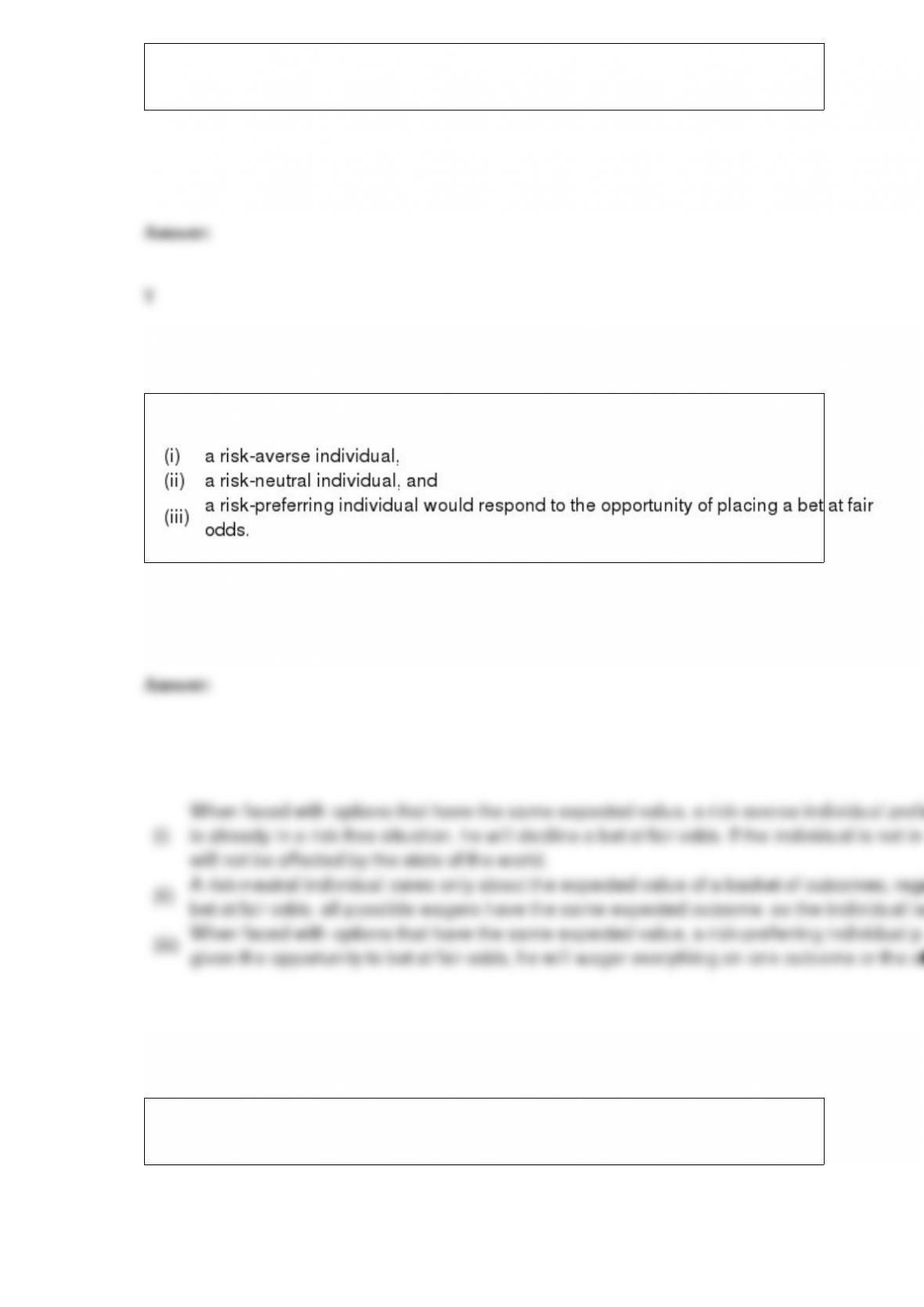
A competitive firm’s short-run demand for labor will rise when the price of its product
rises.
Explain how
If 1000 pounds of steel can produce 3000 cars, then 2000 pounds of steel can produce
6000 cars and 3000 pounds of steel can produce 9000 bushels of cars.
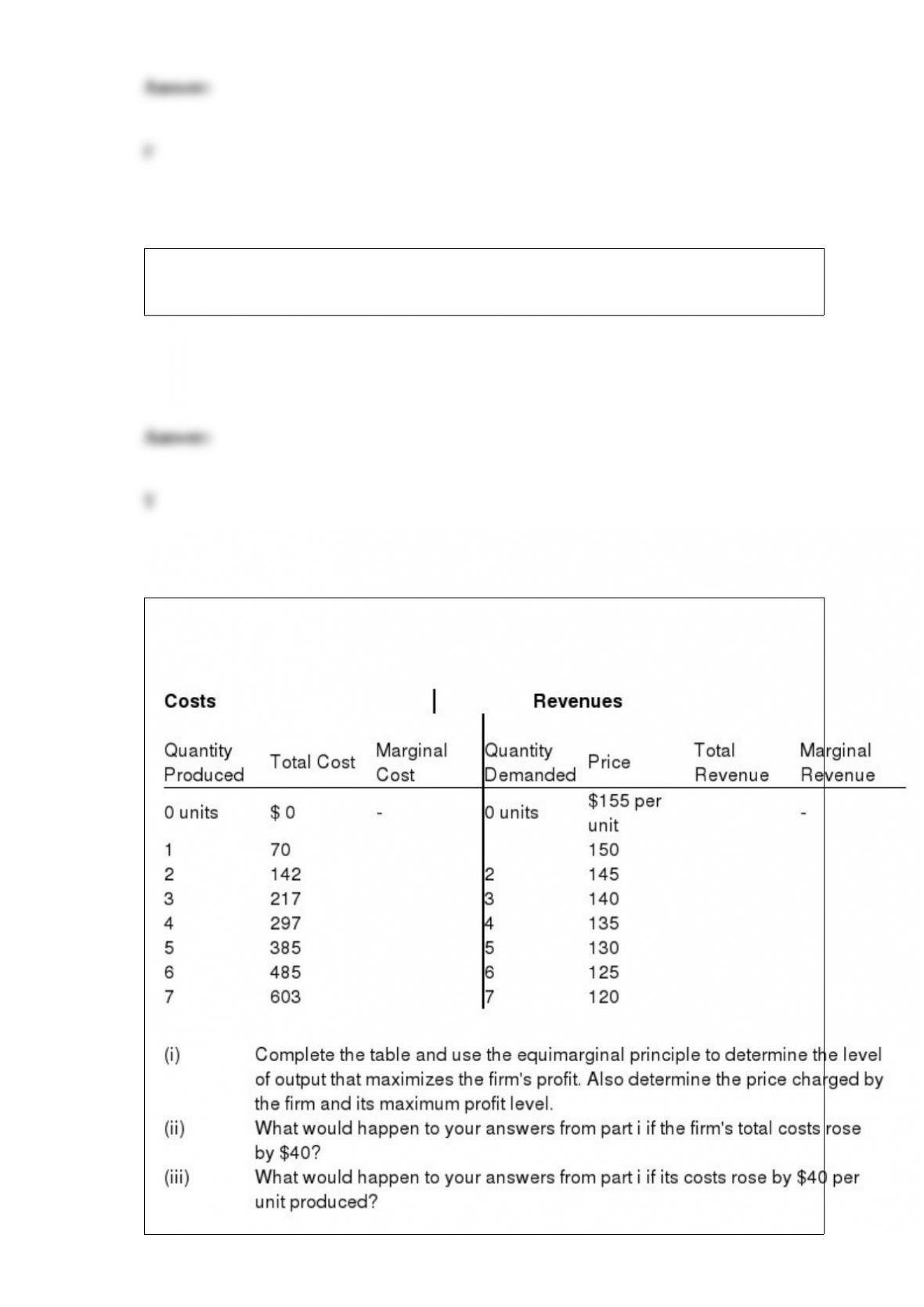
When a competitive firm earns zero profit, the market price is equal to both the firm’s
average and marginal costs.
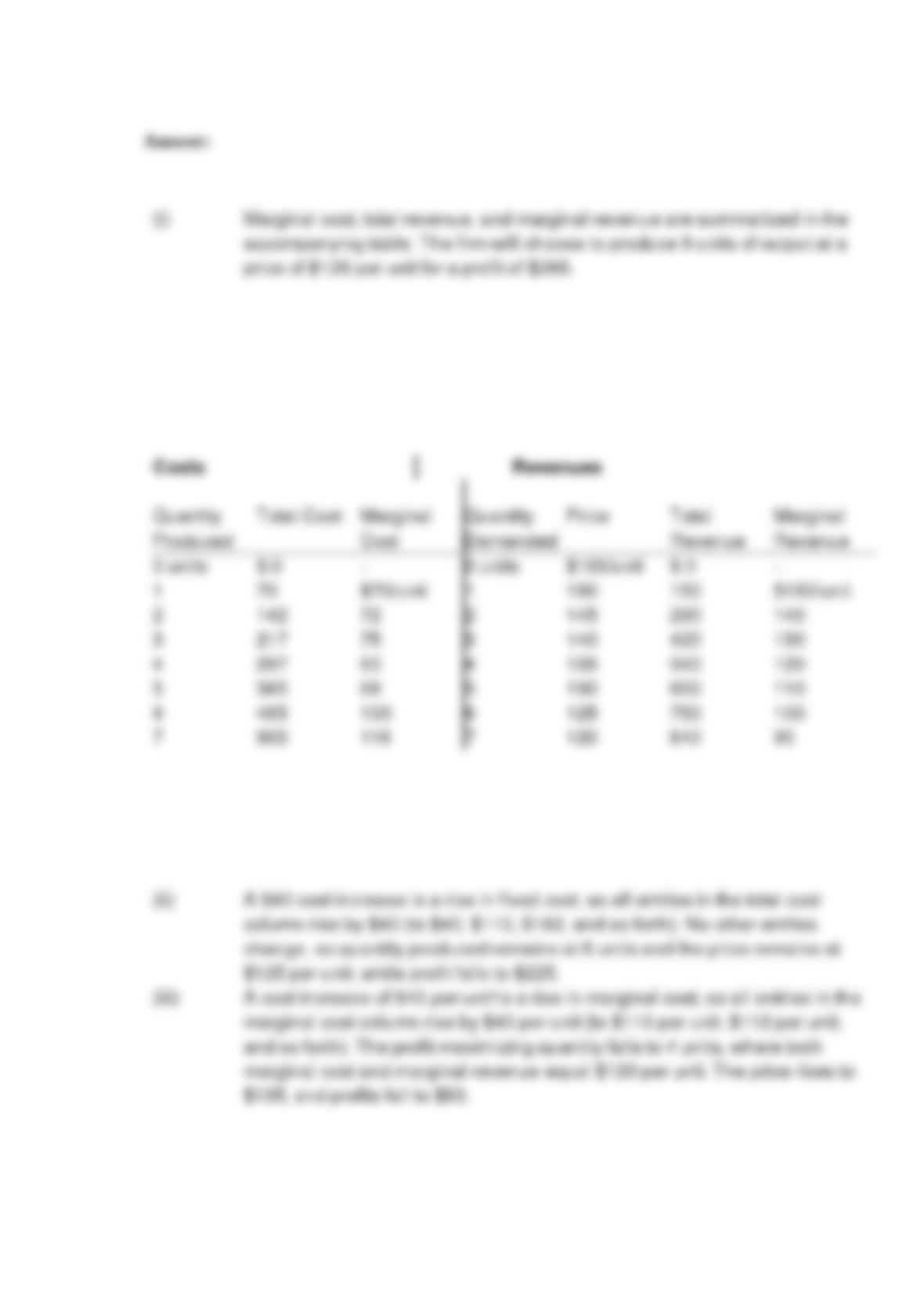
A firm’s total cost schedule and the demand for its product are summarized in the table
below.

Parallel shifts in the budget line are considered when deriving the demand curve for a
good.