
Buying a house during a recession may be a good idea if your job seems secure because
the Federal Reserve often lowers interest rates during a recession.
Consumers in monopolistically competitive markets face a tradeoff between paying
prices greater than marginal costs and purchasing products that are more closely suited
to their tastes.
A surplus is defined as the situation that exists when the quantity of a good supplied is
greater than the quantity demanded.
A monopolistically competitive firm can convince buyers that its product has value by
differentiating its product to suit consumers’ preferences.
A member of a cartel earns more profits by producing more than its quota and selling at
a price higher than the cartel’s price.
If the marginal propensity to save is 0.4, the multiplier is 2.5.
When Audrina raised the price of her home made cookies, her total revenue increased.
This suggests that the demand for Audrina’s cookies is elastic.
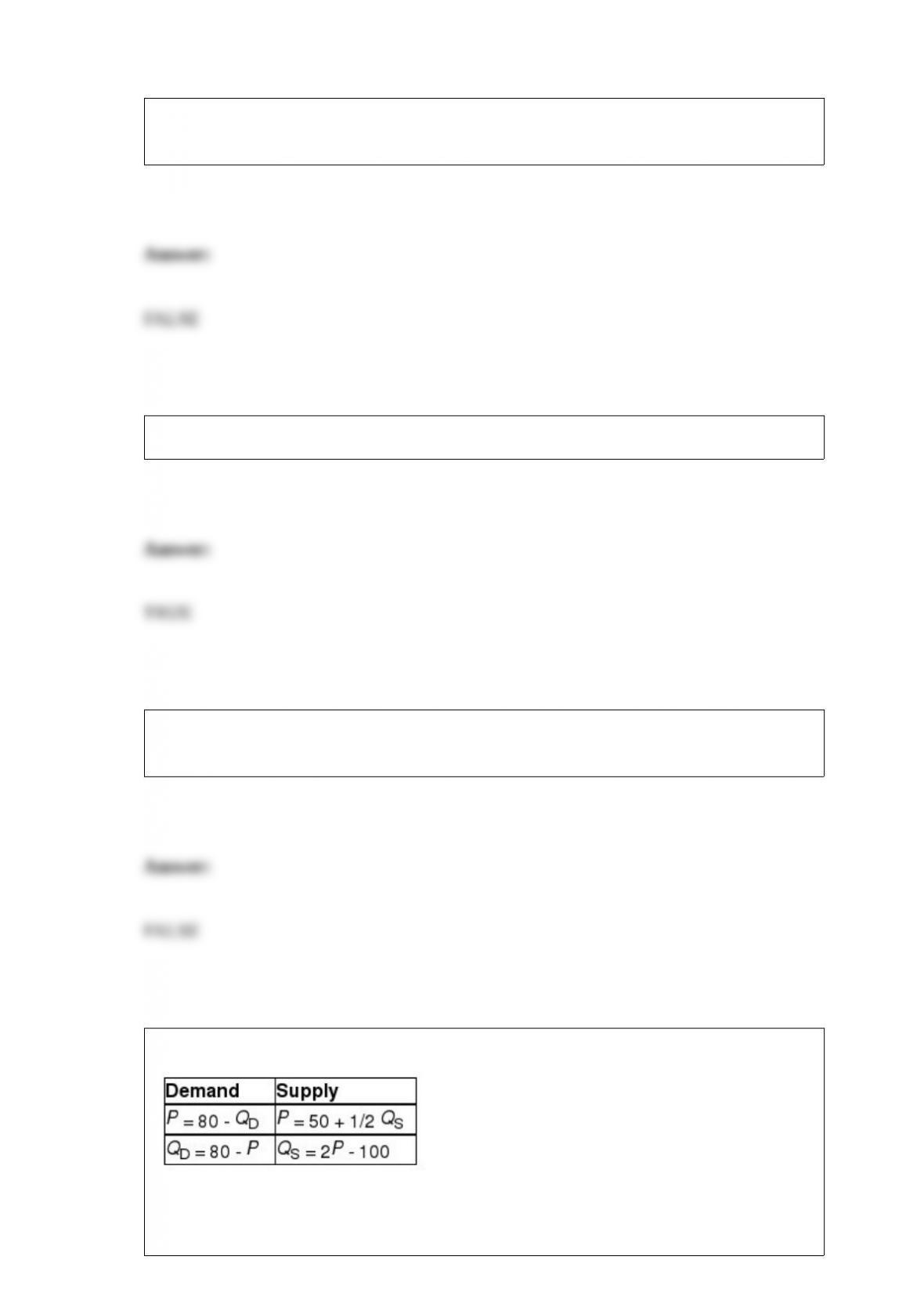
Table 4-6
The equations above describe the demand and supply for Chef Ernie’s Sushi-on-a-Stick.
The equilibrium price and quantity for Chef Ernie’s sushi are $60 and 20 thousand units.

What is the value of economic surplus in this market?
A) $300 thousand
B) $600 thousand
C) $1,200 thousand
D) $1,600 thousand
Which of the following would shift the supply curve for MP3 players to the left?
A) an increase in the price of an input used to produce MP3 players
B) a decrease in consumer tastes for MP3 players
C) an increase in the number of firms that produce MP3 players
D) an increase in the productivity of the workers who produce MP3 players
According to the horizontal-equity principle of taxation
A) individuals who receive the benefits of a good or service should bear a greater share
of the tax burden.
B) individuals who are most able to pay should bear a greater share of the tax burden.
C) people in the same economic situation should be treated equally.
D) individuals who are willing to bear a greater share of the tax burden should be
compensated with non-monetary benefits.
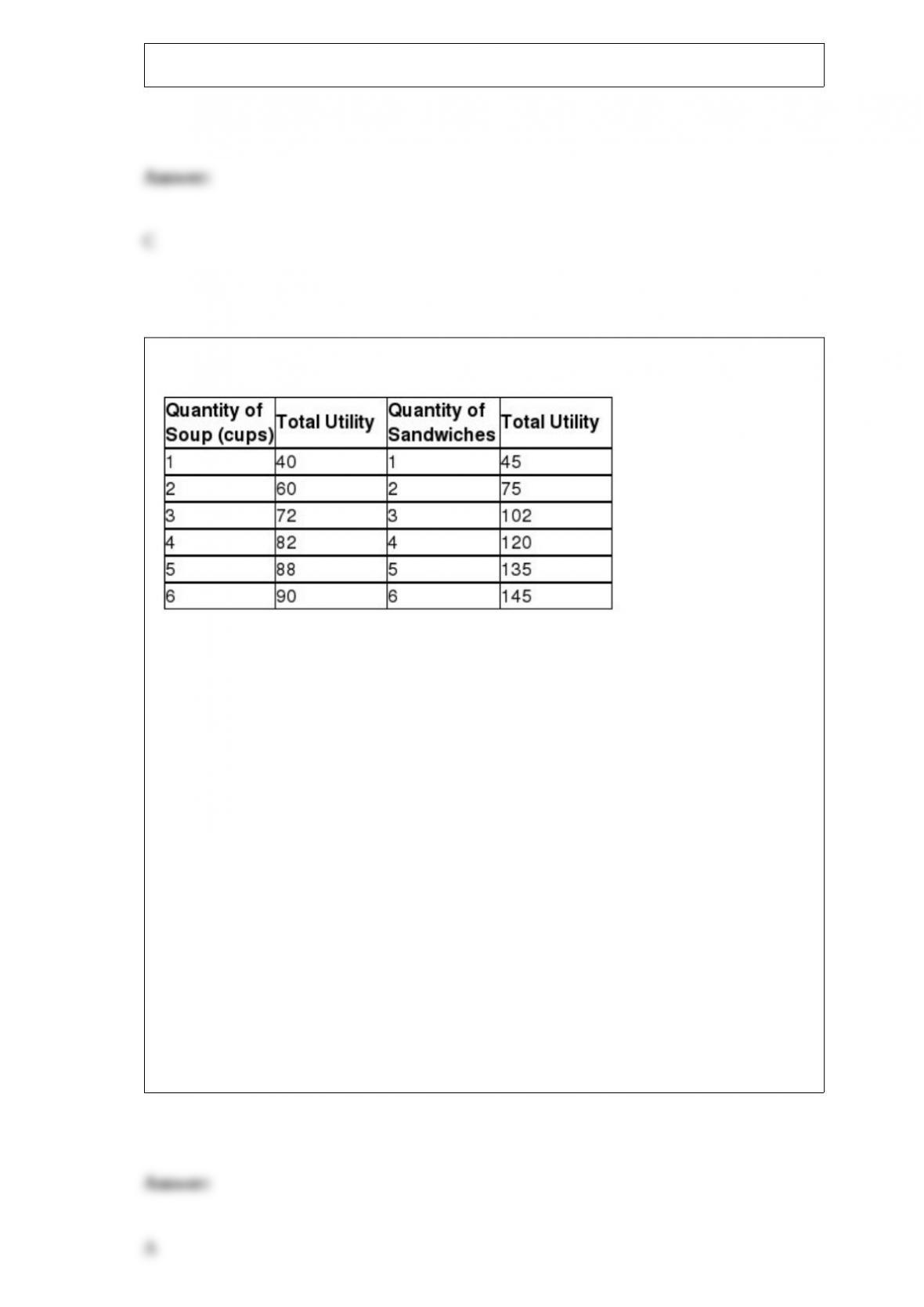
Table 10-2
Table 10-2 above shows Keira’s utility from soup and sandwiches. The price of soup is
$2 per cup and the price of a sandwich is $3. Keira has $18 to spend on these two
goods. Holding prices constant, when Keira’s income changed from $18 to $23, what
happens to her total utility and to the marginal utilities of the last cup of soup and the
last sandwich purchased?
A) Her total utility increases but the marginal utilities of the last cup of soup and the
last sandwich consumed decrease.
B) Her total utility, the marginal utility of the last cup of soup consumed and the
marginal utility of the last sandwich consumed, all increase.
C) Her total utility decreases but the marginal utilities of the last cup of soup and the
last sandwich consumed increase.
D) Her total utility and the marginal utility of the last cup of soup consumed increase
but marginal utility of the last sandwich consumed decreases.
E) Her total utility and the marginal utility of the last sandwich consumed increase but
marginal utility of the last cup of soup consumed decreases.

Which of the following items is likely to have the highest income elasticity of demand?
A) a bus ride
B) a meal at Taco Bell
C) a vacation home in the Swiss Alps
D) a tank of gasoline
The French Bakery ran a special which decreased the price of its croissants from $1.50
to $1.00. Although her money income had not changed, Toni decided to buy 2
croissants instead of her usual 1 bagel and 1 croissant. Toni’s actions are explained by
which of the following?
A) income effect only or substitution effect only but not both effects
B) income and substitution effects
C) price effect
D) consumption effect
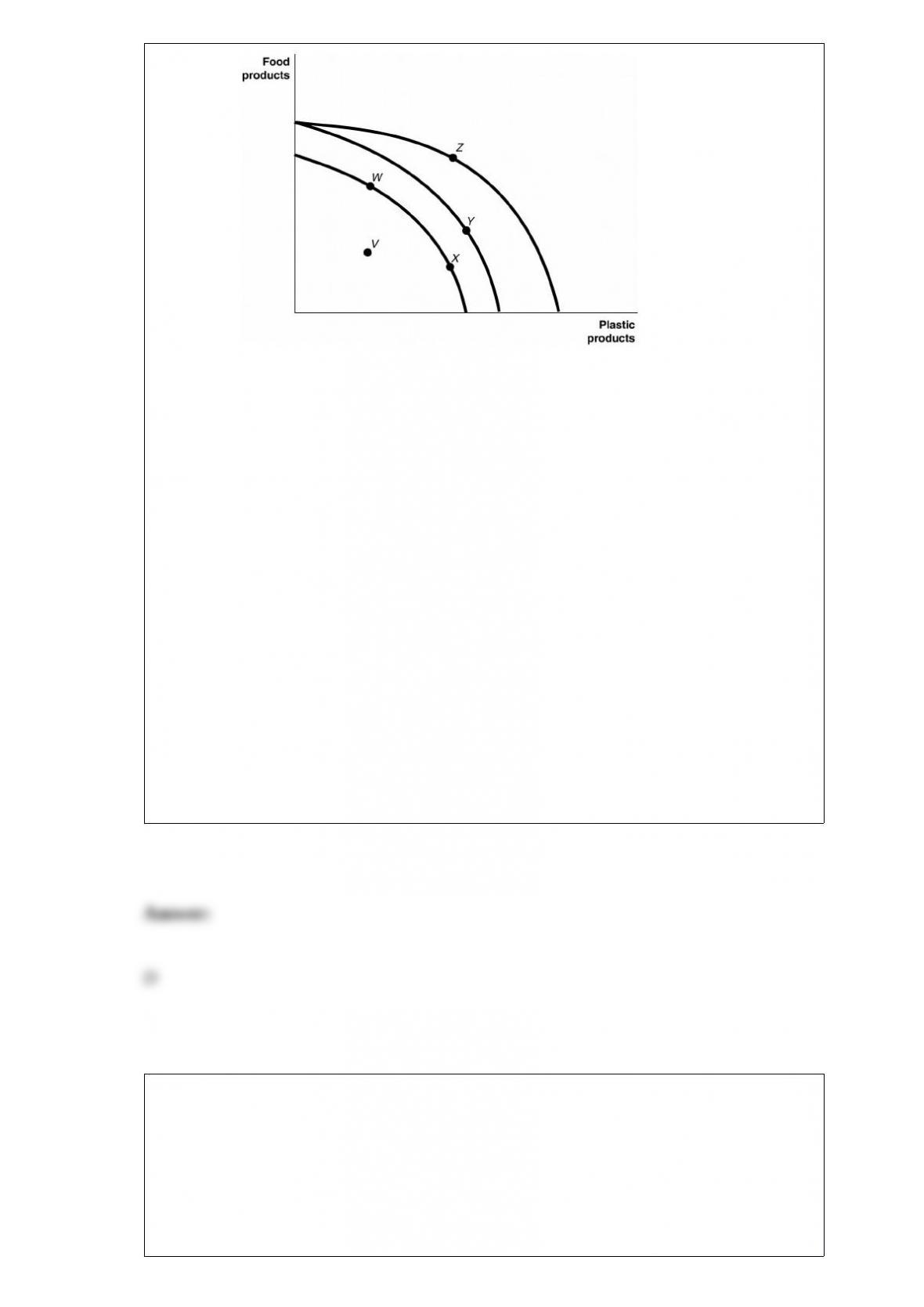
Figure 2-4
Figure 2-4 shows various points on three Different production possibilities frontiers for
a nation.
Consider the following movements:
a. from point V to point W
b. from point W to point Y
c. from point Y to point Z Which of the movements listed above represents
advancements in technology with respect to only plastic production?
A) a, b, and c
B) b and c only
C) b only
D) c only
Consumption spending refers to ________ spending on goods and services.
A) household
B) business
C) government

D) foreign
The 10-year protection period from generic competition for drug manufacturers is a
form of
A) copyright.
B) trademark.
C) hallmark.
D) patent.
Logrolling may result in
A) legislation that yields economy-wide benefits, the funding for which is borne
primarily by a few of the smallest states.
B) a majority of Congress supporting legislation that benefits the economic interests of
a few, while harming the economic interests of a much larger group.
C) members of Congress selling their votes on proposed legislation to the highest
bidder.
D) creating limited incentives for policymakers to consider the immediate
consequences of their proposed legislation.
Because of the shortcomings of concentration ratios, some economists prefer another
measure of competition called
A) the Competition Index.
B) the Marginal Revenue-Marginal Cost Index.
C) the Economic Profit Index.
D) the Herfindahl-Hirschman Index.
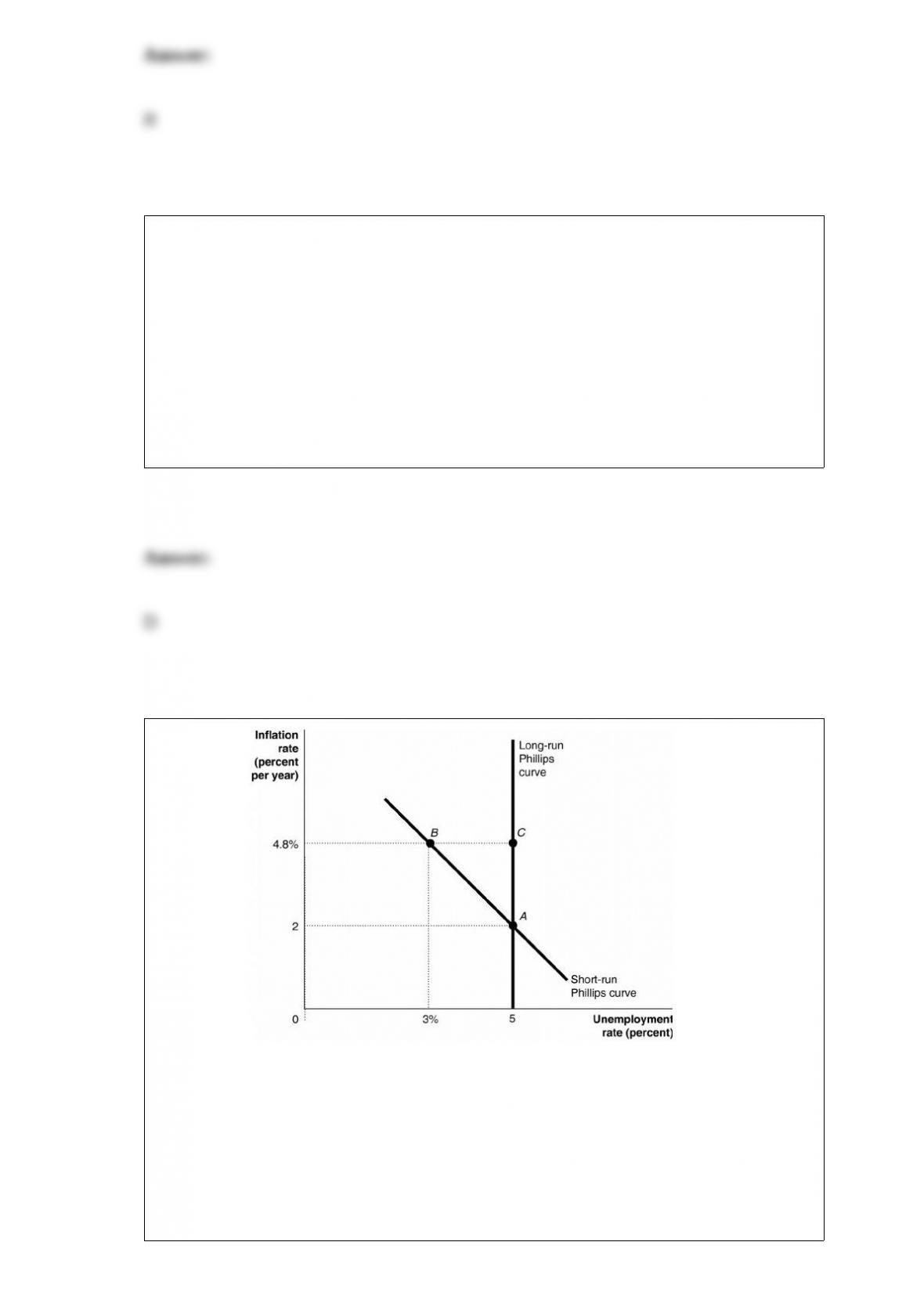
Figure 17-6
If firms and workers have rational expectations, an expansionary monetary policy will
cause the short-run equilibrium to move from
A) point B to point C.
B) point C to point A.

C) point A to point B.
D) point B to point A.
E) point A to point C.
Economists argue that the level of pollution should be
A) reduced completely to zero because by definition, it is a negative external effect.
B) ignored because it has always been present since the beginning of history.
C) reduced to the point where the marginal benefit of pollution reduction is equal to the
marginal cost of pollution reduction to society.
D) best determined by elected officials who can speak on behalf of the public.
Which of the following is true regarding the productivity slowdown in the United States
during the mid-1970s?
A) The productivity slowdown occurred despite a rising quality of labor.
B) The productivity slowdown was unique to the United States, as foreign countries
experienced unprecedented rates of growth during that time.
C) High oil prices raised the costs of doing business for markets worldwide, and
reduced output worldwide as well.
D) The move toward a “new economy” ended in the early 1970s, resulting in less
technological progress in the United States during the mid-1970s.
The current price of canvas messenger bags is $36 each and sales of the bags equal 400
per week. If the price elasticity of demand is -2.5 and the price changes to $44, how
many messenger bags will be sold per week? Use the midpoint formula.
Figure 4-11
The figure above illustrates the markets for two goods, Good X and Good Y. Suppose
an identical dollar tax is imposed in each market.
a. Compare the consumer burden and producer burden in each market. Illustrate your
answer graphically.
b. If the goal of the government is to raise revenue with minimum impact to quantity
consumed, in which market should the tax be imposed?
c. If the goal of the government is to discourage consumption, in which market should
the tax be imposed?
Unemployment arising from a persistent mismatch between the skills and
characteristics of workers and the requirements of jobs is called
A) frictional unemployment.
B) structural unemployment.
C) cyclical unemployment.
D) seasonal unemployment.
E) unnatural unemployment.
Even though it is generally true that the more goods and services people have, the better
off they are, GDP provides only a rough measure of well-being. Assuming language is
not an issue, what other factors besides GDP might you consider when deciding where
to live and work?
What are two reasons why employees would prefer for their employer pay for their
health insurance rather than receiving increased wages and paying for their own health
insurance?
Explain why the budget deficit and the trade deficit are sometimes referred to as the
“twin deficits.”
What are three primary reasons for the growth of international trade over the past 50
years?
How can a partnership raise funds needed for firm expansion?
List the four broad categories of factors of production.